Scan the WeChat code to contact us
Scan the WeChat code to contact us
Feel free to send us a email and we will reply to you as soon as possible.
Creating the future with heart and soul


Recently, several welded railway bogie structural components were completed for an overseas DMU railway project in Africa. The parts were mainly used in the bogie steering and suspension areas, including guide beam structures, steering arm brackets, motor hanger supports, upper and lower support seats, and anti-hunting damper mounting structures.
For this type of railway component, the main difficulty is usually not the welding itself, but maintaining dimensional consistency after welding and machining. Many of the parts contain multiple mounting interfaces distributed across large welded structures. Even relatively small amounts of deformation may affect hole positions, installation surfaces, or final assembly alignment.
Because of this, fixture positioning and welding sequence control were applied throughout fabrication. Before machining, each structure had to be checked to reduce dimensional variation caused by welding stress.
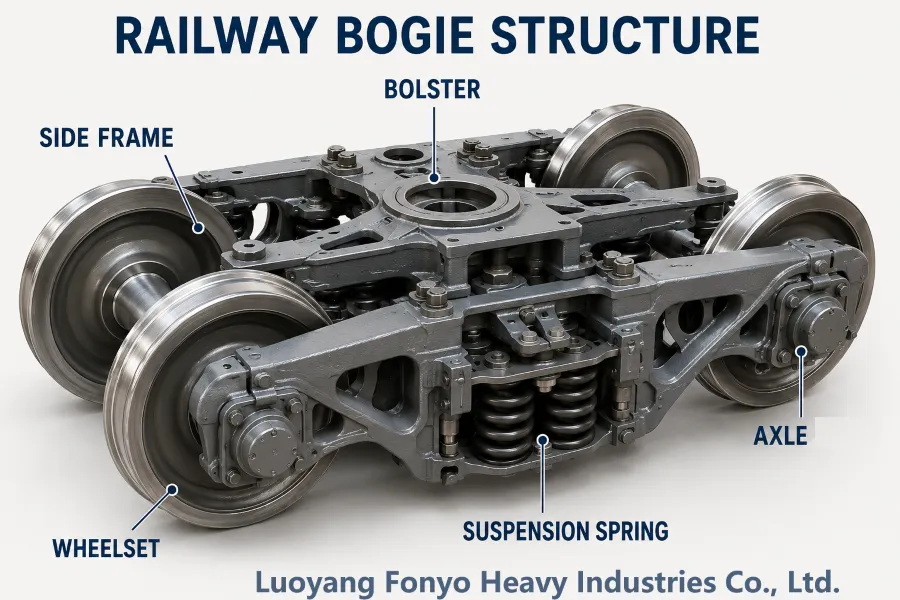
Some of the components required both heavy welding and precision machining within the same production process. This is common in railway bogie manufacturing, especially for parts connected to steering systems, suspension systems, or traction motor supports.
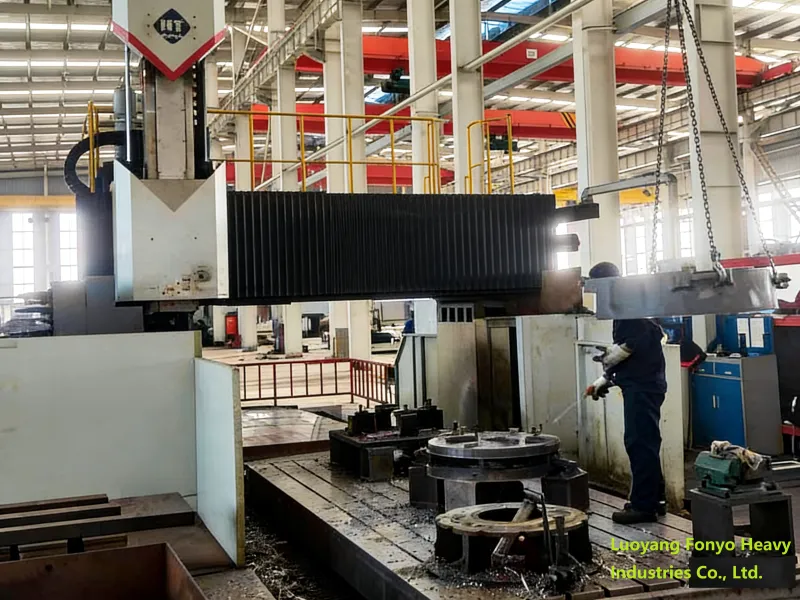
After welding, the components entered CNC machining operations for mounting surfaces, bore positions, and connection interfaces. For several structures, machining involved multiple setups and surface relationships, which required stable clamping and careful process planning during production.
Compared with ordinary steel fabrications, railway bogie parts place higher requirements on dimensional consistency between batches. This becomes especially important during final assembly, where multiple structural components must fit accurately within the bogie system.
Unlike static industrial structures, bogie components operate under continuous vibration and cyclic loading during railway service. Components supporting traction motors or damping systems are constantly subjected to dynamic forces generated by track conditions, vehicle movement, and traction loads.
For this reason, welding quality and structural reliability were treated as key control points during manufacturing. Inspection was carried out throughout production to verify dimensional accuracy and welded areas before delivery.
Depending on structural requirements, non-destructive testing methods such as ultrasonic testing (UT) and magnetic particle testing (MT) can also be applied to critical areas of railway structural components.
Although installed beneath the train and rarely visible during operation, these structural parts directly influence vehicle stability and running performance.
Guide beam structures and steering arm brackets assist wheelsets during curve negotiation and help maintain stable movement within the bogie system. Upper and lower support seats function as load-transfer interfaces between the car body and bogie frame while also helping absorb vibration during operation.
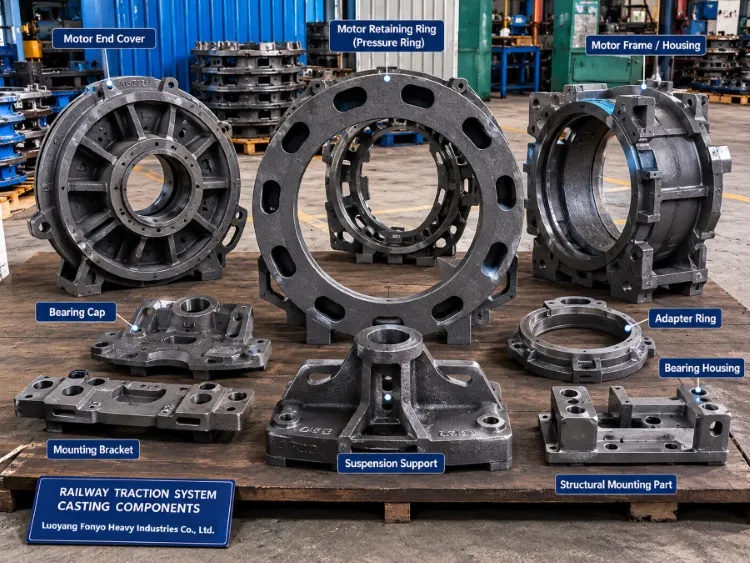
Motor hanger structures support traction motors under continuous dynamic loading conditions, while anti-hunting damper mounting structures are used in lateral vibration control systems that improve running stability at higher speeds.
Together, these components form part of the core structural and suspension system of the railway bogie.
Projects involving welded and precision-machined railway structures continue to expand the manufacturing experience required for modern rolling stock applications.
With experience in railway wheels, railway cast steel components, forged parts, welded assemblies, and CNC machining, Luoyang Fonyo Heavy Industries Co., Ltd. provides manufacturing support for a wide range of railway and heavy industry projects. Our production capability covers railway bogie structural components, railway wheels, cast steel railway parts, suspension structures, traction support components, and other heavy-duty railway assemblies used in international railway applications.