WeChat コードをスキャンしてご連絡ください
WeChat コードをスキャンしてご連絡ください
お気軽にメールをお送りください。できるだけ早くご返信させていただきます.
心と魂で未来を創る


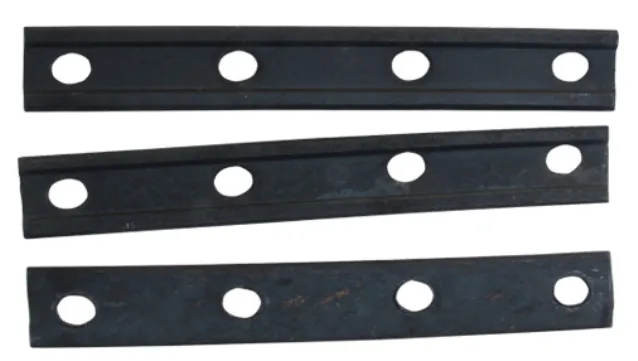
If you’ve ever replaced racked railway fish plates, you probably noticed something interesting. The crack almost always starts near a bolt hole—not in the middle of the plate. That’s because fish plates rarely fail from one heavy load. They fail after millions of wheel passages, tiny movements at the joint, and years of accumulated fatigue.
この記事では, we’ll explain why railway fish plates crack, where cracks usually begin, what accelerates fish plate fatigue, and what maintenance teams can do to extend service life.
Although jointed track represents only a small portion of the entire railway network, rail joints have historically required far more maintenance than continuously welded rail (CWR) because they experience higher impact loads and stress concentration at every wheel passage. And the fish plate—the component holding that joint together—is usually where the trouble starts.
We’ve inspected cracked fish plates on freight lines, 地下鉄システム, and industrial crane tracks across different operating environments. The failure patterns share common characteristics, but the causes behind fish plate cracking are not always obvious at first glance.
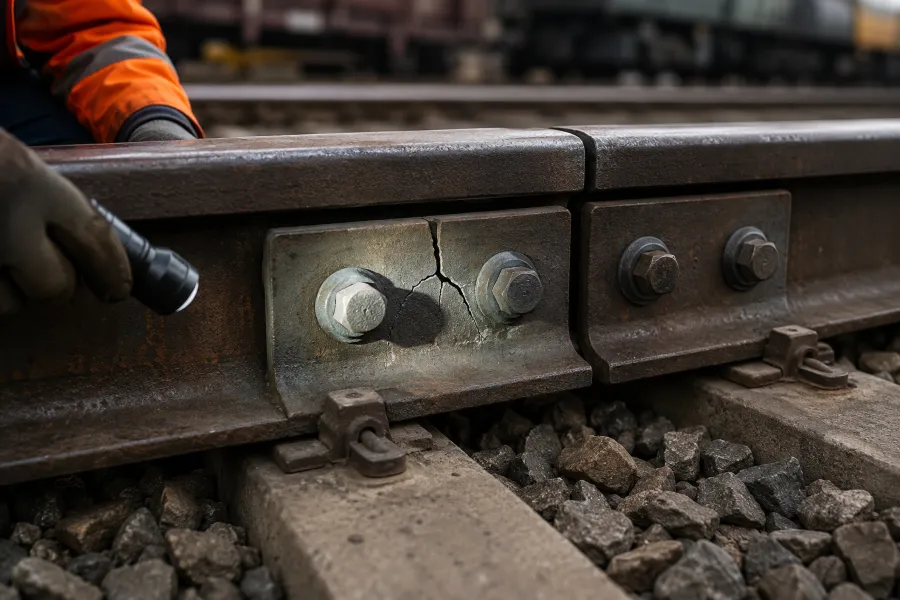
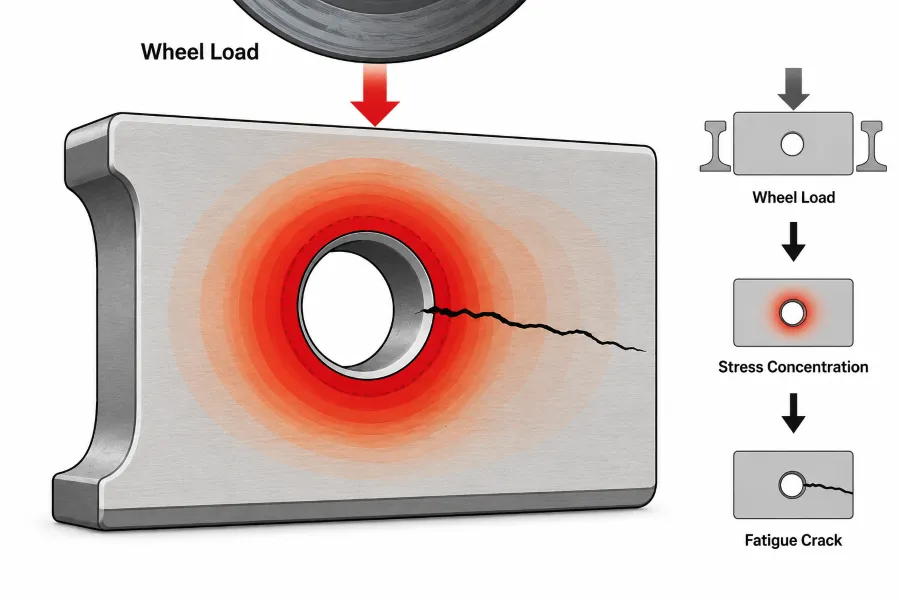
Bolt holes are stress concentrators by design. Every time a wheel passes over the joint, the fish plate flexes slightly, and the highest stress occurs at the hole edges. Over thousands—sometimes millions—of load cycles, a fatigue crack initiates at the hole and propagates outward. Slowly at first. Then faster.
The problem gets worse when the bolt holes are machined poorly. We’ve encountered plates where the hole diameter was oversize or the perpendicularity was off by a few degrees. Visually, they look acceptable. But the effective wall thickness around the hole is reduced, and the fatigue life drops significantly.
Some manufacturers punch holes instead of drilling to reduce production cost. Improperly punched holes may introduce residual stress or microscopic defects around the hole edge that become initiation points for fatigue cracking. If your supplier cannot confirm the hole machining method, that’s a question worth asking before placing an order.
Here’s something that surprises a lot of maintenance teams. A fish plate can develop cracks even when none of the bolts have actually broken.
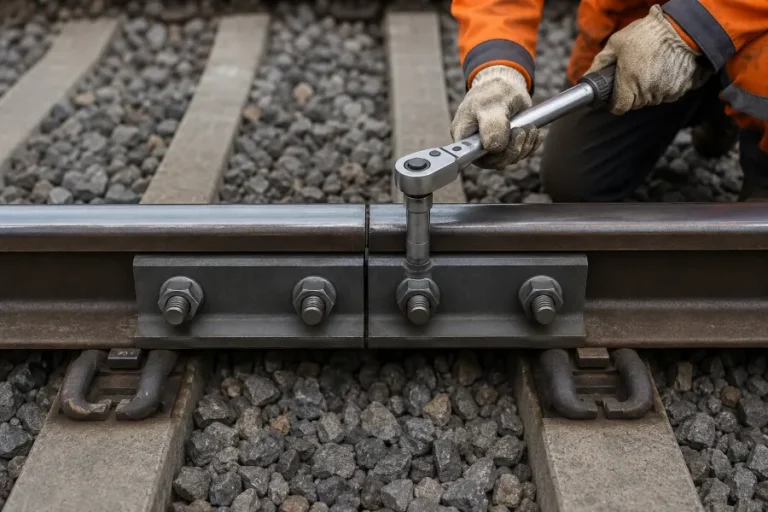
When bolt preload drops significantly—and we’ve measured plenty of joints operating well below expected torque levels—the fish plate starts micro-sliding against the rail web. It’s not visible to the naked eye. But it’s happening. This fretting wears both surfaces, reduces the effective contact area, and transfers more load onto fewer bolts.
The plate is now carrying forces it was never designed to handle alone.
This is why fish bolts matter so much to fish plate longevity. A loose bolt doesn’t just mean a loose joint—it means the fatigue life of the plate itself is being consumed much faster than designed. Spring washers, scheduled torque checks, post-installation verification—these aren’t maintenance formalities. They’re what keeps the plate from cracking prematurely.
On heavy haul freight lines following AREMA or UIC guidelines, bolt torque verification is typically required at regular intervals. When those intervals get stretched—or skipped entirely—that’s when fish plate failure analysis files start getting thicker.
ものづくりの視点から, this is where most avoidable failures originate.
Fish plates made from unverified steel or improperly heat-treated material can look identical to quality plates on the surface. Same dimensions. Same weight. Same coating appearance. But the internal microstructure tells a different story.
Coarse grain or mixed grain structure—what results when heat treatment is rushed, skipped, or performed without proper temperature control—reduces toughness and makes the plate susceptible to brittle fracture. The difference between a properly normalized plate and one that received incomplete heat treatment can be the difference between detecting a crack during routine inspection and experiencing sudden fracture without warning.
Material test certificates are not optional paperwork. If you’re procuring plates that will sit under a rail carrying 25-ton axle loads or more, you need documented evidence of chemical composition, 機械的特性, and heat treatment procedure. Suppliers who cannot provide these documents are supplying risk, not just steel.
Oddly enough, winter is when most fish plate failures get reported. Not because cold weather directly causes cracking—it creates the conditions that accelerate existing damage.
Steel becomes more brittle at low temperatures. The ductile-to-brittle transition temperature varies by steel grade, but for typical fish plate materials, toughness drops noticeably below freezing. Rails contract in cold weather, which increases tensile stress across the joint. Thermal contraction pulls the rail ends apart, putting the fish plate under tensile loading it wasn’t primarily designed for. If there’s already a micro-crack at a bolt hole, cold weather gives it exactly the conditions it needs to propagate.
In regions with significant seasonal temperature swings—Central Asia, Northern China, the North American Midwest, Northern Europe—this pattern is well-documented in maintenance records. The solution isn’t to switch fish plate specifications seasonally. It’s to ensure proper expansion gaps during installation, maintain bolt torque through winter, and increase inspection frequency during cold months.
Corrosion compounds the problem. De-icing salts and moisture collect around bolt holes and between the plate and rail web. Combined with cyclic stress, this creates an ideal environment for stress corrosion cracking—a failure mode that progresses faster than pure mechanical fatigue alone.
During an inspection on an industrial railway serving a steel plant, our engineering team examined a joint that maintenance crews had reported as “loose.” The joint had been re-tightened three times over two months, yet the bolts kept losing torque.
When the fish plate was removed and examined, a hairline crack was visible running from the center bolt hole toward the upper edge. The crack had been completely invisible during previous visual inspections because it originated on the contact surface facing the rail web—the side nobody sees unless the plate is removed.
The crack had initiated at the bolt hole edge, propagated slowly under cyclic loading for several months, then accelerated once the effective contact area between plate and rail dropped below what was needed to distribute the load evenly. The bolts were loosening because the plate was deforming under load—not because the bolts themselves were failing.
The joint was replaced immediately with a new fish plate and bolt set, and the rail profile and gap were verified before returning the track to service. What makes this case worth noting is that every condition for fish plate failure was present: bolt holes as stress concentrators, reduced preload allowing micro-sliding, and accumulated fatigue reaching critical crack length—all while visual inspection from above showed nothing wrong.
This is why standards such as EN 13260 and TB/T 2345 specify not just dimensional tolerances for fish plates, but also requirements for material toughness, hardness range, and NDT acceptance criteria.
When evaluating fish plate suppliers, we normally look at more than the drawing compliance. 材料証明書, heat treatment records, bolt-hole machining method documentation, and third-party inspection reports often tell you far more about the long-term reliability of a fish plate than the unit price alone.
Three areas deserve particular attention:
Material traceability. Request mill test reports showing chemical composition (carbon, マンガン, シリコン, phosphorus, sulfur limits per applicable standard), 機械的特性 (降伏強さ, 抗張力, 伸長, 面積の縮小), and impact test results at relevant temperatures. For fish plates intended for cold-region service, low-temperature impact values are especially important—they’re what separate a plate that cracks in winter from one that doesn’t.
Heat treatment verification. Ask whether the plates were normalized, quenched and tempered, or left as-rolled. Normalized or Q&T plates have significantly better fatigue performance than as-rolled material. The supplier should provide heat treatment records or at minimum hardness survey data confirming consistent treatment across the batch.
Applicable standards compliance. Depending on your region and application, fish plates may need to meet EN 13260 (ヨーロッパ人), アレマ (北米), UIC 864-1, GB/T 227, or TB/T 2345 (Chinese) 仕様. Third-party inspection by an independent laboratory—rather than factory self-inspection—adds meaningful credibility. ISO 9001 tells you the supplier has a quality management system. But EN/AREMA/UIC/TB/T compliance tells you the product itself meets recognized railway technical requirements.
A plate that costs 15% less but fails after three years of service isn’t a saving. It’s a liability. Replacing a cracked fish plate during operation means track possession time, crew mobilization, and service disruption—costs that quickly dwarf the original material price difference.
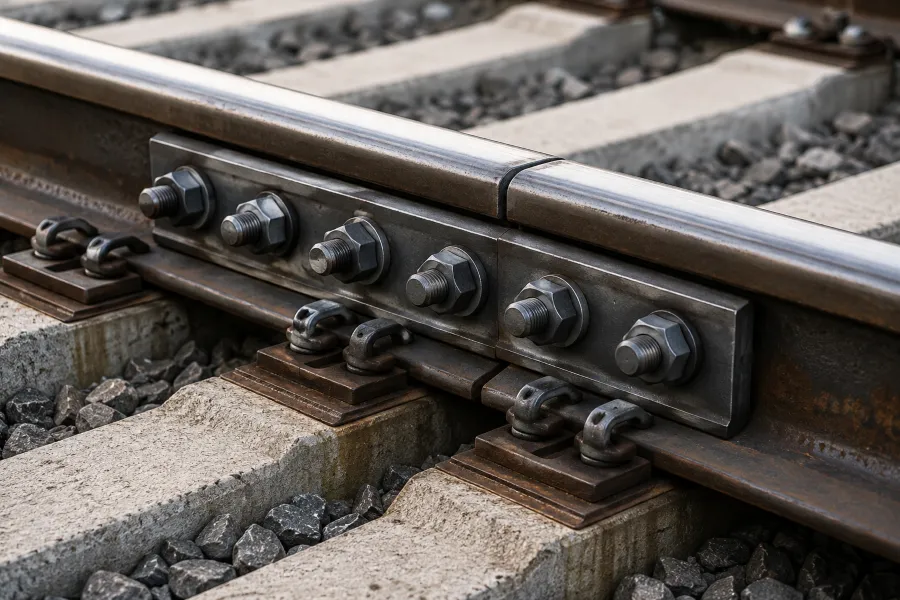
A fish plate may look like one of the simplest components on a railway track, but it often determines whether a rail joint remains stable after years of heavy service. Understanding fish plate failure modes—fatigue cracking from bolt holes, preload loss causing micro-sliding, material defects reducing toughness, and cold-weather brittleness—is essential for both maintenance teams specifying inspection procedures and procurement teams evaluating suppliers.
Whether you’re designing a new jointed track section or replacing failed fish plates during maintenance, selecting the correct material grade, ensuring proper installation torque, and implementing regular bolt-hole inspection will significantly reduce fish plate failure incidents, unplanned joint maintenance, and associated service disruptions.
でFONYO, we manufacture railway 魚皿, フィッシュボルト, elastic rail clips, レールパッド, and other rail fastening components for freight railways, 地下鉄システム, industrial tracks, and crane rail applications worldwide. Our engineering team can recommend the appropriate fish plate specification based on your rail profile, 軸重, operating environment, and applicable standard (で, アレマ, UIC, GB/T, or TB/T).
いいえ. Once a fish plate has developed a fatigue crack, it must be replaced. Welding a cracked fish plate is not an accepted railway practice—the weld creates a hard, brittle zone that will crack again under thermal cycling and dynamic loading. The standard procedure is to remove the joint from service immediately and replace both fish plates (and preferably the bolts) with new, profile-matched components.
With correct material specification, proper installation, and maintained bolt torque, fish plates typically serve 15 に 30 years depending on operating conditions. Heavy haul lines with high axle loads (30+ トン), extreme temperature variation, or aggressive corrosion environments may experience shorter service life. The determining factors are material quality (especially heat treatment), bolt preload maintenance consistency, and regular inspection focused on bolt-hole edges.
Cold weather reduces steel toughness through the ductile-to-brittle transition effect and causes rail contraction, which increases tensile stress across the joint. If a fatigue crack has already initiated at a bolt hole, the additional thermal stress provides the driving force for accelerated propagation. Proper expansion gap design, winter torque verification programs, and increased inspection frequency during cold months are the established mitigation measures.
The most reliable early indicators are bolts that repeatedly loosen despite re-tightening, visible rust staining around bolt holes (which indicates fretting between surfaces), and any discoloration or surface distress near hole edges. Fatigue cracks frequently originate on the concealed side facing the rail web, so single-sided visual inspection can miss them entirely. For critical joints on high-speed or heavy haul lines, periodic ultrasonic testing (ユタ州) or magnetic particle testing (MT) around bolt-hole areas is recommended.
Not entirely—fatigue is inherent in any bolted rail joint subjected to millions of cyclic wheel loads. But the rate of crack initiation and propagation can be dramatically reduced through correct material selection with adequate toughness, proper bolt torque maintained with appropriate fastening hardware, regular inspection protocols, and ensuring full surface contact between the fish plate and rail web. Many railways have extended fish plate service life significantly by focusing on these factors rather than accepting premature replacement as normal.