WeChat コードをスキャンしてご連絡ください
WeChat コードをスキャンしてご連絡ください
お気軽にメールをお送りください。できるだけ早くご返信させていただきます.
心と魂で未来を創る


Crane rail 魚皿 are high-strength steel joint bars that connect two rail ends to ensure continuous alignment, distribute dynamic wheel loads, and maintain track stability under heavy crane operations. Selecting the right fish plate means matching the rail profile (QU70–QU120, DIN A55–A120), while proper installation demands precise alignment, correct bolt torque, and scheduled inspection.
Crane rail joints experience some of the highest impact loads in any rail fastening system. Yet many premature failures are not caused by the rail itself—they begin at the fish plate connection.
After working on crane rail projects across steel mills, ポート, and heavy fabrication plants, we’ve found that choosing the correct fish plate profile and installing it properly often makes the difference between decades of reliable service and constant maintenance. The fish plate may look like one of the simplest components in a crane rail system, but it carries the full force of every wheel passage at every joint.
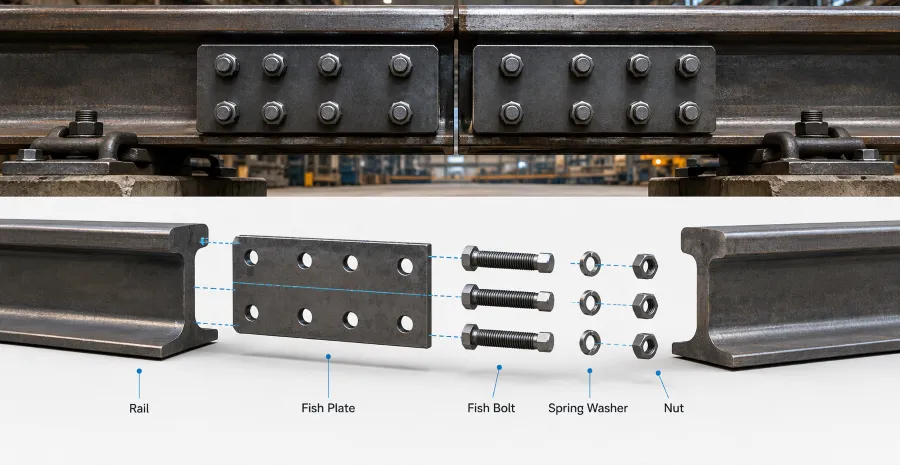
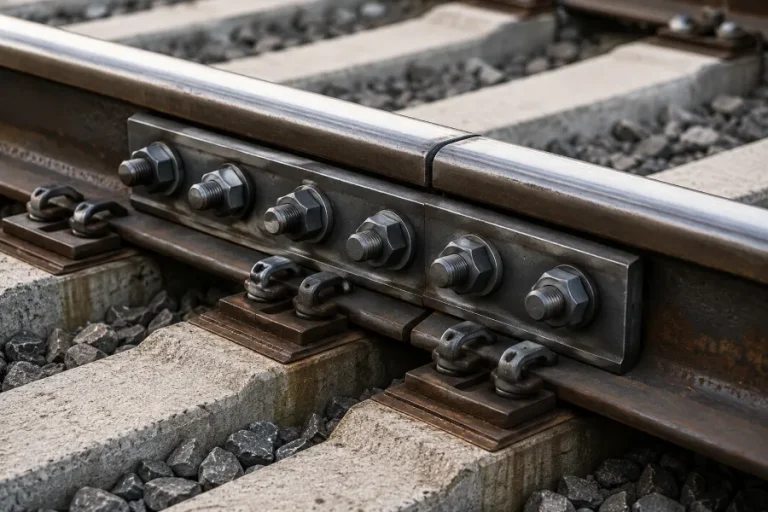
あ 魚のプレート—also called a joint bar or splice bar—is a flat steel bar that clamps onto the web of two adjoining rail ends. You install them in matched pairs, one on each side, and secure the assembly with high-strength fish bolts. The goal is to make two separate rail sections behave as one continuous member.
In a crane rail application, the fish plate does three things. It transfers forces across the joint so the load doesn’t concentrate at the rail ends. It holds the running surface in alignment so crane wheels pass through smoothly. And it absorbs some of the shock each time a wheel crosses the gap, which slows material fatigue and reduces noise.
People often assume that because crane rails run at low speeds, the joints don’t see much stress. The opposite is true. Crane rails handle axle loads that can exceed 30 に 50 トン, and because the crane moves slowly, the wheel sits on the joint longer—transferring the full load through the fish plate for a longer duration than a high-speed train would.
This is where most selection errors begin. Fish plates are profile-specific. There is no universal fit.
Some suppliers advertise universal crane rail fish plates. Personally, I’m skeptical. In most projects we’ve handled, “universal” usually means “not an exact fit.” The plate sort of works, the bolt holes line up, but the fishing angle doesn’t fully contact the rail web. Weeks later, the bolts loosen and nobody can figure out why.
On one steel plant project, we found nearly a 2 mm gap between the fish plate and the rail web because the wrong DIN profile had been supplied. The bolts reached the specified torque, but the joint still loosened after only a few weeks. The cost of that mistake—a few weeks of downtime and a full set of replacement plates—far exceeded what proper profile verification would have cost.
The common crane rail standards include the Chinese GB series (QU70 through QU120), German DIN 536 (A55 through A120), Russian GOST (KP70–KP120), and North American AREMA (CR104, CR135, CR171). Check the marking stamped on the web. If that’s worn off, measure the head width, height, and base width. When in doubt, send photos to your supplier.
Once you know the profile, the dimensions follow. Here’s a reference for the most common QU-series crane rail fish plates:
| Rail Type | 長さ (mm) | Width (mm) | Thickness (mm) | Hole Dia. (mm) | Hole Spacing (mm) | Bolt Size |
| QU70 | 760 | 70 | 20 | 24 | 90 / 105 | M24 |
| QU80 | 820 | 75 | 20 | 24 | 100 / 120 | M24 |
| QU100 | 950 | 80 | 22 | 26 | 105 / 125 | M27 |
| QU120 | 1050 | 85 | 26 | 26 | 110 / 130 | M27 |
Larger crane rails need thicker plates and bigger bolts. That’s not a design choice—it’s physics. Always verify the manufacturer’s drawing before purchasing.
Most crane rail fish plates are carbon steel in the 45# に 55# 範囲. Good tensile strength, good wear resistance, good enough for most applications. For foundry cranes and hot metal ladle cranes, alloy steel like Q345B handles the heat and impact better. Extreme loads call for quenched and tempered plates.
Whatever you choose, the supplier needs to provide a mill test certificate. Not a photocopy. Not a “trust us.” The actual certificate with chemical composition and tensile strength. If they can’t provide it, they can’t guarantee what they’re shipping you.
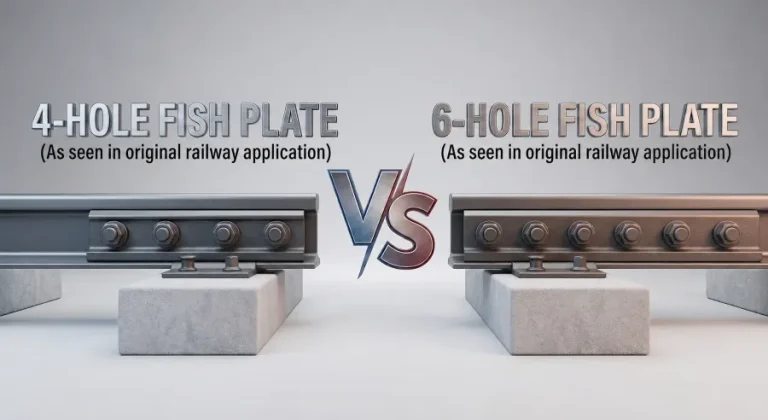
Here’s something that surprises many engineers: the difference between 4-hole and 6-hole fish plates isn’t just bolt count. The 6-hole version spreads clamping force across more of the rail web, which reduces point loading on each bolt. For main runways and anything QU100 or heavier, go with 6-hole. The cost difference is minimal. The reliability difference isn’t.
It sounds obvious, but surface treatment still gets overlooked surprisingly often. Indoor and dry? Oiled is fine. Outdoor? Painted or galvanized. Coastal? Hot-dip galvanized, full stop. Chemical plant? Epoxy or stainless.
On coastal crane rail installations we’ve inspected, standard oiled fish plates corroded through in under three years. Galvanizing would have cost a fraction more. Specifying the right coating for the actual operating environment is cheaper than replacing corroded plates two years in.
One question customers often ask us is whether they can use the same fish plate specification across different rail standards. いいえ. And this is exactly why procurement teams need to be careful.
When purchasing crane rail fish plates, don’t compare suppliers based on price alone. The cheapest quote often comes with compromises you won’t see until the plates are installed. Ask for:
If your project follows DIN 536 or another specific standard, ask the supplier whether the fish plates are manufactured to that standard or simply machined to similar dimensions. There’s a difference. A plate that looks right but wasn’t produced to the standard’s tolerances will perform differently under load.
Personally, I’d rather spend a little more on a correctly machined fish plate than save 10% on a component that will be buried under a crane for the next twenty years. A quotation that looks 15% cheaper can end up costing double once you factor in the labor, downtime, and rail damage from a failed joint.
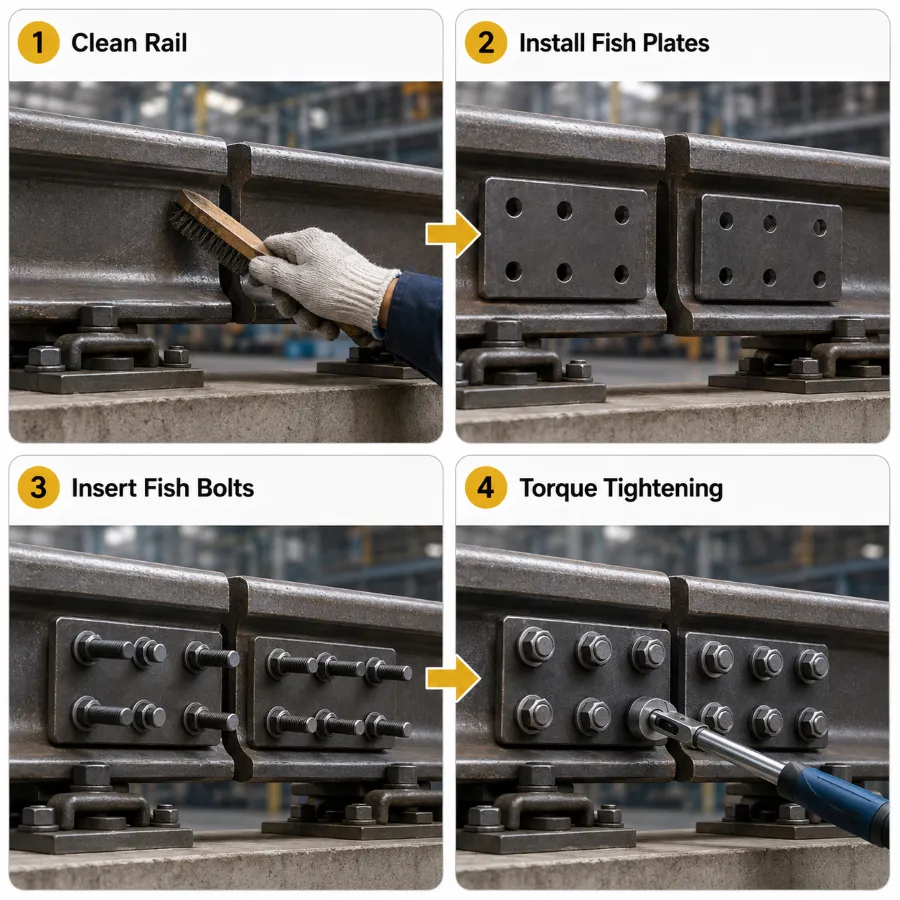
One thing I’ve noticed on many crane rail projects is that crews focus on the bolts and ignore the contact surfaces. Rust, グリース, and mill scale trapped between the rail and fish plate prevent full contact. The clamping force drops long before the bolts actually loosen.
Clean the rail ends. Wire brush, a few minutes per joint. Cheapest thing you can do to extend joint life.
While you’re at it, check for burrs, cracks, or deformation. On more than one project, the rail end had a hairline crack hidden under surface rust. The fish plate installation propagated the crack further under load. If you see a crack, cut the rail back or replace it. Don’t clamp over it.
Crane rails expand with temperature. The joint gap accommodates that movement.
People assume a tighter gap is better—less bump when the wheel crosses. Wrong. A gap that’s too tight causes the rail ends to butt against each other as temperatures rise. The rail can buckle. The fish plate can crack.
For general indoor crane rails, a standard gap works. In high-temperature environments like steel mills, you need more room. What matters is that the gap is uniform across the rail width. Uneven gap means uneven load transfer. A gap gauge takes seconds to use and catches problems that would otherwise show up months later as accelerated wear.
Fish plates come as matched pairs. Left and right. The machining tolerances are set for each pair, and mixing plates from different batches throws off the fit. Don’t do it.
Place one plate against each side of the rail web. Check for full contact. If there’s a gap between the plate and the fishing surface, stop. The profile doesn’t match. Forcing it creates problems that show up as loose bolts within weeks.
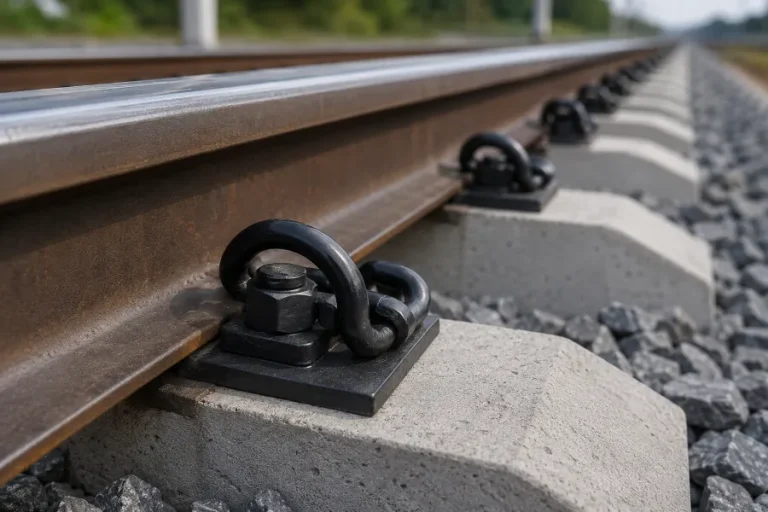
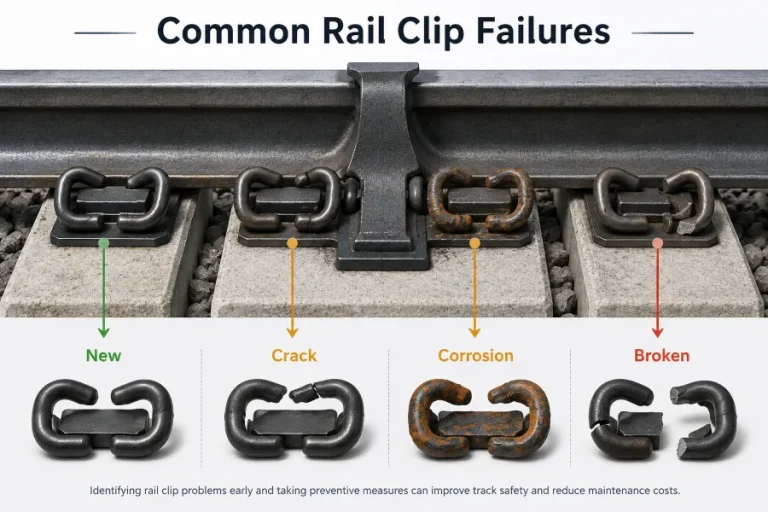
One issue we frequently encounter: the rail clips and rail pads near the joint sometimes interfere with the fish plate seating. Before you blame the fish plate, make sure the surrounding fastening system isn’t the problem.
Many installers think torque is everything. The wrench clicks at the right value, the joint is secure. Not quite.
Torque is one part of the equation. Contact area is another. Bolt grade is another. Spring washers are another—and those get skipped more often than I’d like to admit.
Insert the fish bolts with spring washers. Hand-tighten all of them first so the plates seat evenly. Then use a calibrated torque wrench in a cross-wise pattern, working up to final torque in two or three passes.
| Bolt Size | 学年 | Torque (Nm) |
| M24 | 8.8 | 250–350 |
| M27 | 8.8 | 350–500 |
One mistake I still see surprisingly often: tightening one bolt to full torque before the others. The fish plate twists. Contact area drops. Weeks later, the bolts loosen—not because the bolts are bad, but because the joint was never evenly clamped.
And here’s the thing nobody tells you. After the crane has been running for a day, the bolts settle. All of them. The components seat together under real load, and a bolt that was at spec is now below. This is normal. Go back the next day with a torque wrench. Ten minutes per joint. Saves more callbacks than anything else in the process.
Spirit level across the joint. Running surface flush, no step. Re-check the expansion gap. Record the date, torque values, bolt grade, and batch number.
Two minutes. That’s it. But when something goes wrong six months from now, you’ll know exactly what was installed and when.
A port crane project. Three months in, the bolts kept loosening. The maintenance team re-tightened them. Problem came back every few weeks.
When we inspected the joint, the issue was obvious: QU100 rails had been installed with fish plates intended for QU80 rails. The bolt holes aligned. That’s why nobody caught it. But the fishing angles didn’t fully contact the rail web. The bolts held torque on paper, but the clamping force was hitting maybe 60% of the designed contact area.
That’s the problem. Everything looked correct until we measured the contact surface.
Replacing the fish plates with the correct QU100 profile fixed it entirely. Didn’t touch the rails. Bolt holes lining up doesn’t mean the profile is right.
The same issues show up everywhere. Mixed plates from different batches. Missing spring washers. Sequential tightening instead of cross-wise. No expansion gap. Wrong bolt grade. They’re all basic installation mistakes.
But two problems deserve a closer look because they account for the majority of joint failures we encounter.
This is probably the single most common omission. The bolts get torqued correctly during installation, everyone signs off, and nobody goes back. The problem is that bolts settle. When a crane starts running, vibration and load cause the fish plate, rail web, and bolt assembly to seat together more tightly—sometimes enough that a bolt at spec is now significantly below. A joint that isn’t re-torqued after the first day of operation is far more likely to loosen within the first three months. The fix takes ten minutes per joint. I’ve lost count of how many callback visits could have been prevented by this one step.
Spring washers are small and cheap, which is probably why they get overlooked. But they’re the component that maintains bolt tension under vibration. On many projects we’ve inspected, the spring washers were either never installed or were reused from a previous joint. Here’s the thing: a spring washer that’s already been compressed past its yield point provides almost no residual tension. Without functioning washers, the bolt relies entirely on friction—and crane rail vibration will overcome that within weeks. Treat spring washers as consumables. Every bolt removal means new washers on reassembly. No exceptions.
Fish plates need a regular inspection schedule. Weekly visual check for cracks, 腐食, loose bolts, or rail end movement. Monthly torque verification with a calibrated wrench. Quarterly gap measurement to catch rail creep or thermal issues. Annual full inspection—pull the bolts, clean the surfaces, check for fatigue cracks, reassemble with new spring washers.
Replace immediately if you spot hairline cracks, elongated bolt holes, significant corrosion, or rail end deformation. These aren’t “watch and see” conditions. Waiting on a cracked fish plate is how a minor replacement turns into a major repair—because a failed joint under a loaded crane can damage the rail ends, the rail pads, and in worst cases, the crane wheel itself.
A fish plate may look like one of the simplest components on a crane rail system, but it often determines whether a joint remains stable after years of heavy service.
Whether you’re designing a new crane runway or replacing worn joints during maintenance, choosing the correct fish plate from the beginning is one of the simplest ways to improve long-term reliability.
で FONYO, we manufacture crane rail 魚皿, クレーンレール フィッシュボルト, elastic rail clips, レールパッド, 鉄道の車輪, and railway casting products for industrial railways and crane systems worldwide. If you’re unsure which specification matches your rail profile, our engineering team can help identify the correct solution based on your drawings or rail dimensions.
いいえ. Fish plates are designed as mechanical bolted joints to allow for thermal expansion and easy replacement. Welding defeats that purpose and creates a rigid joint that will crack under thermal stress. If you need a continuous rail, look into continuous welded rail (CWR) instead.
With proper installation and regular maintenance, 通常 10 に 20 年. Heavy-duty environments like steel mills may shorten that. The key factors are correct profile matching, proper bolt torque maintenance, and corrosion protection.
We don’t recommend it. High-strength bolts undergo permanent stretch during torquing. Reusing them risks inconsistent clamping force and potential shear failure. Spring washers should always be replaced too—they lose their tension after one cycle.
Not really. Fish plates can tolerate very minor vertical misalignment, but they’re not alignment correction tools. If the rail ends are visibly misaligned, fix the rails first. Using the fish plate to force alignment will accelerate wear on everything.
Missing or worn spring washers. Uneven bolt tightening that warps the plate. Incorrect torque values. Poor contact between the fish plate and rail web due to profile mismatch or dirty surfaces. Vibration from heavy crane loads will loosen any joint that isn’t properly clamped—which is why that post-installation torque check matters so much.