WeChat コードをスキャンしてご連絡ください
WeChat コードをスキャンしてご連絡ください
お気軽にメールをお送りください。できるだけ早くご返信させていただきます.
心と魂で未来を創る


The quality of 電車の車輪 directly determines the safety and efficiency of train operation. Quality control is not a single inspection process but a systematic project that runs through the entire process from raw materials to the final product. To do this well, the following key aspects should be addressed:
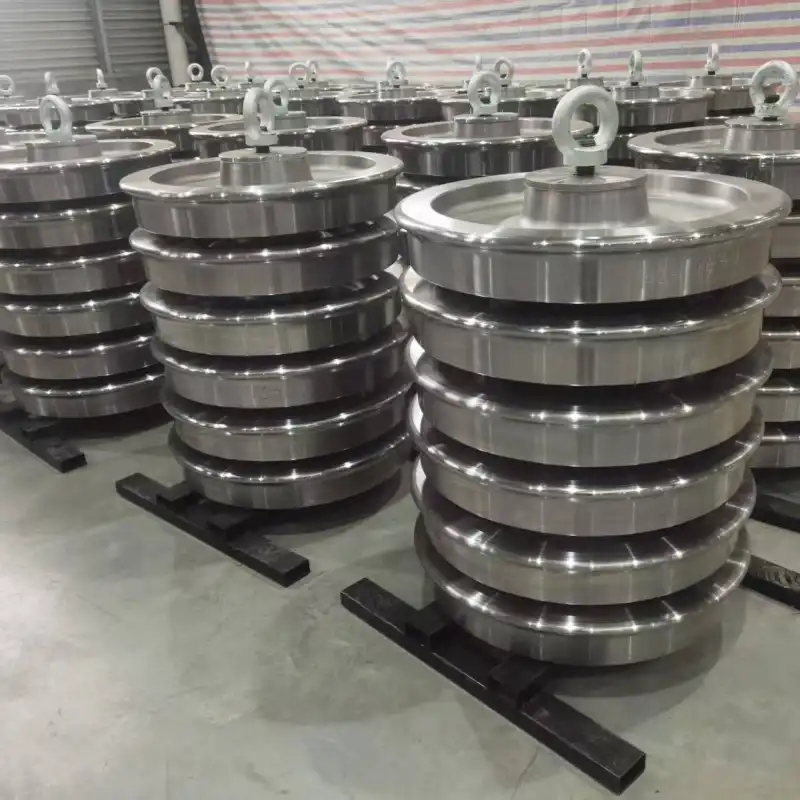
The starting point of quality control is raw materials. Train wheels are typically made of high-quality alloy steel. Every batch of steel entering the factory must undergo strict chemical composition re-inspection to ensure that the content of beneficial elements such as carbon, マンガン, and silicon is precisely within the standard, while strictly controlling the content of harmful impurities such as sulfur and phosphorus. さらに, non-destructive testing techniques such as ultrasonic testing should be used to inspect the steel billets for any inherent defects such as shrinkage cavities and inclusions. Only by ensuring the purity and uniformity of the material from the source can a solid foundation be laid for manufacturing qualified wheels.
Stability during the production process is the core of quality assurance. This requires monitoring and recording every key process.
2.1 鍛造と圧延: The forging process must strictly control the start and end forging temperatures to ensure the continuity of metal fiber flow lines, thereby enhancing the overall toughness of the wheel. The subsequent rolling process must ensure the precise dimensions and dense structure of the rim area.
2.2 熱処理: This is a crucial step that determines the comprehensive performance of the wheel. The heating temperature, holding time, and cooling rate during quenching must be precisely controlled to obtain a high-hardness and high-strength surface structure. The subsequent tempering process, with its temperature and time control, is equally important as it is used to eliminate internal stress and adjust the wheel’s toughness index to achieve the best balance between strength and toughness. The uniformity of the temperature field in all heat treatment furnaces must be regularly calibrated, and all process parameters should be fully recorded and traceable.
Finished product inspection is the final checkpoint before the wheels leave the factory and requires a comprehensive verification using multiple methods.
非破壊検査: This is the core method for detecting hidden defects.
3.1 超音波検査: It is used to detect internal defects such as cracks, 内包物, and white spots in the wheel. The probe will conduct a full scan of key areas such as the rim and spokes, leaving no detection blind spots.
3.2 磁粉試験: It is mainly used to inspect surface and near-surface defects in areas such as the rim, トレッド, and flange. It can clearly display hairline cracks.
3.3 Dimension and Geometric Tolerance Inspection: High-precision calipers, templates, and three-dimensional measuring instruments are used to conduct 100% inspection of the rim thickness, flange height, tread profile, hub hole diameter, and overall radial and end face runout of the wheel. Any dimensional deviation may affect the stability of the train or cause abnormal wear.
3.4 機械的特性試験: Samples are taken from wheels of the same melting furnace batch or from designated positions on the wheel body and processed into standard test bars for tensile, インパクト, and hardness tests in the laboratory. These data directly verify whether the wheel’s strength, 靭性, and wear resistance meet the standard requirements.
3.5 Static Balance Testing: Uneven mass distribution of the wheel can cause severe vibration at high speeds. Through static balance testing machines, the imbalance of the wheel can be measured, and weight reduction and correction can be carried out at designated positions to ensure smooth operation.
A complete quality management system is the backbone supporting all quality control activities. An independent identity file must be established for each wheel, recording complete information from raw materials, production batches, heat treatment data, to all inspection results. This traceability ensures that in case of any problems, they can be quickly located and traced back to the same batch of products. 同時に, statistical analysis of all quality data generated during the production process can help identify potential risk points, thereby driving continuous optimization and improvement of the production process.
To ensure the quality control of train wheels, it is necessary to establish a closed-loop management system that covers all elements, including personnel, 装置, 材料, methods and environment from the entry of materials to the exit of products. It relies on strict standards, precise execution, advanced detection technologies and an unquestionable sense of responsibility. Only in this way can the most solid safety guarantee be provided for every high-speed run on the steel rails.
洛陽豊洋重工業株式会社, 株式会社,1998年に設立された鉄道鋳造部品のメーカーです。当社の工場面積は72,600㎡です。, 以上の 300 従業員, 32 技術者, 含む 5 シニアエンジニア, 11 アシスタントエンジニア, そして 16 当社の生産能力は 30,000 年間トン. 現在, 私たちは主に鋳物を生産しています, 機械加工, 機関車の組立て, 鉄道車両, 高速鉄道, 鉱山機械,風力,等.
当社はCRRCに鉄道部品を供給しています。(以上を含む 20 CRRCの支店および子会社),Gemacエンジニアリングマシナリー,サニーグループ, 中信重工業,等. 当社の製品はロシアに輸出されています, 米国, ドイツ, アルゼンチン, 日本, フランス, 南アフリカ,イタリアをはじめとする世界中の国.