WeChat コードをスキャンしてご連絡ください
WeChat コードをスキャンしてご連絡ください
お気軽にメールをお送りください。できるだけ早くご返信させていただきます.
心と魂で未来を創る


Our factory has been deeply engaged in the casting of 鉄道部品 for many years and fully understands that “安全性” is the unshakable lifeline of the railway industry. Railway parts are constantly subjected to repeated impacts and loads during the long-term and high-intensity operation of trains. したがって, improving the fatigue resistance of products is not only a basic requirement to meet customer standards but also a solemn commitment we make to train safety. This plan will systematically propose the path for our next technical improvements from four aspects: “Treating the Root Cause”, “Precision Workmanship”, “Strengthening the Body”, そして “Diagnosis”.

Fatigue begins from within. We must lay a solid foundation from the design and material selection stage before the parts are “born”.
Material Upgrade and Purification:
1.1 Selecting High-Quality Raw Materials: We will resolutely use high-purity and reliable primary iron and scrap steel, controlling the content of harmful elements such as sulfur and phosphorus from the source. These harmful elements are like “weak points” inside the metal, easily becoming the origin of fatigue cracks under alternating stress.
1.2 Optimizing Alloying: Based on traditional materials, we will fine-tune the alloy ratio according to the specific force characteristics of each component. 例えば, appropriately increasing the content of elements such as manganese, クロム, and molybdenum can significantly refine the grain structure, enhancing the material’s strength and toughness, like “strengthening the bones and muscles” of the metal to better resist fatigue.
Structural Optimization Design:
1.3 Eliminating Stress Concentration: Fatigue cracks prefer to start from “sharp corners” そして “notches”. Our design team must ensure smooth transitions at all corners, grooves, holes, and other locations when drawing the blueprints. Even a small fillet can greatly disperse stress and avoid the “weak link effect”.
1.4 Simulation Analysis Assistance: For core load-bearing parts, we will introduce computer-aided engineering analysis. Before mold opening, we will simulate the stress conditions under real working conditions through software to identify potential high-stress areas in advance and optimize the design in the design stage, achieving “prevention before the problem occurs”.
The stability of the casting process directly determines the internal quality of the product.
Melting and Pouring:
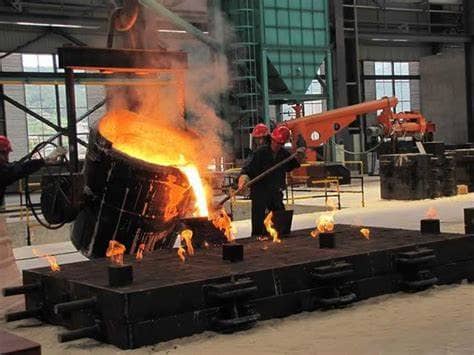
2.1 Precise Temperature Control: We will adhere to the principle of “high-temperature melting and low-temperature pouring”. High-temperature melting ensures uniform composition and the complete floating of gases and inclusions; low-temperature pouring reduces defects such as shrinkage porosity and hot cracking caused by casting shrinkage. This is like cooking, where the dish is only delicious when the heat is just right.
2.2 Spheroidization and Inoculation: For ductile iron castings, this is a critical process. We must strictly control the amount and timing of the addition of spheroidizing agents and inoculants to ensure a high spheroidization rate and good roundness of graphite. These round graphite spheres can effectively prevent the expansion of cracks and are the core to enhancing toughness.
Molding and Cooling:
2.3 Sand Mold Strength and Permeability: Ensure that the sand mold has sufficient strength and uniform permeability to prevent surface defects such as sand sticking and porosity in the castings. Any surface defect is a ready-made “fatigue source”.
2.4 Scientific and Orderly Cooling: The cooling rate of the casting in the sand mold must be uniform. Excessive cooling leads to excessive internal stress, while too slow cooling results in coarse grains. We should consider setting up reasonable “insulating risers” そして “chill irons” to guide the casting to solidify in a “bottom-up, thin-to-thick” 順序, obtaining a dense and uniform internal structure.
Casting is only the “rough form”, and heat treatment is the key step to unlocking its potential.
3.1 Tailored Heat Treatment:
Abandoning the “one-size-fits-all” heat treatment model. We will develop precise normalizing, annealing, 急冷 + tempering process curves based on different materials and performance requirements. Especially the quenching + high-temperature tempering (tempering after quenching), which can endow parts with excellent strength and toughness, is the “ace card” for enhancing fatigue resistance. Strict control of tempering temperature and time: Tempering is to eliminate quenching stress and obtain a stable structure. We must precisely control the tempering process, like carefully stewing soup, to ensure stable performance.
3.2 Application of surface strengthening technology:
3.2.1 Shot peening: This is the process we should popularize and strengthen the most at present. By using a high-speed stream of shots to impact the surface of the parts, plastic deformation occurs, forming a dense layer of compressive stress. Fatigue cracks are difficult to form and expand under pressure. This is like putting on a “tight bulletproof vest” on the surface of the parts.
3.2.2 Strengthening of holes and threads: For stress concentration areas such as bolt holes and threads, a special rolling process is used to introduce compressive stress on the surface, which can increase the fatigue life of these weak links several times.
Quality without inspection is just empty talk. We must establish a quality monitoring system throughout the process.
4.1 Full coverage of non-destructive testing:
For core parts leaving the factory, 100% magnetic particle or ultrasonic testing is conducted to ensure there are no internal cracks, ひけ巣, or other fatal defects. これは、 “final physical examination” before the product leaves the factory, and no negligence is allowed.
4.2 Establishment of quality traceability files:
For each batch, even for key parts, a full-process file from “furnace number – molding – 熱処理 – 機械加工 – 検査” is established. In case of any problems, the source can be quickly traced, the cause analyzed, and closed-loop management achieved.
4.3 Continuous improvement mechanism:
Regularly collect customer feedback during use, especially in cases of fatigue damage. Feed this first-hand information from the “battlefield” back to our design, production, and quality inspection departments as the most valuable basis for continuous optimization.
Improving the fatigue resistance of railway parts is not an overnight task and is not the responsibility of a single department. It is a systematic project that requires us to be meticulous in every link from design, smelting, 鋳造, 熱処理, 機械加工, to inspection, and ensure that each link is closely connected.
Let’s implement the measures of this plan with the heart of a craftsman, persistently, and jointly forge safer, more reliable, and longer-lasting railway parts. This is not only the foundation of our enterprise but also our heavy responsibility and contribution to the national railway industry.
洛陽豊洋重工業株式会社, 株式会社, 1998年に設立された鉄道鋳造部品のメーカーです. 当社の工場面積は72,600㎡です。, 以上の 300 従業員, 32 技術者, 含む 5 シニアエンジニア, 11 アシスタントエンジニア, そして 16 技術者. 弊社の生産能力は 30,000 年間トン. 現在, 私たちは主に鋳物を生産しています, 機械加工, 機関車の組立て, 鉄道車両, 高速鉄道, 鉱山機械,風力, 等.
当社はCRRCに鉄道部品を供給しています。(以上を含む 20 CRRCの支店および子会社), Gemacエンジニアリングマシナリー, サニーグループ, 中信重工業, 等. 当社の製品はロシアに輸出されています, 米国, ドイツ, アルゼンチン, 日本, フランス, 南アフリカ, イタリアをはじめとする世界中の国.