Scansiona il codice WeChat per contattarci
Scansiona il codice WeChat per contattarci
Sentiti libero di inviarci un'e-mail e ti risponderemo il prima possibile.
Creare il futuro con cuore e anima


In the crisscrossing railway network, track clamps (commonly known as fishplates) E elementi di fissaggio (also called clips) are like the “joints” E “scheletro” of the rails, jointly constructing a precise system capable of carrying trains weighing tens of thousands of tons. As key components of track engineering, although they have different shapes, they form a tight mechanical complementary system in function.
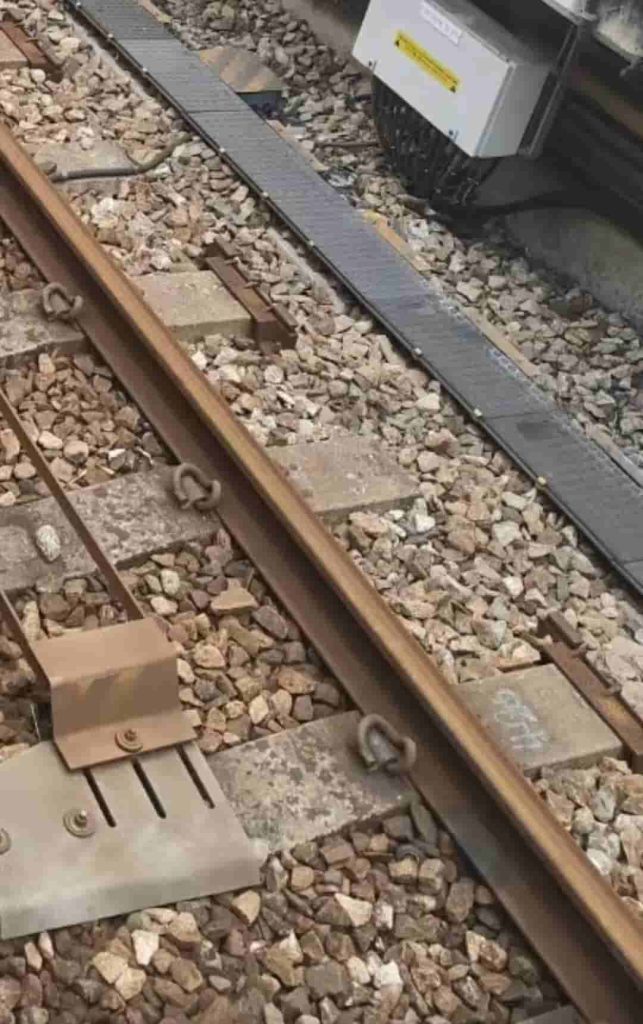
1. Structural Characteristics
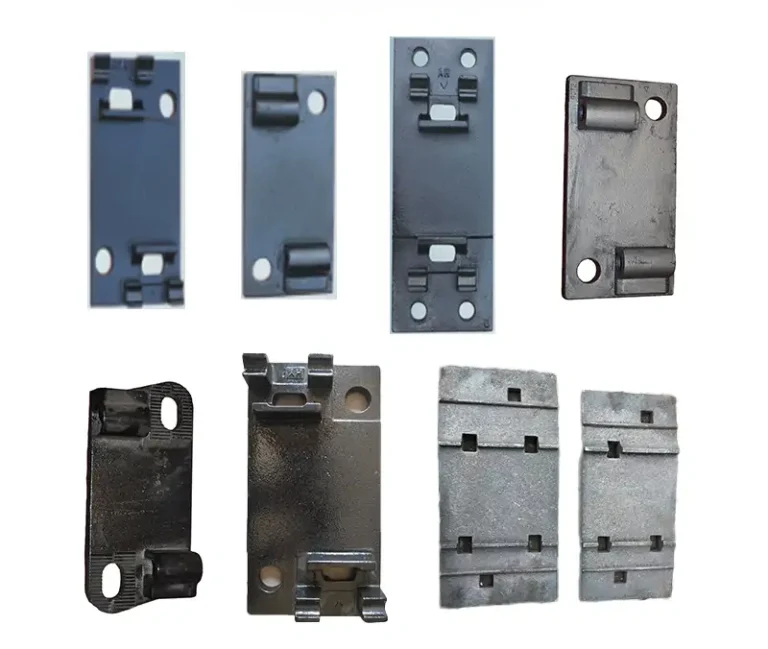
It is an alloy steel component with a double-headed symmetrical design and an I-shaped cross-section for reinforcement. The standard length is 400-800mm, with bolt holes reserved in the middle and gradually thinning to 15-22mm at both ends to achieve seamless curved surface contact with 60kg/m rails. The surface hardening layer formed by cold forging (with a hardness of HB300-380) can withstand 200 million cycles of load impact.
2. Funzioni principali
2.1 Mechanical Conduction: Connect adjacent rotaie into a whole through 6 sets of 10.9-grade high-strength bolts (with a preload of 300kN), transmitting longitudinal and lateral forces between the wheel and rail.
Dynamic Compensation: Reserve 8-12mm expansion joints and elastic washers to absorb rail end displacement caused by temperature stress.
2.2 Defect Shielding: Cover the quenched zone at the rail end to prevent crack initiation in the heat treatment vulnerable zone.
3. Technological Evolution
From cast iron (1900S) to quenched alloy steel (1980S), and up to the current friction-welded integral clips, the fatigue resistance has increased nearly 17 volte. The titanium alloy composite clips used on the Beijing-Zhangjiakou High-Speed Railway maintain 92% of their fracture toughness even at -40°C.
1. System Positioning
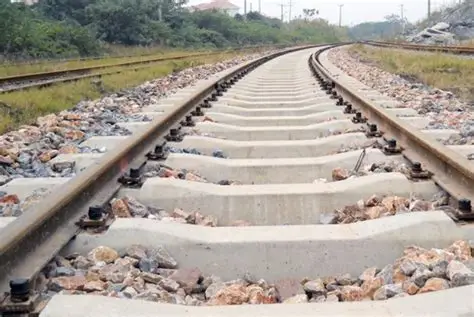
As the core pressure-bearing unit of the fastening system, the clip, along with the elastic bar and gauge spacer, forms a “trinity” restraint mechanism. Its wedge-shaped structure generates a continuous clamping force of 18-24kN, firmly anchoring the rail to the concrete sleeper.
2. Innovative Design
2.1 Double friction surfaces: The upper surface is treated with a wave pattern (Ra=12.5μm) to enhance the friction coefficient with the elastic bar, while the lower surface is mirror-polished (Ra=0.8μm) to reduce rail bottom slippage.
2.2 Collapse-type safety protrusion: When the clamping force exceeds the limit, it breaks first to protect the threaded rail spikes on the sleeper.
Zinc-chromium coating + micro-arc oxidation: Dual protection for a 25-year anti-corrosion cycle in coastal areas.
2.3 Dynamic Adjustment
Heavy-haul railways use hydraulic servo clips that adjust the clamping force in real time through pressure sensors. The intelligent clips on the Daqin Railway increase the clamping force by 12% when a train passes to suppress rail wave wear.
2.4 Cooperative Working Mechanism
When a D8A heavy-haul locomotive (axle load 35t) passes:
The wheel impact causes a 3-5mm vertical displacement of the rail.
The clip absorbs 60% of the kinetic energy through the deformation of the elastic bar.
The remaining kinetic energy is dispersed and transmitted to adjacent sleepers through the clip bolts.
The system dissipates the energy and restores the track surface smoothness within 0.15 secondi.
This precise collaboration keeps the gauge deviation of the Shanghai-Kunming High-Speed Railway within ±1mm at 350km/h, far below the safety threshold of 3mm.
2.5 Frontier Technology Breakthroughs
Shape memory alloy clips (trial use by Shanghai Bureau): Utilizing the phase transformation characteristics of nickel-titanium alloys to adjust the bolt preload force with temperature changes automatically.
Piezoelectric smart clips (Beijing-Xiong’an High-Speed Railway): Embedded with piezoelectric ceramic power generation units to collect vibration energy for powering trackside sensors.
3D-printed gradient material clips (tested by the Railway Science Research Institute): Surface is high-hardness and wear-resistant (HRC55), core is high-toughness and impact-resistant (AKv=80J).
Luoyang Fonyo Heavy Industries Co., Ltd,fondata nel 1998, è un produttore di pezzi fusi per ferrovie. La nostra fabbrica copre un'area di 72.600㎡, con più di 300 dipendenti, 32 tecnici, compreso 5 ingegneri senior, 11 ingegneri assistenti, E 16 tecnici. La nostra capacità produttiva è 30,000 tonnellate all'anno. Attualmente, produciamo principalmente fusione, lavorazione, e assemblaggio per locomotiva,vagone ferroviario,treni ad alta velocità, attrezzature minerarie,energia eolica,ecc.
Siamo la fornitura di componenti ferroviari a CRRC(compreso più di 20 filiali e controllate di CRRC),Macchine per l'ingegneria Gemac,Sanygroup, Industrie pesanti Citic,ecc. I nostri prodotti sono stati esportati in Russia, gli Stati Uniti, Germania, Argentina, Giappone, Francia, Sudafrica,Italia e altri paesi in tutto il mondo.
Informazioni sui contatti:
E-mail:[email protected]
Mobile:008615515321683