Scansiona il codice WeChat per contattarci
Scansiona il codice WeChat per contattarci
Sentiti libero di inviarci un'e-mail e ti risponderemo il prima possibile.
Creare il futuro con cuore e anima


The iron base plates in elementi di fissaggio ferroviari are important components of the railway track system. They are responsible for supporting the rails, distributing the track load, and ensuring the stability and safety of the track system.
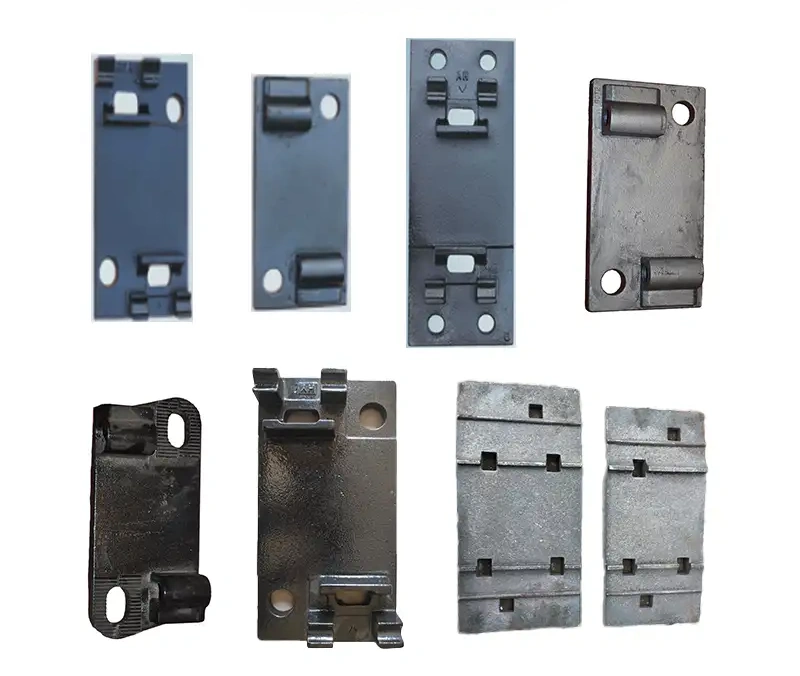
The types and models of railway fastener iron base plates are diverse to meet the needs of different railway lines.
This combination is commonly used in wooden sleeper tracks and is the traditional fastening method. It mainly fixes the iron base plates to the wooden sleepers through fasteners.
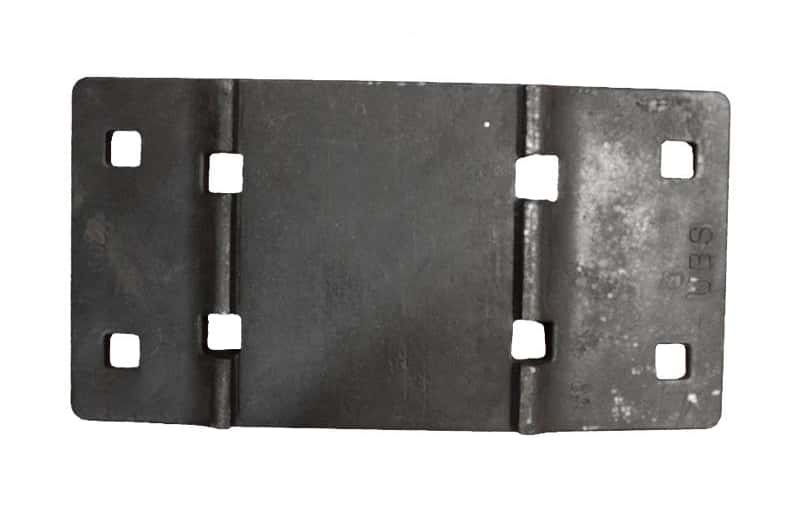
There are various types, such as plate-type, arched-plate type, and spring-type. Tra loro, spring-type fasteners are the most commonly used. Specific models include spring type I, e-type, ω-type, and w-type. These fasteners consist of threaded fasteners, noci, flat washers, molle, gauge plates, guard plates, and rubber pads etc.
3.1 For high-speed railways: High-speed railways have extremely high requirements for the stability and smoothness of the track. Perciò, they often adopt high-performance fastener systems such as WJ-7 and WJ-8. These fasteners are specifically designed for high-speed railways and have higher strength, durabilità, excellent insulation performance, and noise reduction and vibration-damping capabilities.
3.2 For urban rail transit: Metro and other urban rail transit systems have high environmental protection requirements for vibration and noise reduction. Perciò, the steel rail fasteners must have good vibration reduction performance to attenuate track vibrations and reduce noise transmission, improving passenger comfort.
Elevata resistenza e durata: Due to the long operating time, high traffic density, and poor maintenance conditions of railway operations, the fasteners and iron base plates must have sufficient strength and durability to ensure safe operation.
4.1.Good insulation performance: In railway systems, the running rails are often used as return rails. The fasteners must have good insulation performance to prevent current leakage through the fasteners, which could cause corrosion of structural steel bars and municipal pipelines.
4.2.Excellent vibration reduction and noise reduction performance: The fasteners and iron base plates use elastic elements (come i cuscinetti in gomma) to buffer the vibration impact between the wheels and the rails, reducing noise transmission and improving passenger comfort.
4.3.Easy adjustment and maintenance: Modern railway fastener systems usually have track gauge and level adjustment capabilities, which are convenient for solving problems such as wear of curved rails and uneven settlement of the structure. Allo stesso tempo, the fastener structure should be simple, with few components, and easy for construction and maintenance.
4.4.General interchangeability: To improve construction and maintenance efficiency, the fastener system should have certain general interchangeability, questo è, different models and specifications of fasteners and iron base plates can be interchanged for use.
In conclusion, railway fastener iron base plates, as key components of the railway track system, their types, models, scenari applicativi, and characteristics all play a crucial role in the safety, stabilità, and efficient operation of railways. With the continuous development of railway transportation technology, the technical level of railway fastener iron base plates will also continue to improve to better meet the needs of modern railway transportation.
Luoyang Fonyo Heavy Industries Co., Ltd,fondata nel 1998, è un produttore di pezzi fusi per ferrovie. La nostra fabbrica copre un'area di 72.600㎡, con più di 300 dipendenti, 32 tecnici, compreso 5 ingegneri senior, 11 ingegneri assistenti, E 16 tecnici. La nostra capacità produttiva è 30,000 tonnellate all'anno. Attualmente, produciamo principalmente fusione, lavorazione, e assemblaggio per locomotiva,vagone ferroviario,treni ad alta velocità, attrezzature minerarie,energia eolica,ecc.
Siamo la fornitura di componenti ferroviari a CRRC(compreso più di 20 filiali e controllate di CRRC),Macchine per l'ingegneria Gemac,Sanygroup, Industrie pesanti Citic,ecc. I nostri prodotti sono stati esportati in Russia, gli Stati Uniti, Germania, Argentina, Giappone, Francia, Sudafrica,Italia e altri paesi in tutto il mondo.
Informazioni sui contatti:
E-mail:[email protected]
Mobile:008615515321683