Scannen Sie den WeChat-Code, um mit uns Kontakt aufzunehmen
Scannen Sie den WeChat-Code, um mit uns Kontakt aufzunehmen
Schicken Sie uns gerne eine E-Mail und wir werden Ihnen so schnell wie möglich antworten.
Mit Herz und Seele die Zukunft gestalten


Overview of Railway Sleepers
Schläfer, als wichtiger Bestandteil des Gleisbaus, befinden sich zwischen den Schienen und dem Schotter. Their main functions are to bear the various pressures from the rails and evenly distribute them to the ballast, maintain the geometric shape of the track, and resist longitudinal and lateral displacements. Traditional sleepers can be classified into wooden sleepers, Stahlschwellen, and prestressed reinforced concrete sleepers based on different materials. Wooden sleepers were the first to be used, and over 2.5 billion have been laid worldwide. They have high elasticity and are easy to process and use, but are prone to corrosion and difficult to maintain the geometric shape of the track. Steel sleepers emerged in the 1880s and are light in weight and have a long service life, but have poor insulation and generate significant vibration and noise. The first prestressed reinforced concrete sleeper was used in 1943 and was promoted due to its high longitudinal and lateral resistance and long service life, but it has the disadvantages of being heavy and having poor elasticity. To enhance the service life of sleepers, Produktionskosten senken, and minimize environmental pollution during production, research on composite sleepers has gradually begun.
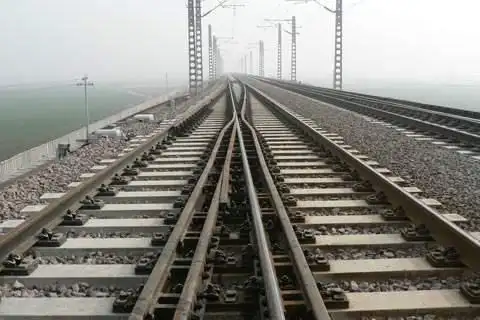
Researchers have continuously optimized the materials of sleepers to meet the traditional functional requirements of sleepers during the development of railways. To ensure the safety of line operation and reduce maintenance costs, special functional requirements have been put forward for sleepers. Based on the current research status at home and abroad, various special functional sleepers are introduced.
Special Function Sleepers
In 1958, China completed the first railway crossing the desert, the Baolan Railway. Anschließend, railways such as the Wugi, Baixi, Nanjiang, Beijiang, and Lanxin all experienced varying degrees of sand damage. As of 2014, um 10,000 km of railway lines in China (approximately 12% of the total mileage) were affected by wind and sand due to crossing deserts and sandy areas. Gleichzeitig, with the proposal of the “Belt-and-Road-Initiative” In 2013, China’s railways have gone global. Many foreign railway projects also face sand damage problems, such as the Tehran-Iran Railway and the Desert Railway in the United Arab Emirates. The impact of wind and sand on railways mainly manifests as: (1) the accumulation of sand particles causes the ballast to become compacted and lose elasticity, increasing the stiffness of the track structure and accelerating the wear of rails and wheels; (2) under the action of rain, the salt in the sand causes rust on rails and fasteners; (3) sand particles can clog turnouts and bury rails. Wind and sand deteriorate the service condition of the line, affect train safety, and increase maintenance costs.
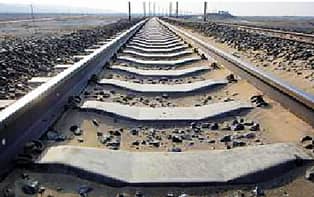
Anti-sand sleepers for ballasted tracks are shown in the figure below. These sleepers mainly utilize the Venturi effect by increasing the height of the rail-bearing part from the ballast surface, thereby increasing the cross-sectional area of the flow passage formed by the rail and the bearing platform, which facilitates the flow of wind and sand through the gap and reduces sand accumulation. Gleichzeitig, the rail is raised, so even if sand accumulates, the rate of rail burial is reduced. The ends of the bearing platform are conical to reduce wind resistance and the amount of sand accumulation in the ballast without affecting tamping maintenance. Based on this sleeper, anti-sand track slabs have been developed, but when the wind direction is not orthogonal to the track structure, the Venturi effect weakens. South Africa developed the T-type track structure in 1989, and it was applied in the Namibian desert and Saudi Arabia in 2008. This system has low installation and maintenance costs and no ballast contamination issues.
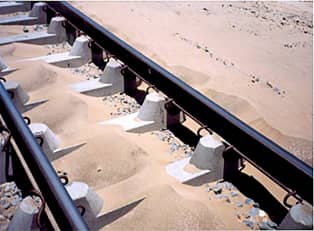
Anti-flying ballast sleepers
The mechanism of flying ballast is shown in the figure below. During the operation of high-speed trains, ballast may leave the ballast bed due to the combined action of wind load and ballast bed vibration, hitting the bogies and car bodies and causing damage. In der Zwischenzeit, ballast remaining on the rail surface can cause rail damage under the load of the train. Flying ballast is mainly influenced by train speed, ballast particle size, density, gradation, and the shape and arrangement of sleepers. It should be noted that in cold regions, low-speed trains may also experience flying ballast due to ice and snow. Momentan, the main measures adopted at home and abroad to address flying ballast include optimizing the ballast cross-section, curing the ballast with polyurethane, and optimizing the ballast gradation.
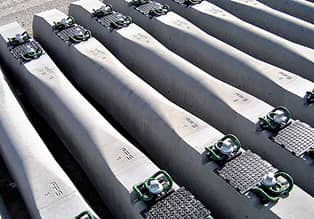
Optimizing the structure of sleepers can also achieve the effect of preventing flying ballast. The Spanish Railway Administration has developed aerodynamic sleepers based on fluid mechanics principles. The top and sides of these sleepers transition smoothly without sharp corners, and the middle part is rounded and protruding, making it less likely for ballast to remain on the sleeper’s surface. The transition between the sleeper and the ballast bed is smooth, reducing the step cavity flow effect and lowering the wind pressure distribution by more than 30%. The wide sleepers can also reduce the probability of flying ballast by decreasing the sleeper spacing.
Anbieter
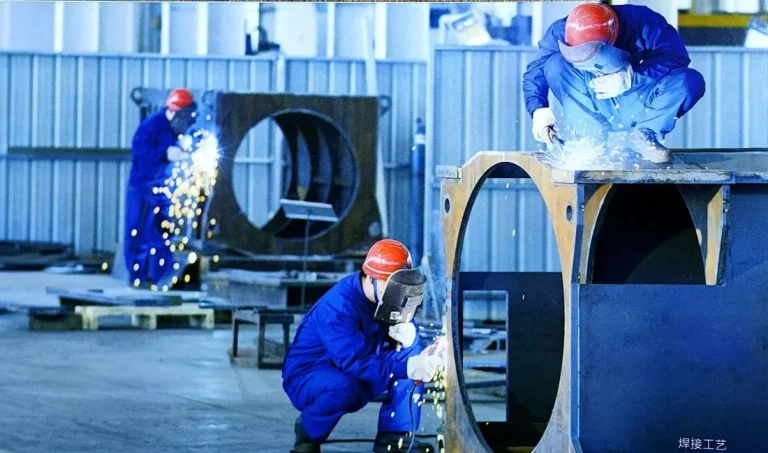
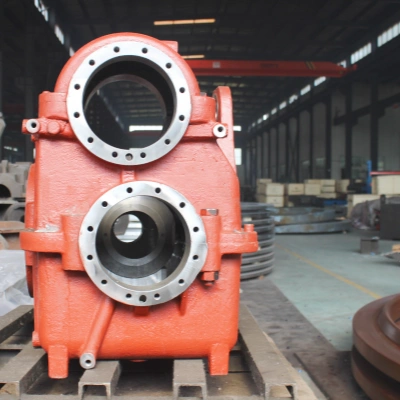
Luoyang Fonyo Heavy Industries Co., Ltd,Das 1998 gegründete Unternehmen ist ein Hersteller von gegossenen Eisenbahnteilen. Unsere Fabrik erstreckt sich über eine Fläche von 72.600 qm, mit mehr als 300 Mitarbeiter, 32 Techniker, einschließlich 5 leitende Ingenieure, 11 Hilfsingenieure, Und 16 Techniker. Unsere Produktionskapazität beträgt 30,000 Tonnen pro Jahr. Momentan, Wir produzieren hauptsächlich Gussteile, Bearbeitung, und Montage für Lokomotive,Triebwagen,Hochgeschwindigkeitszüge, Bergbauausrüstung,Windkraft,usw. Unsere Produkte wurden nach Russland exportiert, die Vereinigten Staaten, Deutschland, Argentinien, Japan, Frankreich, Südafrika,Italien und andere Länder.
Kontakt:Cathy
E-Mail:[email protected]
Mobile:008615515321683