Scan the WeChat code to contact us
Scan the WeChat code to contact us
Feel free to send us a email and we will reply to you as soon as possible.
Creating the future with heart and soul


A railway draft gear is the energy-absorbing unit mounted behind a railcar coupler. It cushions the buff (compression) and draft (tension) forces between cars during coupling, braking, and acceleration, protecting the car body and lading from impact damage.
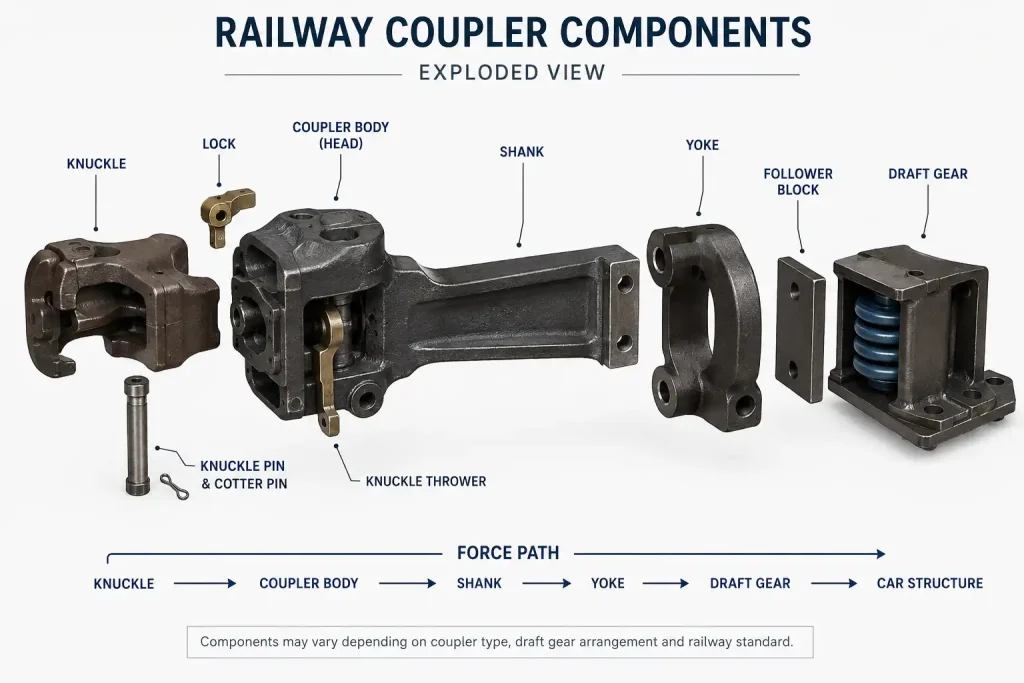
Ask most people what protects a railcar in the yard and they will point at the coupler. They are looking at the wrong component. The coupler is the hook, the mechanical link that holds two cars together. It is the unit behind it that actually absorbs the blow when a car is humped into a cut at five miles an hour.
That is the first thing to understand, and most supplier documents will not tell you plainly: the coupler holds the train together, but the draft gear decides how hard it hits. Everything downstream, the car structure, the lading, the tank walls if you run hazardous cargo, is protected or not protected by the quality of that unit, not by the coupler.
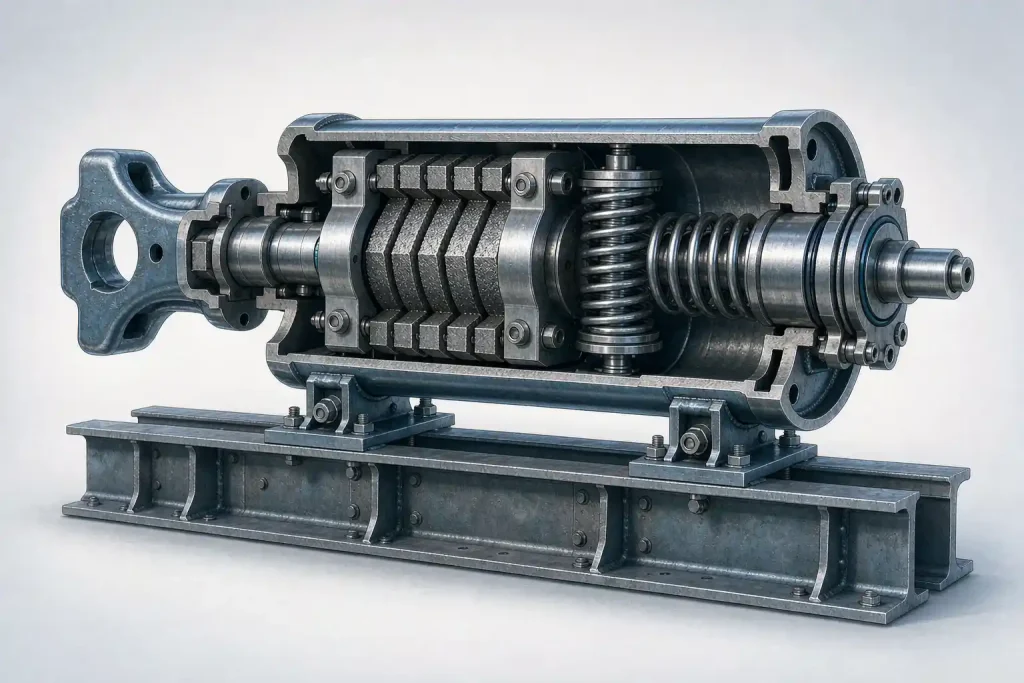
The reason this matters is that a draft gear is not a rigid block. It is a controlled spring, and its whole job is to turn a sharp impact into a longer, softer push. When a moving car strikes a stationary cut, the coupler transmits that force into the draft gear, and the unit absorbs part of it and gives the rest back over time. Without a working unit, that same impact arrives at the car body all at once.
So when you are specifying one, you are really specifying how much violence your car can survive. That is a different conversation from “which coupler fits.”
A draft gear works in both directions, and this is easy to forget because the name suggests only one. The word “draft” refers to pulling, and “buff” refers to pushing. A single unit has to handle both, because in train service the cars are constantly running in and running out against each other.
Think of the forces it faces:
Each of these arrives as a spike. Its job is to catch the spike and spread it out, so the car structure never has to. It sits in the same family as the other railway track components, but it is the part that decides how much of the spike the car actually feels.
Most freight gears are friction designs, and they share one architecture. Picture a cast housing with a tapered bore at its open end. A spring nest sits inside. A set of friction shoes or wedges sits in that tapered bore, and a wedge transfers the impact force both axially into the spring and radially into the housing walls.
The clever part is the friction itself. As the shoes slide in the tapered bore, they generate friction, and that friction is what dissipates the energy as heat. The spring alone would just store the energy and give it all back in a bounce. The friction is what actually removes energy from the system, which is why a friction gear absorbs a blow instead of just rebounding from it.
That combination of spring resistance plus frictional resistance is the oldest idea in the book, dating back to the 1890s, and it is still the dominant design because it is simple, robust, and repairable.
There are three families you will actually encounter in freight service, and they behave differently enough that the choice matters.
Steel friction draft gears (AAR M-901E). All-steel construction, with hardened wedges and steel coil springs. This is the workhorse, the Mark 50 and its descendants. The friction between the steel shoes does the absorbing, and the gears are rugged, rebuildable, and relatively light. Typical travel is around 3 to 3-1/4 inches, roughly 83 mm.
Elastomer and rubber-friction draft gears (AAR M-901G). These replace the steel spring nest with an elastomer or rubber spring package. Damping comes from the hysteresis of the material itself rather than from steel-on-steel friction, which gives a smoother compression and release curve. They often carry a higher rated capacity for heavy-haul and hazmat service.
Hydraulic cushioning units. Instead of friction, these push hydraulic fluid through valves, absorbing energy through viscous resistance. They offer much longer travel, ten inches or more, which makes them valuable for end-of-car cushioning on cars carrying fragile lading. They are heavier, more expensive, and more maintenance-intensive, so you see them on tank cars and auto racks more than on general freight.
There is also a family of polymer-spring and elastomer-cement gears used heavily in China, such as the MT-2 and MT-3. These are all-steel friction designs in the Mark 50 lineage, with the MT-3 rated around 2,000 kN maximum resistance and 45 kJ capacity, and the MT-2 around 2,270 kN and 50 kJ.
This is one of the least understood distinctions in the component, and it matters for what you are actually buying.
Under the AAR Manual, freight gears are certified to either M-901E or M-901G, and the two are tested differently. M-901E gears are qualified by a drop-hammer test, with a minimum official capacity of 36,000 ft-lb under the standard 27,000 lb drop hammer, and a minimum of 6,000 ft-lb at 1-5/16 inches of travel. M-901G gears are qualified by full-scale impact testing instead, and must meet a minimum rating impact velocity of 5 mph, defined as the velocity that produces a 500,000 lb reaction, using 70-ton cars.
The practical difference is that a G-spec gear has been proven in something closer to a real yard impact, not just a falling weight. The industry has long believed G gears outperform E gears in heavy service, but the honest answer is that the difference has not been fully quantified. When a project runs 286,000 lb gross rail load tank cars, the draft gear is a safety component, and the spec letter is not a formality.
Two numbers drive the selection, and suppliers report them in ways that are easy to compare badly.
Capacity is how much energy the unit can absorb, usually quoted in foot-pounds or kilojoules. A Mark 50 all-steel gear is rated around 38,940 ft-lb, roughly 53 kJ. A heavier Crown SE runs about 44,980 ft-lb, around 61 kJ. These are official rating figures, and different makers report rated, official, and maximum values, so compare only under the same definition.
Travel is how far the unit compresses, and it sets the geometry of the pocket. Standard AAR gears fit a 24-5/8 inch pocket with around 3-1/4 inches of travel. A hydraulic unit is a different animal, with travel past ten inches, and it will not fit the standard pocket without redesign.
The rule I keep coming back to when I look at a data sheet: read the force-travel curve, not the headline number. Two gears with the same rated capacity can behave very differently in the middle of the stroke, and the curve is where that shows up.
This is where procurement and engineering overlap, and the questions are specific. When I put one on order, I want these nailed down before the quote:
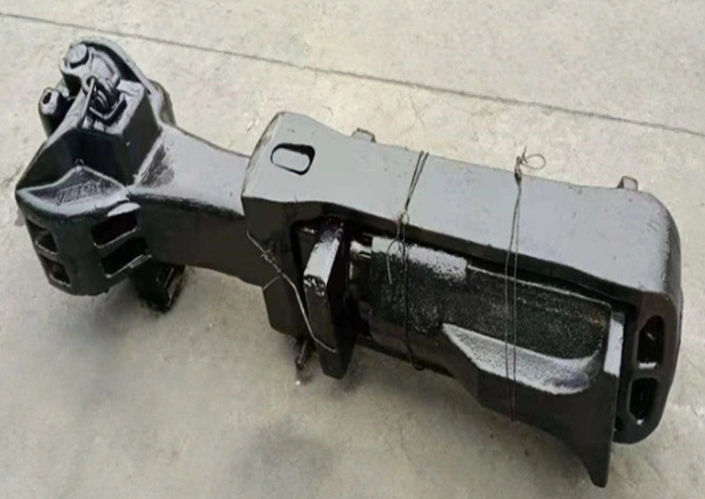
A draft gear is never a standalone purchase the way a bolt is. It has to mate with the coupler, the yoke, and the follower, and those three have to match the gear’s geometry. Quote it as part of a set, not as a head in isolation. This connects directly to the coupler side, which we covered in our AAR vs UIC coupler comparison.
Here is a fact that surprises people. A draft gear gets better before it gets worse. Most gears reach their peak capacity only after a break-in period, as the friction surfaces seat. Toward the end of their life, they go soft and lose capacity.
That softness is the maintenance signal. On the AAR side, draft gear reconditioning is governed by Field Manual Rule 21, and a gear is a candidate for reconditioning when it shows the wear limits or defects listed there, or when the movable plate contacts the wear tab. Reconditioning, testing, and pinning an existing unit is a standard practice, and it is often far cheaper than replacement.
The thing to watch is that a soft gear does not announce itself. It just quietly transmits more force to the car structure with every impact. On a tank car carrying hazardous material, that is not a place to find out late.
Whether you are specifying new units for a fleet or reconditioning the ones in service, the starting point is the same: match the gear to the coupler, the yoke, and the pocket, and read the force-travel curve rather than the headline rating. Choosing a supplier who can hold that geometry and traceability over time matters as much as the spec itself, which is the point we made in our railway track supplier guide. At FONYO, we manufacture railway coupler and draft gear components alongside fish plates, fish bolts, elastic rail clips, and rail pads, and we quote against the applicable AAR or UIC standard, not against a catalog photo.
What is the difference between a coupler and a draft gear?
The coupler is the mechanical link that connects two cars. The gear is the energy-absorbing unit behind it that cushions the impact. The coupler holds the train together; the gear decides how hard it hits.
Do draft gears work in both directions?
Yes. The unit absorbs both draft (pulling) and buff (pushing) forces, because cars constantly run in and run out against each other in service.
What is the difference between M-901E and M-901G draft gears?
M-901E gears are qualified by a drop-hammer test with a minimum 36,000 ft-lb capacity. M-901G gears are qualified by full-scale impact testing and must meet a 5 mph minimum rating impact velocity. The G spec reflects a test closer to a real yard impact.
How long is a standard draft gear pocket?
The standard AAR pocket is 24-5/8 inches, and a typical friction gear has around 3 to 3-1/4 inches of travel. Hydraulic cushioning units have much longer travel and need a different pocket design.
Can a worn draft gear be rebuilt?
Yes. Reconditioning, testing, and pinning a unit under AAR Field Manual Rule 21 is standard practice and usually cheaper than replacement. The trigger is reaching the defined wear limits or softening that reduces capacity.
Which type of draft gear is best for heavy haul?
For heavy axle loads and hazmat service, a higher-capacity elastomer or rubber-friction gear, or a G-spec gear, is typically specified. The choice depends on the car type, gross rail load, and the force-travel curve, not on a single headline rating.
Why does a draft gear matter for tank car safety?
It governs how much impact force reaches the tank structure during coupling and slack action. A soft or under-specified unit transmits more force to the car body, which is a safety issue on cars carrying hazardous material.