Scan the WeChat code to contact us
Scan the WeChat code to contact us
Feel free to send us a email and we will reply to you as soon as possible.
Creating the future with heart and soul


A steel grade comparison shows which grades from different standard systems look similar on paper. It does not show whether one can actually replace another. Q235, ASTM A36, EN S235JR and JIS SS400 are commonly compared structural steels, and 42CrMo, AISI 4140, 42CrMo4 and SCM440 are commonly compared alloy steels, but a comparison chart is a starting point for a deeper review, not a permission slip to substitute.
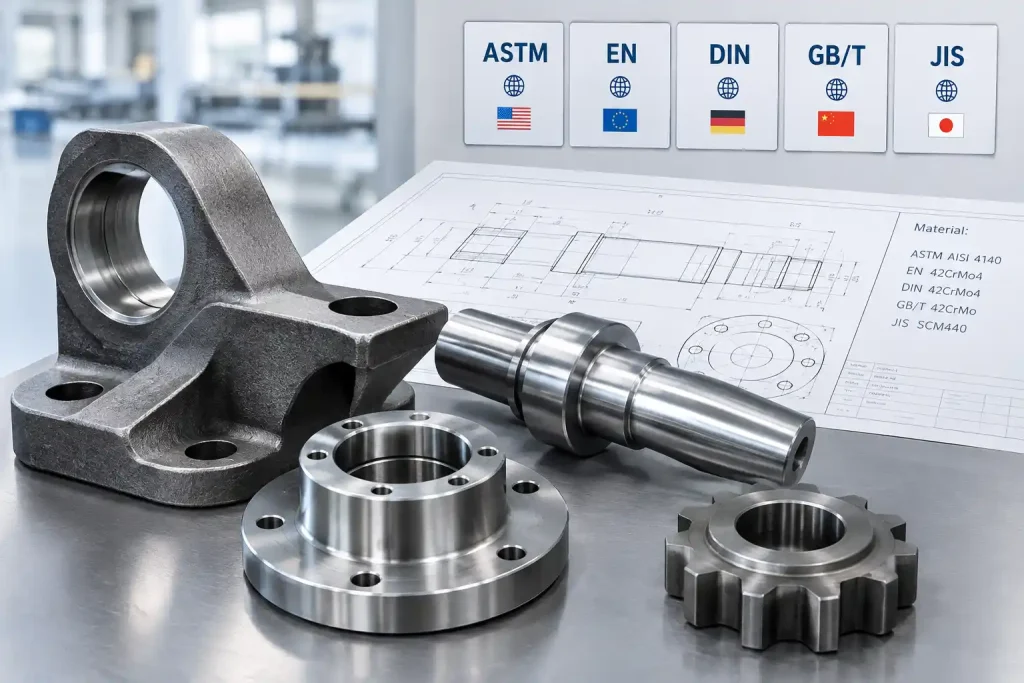
When an overseas customer sends a drawing to a Chinese manufacturer, the material line is often one of the first things I check. The drawing may call for an ASTM, EN, DIN or JIS steel grade. The steel a Chinese mill normally stocks is specified against GB/T standards instead.
So the question almost always comes up:
“Can a Chinese GB/T grade be used instead?”
Sometimes the answer is yes. I have never been comfortable with that answer being decided by a steel grade comparison chart alone.
Two grades can sit next to each other on a comparison table with near-identical chemical composition, similar strength and overlapping applications, and still carry different requirements for heat treatment, testing, product form or mechanical properties. For a simple fabricated bracket, the difference may not matter. For a forged, cast or machined component with a certification requirement, it usually does.
This is why I avoid calling these grades “equivalents.” I call them commonly compared grades, and I treat the comparison as the opening question, not the conclusion.
A steel grade is more than a label on a piece of steel. The standard behind the grade defines a package of requirements, and that package can include chemical composition, mechanical properties, heat treatment, testing and delivery condition.
Different countries name and classify steel differently, which is why a buyer can see several names for materials used in very similar components.
The “Q” in Chinese Q235 points to yield strength, and the 235 is the nominal minimum yield strength in MPa. In 45 Steel, the number points to the approximate carbon content, around 0.45%. In 40Cr, the Cr flags chromium as the key alloying element.
European designations split into different systems. S235JR and S355JR are structural grades. C45 and 42CrMo4 show up more in mechanical engineering. Japanese standards have their own logic, with names like S45C and SCM440.
| Standard system | Examples | Typical use |
| ASTM | A36, 1045, 4140, 5140 | US structural and engineering applications |
| AISI / SAE | 1045, 4140 | Carbon and alloy steels |
| EN | S235JR, S355JR, 42CrMo4 | European structural and engineering applications |
| DIN | C45, 42CrMo4 | German and European engineering |
| GB/T | Q235, Q355, 45, 40Cr, 42CrMo | Chinese manufacturing |
| JIS | SS400, S45C, SCM440 | Japanese engineering applications |
The table is a useful map of the systems. It is not a conversion chart, and treating it as one is where a lot of material selection goes quietly wrong.
Q235 is one of the most widely used structural steels in China. It turns up in welded structures, brackets, supports, machine bases and general fabrication.
It is almost always compared with ASTM A36, EN S235JR and JIS SS400, because the four grades have overlapping applications and similar strength levels. The comparison makes sense from an engineering point of view.
That does not mean the four materials share one specification.
There are real differences hiding behind the similar yield numbers. Q235B has a lower carbon maximum than A36, which makes it slightly more weldable. A36 permits a higher carbon ceiling for some product forms and does not mandate impact testing, while Q235B and higher carry a Charpy requirement at a specified temperature. S235JR and SS400 sit in the same general range but bring their own chemistry and testing rules.
For a straightforward fabricated structure, none of this may create a practical problem. For a component with a specific mechanical or certification requirement, the manufacturer has to compare the complete specifications, not just the grade names.
This matters most when a customer is buying a fabricated or machined part against an overseas drawing. A note that reads “A36 or equivalent” leaves a lot of room for a supplier to make the wrong call.
Q355 is the other common Chinese structural grade. Compared with Q235 it delivers a higher yield-strength level, and it is used where more load-bearing capacity is needed.
Buyers frequently compare Q355 with ASTM A572 Grade 50 or EN S355JR. The three occupy similar ground in structural engineering, but their chemical composition and detailed requirements are not identical. The 2018 revision of GB/T 1591 folded the older Q345 designation into Q355, but Q345 still appears in older drawings and in mill stock, which adds another layer of confusion to any steel grade comparison.
If a drawing specifies S355JR, the safer move is to ask the manufacturer to review the complete specification rather than silently switching the material to Q355 because both grades sit near a 355 MPa yield strength.
A yield number is a useful filter. It is not the whole requirement.
20 Steel is widely used in China for mechanical components and is specified under GB/T 699. It is a relatively low-carbon steel, chosen where a combination of machinability, weldability and moderate strength is wanted.
It is often compared with AISI 1020, C22 and JIS S20C.
For a simple machined part, these materials look nearly identical on a comparison chart. If the component carries a specific heat-treatment or mechanical-property requirement, those details have to be checked as well. The carbon number in the name is only part of the story.
This is one reason we normally ask customers to send the complete drawing or material specification when they ask us to quote a custom component. A grade name alone does not carry enough information to answer the substitution question properly.
45 Steel is probably the most familiar Chinese material for mechanical components. At roughly 0.45% carbon, it is used for shafts, pins, gears and other parts that need more strength and hardness than a low-carbon steel will give.
It is commonly compared with AISI 1045, C45/C45E and JIS S45C.
The carbon levels line up closely, but the final performance of a component depends on more than carbon content. Heat treatment makes a significant difference, and it is usually the part of the comparison that gets skipped.
A 45 Steel part in a normalized condition is not the same component as a 45 Steel part quenched and tempered to a specified hardness. When I compare 45 Steel against an overseas grade, I treat the heat-treatment condition as part of the material requirement, not as a separate afterthought.
The same logic applies to every grade in this article. The name tells you the chemistry family. The condition and the process tell you what the part will actually do.
40Cr is a commonly used chromium-alloy structural steel in China. The chromium improves hardenability, letting the steel reach higher strength after heat treatment.
It is often compared with AISI 5140, EN 41Cr4 and JIS SCr440.
The compositions are similar enough to make the comparison useful, but they are not identical specifications. This matters more as the section size grows, or where hardness and mechanical properties have to be controlled through the whole cross-section.
For a small machined part, the difference may be less significant than for a large forged component. The application and the manufacturing route have to be part of the decision, which is why a steel grade comparison that only lines up chemistry can mislead on exactly the parts where it matters most.
42CrMo is another important alloy steel in Chinese manufacturing. It is commonly selected for shafts, gears, high-load mechanical components and parts that need a combination of strength and toughness.
The most commonly compared international grades are AISI 4140, EN 42CrMo4 and JIS SCM440.
These grades share a chromium-molybdenum alloy system, which is why they get discussed together so often. Their detailed chemical composition limits, heat-treatment requirements and mechanical-property requirements can still differ.
For a safety-critical component, it is not appropriate to approve a substitution just because a general material chart lists 42CrMo and 4140 on the same line. I would want the full picture before signing off, and I would expect a customer’s engineering team to want the same.
When a customer asks whether a GB/T material can replace an ASTM, EN, DIN or JIS grade, the first thing I look at is the original requirement.
Chemical composition is important, but it is only the beginning. I also need the required tensile strength, yield strength, hardness and, where it applies, impact toughness.
The manufacturing process can change the answer. A forged component may have different requirements from a machined component produced from rolled bar. A casting brings its own considerations around material grade, casting process, heat treatment and inspection. The same material designation can produce very different results under a different manufacturing condition.
Heat treatment is another part of the comparison. Quenching and tempering, normalizing, annealing and surface hardening all change the final properties of a component. If a drawing specifies a heat-treatment condition, it should be treated as part of the material requirement rather than a separate issue.
Testing and documentation matter too. Depending on the application, a customer may require tensile testing, hardness testing, impact testing, chemical analysis, ultrasonic testing, magnetic particle testing or a material certificate such as EN 10204 3.1.
So the useful question is not:
“What is the Chinese equivalent of this steel?”
The useful question is:
“Can the proposed Chinese material and the manufacturing process satisfy the complete requirements of this component?”
The first question can be answered with a chart. The second one cannot.
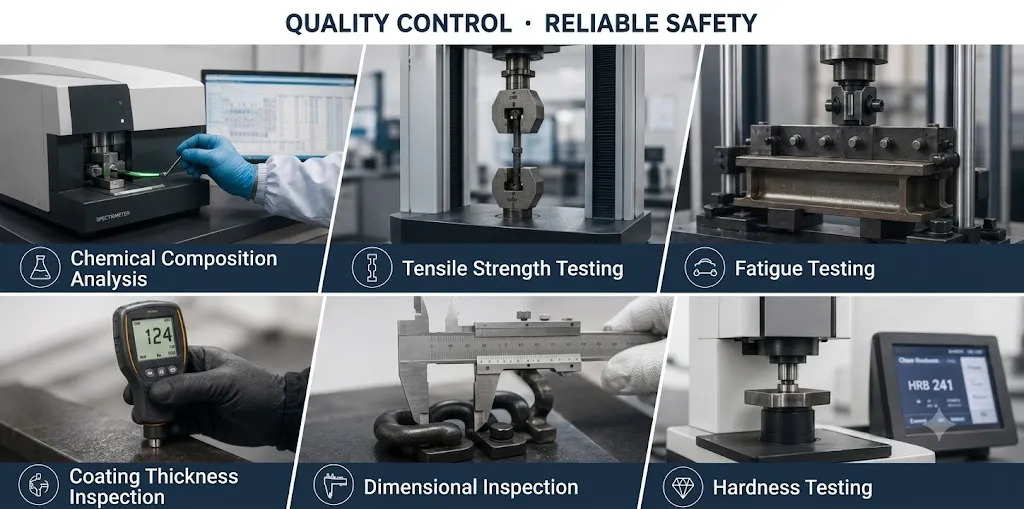
The material cannot always be separated from how the part is made. A customer may start with a material requirement, but the finished component often goes through forging or casting, heat treatment, rough machining, precision machining and inspection before it is ready for use.
At FONYO, we manufacture custom components using both casting and forging, with supporting heat treatment, machining and inspection in-house. That lets us look at the material requirement from the beginning of the process, rather than treating material selection as something that only happens when steel is purchased.
If a customer sends a drawing for a forged railway component and the drawing specifies an international steel grade, we can review that grade together with the forging process, heat treatment and machining requirements. The same approach applies to cast steel components and machined parts.
This is also why providing the drawing or a sample is useful when requesting a quotation. The material grade alone does not always tell us enough about the component.
If your drawing specifies an ASTM, EN, DIN or JIS material and you want to know whether a Chinese GB/T grade can be used, send the complete technical information rather than only the material name.
The drawing, the material specification, the required heat-treatment condition and the mechanical properties give the manufacturer a far better basis for comparison.
Instead of asking “Can you supply 4140?”, it is far more useful to send the drawing and specify the required standard, material condition, hardness or mechanical properties, and the testing and certification requirements.
The manufacturer can then compare the original requirement against the proposed Chinese material and explain any differences before production starts.
For critical components, the proposed substitution may also need approval from the customer or the end user. A material that looks similar on paper should not be substituted without approval when the original specification is controlled by a project, a railway operator, an engineering company or another end user.
A steel grade comparison is useful, but it works as a starting point, not as a conversion table.
Q235 and A36, 45 Steel and 1045, or 42CrMo and 4140 are commonly compared because they have similar applications or material characteristics. That does not mean one can automatically replace the other.
The safest approach is to compare the complete requirements: material composition, mechanical properties, product form, heat treatment, manufacturing process, inspection and certification.
For customers sourcing custom components from China, this matters especially, because material and manufacturing process are closely connected. A forged component, a cast component and a CNC-machined component can need different considerations even when similar steel grades are involved.
At Luoyang Fonyo Heavy Industries Co., Ltd., our capabilities cover casting, forging, heat treatment, CNC machining and inspection. If you have a drawing, sample or material specification using ASTM, EN, DIN, JIS or GB/T steel, send us the requirements for review, and we will evaluate the material together with the manufacturing process and finished-component requirements before production.
Similar steel grades are a useful starting point. The complete specification is what decides whether the material is actually suitable.
Not automatically. A steel grade comparison can show that two grades have similar chemistry and strength, but the standards behind them can differ on heat treatment, testing, impact requirements and delivery condition. Treat comparison as a starting point, not a substitute.
Q235 is the grade most often compared with A36 for general structural use. Q235B has a lower carbon maximum than A36 and carries a Charpy requirement, while A36 permits higher carbon for some forms and does not mandate impact testing. Confirm the full specification before substituting.
They share a chromium-molybdenum alloy system and are commonly compared, but their detailed composition limits, heat-treatment and mechanical-property requirements can differ. For a safety-critical component, verify the complete specification rather than relying on the comparison alone.
The carbon levels are similar, but the heat-treatment condition changes what the part will do. A normalized 45 Steel part is not the same as one quenched and tempered to a specified hardness, so the condition should be checked together with the grade.
Send the complete technical information: the drawing, the material specification, the required heat-treatment condition, the mechanical properties, and the testing and certification requirements. A grade name alone is not enough to answer the question.
Not necessarily. Hardness is one property among several, and pushing it higher can reduce toughness. The requirement should come from the application and the standard, not from a default assumption.
When the original specification is controlled by a project, a railway operator, an engineering company or another end user. A material that looks similar on paper should not be changed without approval in that case.