Scan the WeChat code to contact us
Scan the WeChat code to contact us
Feel free to send us a email and we will reply to you as soon as possible.
Creating the future with heart and soul


Railway sleepers may seem like simple structural components, but anyone involved in railway engineering knows they have a significant influence on track performance. They support the rails, maintain the correct gauge, transfer wheel loads to the ballast or slab, and work together with the rail fastening system to keep the track stable under repeated dynamic loads.
Choosing the right railway sleeper is not simply a matter of selecting the strongest material. A sleeper that performs well on a heavy-haul freight line may not be the best choice for a metro system, while a material that offers the lowest initial cost may require much higher maintenance over its service life.
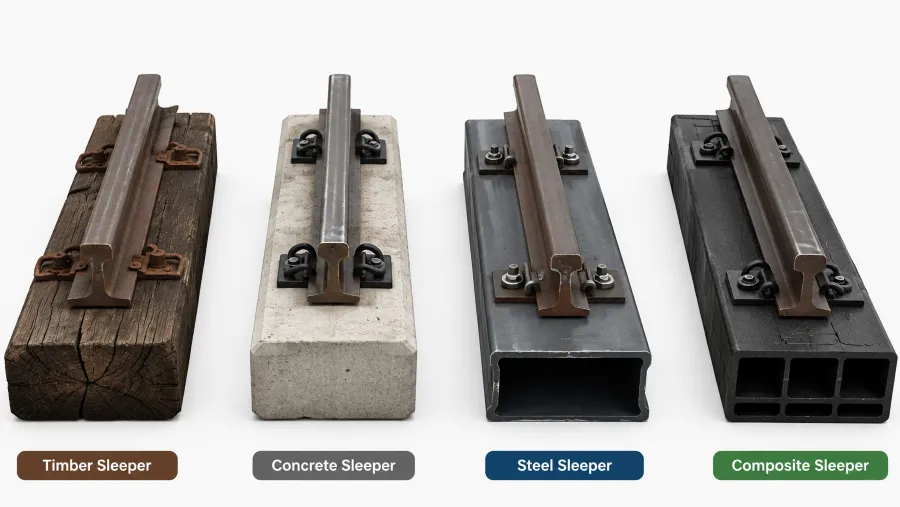
Today, four types of railway sleepers are widely used around the world:
Each has its own strengths, limitations, and ideal applications. The best option depends on factors such as axle load, train speed, climate, maintenance strategy, environmental conditions, and project budget.
In this guide, we’ll compare concrete, timber, steel, and composite railway sleepers from an engineering perspective. Rather than simply listing advantages and disadvantages, we’ll explain why each material performs differently and where it delivers the greatest value. Whether you’re designing a new railway, upgrading an existing line, or sourcing railway components, understanding these differences will help you make a more informed decision.
When people think about railway infrastructure, they usually focus on rails or trains. In reality, the stability of the entire track structure depends on the interaction between several components, and the railway sleeper is one of the most important among them.
A railway sleeper performs several essential functions:
Without properly selected sleepers, even high-quality rails and fasteners cannot maintain long-term track geometry.
For this reason, railway engineers rarely evaluate sleepers in isolation. Instead, they consider the entire track system, including the rails, rail clips, rail pads, fastening assemblies, ballast condition, and expected operating environment.
A railway sleeper that performs well with one fastening system may not be suitable for another. Likewise, a sleeper designed for a high-speed passenger line may not deliver the durability required for a heavy-haul freight corridor carrying high axle loads.
The right sleeper material improves not only track stability but also maintenance efficiency, ride comfort, and the overall life-cycle cost of the railway.
Although many specialized sleeper designs exist, modern railways mainly use four materials.
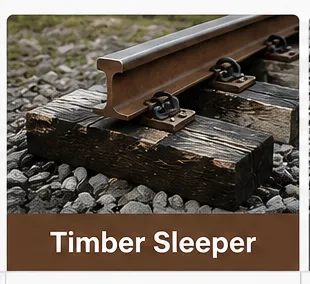
Timber sleepers are the oldest type of railway sleeper and have been used since the earliest days of railway construction. Even today, they remain common in North America, Australia, and many existing railway networks.
One reason timber sleepers have survived for so long is their flexibility. Wood naturally absorbs vibration and impact loads, making it suitable for locations where some elasticity is beneficial.
Timber sleepers are also relatively easy to drill, cut, or modify on site. This flexibility makes them especially useful for switches, crossings, bridges, and maintenance work where customized installation is often required.
However, timber is an organic material, and its durability is heavily influenced by moisture, insects, fungi, and weather conditions. Even when treated with preservatives, timber sleepers generally have a shorter service life than concrete or steel alternatives.
From a maintenance perspective, they require more frequent inspection and replacement, particularly on heavily trafficked railway lines.
Today, timber sleepers are most commonly used for:
While timber sleepers are no longer the preferred choice for most new high-speed or heavy-haul railways, they continue to offer practical advantages in applications where flexibility and ease of maintenance are more important than maximum service life.
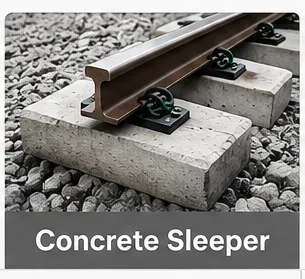
If you visit a newly constructed high-speed railway, metro line, or heavy-haul freight corridor almost anywhere in the world, you’ll most likely find concrete railway sleepers.
Their widespread use is not accidental. Concrete sleepers provide an excellent balance of strength, durability, dimensional stability, and long-term maintenance performance, making them the preferred choice for most modern railway infrastructure.
Most concrete railway sleepers are manufactured as prestressed concrete sleepers. During production, high-strength steel tendons are tensioned before the concrete is poured. Once the concrete reaches the required strength, the tension is released, creating permanent compressive stress inside the sleeper. This significantly improves crack resistance and allows the sleeper to withstand millions of repeated wheel loads throughout its service life.
Compared with timber sleepers, concrete sleepers are much heavier. While this increases transportation and installation costs, the additional weight also helps keep the track stable under high-speed traffic and heavy axle loads. The increased mass reduces sleeper movement, improves resistance to lateral forces, and contributes to better track geometry over time.
Another advantage is consistency. Because concrete sleepers are manufactured using standardized molds and strict quality control, every sleeper has nearly identical dimensions. This makes rail installation more accurate and helps maintain the designed track gauge throughout the railway’s life.
Concrete sleepers are particularly well suited for:
Of course, concrete sleepers are not perfect. Their greater weight requires lifting equipment during installation, and repairing damaged sleepers is more difficult than replacing timber ones. In addition, if the ballast foundation is poorly maintained, impact forces may increase because concrete is less flexible than timber.
For most modern railway projects, however, these disadvantages are outweighed by lower maintenance requirements and a significantly longer service life. This is why concrete railway sleepers have become the global standard for new railway construction.
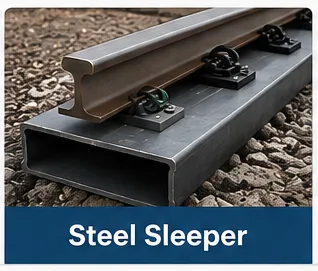
Steel railway sleepers have been used for more than a century, although their application has always been more specialized than concrete or timber.
Unlike concrete sleepers, steel sleepers are manufactured by forming and pressing steel plates into specific cross-sectional shapes. This gives them high strength while keeping their overall weight lower than concrete.
One characteristic engineers appreciate is their excellent dimensional accuracy. Steel sleepers are manufactured with tight tolerances, making them suitable for projects where precise track geometry is essential.
Steel also performs well in environments where timber deteriorates quickly. It is not affected by termites, fungal decay, or moisture in the same way as wood, making it an attractive option in tropical climates and regions where biological degradation is a concern.
Another advantage is recyclability. At the end of their service life, steel sleepers can be recycled almost entirely, reducing material waste and supporting sustainability goals.
However, steel sleepers also present several engineering challenges.
Because steel is highly conductive and relatively rigid, vibration and noise transmission can be greater than with timber sleepers. Corrosion protection is another important consideration, especially in coastal environments or regions where aggressive chemicals are present. Protective coatings and regular inspection are therefore essential for maintaining long-term performance.
Steel sleepers are commonly used in:
Although they represent only a small percentage of the global railway sleeper market, steel sleepers remain an effective solution for projects with specific environmental or operational requirements.
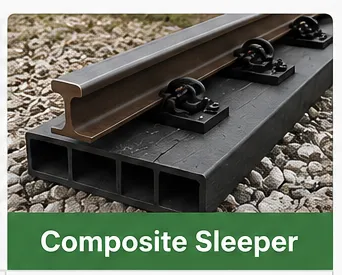
Composite railway sleepers are the newest major category of railway sleepers and continue to gain attention as railway operators look for more sustainable infrastructure solutions.
Instead of natural timber or reinforced concrete, composite sleepers are manufactured using recycled plastics, fiberglass, synthetic resins, or other engineered composite materials. Different manufacturers use different formulations, but the overall objective is the same: combine the durability of modern materials with the flexibility traditionally associated with timber.
From an engineering perspective, composite sleepers offer an interesting balance of properties.
They do not rot, absorb water, or suffer insect damage like timber sleepers. They are also much lighter than concrete sleepers, making transportation and installation easier in locations where heavy lifting equipment is unavailable.
One feature that railway maintenance teams often appreciate is that composite sleepers can usually be drilled, cut, and machined on site using tools similar to those used for timber. This makes them particularly suitable for bridge renewals, tunnel maintenance, and track upgrades where customized installation is required.
Composite sleepers also provide excellent electrical insulation and good vibration damping, helping reduce stray current issues and improve ride comfort in certain railway systems.
The main limitation is cost. Initial purchase prices are generally higher than those of timber or concrete sleepers. Because composite technology is still evolving, long-term field data covering 40 to 50 years of service is also less extensive than for traditional materials.
Nevertheless, when maintenance costs, environmental resistance, and expected service life are considered together, composite sleepers often deliver competitive life-cycle value.
Today they are increasingly used in:
There is no single railway sleeper that performs best in every situation. The right choice depends on the operating conditions, maintenance strategy, environmental factors, and life-cycle cost of the railway.
The table below summarizes the key differences between the four major railway sleeper materials.
| Feature | Timber Sleepers | Concrete Sleepers | Steel Sleepers | Composite Sleepers |
| Initial Cost | Low | Medium | Medium | High |
| Service Life | 20–30 years* | 40–60 years* | 30–50 years* | 40–50+ years* |
| Weight | Light | Heavy | Medium | Medium |
| Track Stability | Good | Excellent | Very Good | Very Good |
| Maintenance | High | Low | Medium | Low |
| Corrosion Resistance | Excellent | Excellent | Requires protection | Excellent |
| Rot & Insect Resistance | Poor | Excellent | Excellent | Excellent |
| Noise & Vibration Damping | Excellent | Good | Fair | Very Good |
| Installation | Easy | Heavy lifting required | Moderate | Easy |
| Recyclability | Moderate | Moderate | Excellent | Good |
| Typical Applications | Turnouts, bridges, secondary lines | High-speed, freight, metro | Mining, industrial, desert railways | Bridges, tunnels, wet environments |
*Actual service life depends on axle load, traffic density, climate, maintenance practices, and local operating conditions.
Although comparison tables provide a useful overview, they should never be the only basis for selecting railway sleepers. Engineering decisions should always consider the entire railway system rather than focusing on a single component.
For example, a heavy-haul railway carrying 32.5-tonne axle loads places very different demands on the track than a light industrial railway. Likewise, a coastal railway exposed to salt spray faces different durability challenges than a dry inland freight corridor.
This is why experienced railway engineers evaluate sleepers together with rail sections, ballast quality, fastening systems, drainage conditions, maintenance capabilities, and expected traffic volume before making a final decision.
One of the questions we hear most often from customers is:
“Which railway sleeper is the best?”
The answer is surprisingly simple:
There is no universal “best” railway sleeper—only the sleeper that best matches your operating conditions.
Below are some typical recommendations based on common railway applications.
Concrete railway sleepers are the preferred choice for high-speed lines because they provide excellent stiffness, dimensional consistency, and long-term track stability.
At speeds exceeding 250 km/h, maintaining precise track geometry becomes critical. The heavier weight of concrete sleepers helps resist track movement, while prestressed construction minimizes cracking under repeated dynamic loading.
For this reason, nearly all newly constructed high-speed railways use prestressed concrete sleepers.
Heavy-haul railways carrying high axle loads require sleepers capable of resisting enormous vertical and lateral forces over millions of loading cycles.
Concrete sleepers are generally the first choice due to their strength, durability, and low maintenance requirements.
However, in mining railways or industrial operations where track layouts change frequently, steel sleepers may also provide practical advantages because they are easier to recover, relocate, and recycle.
Urban rail systems operate under a different set of priorities.
Besides structural performance, operators often focus on ride comfort, vibration control, and maintenance efficiency.
Concrete sleepers remain the most common option for metro systems because they offer stable geometry and long service life. In locations with strict vibration or stray-current requirements, composite sleepers may also be considered for specific sections of track.
Bridges, switches, and crossings often require sleepers that can be modified during installation or maintenance.
This is one reason timber sleepers continue to be widely used in these locations.
Composite sleepers have also become increasingly popular because they combine many of timber’s installation advantages with significantly better resistance to moisture, insects, and weathering.
Moisture is one of the biggest challenges for railway infrastructure.
Timber sleepers may deteriorate more rapidly when exposed to continuous moisture, while unprotected steel sleepers require careful corrosion control.
Concrete and composite sleepers generally perform better in wet environments due to their superior resistance to biological degradation and water absorption.
Industrial facilities, construction railways, and temporary tracks often prioritize flexibility and lower initial investment.
Depending on the operating conditions, timber or steel sleepers may offer the most economical solution, particularly when track layouts are expected to change during the project’s lifetime.
Ultimately, selecting the right railway sleeper is a balance between initial investment and long-term operating cost.
A sleeper with the lowest purchase price may require more frequent replacement and higher maintenance costs, while a more durable option can reduce track possessions, maintenance labor, and life-cycle expenditure over several decades.
For this reason, many railway authorities now evaluate railway sleeper projects based on total life-cycle cost rather than purchase price alone.
Choosing the right railway sleeper is only part of the engineering decision. Equally important is selecting a rail fastening system that is compatible with the sleeper material.
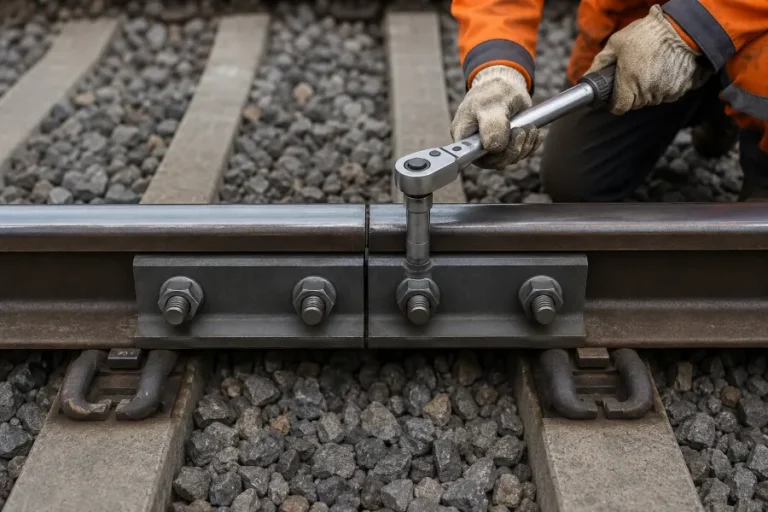
Rails, sleepers, rail clips, rail pads, fish plate, and fastening fish bolts work together as one system. Changing the sleeper material often means changing the fastening arrangement as well.
This is why railway engineers evaluate the complete track structure instead of selecting each component independently.
Concrete sleepers are typically designed with cast-in shoulders or embedded inserts during manufacturing. These components provide secure anchoring points for elastic rail clips.
A typical concrete sleeper fastening assembly may include:
Because concrete is rigid, elastic rail clips and rail pads play an especially important role. They provide the necessary clamping force while absorbing impact loads and reducing vibration transmitted from the rail to the sleeper.
This combination allows concrete sleepers to maintain excellent track geometry while still providing the elasticity needed for modern railway operations.
Timber sleepers offer greater flexibility during installation because fasteners can be installed directly into the wood.
Depending on the railway standard, timber sleepers commonly use:
One advantage of timber sleepers is that damaged fastening locations can often be repaired or modified on site. This flexibility makes timber sleepers particularly suitable for turnouts, bridges, and maintenance work where customized installation is frequently required.
However, repeated loading may gradually reduce the holding strength of fasteners if the timber deteriorates with age or moisture exposure.
Steel sleepers require specially designed fastening systems because the sleeper itself is manufactured from formed steel sections.
Unlike timber, fasteners cannot simply be driven into the sleeper, and unlike concrete, there are no cast-in inserts. Instead, fastening components are designed specifically to match the geometry of the steel sleeper.
Electrical insulation is another important consideration. Since steel is conductive, insulating components are required to prevent unwanted electrical current from passing through the track structure in electrified railway systems.
Composite sleepers are generally designed to be compatible with fastening methods already used for timber sleepers, making them a practical replacement in many track renewal projects.
Because composite materials can usually be drilled and machined on site, installation procedures are often familiar to maintenance crews.
Nevertheless, engineers must still verify that the fastening system is compatible with the mechanical properties of the composite material. Factors such as screw pull-out resistance, fastening torque, and long-term load distribution should all be considered during system design.
Selecting high-quality sleepers alone does not guarantee reliable track performance.
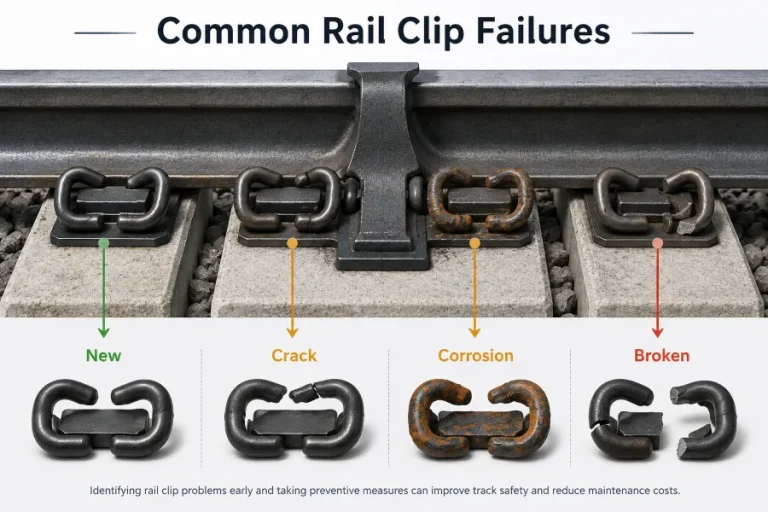
A concrete sleeper paired with an unsuitable rail clip, or a composite sleeper fitted with an incompatible fastening arrangement, can lead to premature component wear, reduced clamping force, increased maintenance requirements, and even deterioration of track geometry over time.
For this reason, railway infrastructure projects are increasingly specified as complete fastening systems rather than individual components.
When evaluating a railway project, engineers typically consider:
Only when these elements work together can the track achieve the durability, safety, and reliability expected throughout its service life.
Concrete, timber, steel, and composite railway sleepers all have important roles in today’s railway industry. None of them is universally better than the others, because each material has been developed to solve different engineering challenges.
Concrete sleepers have become the preferred choice for most new mainline, metro, and high-speed railway projects thanks to their strength, stability, and long service life.
Timber sleepers remain valuable for bridges, turnouts, and maintenance applications where flexibility and ease of modification are essential.
Steel sleepers continue to provide reliable performance in mining railways, industrial lines, and environments where durability and recyclability are priorities.
Composite sleepers represent an increasingly attractive alternative for bridge renewals, wet environments, and projects seeking longer service life with reduced maintenance.
The key is to evaluate the railway as a complete system rather than selecting components individually. The right sleeper, combined with a properly designed rail fastening system, helps improve track stability, reduce maintenance costs, and extend the service life of the entire railway infrastructure.
At Luoyang Fonyo Heavy Industries Co., Ltd., we manufacture a wide range of railway fastening components that are compatible with concrete, timber, steel, and composite sleeper systems. Our product portfolio includes rail clips, rail pads, fish plates, fish bolts, and other railway fastening components manufactured to international standards for freight, passenger, metro, and heavy-haul railway projects worldwide.
If you’re selecting railway sleepers for a new project or upgrading an existing railway line, our engineering team can help you identify fastening solutions that match your track design and operating requirements.
There is no single best railway sleeper material for every project. Concrete sleepers are generally preferred for high-speed and heavy-haul railways because of their durability and stability. Timber sleepers remain suitable for bridges and turnouts, while steel and composite sleepers are often selected for specific environmental or operational requirements.
Concrete railway sleepers offer a long service life, excellent dimensional stability, and lower maintenance requirements than timber sleepers. Their strength and resistance to repeated dynamic loading make them the preferred choice for most modern railway infrastructure.
Yes. Although concrete sleepers dominate new railway construction, timber sleepers are still widely used for railway bridges, switches, crossings, heritage railways, and maintenance projects where on-site modification is important.
Composite railway sleepers resist moisture, insects, and rot while providing good vibration damping and electrical insulation. They are increasingly used in bridges, tunnels, coastal railways, and environmentally sensitive areas where long service life is required.
Service life depends on material, traffic conditions, maintenance, and climate.
Typical service lives are:
Actual performance varies depending on axle loads and operating conditions.
Prestressed concrete sleepers are generally the preferred choice for heavy-haul railways because they provide excellent load capacity, track stability, and resistance to repeated fatigue loading.
Not always. Different sleeper materials require different fastening arrangements. Concrete sleepers commonly use elastic rail clips with cast-in shoulders or inserts, while timber, steel, and composite sleepers require fastening systems specifically designed for their structural characteristics.
Neither material is universally better. Concrete sleepers are generally preferred for high-speed and mainline railways, while steel sleepers perform well in mining railways, industrial tracks, desert environments, and projects where recyclability is important.
Important factors include axle load, train speed, traffic density, climate, maintenance strategy, ballast condition, environmental exposure, fastening system compatibility, and total life-cycle cost rather than purchase price alone.
Railway sleepers and fastening components work together as a complete track system. Selecting compatible rail clips, rail pads, insulators, and fastening hardware helps maintain track geometry, improve vibration control, reduce maintenance, and extend the service life of the railway.