Scan the WeChat code to contact us
Scan the WeChat code to contact us
Feel free to send us a email and we will reply to you as soon as possible.
Creating the future with heart and soul


In railway and heavy industrial applications, product quality is not determined only by machining accuracy or material strength. What matters even more is whether hidden defects can be detected before the component enters service. For railway wheels, cast steel components, bogie parts, and heavy-load industrial wheels, internal cracks, shrinkage cavities, inclusions, or surface fatigue defects may not be visible during normal visual inspection. Yet under continuous cyclic loading, these small imperfections can eventually develop into serious operational failures. That is why non-destructive testing (NDT) is a critical part of manufacturing. At our facility, NDT is integrated into the production workflow of railway wheels and cast steel products to help ensure structural reliability, dimensional stability, and long-term operational safety.
Railway wheels and cast components operate under extremely demanding conditions:
Unlike ordinary industrial components, railway products cannot tolerate hidden structural weaknesses.
A small internal defect may remain stable during initial operation, but after thousands of load cycles, it can propagate into:
For this reason, many railway customers require strict inspection procedures before shipment.
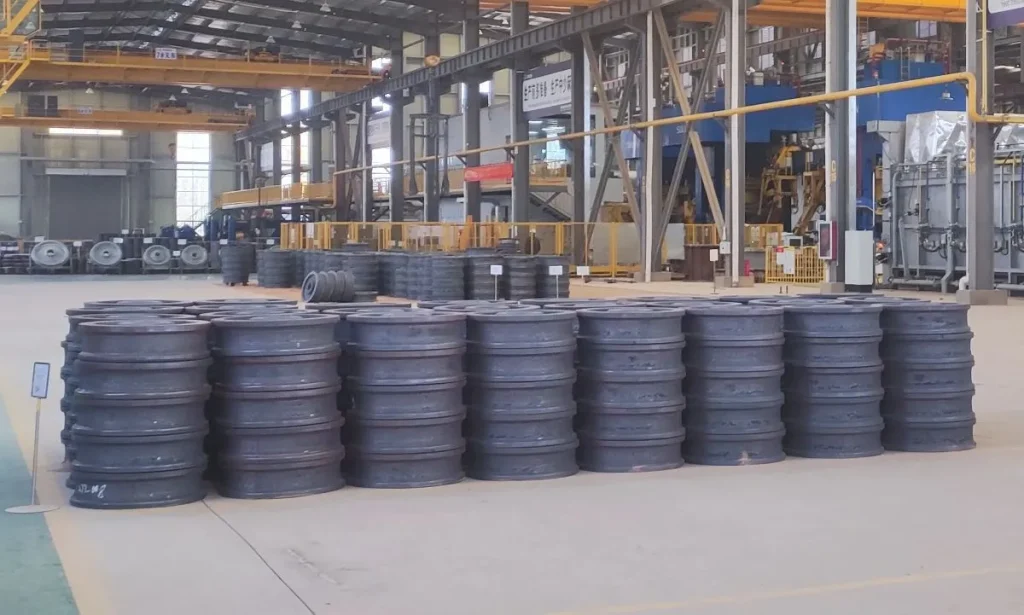
We perform multiple non-destructive testing methods depending on product type, geometry, material grade, and customer specifications.
These inspection methods are applied to:
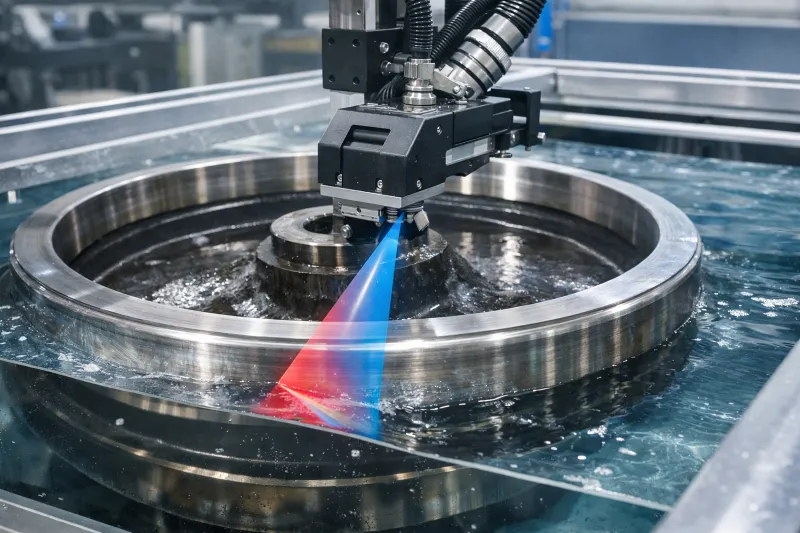
Ultrasonic Testing is one of the most important inspection methods for railway wheels and forged components.
High-frequency sound waves are introduced into the material to detect internal discontinuities such as:
For railway wheels, UT is especially important because some internal defects cannot be detected from the surface.
The inspection process follows applicable customer requirements and international standards when specified.
Magnetic Particle Testing is primarily used to identify surface and near-surface cracks in ferromagnetic materials.
After magnetization, fine magnetic particles are applied to the component surface. Any discontinuity interrupts the magnetic field and becomes visible during inspection.
MT is commonly used for:
This method is highly effective for detecting fine fatigue cracks before delivery.
For certain machined or precision-finished surfaces, Dye Penetrant Testing may also be used.
This process helps reveal:
PT is particularly useful for components with complex geometries where visual inspection alone may not be sufficient.
Non-destructive testing is only one part of quality verification.
For railway wheels and rotating components, dimensional accuracy is equally important.
Our inspection procedures may include:
Precision measuring instruments are used throughout machining and final inspection processes.
For export railway components and industrial wheel products, inspection traceability is often required by customers.
Depending on project requirements, we can provide:
This documentation helps customers verify compliance with technical specifications and internal procurement standards.
In heavy railway and industrial manufacturing, quality cannot rely only on final visual checks.
Reliable railway wheels and cast steel components require:
Non-destructive testing plays an important role in identifying hidden risks before products enter service conditions.
For railway operators, industrial plants, and heavy equipment manufacturers, this directly affects operational reliability and long-term maintenance costs.
We manufacture and inspect various railway and heavy industrial components, including:
Inspection procedures can be arranged according to customer drawings, technical specifications, and project requirements.
If your project requires railway wheels or cast steel components with documented NDT inspection and quality verification, our engineering team of Luoyang Fonyo Heavy Industries Co., Ltd. can support both manufacturing and inspection requirements throughout production.