Scan the WeChat code to contact us
Scan the WeChat code to contact us
Feel free to send us a email and we will reply to you as soon as possible.
Creating the future with heart and soul


The railway wheel manufacturing process is a fully integrated engineering system that transforms steel billets into finished railway wheels through controlled stages including cutting, forging, heat treatment, CNC machining, and multi-level inspection. Each step directly influences the wheel’s strength, hardness, and long-term operational reliability.
If you walk into a railway wheel manufacturing plant for the first time, what you see is not a single machine, but a continuous flow of controlled transformation.
A steel billet enters from one side of the production line, and a finished railway wheel exits from the other. Between these two points, the material goes through forging, rolling, heat treatment, machining, inspection, and surface finishing.
As engineers, we don’t think of this as separate workshops. We think of it as one integrated system where every stage influences the next. A small variation in forming can affect heat treatment behavior. A slight machining deviation can influence wheel-rail interaction. This is why the entire process must be controlled as a continuous engineering chain rather than isolated operations.
In this article, I will walk you through our railway wheel manufacturing process based on how it actually runs on the production floor.

Before we go into the details, it is important to understand one principle:
A railway wheel is not “manufactured step by step” — it is “engineered through transformation.”
Our production line is designed as a continuous flow consisting of:
steel cutting → forging and rolling → heat treatment → CNC machining → online inspection → surface finishing
Each stage has a specific engineering purpose. The goal is not just shaping steel, but controlling its internal structure, mechanical properties, and final performance.
The first step looks simple, but it sets the foundation for everything that follows.
We start with high-quality steel billets. These billets are cut into precise lengths before entering the forging stage. The reason for this precision is not just dimensional consistency, but predictable material behavior during deformation.
If the billet size varies, the forging force distribution changes. That leads to uneven deformation, which later affects grain flow and even heat treatment response.
So in practice, steel cutting is not just preparation. It is the first point where we control stability in the entire manufacturing system.
This is the stage where the material begins its real transformation into a railway wheel.
On our production line, forging and rolling are carried out through a combination of multiple presses and a rolling mill operating under full automation control. From an engineering perspective, the key here is not force, but controlled deformation.
Instead of shaping the material in a single impact, we gradually form it through multiple controlled steps. This allows the internal grain structure of the steel to flow in a continuous direction rather than being broken randomly.
Why does this matter?
Because grain flow determines fatigue resistance. A well-controlled flow structure allows the wheel to better absorb cyclic loads during long-term rail operation.
Another important outcome of this stage is efficiency. Through optimized forming control, our material utilization rate exceeds 70%, which means we reduce waste while maintaining stable forming accuracy.
Once the wheel is formed, it still does not have the mechanical properties required for service. That is achieved in the heat treatment stage.
So heat treatment process is very important, this is where metallurgy becomes critical.
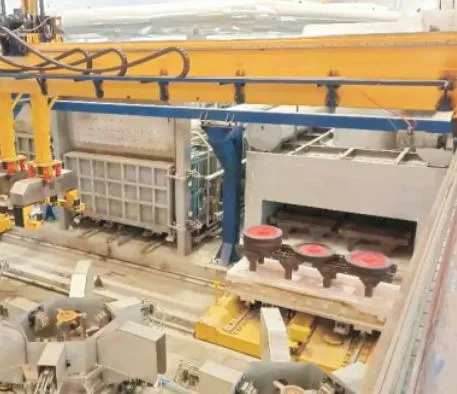
The wheel enters a controlled thermal system that includes a tunnel-type heating furnace, quenching station, and tempering furnace. The entire system operates under automated control, which ensures that every wheel follows the same thermal history.
The most sensitive part of this process is quenching. Cooling intensity must be carefully controlled. If cooling is too fast or uneven, internal stress develops. If it is too slow, hardness is insufficient.
To solve this, we use a flexible cooling system that allows uniform heat extraction across the wheel surface.
From a quality perspective, one of the most important indicators is hardness consistency. We control hardness variation within 20HB across a batch, which ensures stable wear performance during service.
After heat treatment, the wheel has its required mechanical strength, but it is not yet geometrically precise.
This is where CNC machining becomes essential.
We use dedicated wheel machining systems designed specifically for railway applications. Unlike general machining, the challenge here is not just accuracy, but repeatability at scale.
Each wheel must meet strict dimensional requirements for tread profile, diameter, and surface finish. These parameters directly influence how the wheel interacts with the rail under dynamic conditions.
From an engineering standpoint, even small deviations can affect vibration behavior, noise levels, and long-term wear patterns.
This is why CNC machining is treated as a precision control stage rather than a simple finishing process.
In traditional manufacturing systems, inspection is often the final step. In our case, inspection is integrated into the entire production flow.
We use multiple inspection technologies to evaluate different aspects of the wheel.
Ultrasonic testing is used to detect internal defects that cannot be seen from the surface. Magnetic particle inspection is used to identify surface and near-surface cracks. Hardness testing ensures mechanical property stability. Static balancing checks rotational behavior, which is critical for high-speed operation.
Each wheel is also individually marked, which allows full traceability throughout its lifecycle.
From an engineering perspective, this stage ensures that no uncertainty remains in the final product.
Before shipment, the wheel undergoes surface finishing.
We use controlled shot blasting to clean and strengthen the surface. This process also improves surface fatigue resistance by creating a more stable outer layer.
After surface treatment, each wheel is marked and prepared for shipment. At this stage, the product is no longer just a machined component—it is a fully verified engineering part ready for railway service.
If you look at the entire process as a whole, the key difference is integration.
Most production systems treat forging, heat treatment, machining, and inspection as separate departments. In our system, they are connected as one continuous engineering chain.
This integration provides several advantages.
First, it ensures stability. Because each stage is linked, variation is controlled early instead of being corrected later.
Second, it improves consistency. Every wheel follows the same controlled process flow from start to finish.
Third, it increases efficiency. With optimized forming and heat treatment, we achieve high material utilization and reduced energy consumption.
But most importantly, it ensures reliability. A railway wheel is a safety-critical component, and reliability cannot be added at the end—it must be built into every stage of manufacturing.
Our railway wheels are used in a wide range of applications, including freight transportation, passenger trains, locomotives, and high-speed rail systems.
Each application has different operational demands, but all require the same foundation: stable mechanical properties, precise geometry, and long-term fatigue resistance.
These properties are not achieved in a single process step—they are the result of a fully controlled manufacturing system.
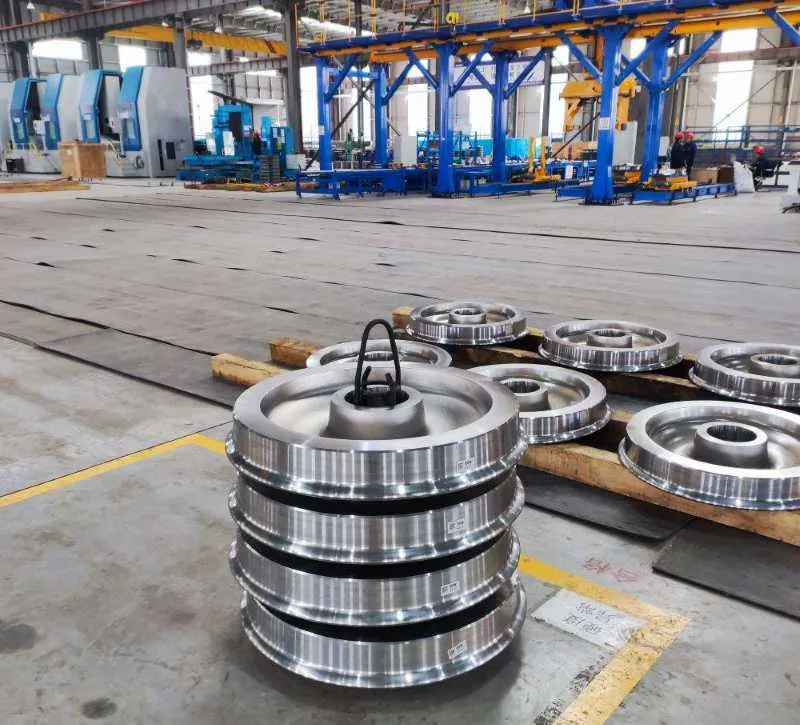
When we look at a finished railway wheel, what we actually see is the result of a fully controlled engineering process rather than a single manufacturing step.
From raw steel cutting, to forging and rolling, to heat treatment, precision machining, and multi-stage inspection, every stage contributes to the final performance of the wheel. Each process is interconnected, and each parameter is controlled with a clear engineering purpose: stability, consistency, and long-term safety in railway operation.
This is why we do not view railway wheel production as isolated workshops. Instead, it is a continuous manufacturing system where material transformation is carefully managed from start to finish.
In Luoyang Fonyo Heavy Industries Co., Ltd. production system, this integrated process is built into daily manufacturing practice, combining automation, precision control, and multi-layer quality assurance to ensure stable output for different railway applications.
For more technical information about our railway wheel manufacturing capability and production system, you can visit: www.railwaypart.com