Scan the WeChat code to contact us
Scan the WeChat code to contact us
Feel free to send us a email and we will reply to you as soon as possible.
Creating the future with heart and soul


In modern heavy industries, manufacturers are constantly balancing three factors: complex geometry, production efficiency, and structural reliability. Among various casting methods, Lost Foam Casting (LFC) has become an important process for producing medium to large complex metal components. It is widely used in railway engineering, construction machinery, automotive systems, and heavy industrial equipment. Unlike traditional sand casting, this process uses a foam pattern that evaporates during pouring, allowing molten metal to directly form the final shape.
Lost Foam Casting is a metal casting process where a polystyrene foam pattern is used instead of a traditional sand mold cavity.
The foam pattern is coated with a refractory layer and then buried in dry sand. When molten metal is poured into the mold, the foam evaporates immediately and is replaced by the metal.
From an engineering perspective, the key idea is simple:
The foam pattern acts as a “temporary geometry model” that disappears during casting, enabling near-net-shape manufacturing without mold separation or cores.
This makes it possible to produce highly complex internal structures in a single casting operation.
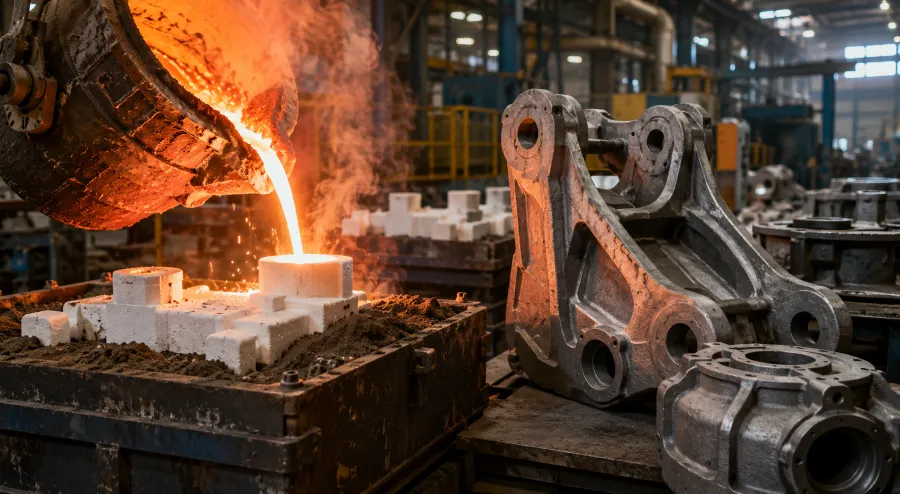
In the railway industry, this kind of casting process is mainly used for large structural and safety-critical components where complexity and strength must be balanced.
Typical applications include:
These components often require:
Lost foam casting allows these parts to be produced as integrated structures, reducing assembly errors and improving fatigue performance.
In construction machinery and mining equipment, lost foam casting is widely used for wear-resistant and structural components.
Typical applications include:
These parts often require a combination of:
Lost foam casting provides a practical solution for producing these components with fewer machining and welding operations.
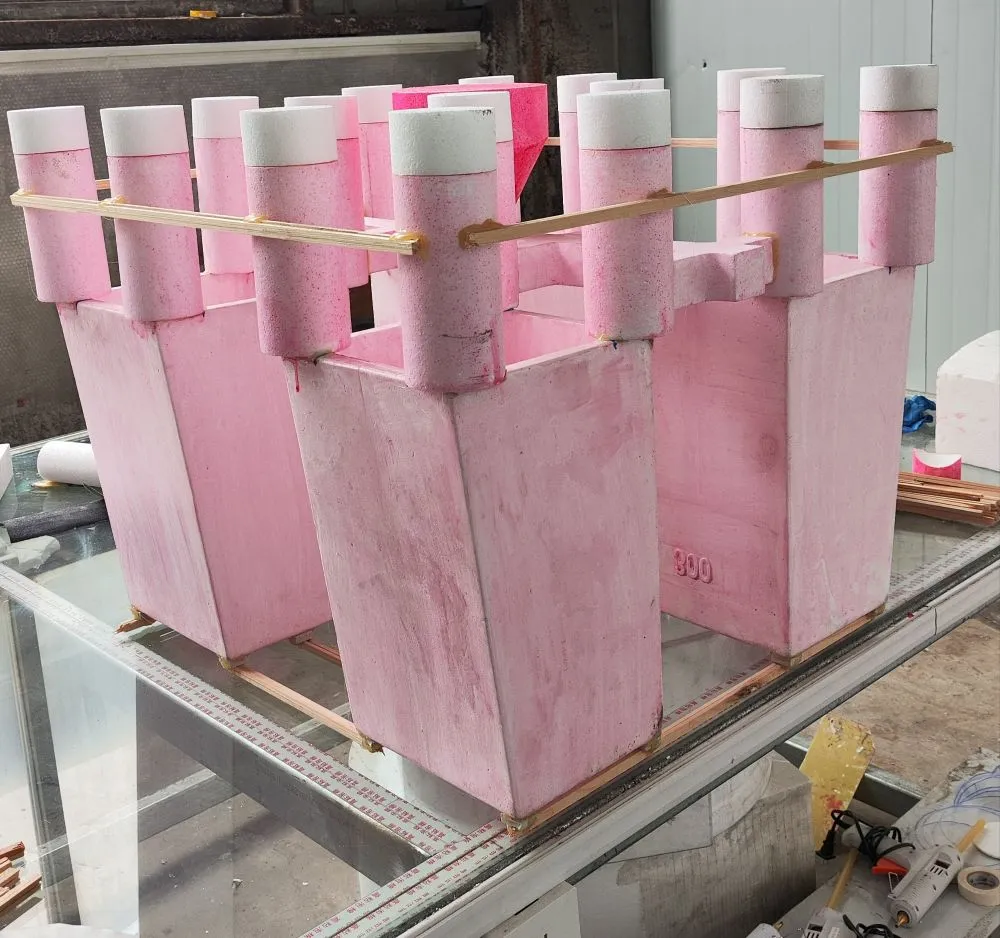
Lost foam casting offers several key advantages in heavy industrial production:
First, it provides high design freedom, allowing engineers to create complex internal structures that are difficult or impossible in traditional sand casting.
Second, it reduces the need for welding and assembly by enabling integrated one-piece casting designs, which improves structural reliability.
Third, it is suitable for mass production with good dimensional consistency, making it ideal for OEM components in railway and machinery industries.
Finally, it supports near-net-shape manufacturing, which reduces machining time and material waste.
Despite its advantages, lost foam casting also has limitations.
The foam pattern tooling requires upfront investment, making it less suitable for very small production runs.
The process is sensitive to coating quality, metal pouring temperature, and gas evacuation control. Improper control can lead to defects such as porosity.
Therefore, it is generally more suitable for medium to large batch production of complex components rather than simple or highly cosmetic parts.
Lost foam castings and sand castings are both widely used in industrial manufacturing, but they differ significantly in structure and capability.
Sand casting requires parting lines and often uses cores to form internal cavities, which limits design freedom.
Lost foam casting eliminates parting lines and allows more complex geometries and integrated structures.
In general:
Lost Foam Casting
Lost foam casting is a manufacturing process that enables complex, integrated, and efficient production of industrial metal components.
In railway engineering, it supports the production of structural safety parts such as bogie frames and housings. In construction machinery, it is widely used for GET components and wear-resistant parts.
As industrial design continues to move toward integration and lightweight structures, the role of lost foam casting will continue to grow.
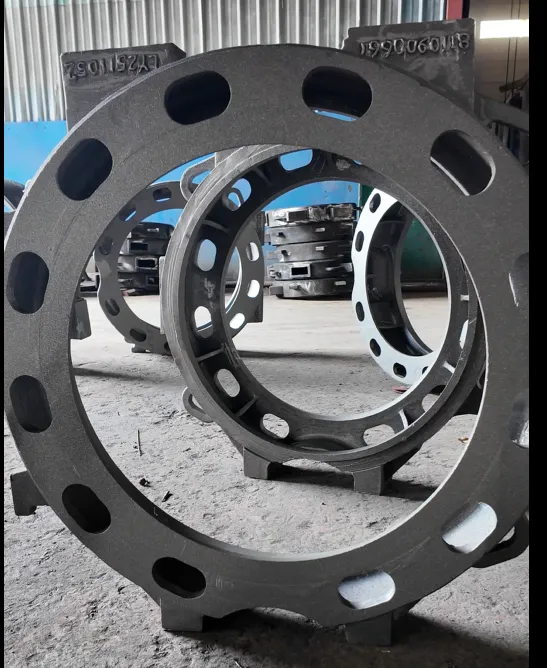
Q1: What is Lost Foam used for?
It is used for producing complex metal components such as railway parts, automotive housings, and heavy machinery components.
Q2: Is Lost Foam Castings process suitable for railway parts?
Yes. It is widely used for bogie frames, bolsters, and structural railway components due to its ability to form integrated complex structures.
Q3: What industries use Lost Foam Casting?
It is used in railway, construction machinery, automotive, and heavy equipment manufacturing industries.
Q4: What are the advantages of Lost Foam Casting?
It offers high design freedom, reduced assembly, good dimensional consistency, and near-net-shape production.
Q5: What is the difference between Lost Foam Casting and Sand Casting?
Lost foam cast allows more complex integrated structures without parting lines, while sand casting is better for simpler and smaller production runs.
We are a professional manufacturer specializing in railway components and heavy industrial castings, including bogie parts, structural castings, and wear-resistant components for construction machinery.
With advanced casting processes and strict quality control, Luoyang Fonyo Heavy Industries Co., Ltd. provide reliable OEM solutions for global industrial customers.
Learn more at:
Website: www.railwaypart.com