Отсканируйте код WeChat, чтобы связаться с нами.
Отсканируйте код WeChat, чтобы связаться с нами.
Не стесняйтесь, отправьте нам электронное письмо, и мы ответим вам как можно скорее.
Создаем будущее сердцем и душой


Overview of AC motors
DC traction motors have excellent traction and braking performance. By adjusting the terminal voltage and excitation, speed regulation can be conveniently performed. Однако, the commutator structure of DC traction motors still has a series of disadvantages: motor commutation is difficult and potential conditions are deteriorating, the structure is complex, the working reliability is poor, the manufacturing cost is high, and the maintenance is troublesome. Especially at high voltage and high power, the commutator becomes difficult, the potential conditions deteriorate, and the working reliability of the motor is reduced. AC motors do not have commutators. As traction motors, a series of problems caused by this are eliminated. Кроме того, they have a series of advantages such as simple structure, convenient maintenance, small size, light weight, высокоскоростной, high power, and automatic anti-skid. Поэтому, they are a relatively ideal traction motor and are rapidly replacing DC traction motors in the field of urban rail transit. Let me take the three-phase asynchronous motor of Nanjing Metro as an example to talk about the application of AC motors in urban rail transit.
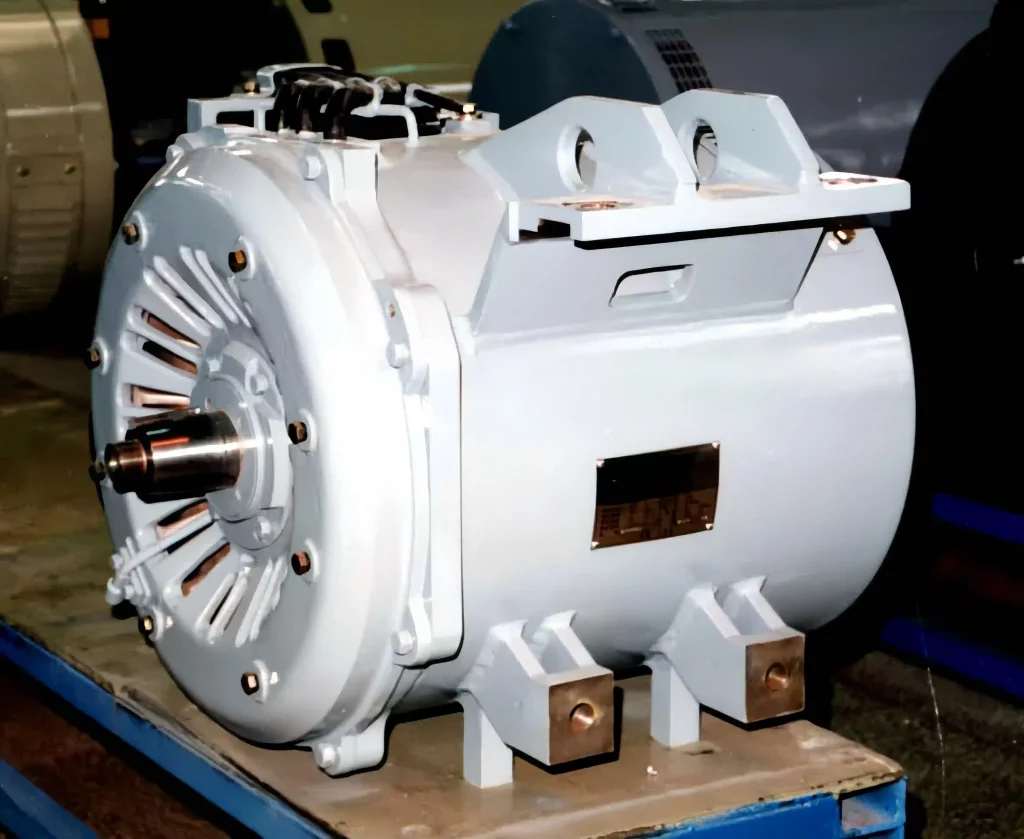
1.Structure of AC motors
AC motors are composed of stators and rotors. In the model, the stator is the stationary part, the rotor is the rotating part, and there is a certain air gap between the stator and the rotor. The stator consists of three parts: the core, the winding and the base. The rotor consists of an iron core and a winding. The rotor winding can be a squirrel cage type or a wire wound type. The squirrel cage rotor is made by inserting copper bars into the rotor core slots and then welding the two ends of all the copper bars to two copper end rings. The wire wound rotor winding is the same as the stator winding, which consists of coils placed in the rotor core slots. Although the structures of squirrel-cage and wire-wound motors are different, their working principles are the same.
2.Application examples of AC motors in urban rail transit
(1) Working principle of 1C4M for urban rail transit AC motors
1C4M refers to a method in which a VVVF inverter supplies power to four asynchronous motors connected in parallel on the same vehicle, also known as the “vehicle control” method. Например, the Guangzhou Metro adopts the vehicle control power supply method. There is also a configuration in which an inverter supplies power to two parallel traction motors on the same bogie, called the “frame control” method, namely “1C2M”, such as the Tianjin Binhai Metro. The choice of power supply method depends on the traction and braking characteristics requirements, as well as the capacity of the inverter and motor. If an inverter only supplies power to one traction motor, it is called “axle control”, i.e., “1ClM”. In urban rail EMUs, since the power of traction motors is relatively small, there is no need to use the axle control method. The function of the VVF inverter is to convert DC power into AC power with adjustable voltage and frequency to supply the traction motor under traction conditions. Under electric braking conditions, the inverter feeds back the power to the grid (regenerative braking) or consumes it on the resistor (resistance braking) in a rectified manner
(2) Circuit principle of the “two motors and one trailer (2M1T)” unit vehicle
The grid supplies power to the inverter through the high-speed switches of the two EMUs after the pantograph. A main traction inverter controls each EMU to control the four AC traction motors of the two bogies. The four AC traction motors are operated in parallel; the pantograph powers the auxiliary inverter on the trailer after receiving current through the isolation diode.
(3) Case analysis of the main traction system of Guangzhou Metro Line 1
Adtranz of Germany provides the traction and electric braking system of the Guangzhou Metro Line 1. It is the first metro vehicle project in China to adopt AC transmission and distributed power control technology. The whole system consists of the pantograph, a high-speed circuit breaker HSCB, a VVVF traction inverter, a DCU/UNAS (traction control unit), a traction motor, a brake resistor, и т. д..
The train pantograph receives current from the contact network, and after passing through the high-speed circuit breaker, it sends the DC1500V voltage to the VVVF traction inverter. The VVVF traction inverter adopts PWM mode to invert the DC1500V into three-phase AC with adjustable frequency and voltage, and supplies it to the four AC cage asynchronous traction motors of the vehicle in parallel, regulating the speed of the motors and realizing the traction and braking functions of the train.
A speed sensor and two output channels are installed on the shaft of each traction motor. Each channel has a square wave with a phase difference of 90°, and the direction is determined by judging the phase difference. Each traction control unit is connected to 3 speed sensors. Under normal circumstances, this value is directly sent to the traction control unit for traction control. When measuring speed, if the speed values are not equal (например, when idling/coasting), even in extreme cases, the speed information of one motor is sufficient for traction control.
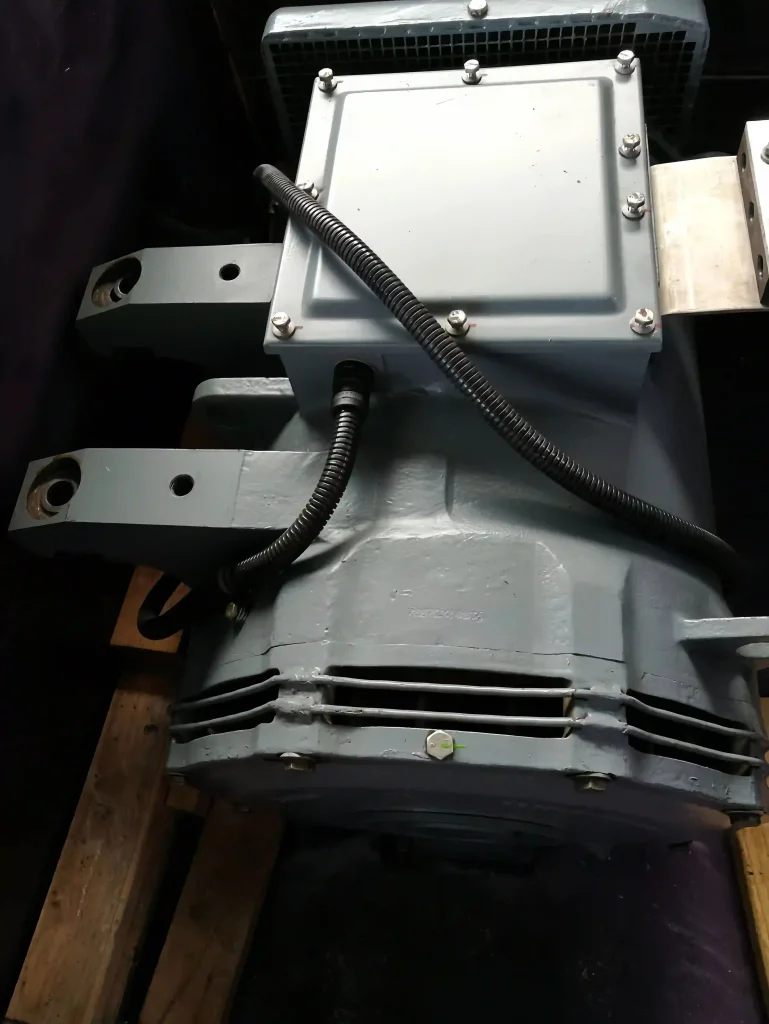
The motor is controlled by space vector control. The parameters of the inverter output voltage, phase current and motor speed can approximate the magnitude and direction of the motor flux (space vector). The current in the winding and the motor voltage are related to the flux as space vectors. This decoupling process can realize the separate control of flux and torque (field-oriented control)
The generation of motor torque current depends on the interaction between the excitation magnetic field and the rotor magnetic field. In the case of asynchronous motors, the excitation magnetic field and the rotor magnetic field are both generated by the stator current. At high speed, the motor reaches the control limit. The motor transitions to the field weakening mode, in which the pulse control takes precedence over the input control of the inverter set torque.
Поставщик
Лоянская компания Fonyo Heavy Industries Co., ООО,Основанная в 1998 году, является производителем литых железнодорожных деталей. Наш завод занимает площадь 72 600 кв.м., с более чем 300 сотрудники, 32 техники, включая 5 старшие инженеры, 11 помощники инженера, и 16 Техники.Наша производственная мощность 30,000 тонн в год. В настоящее время, в основном мы производим литье, механическая обработка, и сборка для локомотива,вагон,высокоскоростные поезда, горное оборудование,энергия ветра,и т. д. Наша продукция экспортируется в Россию, Соединенные Штаты, Германия, Аргентина, Япония, Франция, ЮАР,Италия и другие страны.
Контакт: Стелла Лю
Электронная почта:[email protected]
мобильный:+8615515351287