WeChat 코드를 스캔하여 문의하세요
WeChat 코드를 스캔하여 문의하세요
이메일을 보내주시면 최대한 빨리 답변해 드리겠습니다..
마음과 영혼을 다해 미래를 창조하다


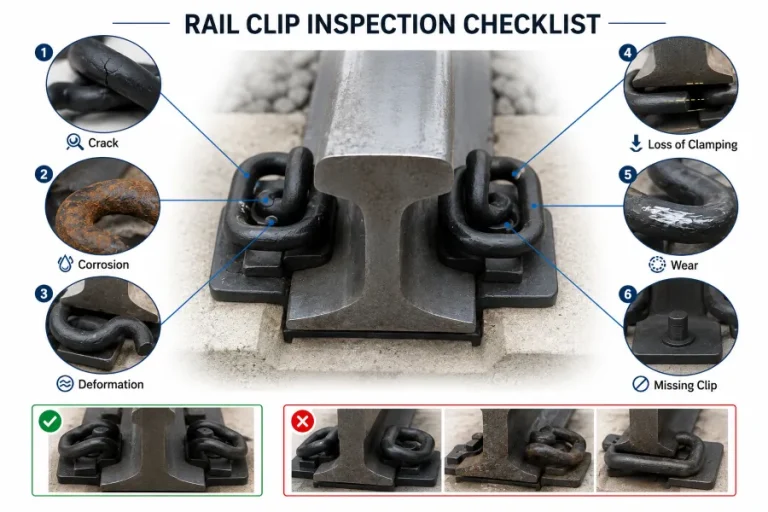
60Si2Mn은 다음 용도로 사용됩니다. 레일 클립 실리콘-망간 스프링강이므로 탄성한계가 높고 내피로성이 우수합니다.. 담금질 및 템퍼링 후, 이는 클립이 클램핑 힘을 탄성 편향으로 저장하고 이를 수백만 번의 로드 사이클 동안 유지할 수 있도록 균일하게 강화된 미세 구조를 형성합니다.. 해당 등급의 실리콘과 망간은 함께 작용하여 탄성 한계를 높이고 응력 완화에 저항합니다., 이는 수십 년 동안 레일을 눌려진 상태로 유지하는 데 스프링 클립이 필요한 것입니다..
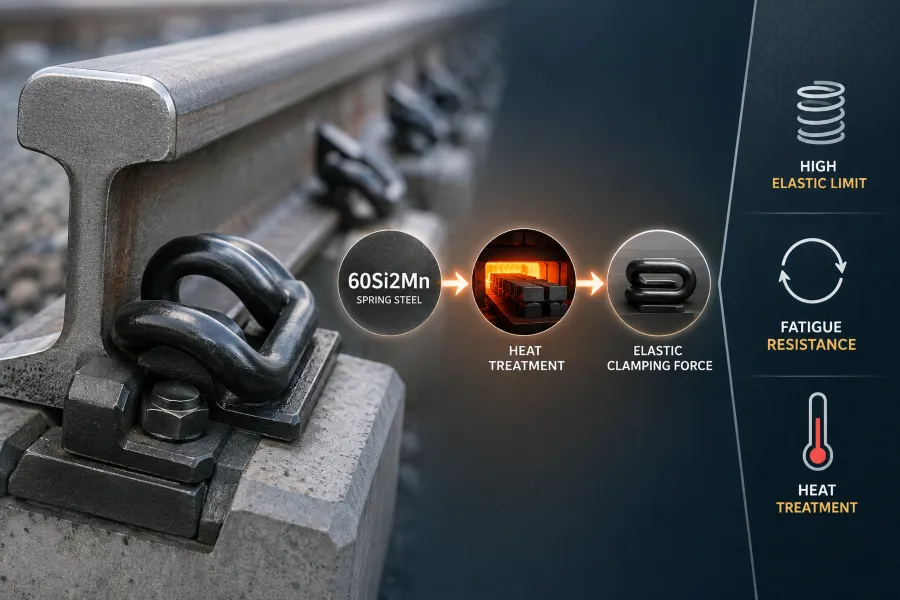
혹시 레일클립 사양을 보시고 본 적이 있으신가요? “60Si2Mn” 재료로 쓴, 그러다가 다음과 같은 다른 그림을 보았습니다. “38Si7” 또는 “60Si2CrA”, 당신은 질문을 했습니다. 이 글은 답변을 제공합니다. 클립이 똑같네요. 동일한 작업을 수행합니다.. 그렇다면 재료 지정이 중요한 이유는 무엇입니까??
언뜻보기에, 선택은 세부적인 것 같아요: 강철은 강철이다.
실제로, 레일 클립 소재는 그렇게 간단하지 않습니다..
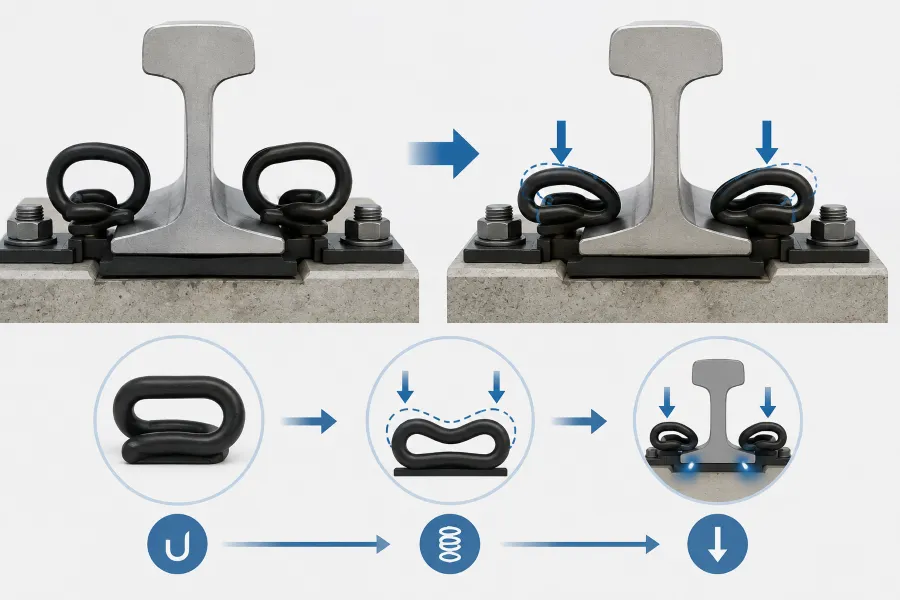
레일 클립은 스프링입니다.. 전체 작업은 설치 중에 방향이 바뀌는 것입니다., 편향을 클램핑력으로 저장, 수년간 레일 풋을 느슨해지거나 갈라지지 않고 계속 누르고 있습니다.. 모든 강철이 그렇게 할 수 있는 것은 아닙니다.. 재료는 스프링처럼 작동하는 방식에 맞게 특별히 선택되었습니다., 60Si2Mn은 이러한 이유로 가장 널리 사용되는 등급 중 하나입니다..
그렇다면 60Si2Mn이 레일 클립에 적합한 소재인 이유는 무엇입니까?, 그리고 도면에 나타날 때 무엇을 확인해야 할까요?? 이 가이드에서는 60Si2Mn 레일 클립이 널리 사용되는 이유에 대해 설명합니다., 그리고 등급 이름이 실제로 무엇을 약속하는지.
60Si2Mn은 실리콘-망간 스프링강입니다., 이는 서비스에서 볼 수 있는 대부분의 60Si2Mn 레일 클립 뒤에 있는 재료입니다.. 이름 자체가 구성을 말해줍니다, 숫자는 탄소 함량이고 문자는 합금 원소인 중국 지정 시스템에서.
등급명은 이렇게 나뉜다: 그만큼 “60” 의 공칭 탄소 함량을 나타냅니다. 0.60%, 그만큼 “Si2” 대략적으로 나타냄 2% 규소, 그리고 “망” 망간을 나타냄. 이건 무작위 조합이 아니예요. 탄소는 힘을 제공합니다, 실리콘은 탄성 거동을 향상시킵니다., 망간은 경화성과 강도를 향상시킵니다..
국제 실무에서, 60Si2Mn은 대략 SAE/AISI에 해당합니다. 9260, 유사한 등급이 60Si7과 같은 이름으로 다른 지정 시스템에 나타납니다.. 서신이 가깝습니다, 단, 프로젝트별로 정확한 구성 한도와 적용 기준을 확인해야 합니다., 등급은 그것을 관리하는 표준에 의해 정의되기 때문입니다..
60Si2Mn의 일반적인 구성 범위, as specified in the relevant spring steel standard, is roughly 0.56 에게 0.64% 탄소, 1.50 에게 2.00% 규소, 그리고 0.60 에게 0.90% 망간, with limits on phosphorus and sulphur. The exact values depend on the standard edition and the metallurgical quality group, which is why the material should always be referenced to the standard and not just to the name.
For a clip that must survive millions of cycles, the composition is only the starting point. The heat treatment turns that composition into the spring.
The reason rail clips are made from spring steel, rather than ordinary structural steel, comes down to one property: the elastic limit. And the reason 60Si2Mn rail clips work so well is that this grade is engineered to raise exactly that property.
A spring stores energy by being deflected within its elastic range. When the load is removed, it returns to its original shape and releases the energy. A rail clip is installed by deflecting it, and that deflection is what produces the clamping force on the rail foot. The higher the elastic limit, the more the clip can be deflected and the more clamping force it can store without permanently deforming.
Ordinary steel yields too easily for this job. Under the repeated load of passing trains, it would gradually lose its shape and its clamping force. Spring steel is engineered to resist that.
Silicon and manganese each play a specific role:
규소. Silicon is the element that raises the elastic limit and improves resistance to stress relaxation. Stress relaxation is the gradual loss of clamping force over time as a spring stays deflected. For a rail clip that must hold its toe load for years, resistance to relaxation matters as much as initial strength.
망간. Manganese improves hardenability, which means the steel can be hardened more uniformly through the cross-section during heat treatment. It also contributes to strength.
함께, the carbon, silicon and manganese in 60Si2Mn give the steel a high elastic limit, good hardenability and adequate toughness for a spring component. That is the material side of the answer.
The other side is what happens in the furnace.
The composition of 60Si2Mn is only useful because it responds well to heat treatment. This is what turns the steel into the spring that makes 60Si2Mn rail clips reliable over their service life.
A rail clip is formed, then quenched and tempered. Quenching hardens the steel. Tempering relieves brittleness and produces the final microstructure that gives the clip its spring behavior. The result is a uniform tempered structure with a high elastic limit and enough toughness to avoid brittle fracture.
The heat treatment is not a detail to be assumed. The quenching temperature, the tempering temperature and the cooling control all affect the final properties. Two clips made from the same 60Si2Mn composition but heat-treated differently will not behave the same in service.
This is why the mechanical property requirements for spring steel are usually given together with the heat treatment condition. For 60Si2Mn, the achievable tensile strength depends on the tempering temperature: a lower tempering temperature gives higher strength and a higher one gives more toughness. The specification selects the balance the clip needs.
The practical point is that “60Si2Mn” on a drawing is shorthand. The full requirement is the grade plus the heat treatment plus the test requirements. A supplier quoting only the grade has not told you enough. If you are working through the wider maintenance picture, our guide to railway track maintenance shows where clip condition sits inside the full inspection cycle.
This is the question that gets at the heart of it. If 60Si2Mn is strong, why not use a higher-strength steel and get a stronger clip?
Because a rail clip is not chosen for strength alone. It is chosen for the combination of elastic limit, fatigue resistance and resistance to relaxation.
A very high-strength steel may have a high yield strength but poor resistance to stress relaxation, or it may be brittle and prone to sudden fracture under impact. A clip made from such steel could hold enormous clamping force initially and then lose it over time, or crack under a shock load.
The right spring steel balances the properties. It is strong enough to carry the load, elastic enough to store and return energy, tough enough not to fracture, and resistant enough to relaxation to hold its clamping force for years.
That balance is exactly what silicon-manganese spring steel is designed to provide, and exactly why 60Si2Mn rail clips have become a default choice across many fastening systems. This is also why two clips with the same geometry can behave very differently if they are made from different grades: the geometry determines the deflection, but the material determines what happens to the force over time.
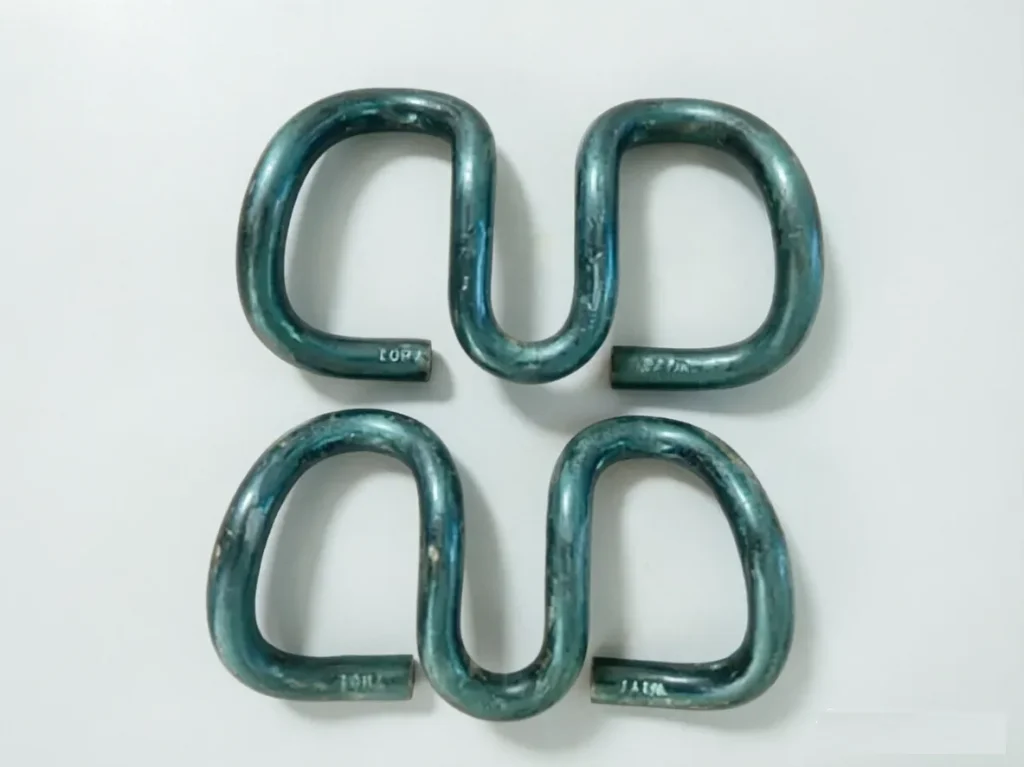
60Si2Mn is common, but it is not the only spring steel used for rail clips. The choice between grades usually comes down to the service conditions and the standard.
| 등급 | Typical Role | Why It Is Chosen |
|---|---|---|
| 60Si2Mn | General elastic clips, E-type and SKL designs | Balanced elastic limit, fatigue and availability |
| 60Si2CrA | Higher-strength clips, 무거운 운반 응용 프로그램 | Chromium improves hardenability and fatigue |
| 38Si7 | Some SKL-type clips | Different alloying balance, commonly in European practice |
| 55Si2Mn | Spring components with lower carbon | Slightly softer, where less strength is needed |
This table is a simplified comparison, not a universal specification. The final material choice depends on the clip design, the toe load required, the standard that applies and the service conditions.
The important point is that these grades are alternatives, not upgrades in a simple ranking. A grade with more chromium or more carbon is not automatically better for every clip. It is chosen where the design or the standard calls for it.
If you are comparing clip types themselves, 우리의 가이드E-clip vs SKL clip covers the system differences, while this article focuses on the material they share or trade between.
When buying rail clips, I would not stop at asking whether the material is 60Si2Mn. Ask what the material requirement actually includes.
신뢰할 수 있는 공급업체가 제공할 수 있어야 합니다.:
For larger projects, traceability matters most. If a batch of clips later shows relaxation or cracking, the ability to trace it back to the heat and the heat treatment records is what makes the investigation possible.
The material designation is a promise about how the clip will behave, and that promise is only as reliable as the heat treatment and inspection behind it. 우리의 가이드바퀴에 대한 철도 표준 explains the same principle for standards in general.
60Si2Mn is used for rail clips because a rail clip is a spring, and silicon-manganese spring steel is engineered to be a spring: high elastic limit, good fatigue resistance, and resistance to stress relaxation over years of service. The composition sets the foundation, and the quenching and tempering turn it into the component that holds the rail down.
That is why I would not recommend choosing a rail clip based on the material grade alone. Start with the clip design and the toe load. Check the applicable standard. Confirm the heat treatment and the test requirements. Then compare suppliers on the system behind the grade, not the grade name itself.
~에 뤄양포뇨중공업(Luoyang Fonyo Heavy Industries), 주식회사., 우리는 제조 탄성 레일 클립 in 60Si2Mn and other spring steel grades, together with 물고기 볼트, 생선 접시 그리고 레일 패드, according to customer drawings, 해당 표준 및 프로젝트 요구 사항. For rail clips, we can review the required material grade, 열처리, testing and inspection requirements before production.
도면이 있으면, specification or an existing clip sample, 우리에게 세부 사항을 보내. Our engineering team can help check the required clip material, 견적 전 해당 표준 및 생산 요구 사항.
Because 60Si2Mn is a silicon-manganese spring steel with a high elastic limit and good fatigue resistance. 담금질 및 템퍼링 후, it stores clamping force as elastic deflection and holds it over millions of load cycles, which is what a rail clip needs.
It is a steel grade designation. 그만큼 “60” refers to roughly 0.60% 탄소, “Si2” 약 2% 규소, 그리고 “망” to manganese. It is a spring steel roughly equivalent to SAE/AISI 9260.
The typical composition is about 0.56 에게 0.64% 탄소, 1.50 에게 2.00% silicon and 0.60 에게 0.90% 망간, with limits on phosphorus and sulphur. The exact values depend on the applicable standard and quality group.
아니요. Other spring steels are also used, including 60Si2CrA, 38Si7 and 55Si2Mn. The choice depends on the clip design, the toe load required, the standard and the service conditions.
자동이 아님. A rail clip needs elastic limit, fatigue resistance and resistance to stress relaxation together. A very high-strength steel may be more brittle or lose clamping force over time.
열처리, 담금질 및 템퍼링, turns the steel composition into a spring with a uniform microstructure. Two clips with the same composition but different heat treatment will behave differently in service.
Ask for the grade and applicable standard, the chemical composition of the actual heat, the heat treatment specification, mechanical and hardness test results, fatigue and clamping force data, coating details and traceability.