Scansiona il codice WeChat per contattarci
Scansiona il codice WeChat per contattarci
Sentiti libero di inviarci un'e-mail e ti risponderemo il prima possibile.
Creare il futuro con cuore e anima


Un elastico rotto clip per binario potrebbe sembrare un piccolo problema, ma su una linea ferroviaria può portare rapidamente a problemi molto più grandi. Una volta che una clip perde la sua forza di serraggio, il binario non è più tenuto saldamente come previsto. Col tempo, ciò può consentire un leggero movimento del binario, aumentare le vibrazioni, accelerare l'usura di altri componenti di fissaggio, e in definitiva influenzano la stabilità dell'intera struttura del binario.
Una domanda che ci viene spesso posta dai clienti è:, “Perché il fermaglio del binario si è rotto quando i carichi del treno rientravano nei limiti di progettazione??” In molti casi, la risposta non è un singolo sovraccarico o un difetto di fabbricazione. I guasti ai fermagli delle rotaie di solito si sviluppano gradualmente a causa di carichi ripetuti sulle ruote, condizioni ambientali, qualità dell'installazione, e le condizioni generali del sistema di fissaggio.
Perché i fermagli elastici per binari sono progettati per funzionare con milioni di cicli di carico durante la loro vita utile, capire come falliscono è importante quanto capire come funzionano. L'identificazione dei primi segnali di guasto consente ai team di manutenzione di sostituire le clip prima che influenzino le prestazioni del binario e aiuta gli ingegneri di progetto a selezionare sistemi di fissaggio che offrono una maggiore durata utile.
In questo articolo, esamineremo i motivi più comuni per cui i fermagli elastici per binari si guastano, spiegare come si sviluppano questi fallimenti, e discutere modi pratici per prolungare la vita dei sistemi di fissaggio ferroviario.
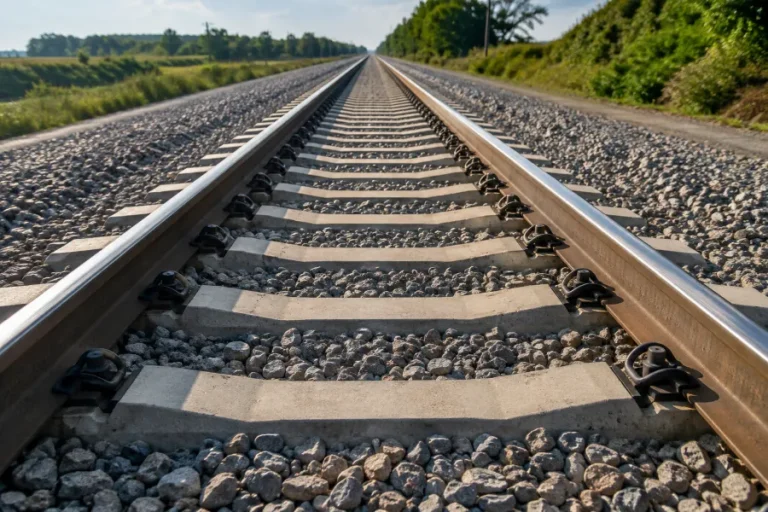
Anche se sembrano semplici componenti in acciaio, i fermagli elastici per binari svolgono uno dei lavori più impegnativi in un sistema di fissaggio ferroviario. Il loro scopo non è semplicemente quello di mantenere la ringhiera in posizione, ma per mantenere una forza di serraggio costante mentre il cingolo è costantemente sottoposto a vibrazioni, impatto, variazioni di temperatura, e carichi pesanti sugli assi.
Ogni volta che passa un treno, la rotaia si flette leggermente sotto carico. La clip elastica del binario si flette con esso, assorbendo parte del movimento per poi ritornare alla sua forma originaria. Questa azione elastica continua mantiene il binario saldamente posizionato contro il cuscinetto del binario, consentendo allo stesso tempo un movimento sufficiente a ridurre lo stress all'interno del sistema di fissaggio.
A differenza dei metodi di fissaggio rigidi utilizzati sulle linee ferroviarie più vecchie, le moderne clip elastiche aiutano a distribuire le forze dinamiche in modo più uniforme. Ciò riduce l'usura delle traversine, riduce al minimo il movimento ferroviario, e contribuisce a una guida più fluida e a una maggiore durata della pista.
Tuttavia, questa deformazione elastica ripetuta spiega anche perché i fermagli del binario alla fine si usurano. Anche l’acciaio per molle di alta qualità ha una durata a fatica limitata. Dopo milioni di cicli di caricamento, iniziano a verificarsi cambiamenti microscopici all'interno del materiale, realizzare una progettazione adeguata, produzione, e manutenzione essenziale.
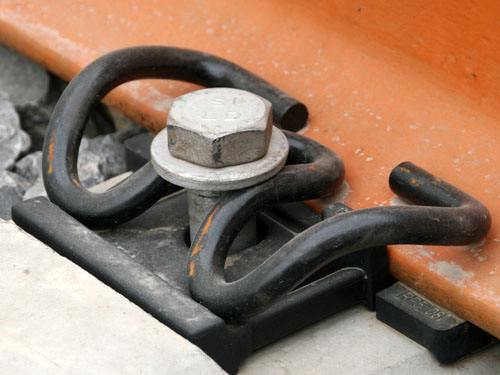
Many people imagine a failed rail clip as one that has snapped into two pieces. In realtà, complete fracture is often the final stage of a much longer process.
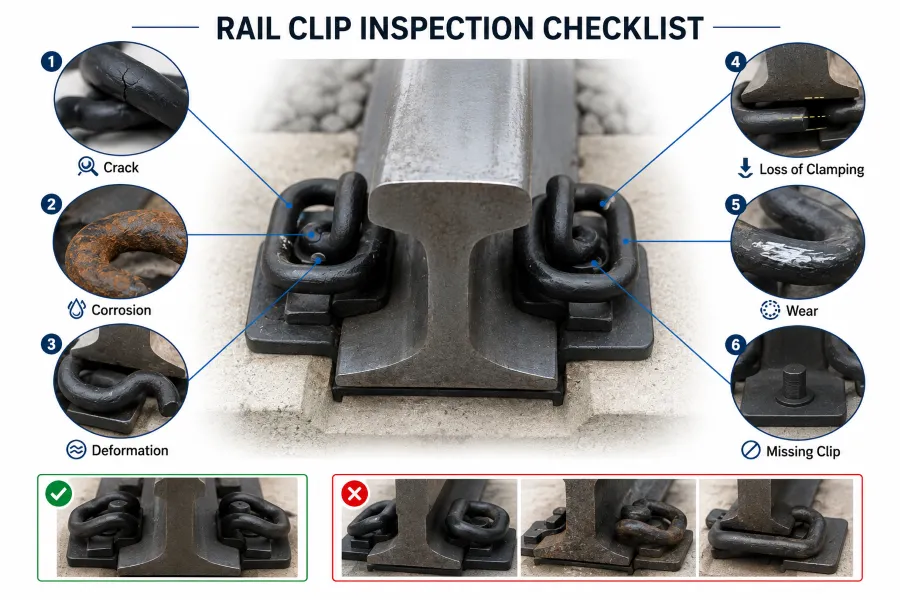
During routine inspections, maintenance engineers are more likely to encounter early warning signs such as small cracks near the curved section of the clip, visible corrosion, slight permanent deformation, or a noticeable reduction in clamping force. These changes may seem minor individually, but together they indicate that the clip is no longer performing as designed.
Dal punto di vista della manutenzione, the most serious consequence is not the broken clip itself—it is the gradual loss of restraint. As clamping force decreases, the rail becomes more susceptible to movement under traffic loads. That movement increases vibration throughout the fastening system, placing additional stress on rail pads, isolanti, dormienti, and neighboring clips.
Per questo motivo, experienced railway maintenance teams rarely wait until clips break completely. Replacing clips when the first signs of fatigue or deformation appear is usually far more economical than dealing with the secondary damage caused by prolonged operation.
If you ask experienced track engineers what causes most broken elastic rail clips, the answer is almost always the same: metal fatigue.
This surprises many people because rail clips are manufactured from high-strength spring steel capable of withstanding extremely high loads. The problem is not that a single train is too heavy. Invece, it is the enormous number of loading cycles the clip experiences throughout its service life.
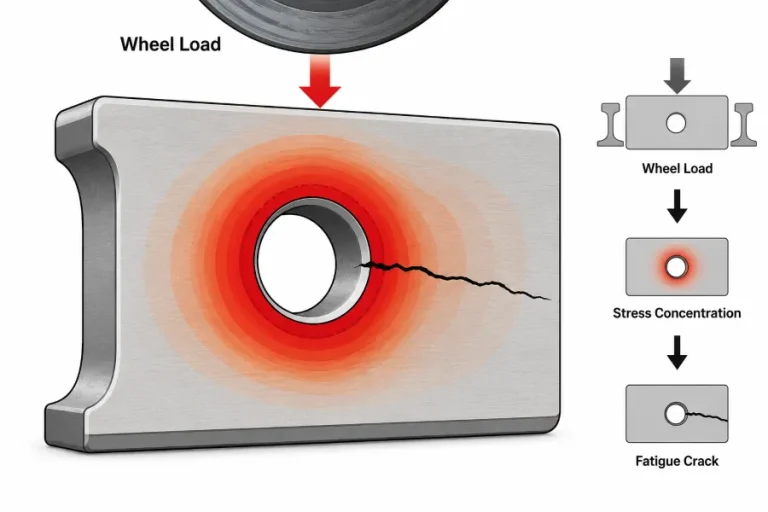
Every passing wheel causes the clip to flex slightly. The movement is extremely small—often impossible to see with the naked eye—but it happens every time a train passes. Over several years, these repeated stress cycles gradually initiate microscopic cracks at locations where stress is naturally concentrated, particularly around bends and contact areas.
All'inizio, the cracks are too small to affect performance. As traffic continues, Tuttavia, they slowly propagate through the material. Eventually, the remaining cross-section becomes too small to carry the required load, and the clip fractures, often without significant prior deformation.
Questo è il motivo per cui i cedimenti dovuti alla fatica possono apparire improvvisi anche se in realtà si stanno sviluppando da mesi o addirittura anni. Sulle ferrovie per il trasporto pesante, dove i carichi sugli assi e la frequenza del traffico sono molto più elevati, il processo di fatica generalmente progredisce più rapidamente, rendendo particolarmente importante l'ispezione regolare.
Mentre la fatica è la ragione più comune per cui un fermaglio alla fine si rompe, la velocità con cui si sviluppa la fatica dipende fortemente dai carichi che la clip subisce durante la sua vita utile.
In condizioni operative normali, una clip elastica per binario si flette all'interno della sua gamma elastica progettata. Una volta rimosso il carico, ritorna alla sua forma originale e continua a fornire la forza di serraggio richiesta. Questo movimento ripetuto è esattamente ciò per cui è stata progettata la clip.
Problems begin when the fastening system is exposed to loads that exceed its original design assumptions.
Ferrovie merci per il trasporto pesante, mining lines, port railways, and crane rail systems often operate with significantly higher axle loads than conventional passenger railways. In questi ambienti, every wheel passage produces greater stress within the fastening system. Although a single overload may not immediately damage the clip, repeated overloading shortens its fatigue life considerably.
Impact loading can be even more damaging than static loads. Instead of applying force gradually, impact loads create sudden stress spikes that place far greater demands on the spring steel.
In pratica, impact loading is commonly associated with:
When these conditions persist, rail clips are forced to absorb loads well beyond those expected during normal operation. Engineers often find that broken clips are concentrated in localized sections of track where impact loading occurs repeatedly, rather than being evenly distributed along the railway.
This is why replacing broken clips alone rarely solves the problem. Unless the underlying track condition is corrected, newly installed clips may fail in exactly the same location after only a relatively short period.
One of the more frustrating causes of rail clip failure is that it can occur before the railway even enters service.
We’ve seen situations where clips manufactured from high-quality spring steel failed much earlier than expected, not because of poor materials, but because they were installed incorrectly.
Elastic rail clips are designed to operate within a specific elastic deformation range. Durante l'installazione, the clip is temporarily deflected to generate the required toe load that holds the rail firmly against the rail pad. If that deformation exceeds the design limit, permanent stresses may remain locked inside the steel.
Those stresses are invisible during installation. The clip may appear perfectly normal, yet its fatigue resistance has already been reduced.
Incorrect installation can result from several factors, including using unsuitable installation tools, forcing the clip into position at an incorrect angle, or applying excessive installation force. Selecting the wrong clip for the rail section or fastening system can produce similar problems, as the clip may never achieve the designed clamping force.
Per questo motivo, proper installation should be viewed as part of the engineering design rather than simply the final step of construction. Following the manufacturer’s installation procedure and verifying the correct toe load can significantly extend the service life of the fastening system.
Corrosion is sometimes treated as a separate issue from fatigue, but in reality the two are closely connected.
A rail clip does not have to lose a large amount of material before its fatigue performance begins to decline. Even a small corrosion pit can create a localized stress concentration where microscopic cracks are more likely to initiate.
This is particularly important on railway lines operating in aggressive environments. Coastal railways are exposed to salt-laden air, industrial railways may encounter chemical contamination, and regions with high humidity often experience prolonged moisture exposure. In colder climates, de-icing salts can further accelerate corrosion on exposed steel components.
Once the protective coating has been damaged, corrosion gradually reduces the effective cross-section of the clip while making stress distribution less uniform. The combination of corrosion and repeated wheel loading often leads to what engineers refer to as corrosion fatigue, a failure mechanism that progresses much faster than ordinary fatigue alone.
Routine inspections should therefore look beyond obvious fractures. Rust around highly stressed areas, pitting on the clip surface, or damage to protective coatings may all indicate that the clip is entering a stage where fatigue cracks are more likely to develop.
For railways operating in harsh environments, selecting clips with appropriate surface protection and implementing regular maintenance programmes can significantly reduce the risk of premature failure.
Two elastic rail clips can look almost identical when they leave the factory, yet perform very differently after several years of service.
The difference often lies in the manufacturing process rather than the appearance of the finished product.
Spring steel used for railway clips must achieve a careful balance between strength, elasticità, e tenacità. Achieving that balance depends on accurate control of heat treatment, particularly the quenching and tempering process.
If the steel is too hard, the clip may become brittle and crack more easily under repeated loading. If it is too soft, it may gradually lose its clamping force through permanent deformation. Neither condition is acceptable for long-term railway service.
Material quality is equally important. Inclusioni non metalliche, difetti interni, surface decarburization, or inconsistent chemical composition can all become weak points where fatigue cracks initiate much earlier than expected.
Per questo motivo, reputable manufacturers invest heavily in process control rather than relying solely on final product inspection. Consistent raw materials, trattamento termico controllato, precisione dimensionale, and comprehensive mechanical testing all contribute to producing clips capable of surviving millions of load cycles in demanding railway environments.
A Industrie pesanti di Luoyang Fonyo, quality control begins long before the finished clip reaches inspection. From raw material selection to heat treatment, prove di durezza, verifica dimensionale, and fatigue performance evaluation, every production stage is carefully monitored to ensure consistent product reliability for railway applications worldwide.
It’s common to hear people blame extreme weather when rail clips begin breaking during winter or summer. While temperature certainly affects railway infrastructure, it is rarely the sole reason an elastic rail clip fails.
Nella maggior parte dei casi, temperature acts as a contributing factor rather than the root cause.
Steel rails expand in hot weather and contract in cold weather. These movements generate additional forces within the fastening system, particularly on continuously welded rail (CWR). Elastic rail clips are designed to accommodate a certain amount of rail movement while maintaining the required clamping force, but they must do so repeatedly throughout their service life.
When thermal stresses are combined with heavy axle loads, corrosione, or existing fatigue cracks, the remaining fatigue life of the clip can decrease more rapidly.
Low temperatures introduce another challenge. Although modern spring steels generally maintain good toughness over a wide temperature range, inferior materials or poorly controlled heat treatment can make clips more susceptible to brittle fracture in cold environments. D'altra parte, prolonged exposure to high temperatures may gradually affect the mechanical properties of improperly heat-treated steel.
For railway operators working in regions with significant seasonal temperature variations, thermal effects should be considered as part of the overall maintenance strategy rather than an isolated problem.
One mistake sometimes made during maintenance is to focus only on replacing the broken clip.
In realtà, a failed rail clip is often telling you that something else on the track deserves attention.
Per esempio, if several clips fail repeatedly in exactly the same location, È improbabile che sostituirli senza indagare sulle condizioni della pista circostante risolva il problema. Potrebbe esserci un carico d'impatto eccessivo causato dalla geometria irregolare del binario, supporto insufficiente per il dormiente, cuscinetti delle rotaie usurati, o interazione anomala ruota-rotaia.
Allo stesso modo, se si riscontra costantemente corrosione sui componenti di fissaggio all'interno di una particolare sezione della ferrovia, il miglioramento del drenaggio o la scelta di una migliore protezione dalla corrosione possono offrire vantaggi a lungo termine molto maggiori rispetto al semplice aumento della frequenza delle ispezioni.
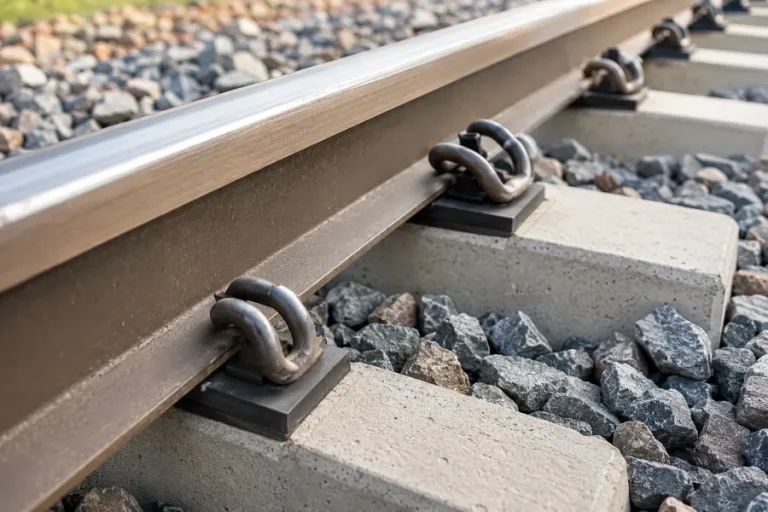
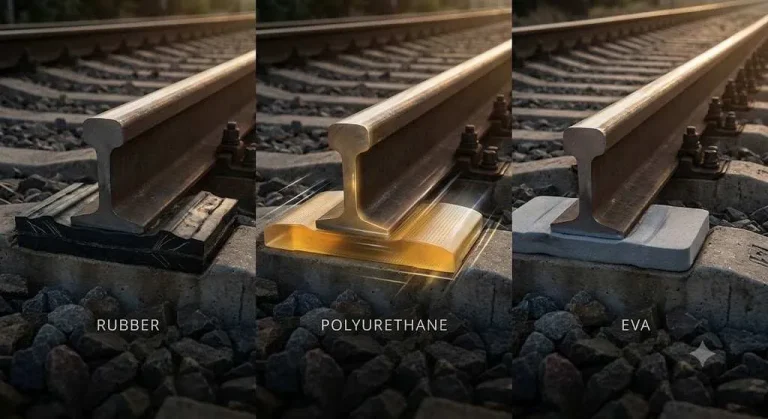
I tecnici esperti della manutenzione guardano quindi al sistema di fissaggio nel suo complesso invece di trattare ciascun componente in modo indipendente. La ferrovia, tampone, isolante, dormiente, spalla, e ritagliare tutto il lavoro insieme. Un problema che colpisce un componente spesso aumenta lo stress subito dagli altri.
Understanding this relationship helps maintenance teams identify the real source of repeated failures and avoid unnecessary replacement costs.
Most rail clip failures do not occur without warning. In molti casi, the earliest signs appear long before the clip actually fractures, which is why regular inspection remains one of the most cost-effective maintenance practices.
Routine inspections usually begin with a careful visual examination. Engineers look for small cracks around the curved sections of the clip, corrosion on exposed surfaces, deformazione permanente, and any obvious reduction in clamping performance. Missing clips or clips that are no longer seated correctly should also be addressed immediately, as they can alter load distribution within the fastening system.
On high-traffic lines or heavy-haul railways, visual inspection alone may not always be sufficient. Non-destructive testing methods, such as magnetic particle inspection, can help detect fatigue cracks before they become visible to the naked eye, allowing components to be replaced during planned maintenance rather than after an unexpected failure.
Inspection intervals should always reflect actual operating conditions. A metro line carrying relatively light passenger traffic requires a different maintenance strategy from a freight railway transporting heavy mineral loads. Condizioni ambientali, carichi sugli assi, densità del traffico, and track geometry all influence how quickly fastening components deteriorate.
Rather than replacing clips solely based on age, many railway operators now combine scheduled inspections with condition-based maintenance, ensuring that components are replaced when their condition justifies it.
By the time a rail clip breaks, the conditions leading to that failure have often been developing for years.
The most effective way to improve service life is therefore to consider the entire life cycle of the fastening system—from product selection and manufacturing through installation, ispezione, and routine maintenance.
Choosing a rail clip that matches the rail profile, tipo dormiente, and expected axle loads provides the foundation for reliable performance. Equally important is ensuring that the clips are manufactured from certified spring steel and produced under well-controlled heat-treatment conditions. These factors determine how well the clip will resist fatigue over millions of loading cycles.
Correct installation is the next critical step. Even the highest-quality clip cannot perform as intended if it is overstressed during installation or paired with incompatible fastening components. Following recommended installation procedures and using suitable tools helps ensure that the clip operates within its designed elastic range.
Once the track enters service, regular inspection becomes the final layer of protection. Detecting corrosion, fatigue cracks, or deformation early allows maintenance teams to replace individual components before more serious damage develops elsewhere in the fastening system.
Dal punto di vista ingegneristico, preventing failure is rarely about one single improvement. It is the combination of good product quality, corretta installazione, and consistent maintenance that delivers the longest service life.
When comparing elastic rail clips, it is easy to focus on dimensions or price alone. Tuttavia, clips that appear almost identical can perform very differently once they are installed on the track.
Long-term reliability depends on factors that are not always visible, including steel quality, heat-treatment consistency, prestazione a fatica, precisione dimensionale, and manufacturing process control. These characteristics determine whether a clip will continue providing stable clamping force after millions of loading cycles.
A Industrie pesanti di Luoyang Fonyo, we manufacture elastic rail clips for a wide range of railway applications, including heavy-haul railways, sistemi metropolitani, binari industriali, and crane rail projects. Every production stage—from raw material selection and heat treatment to dimensional inspection and mechanical testing—is carefully controlled to ensure consistent product quality.
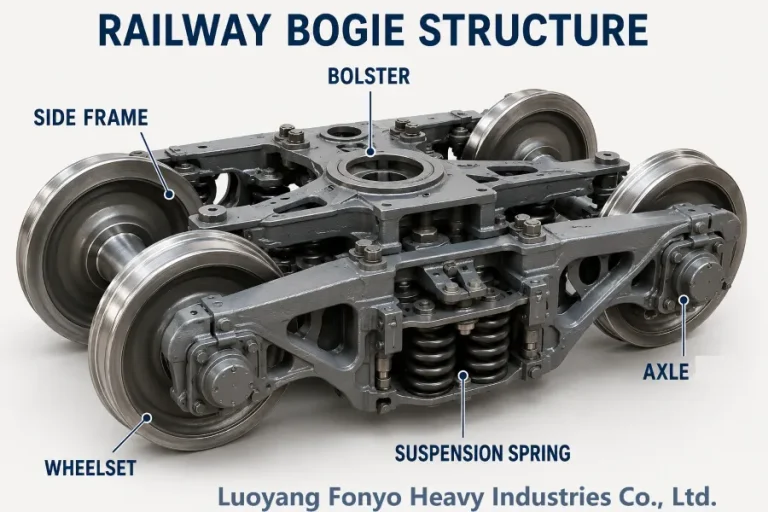
Beyond railway clip ferroviarie, Fonyo manufactures a broad range of railway components, including railway fish plate, ruote ferroviarie, bogie bolsters and side frames, clip ferroviarie, bulloni di pesce, cuscinetti ferroviari, and other custom cast and forged parts. By combining casting, forgiatura, lavorazioni meccaniche di precisione, trattamento termico, and inspection under one roof, we help customers simplify sourcing while ensuring consistent quality across critical railway components.
If you’re planning a new railway project or replacing existing rail joints, simply send us your drawings or technical specifications. Our engineering team will review your requirements and recommend the most suitable solution for your project.