Scannez le code WeChat pour nous contacter
Scannez le code WeChat pour nous contacter
N'hésitez pas à nous envoyer un email et nous vous répondrons dans les plus brefs délais.
Créer l'avenir avec cœur et âme


Un élastique cassé attache de rail peut ressembler à un petit problème, mais sur une voie ferrée, cela peut rapidement conduire à des problèmes bien plus importants. Une fois qu'un clip perd sa force de serrage, le rail n'est plus maintenu aussi solidement que prévu. Au fil du temps, cela peut permettre un léger mouvement du rail, augmenter les vibrations, accélérer l'usure des autres composants de fixation, et finalement affecter la stabilité de l'ensemble de la structure de la voie.
Une question que les clients nous posent souvent est, “Pourquoi le clip de rail s'est-il brisé alors que les charges du train étaient dans les limites de conception?” Dans de nombreux cas, la réponse n'est pas une seule surcharge ou un seul défaut de fabrication. Les ruptures de clips de rail se développent généralement progressivement en raison de charges répétées sur les roues., conditions environnementales, qualité d'installation, et l'état général du système de fixation.
Parce que les clips élastiques pour rails sont conçus pour fonctionner sous des millions de cycles de charge au cours de leur durée de vie, comprendre comment ils échouent est tout aussi important que comprendre comment ils fonctionnent. Identifying the early signs of failure allows maintenance teams to replace clips before they affect track performance and helps project engineers select fastening systems that offer longer service life.
Dans cet article, we’ll look at the most common reasons elastic rail clips fail, explain how these failures develop, and discuss practical ways to extend the life of railway fastening systems.
Although they appear to be simple steel components, elastic rail clips perform one of the most demanding jobs in a railway fastening system. Their purpose is not merely to hold the rail in place, but to maintain a consistent clamping force while the track is constantly subjected to vibration, impact, changements de température, and heavy axle loads.
Each time a train passes, the rail deflects slightly under load. Le clip de rail élastique fléchit avec lui, absorber une partie du mouvement puis reprendre sa forme initiale. Cette action élastique continue maintient le rail fermement appuyé contre le patin du rail tout en permettant juste assez de mouvement pour réduire les contraintes au sein du système de fixation..
Contrairement aux méthodes de fixation rigides utilisées sur les anciennes lignes ferroviaires, les clips élastiques modernes aident à répartir les forces dynamiques plus uniformément. Cela réduit l'usure des traverses, minimise le mouvement des rails, et contribue à une conduite plus douce et à une durée de vie plus longue de la piste.
Cependant, cette déformation élastique répétée explique aussi pourquoi les clips de rail finissent par s'user. Même l'acier à ressort de haute qualité a une durée de vie limitée. Après des millions de cycles de chargement, des changements microscopiques commencent à se produire dans le matériau, faire une conception appropriée, fabrication, et entretien indispensable.
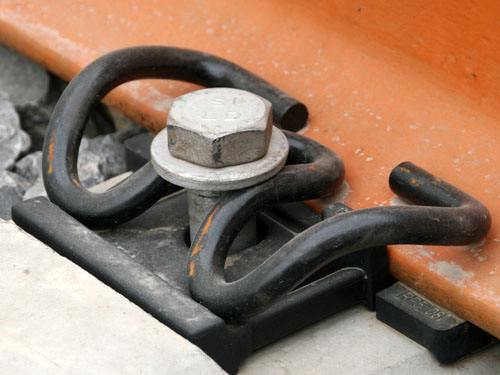
Many people imagine a failed rail clip as one that has snapped into two pieces. En réalité, complete fracture is often the final stage of a much longer process.
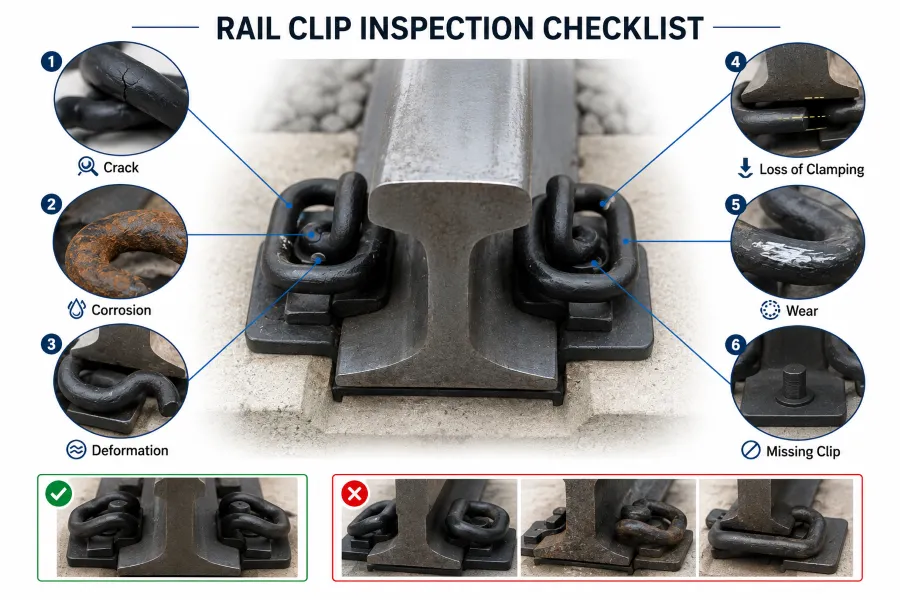
During routine inspections, maintenance engineers are more likely to encounter early warning signs such as small cracks near the curved section of the clip, visible corrosion, slight permanent deformation, or a noticeable reduction in clamping force. These changes may seem minor individually, but together they indicate that the clip is no longer performing as designed.
Du point de vue de la maintenance, the most serious consequence is not the broken clip itself—it is the gradual loss of restraint. As clamping force decreases, the rail becomes more susceptible to movement under traffic loads. That movement increases vibration throughout the fastening system, placing additional stress on rail pads, isolateurs, dormeurs, and neighboring clips.
Pour cette raison, experienced railway maintenance teams rarely wait until clips break completely. Replacing clips when the first signs of fatigue or deformation appear is usually far more economical than dealing with the secondary damage caused by prolonged operation.
If you ask experienced track engineers what causes most broken elastic rail clips, the answer is almost always the same: metal fatigue.
This surprises many people because rail clips are manufactured from high-strength spring steel capable of withstanding extremely high loads. The problem is not that a single train is too heavy. Plutôt, it is the enormous number of loading cycles the clip experiences throughout its service life.
Every passing wheel causes the clip to flex slightly. The movement is extremely small—often impossible to see with the naked eye—but it happens every time a train passes. Over several years, these repeated stress cycles gradually initiate microscopic cracks at locations where stress is naturally concentrated, particularly around bends and contact areas.
D'abord, the cracks are too small to affect performance. As traffic continues, cependant, they slowly propagate through the material. Finalement, the remaining cross-section becomes too small to carry the required load, and the clip fractures, often without significant prior deformation.
This is why fatigue failures can appear sudden even though they have actually been developing for months or even years. Sur les chemins de fer lourds, where axle loads and traffic frequency are much higher, the fatigue process generally progresses more quickly, making regular inspection especially important.
While fatigue is the most common reason a rail clip eventually breaks, the speed at which fatigue develops depends heavily on the loads the clip experiences throughout its service life.
Dans des conditions normales de fonctionnement, an elastic rail clip flexes within its designed elastic range. Once the load is removed, it returns to its original shape and continues providing the required clamping force. This repeated movement is exactly what the clip was designed to do.
Problems begin when the fastening system is exposed to loads that exceed its original design assumptions.
Chemins de fer de fret lourd, mining lines, port railways, and crane rail systems often operate with significantly higher axle loads than conventional passenger railways. Dans ces environnements, every wheel passage produces greater stress within the fastening system. Although a single overload may not immediately damage the clip, repeated overloading shortens its fatigue life considerably.
Impact loading can be even more damaging than static loads. Instead of applying force gradually, impact loads create sudden stress spikes that place far greater demands on the spring steel.
En pratique, impact loading is commonly associated with:
When these conditions persist, les clips de rail sont obligés d'absorber des charges bien au-delà de celles attendues en fonctionnement normal. Les ingénieurs constatent souvent que les clips cassés sont concentrés dans des sections localisées de la voie où les charges d'impact se produisent à plusieurs reprises., plutôt que d'être répartis uniformément le long de la voie ferrée.
C'est pourquoi le remplacement des clips cassés résout rarement le problème.. À moins que l'état sous-jacent de la voie ne soit corrigé, les clips nouvellement installés peuvent échouer exactement au même endroit après seulement une période relativement courte.
L’une des causes les plus frustrantes de la défaillance des clips de rail est qu’elle peut survenir avant même que la voie ferrée n’entre en service..
Nous avons vu des situations dans lesquelles des clips fabriqués à partir d'acier à ressort de haute qualité se sont brisés beaucoup plus tôt que prévu., not because of poor materials, but because they were installed incorrectly.
Elastic rail clips are designed to operate within a specific elastic deformation range. Pendant l'installation, the clip is temporarily deflected to generate the required toe load that holds the rail firmly against the rail pad. If that deformation exceeds the design limit, permanent stresses may remain locked inside the steel.
Those stresses are invisible during installation. The clip may appear perfectly normal, yet its fatigue resistance has already been reduced.
Incorrect installation can result from several factors, including using unsuitable installation tools, forcing the clip into position at an incorrect angle, or applying excessive installation force. Selecting the wrong clip for the rail section or fastening system can produce similar problems, as the clip may never achieve the designed clamping force.
Pour cette raison, proper installation should be viewed as part of the engineering design rather than simply the final step of construction. Following the manufacturer’s installation procedure and verifying the correct toe load can significantly extend the service life of the fastening system.
Corrosion is sometimes treated as a separate issue from fatigue, but in reality the two are closely connected.
A rail clip does not have to lose a large amount of material before its fatigue performance begins to decline. Even a small corrosion pit can create a localized stress concentration where microscopic cracks are more likely to initiate.
This is particularly important on railway lines operating in aggressive environments. Coastal railways are exposed to salt-laden air, industrial railways may encounter chemical contamination, and regions with high humidity often experience prolonged moisture exposure. In colder climates, de-icing salts can further accelerate corrosion on exposed steel components.
Once the protective coating has been damaged, corrosion gradually reduces the effective cross-section of the clip while making stress distribution less uniform. The combination of corrosion and repeated wheel loading often leads to what engineers refer to as corrosion fatigue, a failure mechanism that progresses much faster than ordinary fatigue alone.
Routine inspections should therefore look beyond obvious fractures. Rust around highly stressed areas, pitting on the clip surface, or damage to protective coatings may all indicate that the clip is entering a stage where fatigue cracks are more likely to develop.
For railways operating in harsh environments, selecting clips with appropriate surface protection and implementing regular maintenance programmes can significantly reduce the risk of premature failure.
Two elastic rail clips can look almost identical when they leave the factory, yet perform very differently after several years of service.
The difference often lies in the manufacturing process rather than the appearance of the finished product.
Spring steel used for railway clips must achieve a careful balance between strength, élasticité, et la ténacité. Achieving that balance depends on accurate control of heat treatment, particularly the quenching and tempering process.
If the steel is too hard, the clip may become brittle and crack more easily under repeated loading. If it is too soft, it may gradually lose its clamping force through permanent deformation. Neither condition is acceptable for long-term railway service.
Material quality is equally important. Inclusions non métalliques, défauts internes, surface decarburization, or inconsistent chemical composition can all become weak points where fatigue cracks initiate much earlier than expected.
Pour cette raison, reputable manufacturers invest heavily in process control rather than relying solely on final product inspection. Consistent raw materials, traitement thermique contrôlé, précision dimensionnelle, and comprehensive mechanical testing all contribute to producing clips capable of surviving millions of load cycles in demanding railway environments.
À Luoyang Fonyo Industries Lourdes, quality control begins long before the finished clip reaches inspection. From raw material selection to heat treatment, essai de dureté, vérification dimensionnelle, and fatigue performance evaluation, every production stage is carefully monitored to ensure consistent product reliability for railway applications worldwide.
It’s common to hear people blame extreme weather when rail clips begin breaking during winter or summer. While temperature certainly affects railway infrastructure, c'est rarement la seule raison pour laquelle un clip de rail élastique échoue.
Dans la plupart des cas, la température agit comme un facteur contributif plutôt que comme la cause profonde.
Les rails en acier se dilatent par temps chaud et se contractent par temps froid. Ces mouvements génèrent des efforts supplémentaires au sein du système de fixation, notamment sur rail soudé en continu (CWR). Les clips élastiques pour rail sont conçus pour s'adapter à un certain mouvement du rail tout en conservant la force de serrage requise., mais ils doivent le faire à plusieurs reprises tout au long de leur durée de vie.
Lorsque les contraintes thermiques sont combinées à de lourdes charges par essieu, corrosion, ou fissures de fatigue existantes, la durée de vie restante du clip peut diminuer plus rapidement.
Les basses températures introduisent un autre défi. Bien que les aciers à ressorts modernes conservent généralement une bonne ténacité sur une large plage de températures, inferior materials or poorly controlled heat treatment can make clips more susceptible to brittle fracture in cold environments. D'autre part, prolonged exposure to high temperatures may gradually affect the mechanical properties of improperly heat-treated steel.
For railway operators working in regions with significant seasonal temperature variations, thermal effects should be considered as part of the overall maintenance strategy rather than an isolated problem.
One mistake sometimes made during maintenance is to focus only on replacing the broken clip.
En réalité, a failed rail clip is often telling you that something else on the track deserves attention.
Par exemple, if several clips fail repeatedly in exactly the same location, replacing them without investigating the surrounding track conditions is unlikely to solve the problem. There may be excessive impact loading caused by uneven track geometry, insufficient sleeper support, worn rail pads, or abnormal wheel-rail interaction.
De la même manière, if corrosion is consistently found on fastening components within a particular section of railway, improving drainage or selecting better corrosion protection may deliver far greater long-term benefits than simply increasing inspection frequency.
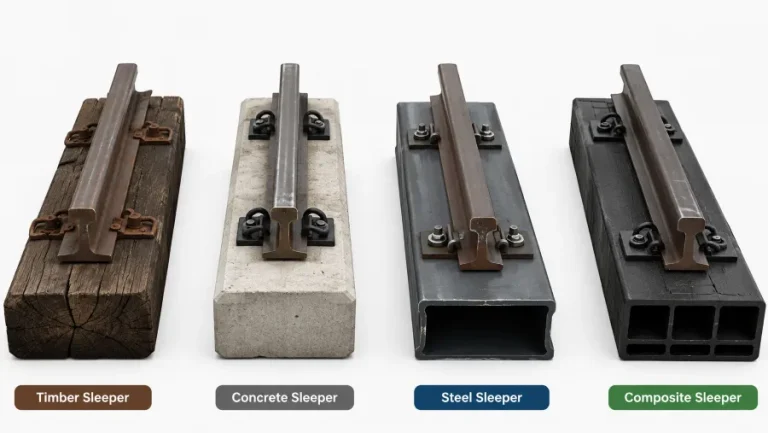
Experienced maintenance engineers therefore look at the fastening system as a whole rather than treating each component independently. Le rail, tampon, isolant, dormeur, épaule, and clip all work together. A problem affecting one component often increases the stress experienced by the others.
Understanding this relationship helps maintenance teams identify the real source of repeated failures and avoid unnecessary replacement costs.
Most rail clip failures do not occur without warning. Dans de nombreux cas, the earliest signs appear long before the clip actually fractures, which is why regular inspection remains one of the most cost-effective maintenance practices.
Routine inspections usually begin with a careful visual examination. Engineers look for small cracks around the curved sections of the clip, corrosion on exposed surfaces, déformation permanente, and any obvious reduction in clamping performance. Missing clips or clips that are no longer seated correctly should also be addressed immediately, as they can alter load distribution within the fastening system.
On high-traffic lines or heavy-haul railways, visual inspection alone may not always be sufficient. Non-destructive testing methods, such as magnetic particle inspection, can help detect fatigue cracks before they become visible to the naked eye, allowing components to be replaced during planned maintenance rather than after an unexpected failure.
Inspection intervals should always reflect actual operating conditions. A metro line carrying relatively light passenger traffic requires a different maintenance strategy from a freight railway transporting heavy mineral loads. Conditions environnementales, charges par essieu, densité du trafic, and track geometry all influence how quickly fastening components deteriorate.
Rather than replacing clips solely based on age, many railway operators now combine scheduled inspections with condition-based maintenance, ensuring that components are replaced when their condition justifies it.
By the time a rail clip breaks, the conditions leading to that failure have often been developing for years.
The most effective way to improve service life is therefore to consider the entire life cycle of the fastening system—from product selection and manufacturing through installation, inspection, and routine maintenance.
Choosing a rail clip that matches the rail profile, type de dormeur, and expected axle loads provides the foundation for reliable performance. Equally important is ensuring that the clips are manufactured from certified spring steel and produced under well-controlled heat-treatment conditions. Ces facteurs déterminent dans quelle mesure le clip résistera à la fatigue sur des millions de cycles de chargement..
Une installation correcte est la prochaine étape critique. Même le clip de la plus haute qualité ne peut pas fonctionner comme prévu s'il est soumis à des contraintes excessives lors de l'installation ou s'il est associé à des composants de fixation incompatibles.. Le respect des procédures d'installation recommandées et l'utilisation d'outils appropriés permettent de garantir que le clip fonctionne dans sa plage élastique conçue..
Une fois la piste entrée en service, une inspection régulière devient la dernière couche de protection. Détection de la corrosion, fissures de fatigue, ou une déformation précoce permet aux équipes de maintenance de remplacer des composants individuels avant que des dommages plus graves ne se développent ailleurs dans le système de fixation.
Du point de vue de l'ingénierie, prévenir l’échec repose rarement sur une seule amélioration. C'est la combinaison d'une bonne qualité de produit, installation correcte, and consistent maintenance that delivers the longest service life.
When comparing elastic rail clips, it is easy to focus on dimensions or price alone. Cependant, clips that appear almost identical can perform very differently once they are installed on the track.
Long-term reliability depends on factors that are not always visible, including steel quality, heat-treatment consistency, performance en fatigue, précision dimensionnelle, and manufacturing process control. These characteristics determine whether a clip will continue providing stable clamping force after millions of loading cycles.
À Luoyang Fonyo Industries Lourdes, we manufacture elastic rail clips for a wide range of railway applications, including heavy-haul railways, systèmes de métro, pistes industrielles, and crane rail projects. Every production stage—from raw material selection and heat treatment to dimensional inspection and mechanical testing—is carefully controlled to ensure consistent product quality.
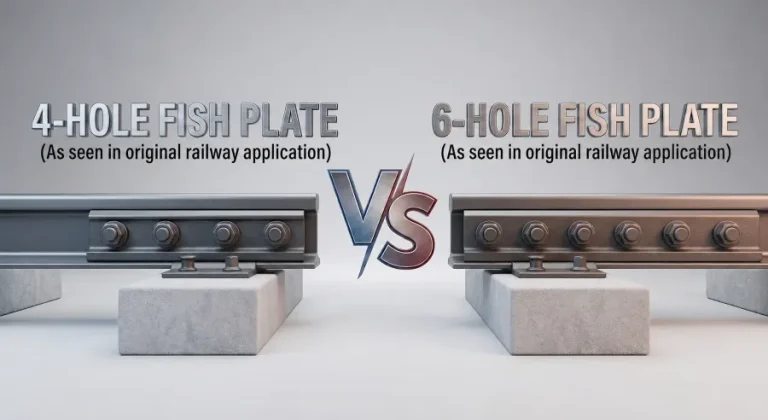
Beyond railway clips de rail, Fonyo manufactures a broad range of railway components, including railway fish plate, roues de chemin de fer, bogie bolsters and side frames, clips de rail, boulons de poisson, patins de rail, et autres pièces moulées et forgées sur mesure. En combinant le casting, forger, usinage de précision, traitement thermique, et inspection sous un même toit, nous aidons nos clients à simplifier l'approvisionnement tout en garantissant une qualité constante pour les composants ferroviaires critiques.
Si vous planifiez un nouveau projet ferroviaire ou remplacez des joints ferroviaires existants, envoyez-nous simplement vos dessins ou spécifications techniques. Notre équipe d'ingénierie examinera vos besoins et recommandera la solution la plus adaptée à votre projet..