Scannez le code WeChat pour nous contacter
Scannez le code WeChat pour nous contacter
N'hésitez pas à nous envoyer un email et nous vous répondrons dans les plus brefs délais.
Créer l'avenir avec cœur et âme

Railway wheels crack because of rolling contact fatigue, thermal loading and manufacturing defects. Rolling contact fatigue is the dominant cause: repeated wheel-rail contact stress creates three distinct crack mechanisms, starting at the surface, just below the surface, or deep in the material. Braking heat, rail surface condition, wheel residual stress and steel cleanliness all influence when and where railway wheels cracks appear. Most cracks can be managed by inspection and re-profiling, but subsurface cracks can grow unseen.
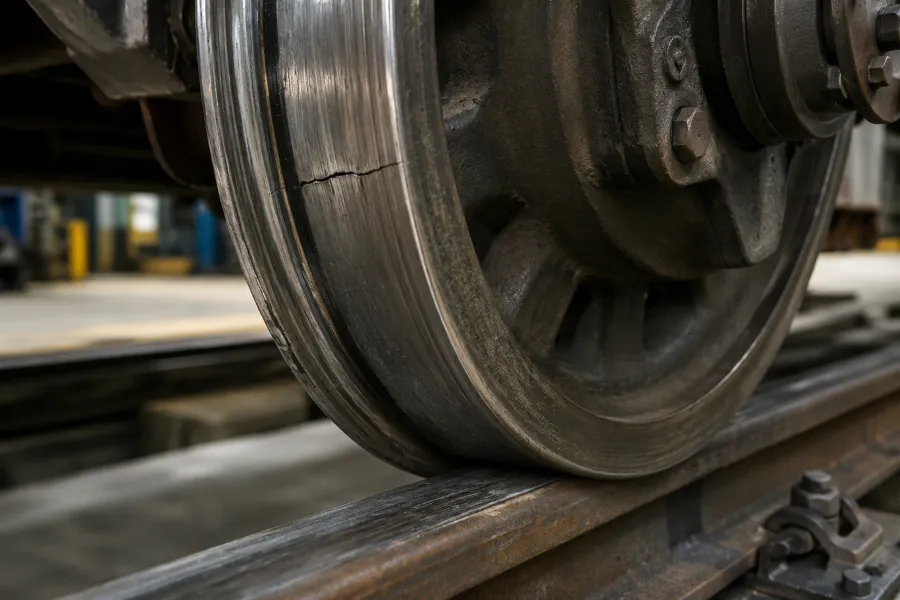
If you have ever stood in a wheel shop looking at a wheel with a crack that was not there at the last inspection, you have asked this question. The wheel was new. It passed the tests. It ran for years. Alors, one day, the ultrasonic probe found something, or the visual inspection caught a hairline line on the tread. Railway wheels cracks do not announce themselves in advance.
À première vue, the logic seems simple: a railway wheel crack means the steel failed.
En pratique, railway wheel cracking is not quite that straightforward.
A crack is the end result of a process that started long before it became visible. It was initiated by stresses that the wheel was designed to carry, then grown by cycles the wheel was designed to survive. Understanding why wheels crack means understanding where those cracks start, what feeds them, and why some wheels crack when identical-looking wheels do not.
So what actually causes railway wheel cracks, and which ones should you worry about?
The most common cause of railway wheel cracks is rolling contact fatigue, usually shortened to RCF. Every time a wheel rolls over a rail, the contact patch between them carries a load concentrated on a small area. Under that patch, the steel experiences stresses that are among the highest found in engineering applications.
Repeated contact stress does two things. It plastically deforms the surface material, and it creates cyclic stress below the surface. Over thousands and millions of cycles, that repeated stress can initiate cracks.
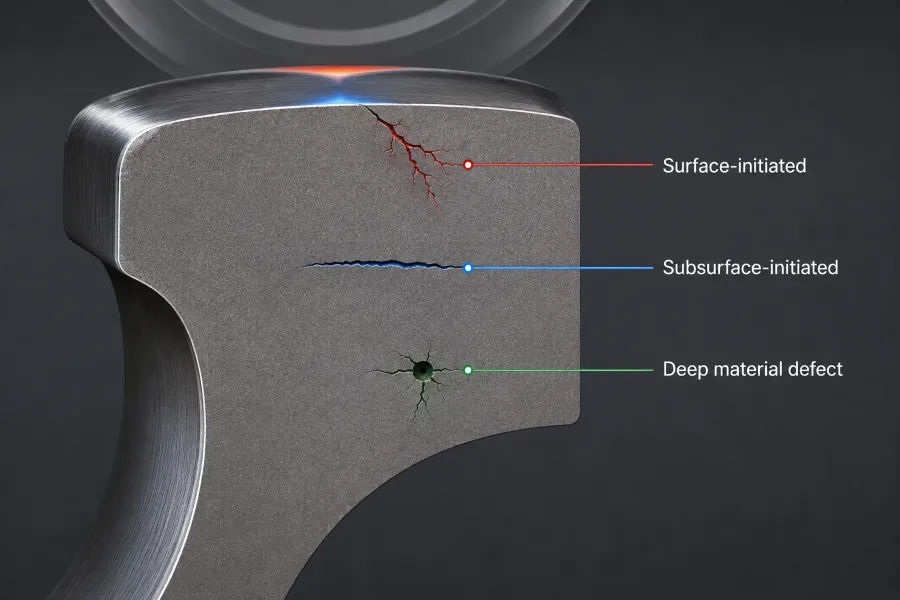
Transportation Safety Board of Canada investigations describe three common RCF mechanisms, and the distinction matters because each one behaves differently:
Surface-initiated fatigue. Severe plastic deformation of the surface layer eventually forms a crack that grows at a shallow angle down into the wheel, then curves back up to the tread. The result is a small piece of tread material detaching, known as a shell. Surface-initiated RCF is the most common form and the least dangerous, because it is visible and can be removed by re-profiling.
Subsurface-initiated fatigue. This starts roughly a quarter of an inch below the tread surface, often where the material’s local fatigue resistance is reduced by microscopic inclusions such as manganese sulphide. The railway wheels crack grows parallel to the tread and is not visible from the outside. It is found by ultrasonic inspection, not by looking at the surface.
Fatigue at deep material defects. This starts half an inch to an inch below the tread, at a macroscopic defect or void around a millimetre in size. The crack grows parallel to the tread and can branch, and final fracture can be sudden.
The first two mechanisms can lead to tread shelling, and shelling is more likely when braking heat reduces the material strength near the surface.
This is why the question “why do railway wheel cracks happen” does not have one answer. It has three, and they need different detection methods and different maintenance responses.
Subsurface cracks are the ones that deserve the most respect, because they are invisible until they are serious.
A subsurface crack starts in the bulk of the material, not on the surface. There may be no macroscopic inclusion or void at the origin. The initiating feature can be microscopic, and the crack grows parallel to the tread for a long distance before it ever turns toward the surface.
In service, this means a wheel can be developing a subsurface crack while every visual inspection comes back clean. The crack is simply not where the eye can see it.
This is why ultrasonic testing matters for railway wheels. Surface inspection finds surface cracks. Ultrasonic inspection looks into the bulk of the material, where subsurface fatigue lives. A railway that inspects wheels only by eye is missing the crack mechanism most likely to produce serious railway wheel cracks that fail without warning.
It is also why the question of steel cleanliness is not a metallurgical detail but a safety question. Subsurface fatigue is made more likely when the material contains microscopic inclusions. Steel with better microcleanliness gives subsurface fatigue fewer places to start. When two wheels from different suppliers carry the same grade designation, the cleanliness of the steel can still differ, and that difference shows up in crack behavior years later.
Most railway wheels crack are managed before they become failures. The exception, and the one that gets the attention, is the vertical split rim, or VSR.
VSR is one of the dominant wheel failure types in North American freight service. It tends to start at the bottom of a rolling contact fatigue shell or spall, then propagate down into the wheel. If the crack reaches the zone of axial residual tensile stress that develops below the tread during service, a section of the rim can break away from the wheel.
What makes VSR difficult is that the initiating shell may not be condemnable by itself. In the TSB investigation into a 2011 Canadian derailment, the failed wheel showed shelling all around the circumference, and the shells were close to, but not over, the AAR maximum allowable limits. The VSR had originated at the base of such a shell.
The lesson is uncomfortable: a wheel can be within the inspection limits, carry a subsurface crack, and still fail catastrophically. That is not a reason to abandon inspection limits. It is a reason to understand that inspection limits are a management tool, pas une garantie.
VSR is also a reminder that managing railway wheels crack is a system problem. The factors that contribute to VSR include service load, unusual impact loads, number of cycles, rail surface condition, wheel residual stress, steel microcleanliness and other damage. The relative importance of each factor is hard to isolate, which is why the industry continues to study it.
Braking is another crack driver, and it works in two ways.
D'abord, tread braking heats the wheel. Elevated temperature reduces the strength of the steel near the surface, which makes surface cracks and shelling more likely under contact stress. A wheel that brakes hard and often runs hotter, and heat-affected steel is weaker steel.
Deuxième, the thermal cycles from braking change the residual stress pattern inside the wheel. New wheels are rim-quenched at manufacture to create compressive residual stress at the tread surface, which resists crack initiation. In service, cyclic loading gradually builds a counter-balancing zone of axial residual tensile stress deeper below the tread. Research cited in TSB reports indicates that repeated braking can move this tensile stress zone closer to the surface, from roughly half an inch to an inch below the tread down to about a third of an inch.
This matters because cracks that grow toward a tensile stress zone are pulled open, not held shut. The residual stress pattern inside a wheel is not a fixed property. It evolves with service, and braking accelerates that evolution.
For operations with heavy braking, such as steep gradients, frequent stops or dynamic braking on freight, the thermal history of the wheel is part of the crack story. It is one more reason why two wheels with the same drawing can have very different lives.
If you have ever seen two wheels from the same batch, same drawing, same grade, and one crack while the other runs for years, you have seen the other side of this question.
The wheel itself is only part of the system. The rail surface condition, the wheel and rail profiles, the loading, the braking, the maintenance history and the inspection regime all shape what happens at the contact patch. A wheel running on a rough or worn rail surface experiences higher dynamic loads than the same wheel on a smooth one. A wheel in a car that hunts or yaws loads its tread differently from a wheel in a well-behaved car.
This is also why the same crack management question comes up across the whole wheel-rail interface. Notre guide pourrailway track maintenance covers the track side of the same problem: rail wear, rail head condition and grinding all affect the loads the wheel sees.
The practical point is that railway wheel cracks are a fleet question, not a single-wheel question. When a crack appears, the investigation should ask what the wheel was doing, what it was running on and how it was braked, not just what the steel looked like.
There is no single answer that fits every wheel, because the right response depends on where the crack is and how it started.
| Crack Type | Where It Starts | How It Is Found | Typical Response |
|---|---|---|---|
| Surface RCF / bombardement | Tread surface | Inspection visuelle | Re-profiling (machining off the cracked layer) |
| Thermal cracks | Tread surface from braking | Inspection visuelle | Re-profiling if shallow; wheel change if deep |
| Subsurface fatigue | Below tread (quarter inch or deeper) | Ultrasonic inspection | Wheel change depending on size and location |
| Vertical split rim | Base of a shell or spall | Often too late; found at failure | Wheel change; investigation |
These are starting points, not a universal procedure. La norme applicable, such as AAR M-107/M-208 in North America or EN 13262 en Europe, defines the inspection requirements and the condemnable limits for each defect type.
The management question is not only “is there a crack” mais “what kind of railway wheel crack is it, and is the inspection method matched to it?” A railway that relies on visual inspection alone is managing surface cracks only, and subsurface cracks will grow unseen until they surface. The inspection regime should be designed against the same standards framework used fornormes ferroviaires pour les roues.
When buying railway wheels, I would not stop at asking whether the wheel meets the grade. Ask what the supplier can demonstrate about the crack-related properties of the steel.
A reliable supplier should be able to provide:
For larger fleets, microcleanliness and traceability matter most. Microcleanliness is where subsurface fatigue gets its starting points, and traceability is what lets you find the sibling wheels from the same heat if one develops a crack. The same procurement discipline applies to the price side of the question, which we cover in our guide torailway wheel prices.
If you are new to the design side, our guide totrain wheel design covers how the wheel geometry and material are chosen before any steel is poured.
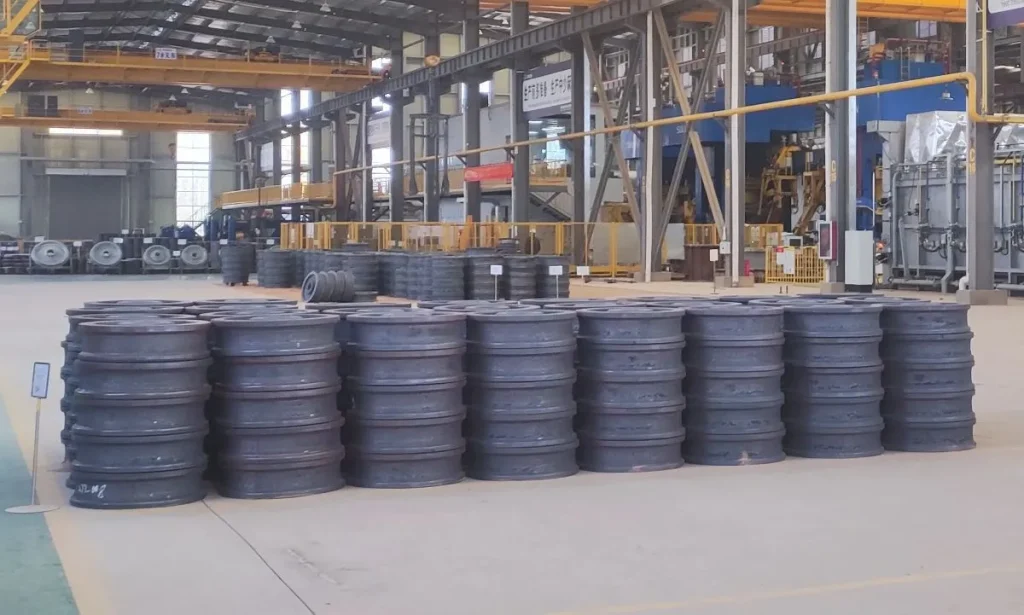
Railway wheels crack because the wheel-rail contact is one of the most demanding stress environments in engineering, and the crack mechanisms that grow there are the price of that duty. Surface cracks can be seen and managed. Subsurface cracks can grow unseen. Vertical split rim can turn a within-limit wheel into a broken wheel.
None of this means railway wheel cracks make wheels unsafe. It means wheel safety is a management system, not a property of the steel alone. Inspection matched to the crack type, re-profiling on schedule, steel cleanliness at manufacture and traceability across the fleet are the parts of that system.
That is why I would not recommend choosing a railway wheel supplier on the certificate alone. Start with the steel and the process. Check the microcleanliness and the ultrasonic inspection. Understand how the wheel will be inspected in service, and match the inspection to the crack types that matter.
ÀLuoyang Fonyo Heavy Industries Co., Ltée., nous fabriquonsroues de chemin de fer etcoulée ferroviaire products according to customer drawings, normes applicables et exigences du projet. Pour roues, we can review the required steel grade, processus de fabrication, traitement thermique, microcleanliness and inspection requirements before production.
Si tu as un dessin, specification or an existing wheel sample, envoyez-nous les détails. Our engineering team can help check the required wheel specification, Norme applicable et exigences de production avant le devis.
Railway wheels crack mainly because of rolling contact fatigue: repeated wheel-rail contact stress creates cracks at the surface, just below the surface, or deep in the material. Braking heat, rail surface condition, wheel residual stress and steel cleanliness all influence when and where cracks appear.
Rolling contact fatigue is the most common cause. Repeated contact stress between the wheel and the rail plastically deforms the surface material and creates cyclic stress below the surface, which over millions of cycles can initiate cracks.
Oui. Subsurface fatigue cracks start below the tread surface and grow parallel to it, so they are invisible to the eye. They are found by ultrasonic inspection, not by visual inspection.
Surface cracks and shells are found by visual inspection. Subsurface cracks are found by ultrasonic testing. Thermal cracks from braking appear on the tread and are found by visual inspection. The inspection method should be matched to the crack type.
A vertical split rim, or VSR, is a wheel failure mode where a crack starting at the base of a shell or spall propagates into the wheel and can cause a section of the rim to break away. It is one of the dominant wheel failure types in North American freight service.
Surface cracks can often be managed by re-profiling, where the cracked layer is machined off and the tread profile restored. Subsurface cracks and vertical split rims are not repairable by re-profiling and generally require the wheel to be changed. Understanding which railway wheel cracks are repairable and which are not is part of every maintenance budget.
Ask for the steel grade and standard, manufacturing process and rim quenching details, mechanical test results, microcleanliness data and the assessment method, rapports de tests par ultrasons, residual stress information where required, and traceability from the heat to the specific wheel.