Scannez le code WeChat pour nous contacter
Scannez le code WeChat pour nous contacter
N'hésitez pas à nous envoyer un email et nous vous répondrons dans les plus brefs délais.
Créer l'avenir avec cœur et âme


Dans l'industrie de la fonderie, le moulage au sable est le pilier absolu. When it comes to moulage au sable, “sable de résine” et “sable enduit” sont indispensables. Cependant, dans des applications pratiques, they each have their own characteristics and uses.
Resin sand, comme son nom l'indique, is a mixture of raw sand (usually quartz sand) and a synthetic resin binder. Its core technology is “auto-durcissant”, which means that the mixed sand will gradually harden on its own.

1. How does it work?
Workers first quickly mix raw sand with a resin binder (often with a catalyst) in a sand mixer. They then quickly fill the mixture into a mold (also called a sand box) and compact it by tamping or vibrating. Once filled, no additional heating is required. With the help of the catalyst, the resin in the sand undergoes a chemical reaction at room temperature, cross-linking and curing. After about a few hours, it becomes a solid sand block. À ce point, le moule est démonté, révélant un moule en sable de forme intérieure identique à la pièce.
2. Quelles sont ses caractéristiques?
Taille flexible, adapté aux grandes pièces: Le sable résineux est auto-durcissant et très résistant, il peut donc être utilisé pour réaliser de très gros moulages. Le sable de résine est largement utilisé dans les grands lits de machines-outils, blocs moteurs de navires, grosses vannes et autres “géants”.
Précision et finition: Comparé au sable de verre à eau traditionnel ou au sable argileux, les moulages en sable de résine sont de taille plus précise et ont une surface plus lisse.
Le processus est relativement simple: aucun équipement de chauffage complexe n'est requis, et l'adaptabilité du site est bonne. Après moulage, le moule en sable a une dureté élevée, est facile à transporter, et n'est pas facilement endommagé.
Un peu de “odeur”: La résine dégagera une odeur âcre pendant le processus de durcissement, et les exigences en matière de ventilation pour l'environnement de travail sont relativement élevées.
Considérations relatives aux coûts: Le coût du liant résine lui-même n’est pas faible, mais pour une seule pièce, gros moulages en petits lots, son coût global reste avantageux.
En bref, le sable de résine est idéal pour construire des pièces moulées vierges complexes et à grande échelle à partir de zéro, et constitue la pierre angulaire de l'industrie de fabrication de machinerie lourde.
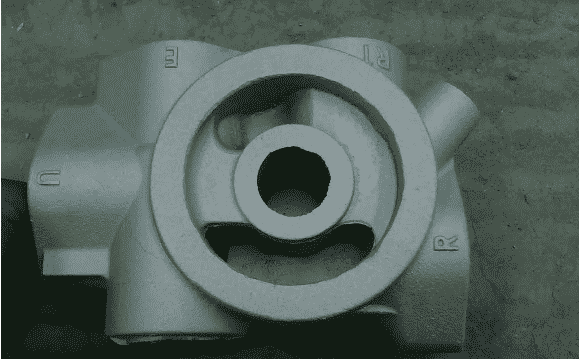
Le “recouvert” une partie du sable enrobé est l'essence. Il s’agit d’un matériau de sable pré-enduit recouvert d’une fine couche de résine phénolique solide, créant un grain semblable à, “pré-enduit” sable. Bien que ce sable soit meuble à température ambiante, sa formation dépend entièrement de la chaleur.
1. How does it work?
D'abord, un moule en métal (généralement du fer ou du cuivre) avec une fonction de chauffage intégrée est créé. Du sable enrobé sec est ensuite injecté ou versé dans ce moule métallique, which is heated to 200-300°C. The coated sand near the mold encounters the high temperature, causing the resin layer on its surface to rapidly melt and flow, then solidify again, forming a hard shell several millimeters thick. After waiting for tens to several minutes for the sand shell to fully harden, the mold is opened, and a hollow, smooth-walled “sand shell” is formed. This is what we often call a “shell mold” ou “shell core.”
2. Quelles sont ses caractéristiques?
High precision and smooth surface: This is the biggest advantage of coated sand. Because it is thermoformed in a precision metal mold, the resulting sand core dimensions are very precise, and the inner holes or cavities of the cast parts have extremely smooth surfaces, requiring almost no subsequent processing.
Ultra-high efficiency, suitable for batch production: The heating and curing process is very fast, and a sand core can usually be made in one or two minutes, which is particularly suitable for automated and large-scale production.
High strength and high gas generation: The sand shell made of coated sand is very hard. Cependant, the disadvantage is that when pouring molten iron, the resin decomposes due to heat and produces a large amount of gas. If the exhaust design is not good, it is easy to cause porosity defects in the casting.
Expertise in creating the “cœur”: Coated sand isn’t primarily used to create the outer mold for the entire casting; rather, it’s specifically used to create the “sand core” placed inside the mold to form the complex inner cavity of the casting. Par exemple, the winding water and oil channels inside the cylinder block and cylinder head of an automobile engine are all composed of individual coated sand cores.
Donc, high temperature and metal molds are used to quickly and accurately replicate sand cores with exquisite details.
For a more intuitive understanding, let’s make a table to summarize:
| feature | Resin sand | Coated sand |
| The essence of craftsmanship | Chemical chilling (auto-durcissant) | Heat curing (thermosetting) |
| Main Applications | Manufacture of entire sand molds for large castings | Precision sand cores for small and medium -sized castings |
| Caractéristiques | Large casting size and good surface quality | Castings are precise in size and have a very smooth surface finish |
| Production efficiency | Slow, takes several hours to cure, suitable for single piece and small batch | Very fast , curing takes only minutes, suitable for large quantities |
| Production costs | Material costs are high, but mold and equipment costs are relatively low | The manufacturing cost of metal molds is high , but the efficiency of each piece is high |
| Applicable castings | Machine tool beds, large gears, vannes, corps de pompe, etc.. | Engine cylinder head, hydraulic valve block, pipe joint, etc.. |
Luoyang Fonyo Heavy Industries Co., Ltée, fondée en 1998, est un fabricant de pièces moulées ferroviaires. Notre usine couvre une superficie de 72 600㎡, avec plus de 300 employés, 32 techniciens, y compris 5 ingénieurs supérieurs, 11 ingénieurs adjoints, et 16 techniciens. Notre capacité de production est 30,000 tonnes par an. Actuellement, nous produisons principalement du moulage, usinage, et montage pour locomotive, wagon, trains à grande vitesse, équipement minier, énergie éolienne, etc..
Nous sommes la fourniture de pièces ferroviaires au CRRC(dont plus de 20 succursales et filiales de CRRC), Machines d'ingénierie Gemac, Groupe Sany, Industries lourdes Citic, etc.. Nos produits ont été exportés vers la Russie, les États-Unis, Allemagne, Argentine, Japon, France, Afrique du Sud, Italie et autres pays du monde.