Scannez le code WeChat pour nous contacter
Scannez le code WeChat pour nous contacter
N'hésitez pas à nous envoyer un email et nous vous répondrons dans les plus brefs délais.
Créer l'avenir avec cœur et âme


When people compare cast steel vs ductile iron, la discussion commence souvent par des chiffres.
Limite d'élasticité.
Résistance à la traction.
Dureté.
Élongation.
Les fiches techniques simplifient la décision. Un matériau a une résistance plus élevée, un autre a un meilleur allongement, and it seems like the choice should be obvious.
But real engineering decisions rarely work that way.
When it comes to railway projects or heavy industrial equipment, it’s not enough to just check a material table. Dans notre fonderie, where we make pièces en acier moulé et ductile iron parts, the real question is always: which part will perform best in the field?
What could realistically go wrong with this part once it enters service?
Material selection begins by understanding how a component will behave under real conditions — not just during laboratory testing. That means looking at loading conditions, manufacturing reliability, géométrie, and the long-term service environment.
When engineers evaluate cast steel vs ductile iron, these practical considerations often matter more than the raw numbers on paper.

One of the first things engineers think about is not strength — it’s failure behavior.
Every material eventually fails. The real concern is how it fails and how predictable that failure is.
Ductile iron has many advantages. Thanks to its graphite nodules, it combines relatively high strength with good fatigue resistance. For many industrial parts that experience stable loading conditions, ductile iron performs extremely well.
Cependant, the graphite structure also changes how cracks initiate and propagate. Under certain situations — especially when stress concentrations are present — cracks can start at graphite nodules.
L'acier moulé se comporte différemment.
Because its microstructure does not contain graphite particles, it tends to have a more continuous metallic matrix. That continuity often gives cast steel higher toughness and better resistance to crack propagation, particularly under dynamic or impact loading.
Pour cette raison, engineers designing safety-critical railway components often lean toward cast steel when there is uncertainty about how the part may be loaded in the future.
It is not always about maximum strength. Often it is about controlling how the material behaves once damage begins.
Another major factor in the cast steel vs ductile iron decision is the way loads act on the component during operation.
Dans les systèmes ferroviaires, loading is rarely perfectly steady.
Wheel loads fluctuate constantly because of:
Some components experience relatively stable forces over long periods. Dans ces cas, ductile iron can be a very efficient solution. Its fatigue resistance and vibration damping properties are well known advantages.
But when loading becomes less predictable, the conversation changes.
Engineers begin asking questions like:
When uncertainty enters the picture, materials with higher toughness and more predictable fracture behavior become attractive.
That is one reason railway cast steel is still widely used in many heavy-duty applications. It provides a level of mechanical robustness that engineers often value when dealing with dynamic environments.
Another aspect that rarely shows up clearly in textbooks is cohérence de fabrication.
Material properties listed in standards assume that the production process is well controlled. En pratique, cependant, real foundry conditions can vary.
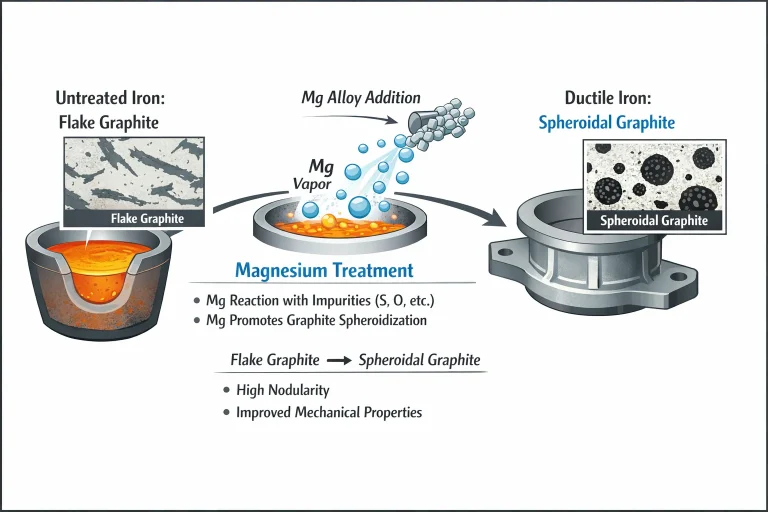
Fonte ductile, Par exemple, depends heavily on proper nodularization during casting. The graphite must form in spherical nodules rather than flakes, and this requires careful control of magnesium treatment, cooling rate, and chemical composition.
Small variations in the process can influence graphite morphology and therefore affect mechanical properties.
Cast steel production has its own challenges, of course. But after proper heat treatment, its microstructure is often more uniform throughout the casting. We explored these principles in more detail in our previous article À l’intérieur des pièces moulées industrielles: Pourquoi l'austénite et le traitement thermique sont importants dans l'acier moulé ferroviaire, where austenite transformation and heat treatment directly influence toughness and strength.
This is why experienced engineers pay attention not only to the material itself, but also to the capabilities of the foundry producing it.
Sometimes a material with slightly lower theoretical performance is preferred simply because it can be produced more consistently and predictably in large quantities.
In large infrastructure systems such as railways, repeatability is extremely important.
Component geometry also influences the cast steel vs ductile iron decision more than many people expect.
Railway parts are rarely thin, simple shapes. Many cast components include thick sections that create challenges during solidification and heat treatment.
In ductile iron castings, thicker sections cool more slowly. That slower cooling can change the balance between ferrite and pearlite in the microstructure and may also affect graphite nodule distribution. We examined this topic in detail in Comprendre l'équilibre ferrite-perlite dans la fonte ductile pour les composants ferroviaires et éoliens.
Par conséquent, properties measured at the surface may not always represent what exists deeper inside the part.
Cast steel components face similar solidification challenges, but they often respond well to controlled heat treatment processes that help refine the internal structure.
À cause de ça, engineers sometimes prefer cast steel when dealing with very thick or heavily loaded sections, where internal material consistency becomes critical.
Instead of focusing only on nominal mechanical properties, engineers want to know something more fundamental:
Is the microstructure stable throughout the entire component?
Cost is always part of the conversation, but it rarely appears in the way people expect.
The price of raw material is only a small part of the overall picture. Engineers and procurement teams typically look at the total cost of ownership over the component’s service life.
Several practical questions come into play:
A material that appears cheaper at first may introduce higher risks during manufacturing or maintenance.
En revanche, a slightly more expensive material may reduce failures, simplify inspection procedures, or extend service life significantly.
For infrastructure systems that operate for decades, reliability often becomes the most important economic factor.
Standards and specifications remain essential tools for engineers.
They establish the boundaries for chemical composition, mechanical strength, et exigences en matière de traitement thermique.
But experienced engineers know that these specifications are only the starting point.
The real story often lies in the microstructure.
We discussed this in more detail in our earlier article Acier moulé vs. Fonte Ductile: Comment la microstructure affecte les performances des énergies ferroviaire et éolienne, where microstructural differences play a central role in material performance.
Under a microscope, materials reveal details that influence long-term performance:
These microstructural features determine how a material responds to stress, changements de température, and fatigue over time.
In many engineering discussions, the final material choice becomes clear only after considering how microstructure, conditions de chargement, and manufacturing control interact together.
Good casting design rarely begins with a spreadsheet.
Plus souvent, it begins with understanding what is happening inside the material itself.

The comparison between cast steel vs ductile iron is often simplified into a debate about mechanical properties.
En réalité, the decision is much more nuanced.
Engineers evaluate several interconnected factors:
Only after considering all these aspects can the most suitable material be selected.
Both railway cast steel et fonte ductile play important roles in modern industrial systems. Each material has strengths that make it valuable in the right application.
The key is not choosing the material with the most impressive numbers on paper.
The key is selecting the material that will perform reliably, de manière prévisible, and safely in the real world.
This article is part of our À l’intérieur du moulage industriel series, where we explore the engineering principles behind industrial casting materials and manufacturing.
Vous pourriez également être intéressé par:
À Luoyang Fonyo Heavy Industries Co., Ltée., we work closely with engineers and equipment manufacturers to produce high-reliability industrial cast components for railway and heavy equipment applications. We can design and manufacture customized products based on your drawings or samples. If you would like to learn more about our casting capabilities and engineering support, s'il vous plaît visitez: www.railwaypart.com