Escanea el código WeChat para contactarnos
Escanea el código WeChat para contactarnos
No dudes en enviarnos un correo electrónico y te responderemos lo antes posible.
Creando el futuro con corazón y alma


Railway sleepers may seem like simple structural components, pero cualquiera que esté involucrado en la ingeniería ferroviaria sabe que tienen una influencia significativa en el rendimiento de la vía.. Ellos apoyan los rieles, mantener el calibre correcto, transfer wheel loads to the ballast or slab, and work together with the rail fastening system to keep the track stable under repeated dynamic loads.
Choosing the right railway sleeper is not simply a matter of selecting the strongest material. A sleeper that performs well on a heavy-haul freight line may not be the best choice for a metro system, while a material that offers the lowest initial cost may require much higher maintenance over its service life.
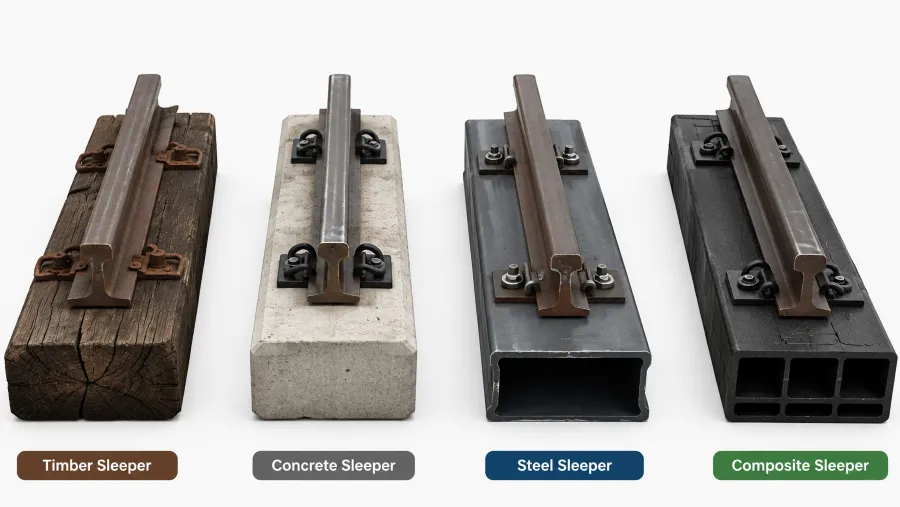
Hoy, four types of railway sleepers are widely used around the world:
Cada uno tiene sus propias fortalezas., limitations, and ideal applications. The best option depends on factors such as axle load, velocidad del tren, clima, maintenance strategy, condiciones ambientales, and project budget.
En esta guía, we’ll compare concrete, madera, acero, and composite railway sleepers from an engineering perspective. En lugar de simplemente enumerar ventajas y desventajas, Explicaremos por qué cada material tiene un rendimiento diferente y dónde ofrece el mayor valor.. Ya sea que esté diseñando un nuevo ferrocarril, actualizar una línea existente, o abastecimiento de componentes ferroviarios, comprender estas diferencias le ayudará a tomar una decisión más informada.
Cuando la gente piensa en infraestructura ferroviaria, Suelen centrarse en rieles o trenes.. En realidad, La estabilidad de toda la estructura de la vía depende de la interacción entre varios componentes., y la traviesa de ferrocarril es una de las más importantes.
A traviesa de ferrocarril realiza varias funciones esenciales:
Without properly selected sleepers, even high-quality rails and fasteners cannot maintain long-term track geometry.
Por esta razón, railway engineers rarely evaluate sleepers in isolation. En cambio, they consider the entire track system, including the rails, clips de riel, almohadillas de riel, fastening assemblies, ballast condition, and expected operating environment.
A traviesa de ferrocarril that performs well with one fastening system may not be suitable for another. Asimismo, a sleeper designed for a high-speed passenger line may not deliver the durability required for a heavy-haul freight corridor carrying high axle loads.
The right sleeper material improves not only track stability but also maintenance efficiency, comodidad de marcha, and the overall life-cycle cost of the railway.
Although many specialized sleeper designs exist, modern railways mainly use four materials.
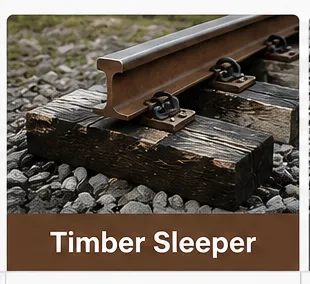
Timber sleepers are the oldest type of railway sleeper and have been used since the earliest days of railway construction. Even today, they remain common in North America, Australia, and many existing railway networks.
One reason timber sleepers have survived for so long is their flexibility. Wood naturally absorbs vibration and impact loads, making it suitable for locations where some elasticity is beneficial.
Timber sleepers are also relatively easy to drill, cut, or modify on site. This flexibility makes them especially useful for switches, crossings, puentes, and maintenance work where customized installation is often required.
Sin embargo, timber is an organic material, and its durability is heavily influenced by moisture, insects, fungi, and weather conditions. Even when treated with preservatives, timber sleepers generally have a shorter service life than concrete or steel alternatives.
Desde una perspectiva de mantenimiento, they require more frequent inspection and replacement, particularly on heavily trafficked railway lines.
Hoy, timber sleepers are most commonly used for:
While timber sleepers are no longer the preferred choice for most new high-speed or heavy-haul railways, they continue to offer practical advantages in applications where flexibility and ease of maintenance are more important than maximum service life.
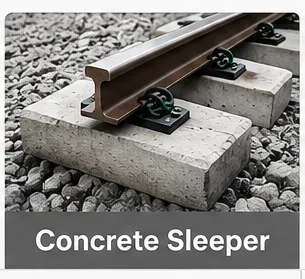
If you visit a newly constructed high-speed railway, metro line, or heavy-haul freight corridor almost anywhere in the world, you’ll most likely find concrete railway sleepers.
Their widespread use is not accidental. Concrete sleepers provide an excellent balance of strength, durabilidad, estabilidad dimensional, and long-term maintenance performance, making them the preferred choice for most modern railway infrastructure.
Most concrete railway sleepers are manufactured as prestressed concrete sleepers. Durante la producción, high-strength steel tendons are tensioned before the concrete is poured. Once the concrete reaches the required strength, the tension is released, creating permanent compressive stress inside the sleeper. This significantly improves crack resistance and allows the sleeper to withstand millions of repeated wheel loads throughout its service life.
Compared with timber sleepers, concrete sleepers are much heavier. While this increases transportation and installation costs, the additional weight also helps keep the track stable under high-speed traffic and heavy axle loads. The increased mass reduces sleeper movement, improves resistance to lateral forces, and contributes to better track geometry over time.
Another advantage is consistency. Because concrete sleepers are manufactured using standardized molds and strict quality control, every sleeper has nearly identical dimensions. This makes rail installation more accurate and helps maintain the designed track gauge throughout the railway’s life.
Concrete sleepers are particularly well suited for:
Por supuesto, concrete sleepers are not perfect. Their greater weight requires lifting equipment during installation, and repairing damaged sleepers is more difficult than replacing timber ones. Además, if the ballast foundation is poorly maintained, impact forces may increase because concrete is less flexible than timber.
For most modern railway projects, sin embargo, these disadvantages are outweighed by lower maintenance requirements and a significantly longer service life. This is why concrete railway sleepers have become the global standard for new railway construction.
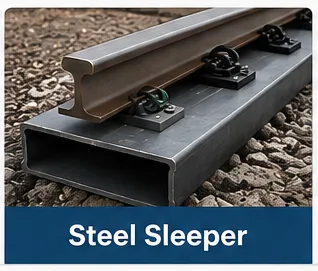
Steel railway sleepers have been used for more than a century, although their application has always been more specialized than concrete or timber.
Unlike concrete sleepers, steel sleepers are manufactured by forming and pressing steel plates into specific cross-sectional shapes. This gives them high strength while keeping their overall weight lower than concrete.
One characteristic engineers appreciate is their excellent dimensional accuracy. Steel sleepers are manufactured with tight tolerances, making them suitable for projects where precise track geometry is essential.
Steel also performs well in environments where timber deteriorates quickly. It is not affected by termites, fungal decay, or moisture in the same way as wood, making it an attractive option in tropical climates and regions where biological degradation is a concern.
Another advantage is recyclability. At the end of their service life, steel sleepers can be recycled almost entirely, reducing material waste and supporting sustainability goals.
Sin embargo, steel sleepers also present several engineering challenges.
Because steel is highly conductive and relatively rigid, vibration and noise transmission can be greater than with timber sleepers. Corrosion protection is another important consideration, especialmente en entornos costeros o regiones donde hay productos químicos agresivos presentes. Por lo tanto, los revestimientos protectores y la inspección periódica son esenciales para mantener el rendimiento a largo plazo..
Las traviesas de acero se utilizan comúnmente en:
Aunque representan sólo un pequeño porcentaje del mercado mundial de traviesas ferroviarias, Las traviesas de acero siguen siendo una solución eficaz para proyectos con requisitos medioambientales u operativos específicos..
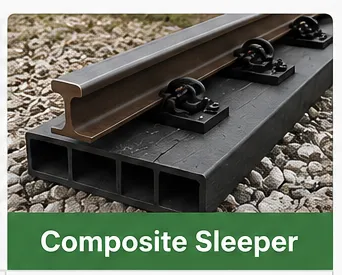
Las traviesas ferroviarias compuestas son la categoría principal más nueva de traviesas ferroviarias y continúan atrayendo atención a medida que los operadores ferroviarios buscan soluciones de infraestructura más sostenibles..
En lugar de madera natural u hormigón armado, Las traviesas compuestas se fabrican con plásticos reciclados., fibra de vidrio, resinas sintéticas, u otros materiales compuestos diseñados. Diferentes fabricantes utilizan diferentes formulaciones., pero el objetivo general es el mismo: Combina la durabilidad de los materiales modernos con la flexibilidad tradicionalmente asociada a la madera..
Desde una perspectiva de ingeniería, Las traviesas compuestas ofrecen un interesante equilibrio de propiedades..
no se pudren, absorber agua, o sufrir daños por insectos como traviesas de madera. También son mucho más ligeras que las traviesas de hormigón., Facilitar el transporte y la instalación en lugares donde no se dispone de equipos de elevación pesados..
One feature that railway maintenance teams often appreciate is that composite sleepers can usually be drilled, cut, and machined on site using tools similar to those used for timber. This makes them particularly suitable for bridge renewals, tunnel maintenance, and track upgrades where customized installation is required.
Composite sleepers also provide excellent electrical insulation and good vibration damping, helping reduce stray current issues and improve ride comfort in certain railway systems.
The main limitation is cost. Initial purchase prices are generally higher than those of timber or concrete sleepers. Because composite technology is still evolving, long-term field data covering 40 a 50 years of service is also less extensive than for traditional materials.
Sin embargo, when maintenance costs, environmental resistance, and expected service life are considered together, composite sleepers often deliver competitive life-cycle value.
Today they are increasingly used in:
There is no single railway sleeper that performs best in every situation. The right choice depends on the operating conditions, maintenance strategy, environmental factors, and life-cycle cost of the railway.
The table below summarizes the key differences between the four major railway sleeper materials.
| Característica | Timber Sleepers | Concrete Sleepers | Steel Sleepers | Composite Sleepers |
| Costo inicial | Bajo | Medio | Medio | Alto |
| Vida útil | 20–30 years* | 40–60 years* | 30–50 years* | 40–50+ years* |
| Peso | Light | Pesado | Medio | Medio |
| Track Stability | Bien | Excelente | Very Good | Very Good |
| Mantenimiento | Alto | Bajo | Medio | Bajo |
| Resistencia a la corrosión | Excelente | Excelente | Requires protection | Excelente |
| Rot & Insect Resistance | Poor | Excelente | Excelente | Excelente |
| Ruido & Vibration Damping | Excelente | Bien | Justo | Very Good |
| Instalación | Easy | Heavy lifting required | Moderado | Easy |
| Recyclability | Moderado | Moderado | Excelente | Bien |
| Aplicaciones típicas | Turnouts, puentes, secondary lines | Alta velocidad, transporte, metro | Minería, industrial, desert railways | Bridges, túneles, wet environments |
*Actual service life depends on axle load, traffic density, clima, practicas de mantenimiento, and local operating conditions.
Although comparison tables provide a useful overview, they should never be the only basis for selecting railway sleepers. Engineering decisions should always consider the entire railway system rather than focusing on a single component.
Por ejemplo, a heavy-haul railway carrying 32.5-tonne axle loads places very different demands on the track than a light industrial railway. Asimismo, a coastal railway exposed to salt spray faces different durability challenges than a dry inland freight corridor.
This is why experienced railway engineers evaluate sleepers together with rail sections, ballast quality, sistemas de fijación, drainage conditions, maintenance capabilities, and expected traffic volume before making a final decision.
One of the questions we hear most often from customers is:
“Which railway sleeper is the best?”
The answer is surprisingly simple:
no hay universalidad “mejor” railway sleeper—only the sleeper that best matches your operating conditions.
Below are some typical recommendations based on common railway applications.
Concrete railway sleepers are the preferred choice for high-speed lines because they provide excellent stiffness, dimensional consistency, and long-term track stability.
At speeds exceeding 250 kilómetros por hora, maintaining precise track geometry becomes critical. The heavier weight of concrete sleepers helps resist track movement, while prestressed construction minimizes cracking under repeated dynamic loading.
Por esta razón, nearly all newly constructed high-speed railways use prestressed concrete sleepers.
Heavy-haul railways carrying high axle loads require sleepers capable of resisting enormous vertical and lateral forces over millions of loading cycles.
Concrete sleepers are generally the first choice due to their strength, durabilidad, and low maintenance requirements.
Sin embargo, en ferrocarriles mineros u operaciones industriales donde el diseño de las vías cambia con frecuencia, Las traviesas de acero también pueden proporcionar ventajas prácticas porque son más fáciles de recuperar., trasladarse, y reciclar.
Los sistemas ferroviarios urbanos operan bajo un conjunto diferente de prioridades.
Además del rendimiento estructural, Los operadores a menudo se centran en la comodidad de marcha., control de vibraciones, y eficiencia de mantenimiento.
Las traviesas de hormigón siguen siendo la opción más común para los sistemas de metro porque ofrecen una geometría estable y una larga vida útil.. En lugares con requisitos estrictos de vibración o corriente parásita, También se pueden considerar traviesas compuestas para secciones específicas de la vía..
Bridges, interruptores, y los cruces a menudo requieren traviesas que se pueden modificar durante la instalación o el mantenimiento..
This is one reason timber sleepers continue to be widely used in these locations.
Composite sleepers have also become increasingly popular because they combine many of timber’s installation advantages with significantly better resistance to moisture, insects, and weathering.
Moisture is one of the biggest challenges for railway infrastructure.
Timber sleepers may deteriorate more rapidly when exposed to continuous moisture, while unprotected steel sleepers require careful corrosion control.
Concrete and composite sleepers generally perform better in wet environments due to their superior resistance to biological degradation and water absorption.
Industrial facilities, construction railways, and temporary tracks often prioritize flexibility and lower initial investment.
Depending on the operating conditions, timber or steel sleepers may offer the most economical solution, particularly when track layouts are expected to change during the project’s lifetime.
Al final, selecting the right railway sleeper is a balance between initial investment and long-term operating cost.
A sleeper with the lowest purchase price may require more frequent replacement and higher maintenance costs, while a more durable option can reduce track possessions, maintenance labor, and life-cycle expenditure over several decades.
Por esta razón, many railway authorities now evaluate railway sleeper projects based on total life-cycle cost rather than purchase price alone.
Choosing the right railway sleeper is only part of the engineering decision. Equally important is selecting a rail fastening system that is compatible with the sleeper material.
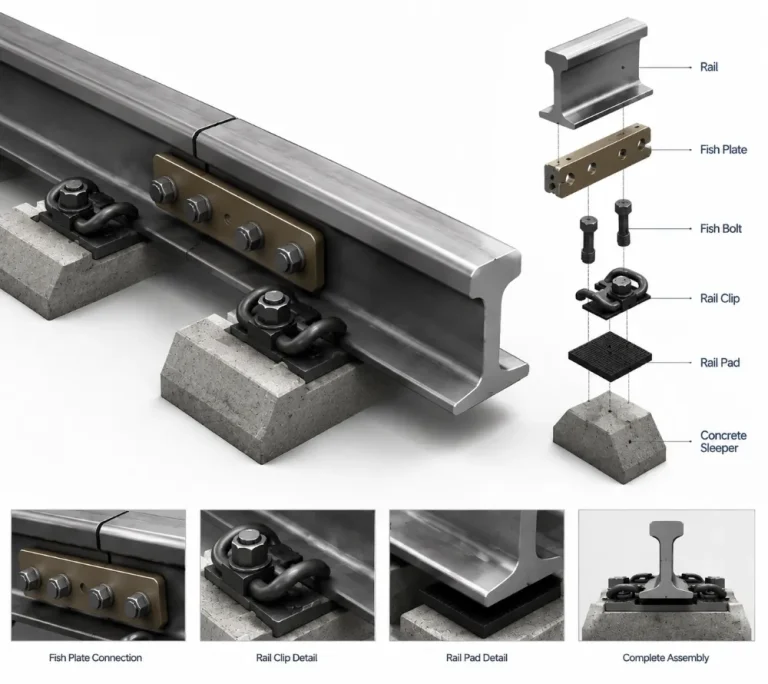
Rieles, traviesas, clips de riel, almohadillas de riel, plato de pescado, y fastening fish bolts work together as one system. Changing the sleeper material often means changing the fastening arrangement as well.
This is why railway engineers evaluate the complete track structure instead of selecting each component independently.
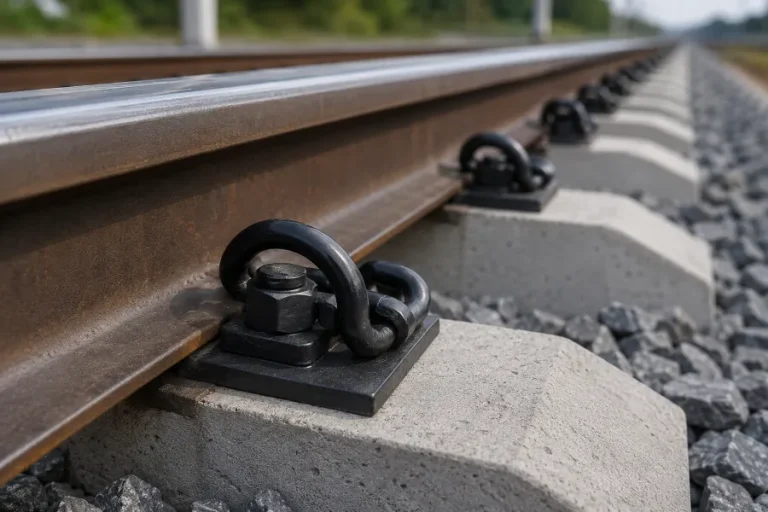
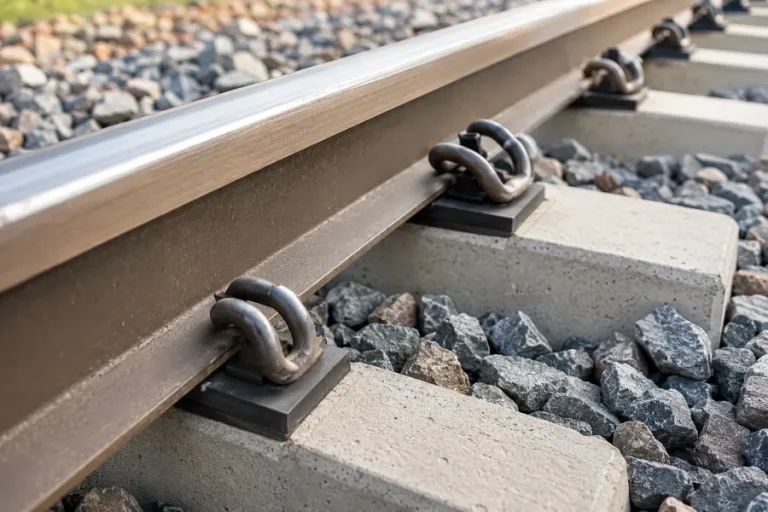
Concrete sleepers are typically designed with cast-in shoulders or embedded inserts during manufacturing. These components provide secure anchoring points for elastic rail clips.
A typical concrete sleeper fastening assembly may include:
Because concrete is rigid, elastic rail clips and rail pads play an especially important role. They provide the necessary clamping force while absorbing impact loads and reducing vibration transmitted from the rail to the sleeper.
This combination allows concrete sleepers to maintain excellent track geometry while still providing the elasticity needed for modern railway operations.
Timber sleepers offer greater flexibility during installation because fasteners can be installed directly into the wood.
Depending on the railway standard, timber sleepers commonly use:
One advantage of timber sleepers is that damaged fastening locations can often be repaired or modified on site. This flexibility makes timber sleepers particularly suitable for turnouts, puentes, and maintenance work where customized installation is frequently required.
Sin embargo, repeated loading may gradually reduce the holding strength of fasteners if the timber deteriorates with age or moisture exposure.
Steel sleepers require specially designed fastening systems because the sleeper itself is manufactured from formed steel sections.
Unlike timber, fasteners cannot simply be driven into the sleeper, and unlike concrete, there are no cast-in inserts. En cambio, fastening components are designed specifically to match the geometry of the steel sleeper.
Electrical insulation is another important consideration. Since steel is conductive, Se requieren componentes aislantes para evitar que corriente eléctrica no deseada pase a través de la estructura de la vía en sistemas ferroviarios electrificados..
Las traviesas compuestas generalmente están diseñadas para ser compatibles con los métodos de fijación ya utilizados para traviesas de madera., convirtiéndolos en un reemplazo práctico en muchos proyectos de renovación de vías..
Porque los materiales compuestos normalmente se pueden taladrar y mecanizar in situ, Los procedimientos de instalación suelen ser familiares para los equipos de mantenimiento..
Sin embargo, Los ingenieros aún deben verificar que el sistema de fijación sea compatible con las propiedades mecánicas del material compuesto.. Factores como la resistencia a la extracción de tornillos, par de apriete, y la distribución de carga a largo plazo deben considerarse durante el diseño del sistema..
La selección de traviesas de alta calidad por sí sola no garantiza un rendimiento confiable de la vía..
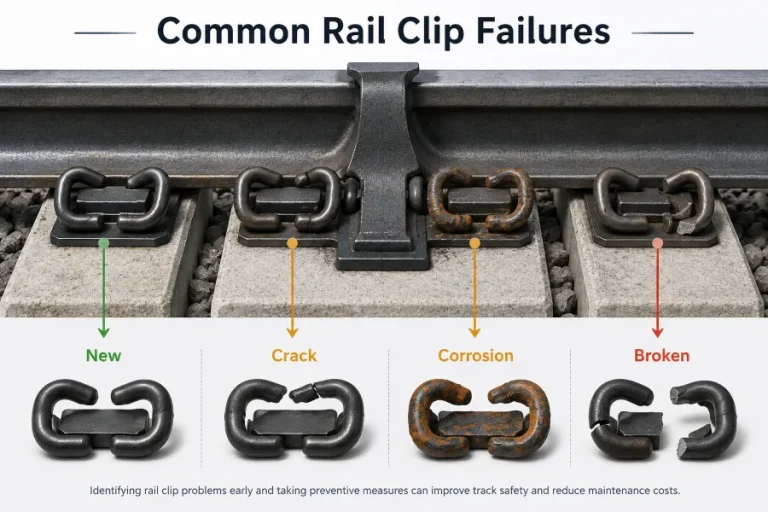
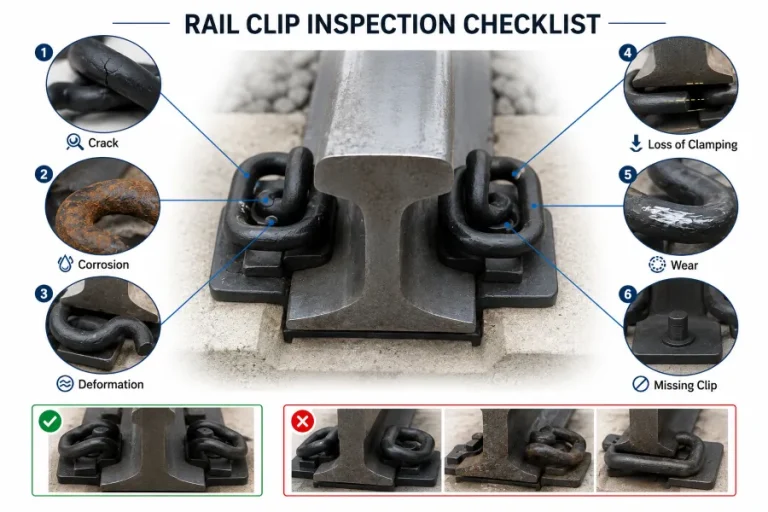
Una traviesa de hormigón combinada con un clip de carril inadecuado, o una traviesa compuesta provista de un dispositivo de fijación incompatible, puede provocar un desgaste prematuro de los componentes, fuerza de sujeción reducida, mayores requisitos de mantenimiento, e incluso deterioro de la geometría de la vía con el tiempo.
Por esta razón, Los proyectos de infraestructura ferroviaria se especifican cada vez más como sistemas de fijación completos en lugar de componentes individuales..
Al evaluar un proyecto ferroviario, Los ingenieros suelen considerar:
Sólo cuando estos elementos trabajan juntos puede la pista lograr la durabilidad, seguridad, y confiabilidad esperada durante toda su vida útil.
Concreto, madera, acero, and composite railway sleepers all have important roles in today’s railway industry. None of them is universally better than the others, because each material has been developed to solve different engineering challenges.
Concrete sleepers have become the preferred choice for most new mainline, metro, and high-speed railway projects thanks to their strength, estabilidad, y larga vida útil.
Timber sleepers remain valuable for bridges, participación, and maintenance applications where flexibility and ease of modification are essential.
Steel sleepers continue to provide reliable performance in mining railways, industrial lines, and environments where durability and recyclability are priorities.
Composite sleepers represent an increasingly attractive alternative for bridge renewals, wet environments, and projects seeking longer service life with reduced maintenance.
The key is to evaluate the railway as a complete system rather than selecting components individually. The right sleeper, combined with a properly designed rail fastening system, helps improve track stability, reducir los costos de mantenimiento, and extend the service life of the entire railway infrastructure.
En Industrias pesadas Co. de Luoyang Fonyo., Limitado., we manufacture a wide range of railway fastening components that are compatible with concrete, madera, acero, and composite sleeper systems. Nuestro portafolio de productos incluye clips de riel, almohadillas de riel, platos de pescado, pernos de pescado, and other railway fastening components manufactured to international standards for freight, pasajero, metro, and heavy-haul railway projects worldwide.
If you’re selecting railway sleepers for a new project or upgrading an existing railway line, our engineering team can help you identify fastening solutions that match your track design and operating requirements.
There is no single best railway sleeper material for every project. Concrete sleepers are generally preferred for high-speed and heavy-haul railways because of their durability and stability. Timber sleepers remain suitable for bridges and turnouts, while steel and composite sleepers are often selected for specific environmental or operational requirements.
Concrete railway sleepers offer a long service life, excelente estabilidad dimensional, and lower maintenance requirements than timber sleepers. Their strength and resistance to repeated dynamic loading make them the preferred choice for most modern railway infrastructure.
Sí. Although concrete sleepers dominate new railway construction, timber sleepers are still widely used for railway bridges, interruptores, crossings, heritage railways, and maintenance projects where on-site modification is important.
Composite railway sleepers resist moisture, insects, and rot while providing good vibration damping and electrical insulation. They are increasingly used in bridges, túneles, coastal railways, and environmentally sensitive areas where long service life is required.
Service life depends on material, traffic conditions, mantenimiento, and climate.
Typical service lives are:
Actual performance varies depending on axle loads and operating conditions.
Prestressed concrete sleepers are generally the preferred choice for heavy-haul railways because they provide excellent load capacity, track stability, and resistance to repeated fatigue loading.
No siempre. Different sleeper materials require different fastening arrangements. Concrete sleepers commonly use elastic rail clips with cast-in shoulders or inserts, while timber, acero, and composite sleepers require fastening systems specifically designed for their structural characteristics.
Neither material is universally better. Concrete sleepers are generally preferred for high-speed and mainline railways, while steel sleepers perform well in mining railways, pistas industriales, desert environments, and projects where recyclability is important.
Important factors include axle load, velocidad del tren, traffic density, clima, maintenance strategy, ballast condition, environmental exposure, fastening system compatibility, and total life-cycle cost rather than purchase price alone.
Railway sleepers and fastening components work together as a complete track system. Selecting compatible rail clips, almohadillas de riel, aisladores, and fastening hardware helps maintain track geometry, improve vibration control, reduce maintenance, and extend the service life of the railway.