Escanea el código WeChat para contactarnos
Escanea el código WeChat para contactarnos
No dudes en enviarnos un correo electrónico y te responderemos lo antes posible.
Creando el futuro con corazón y alma


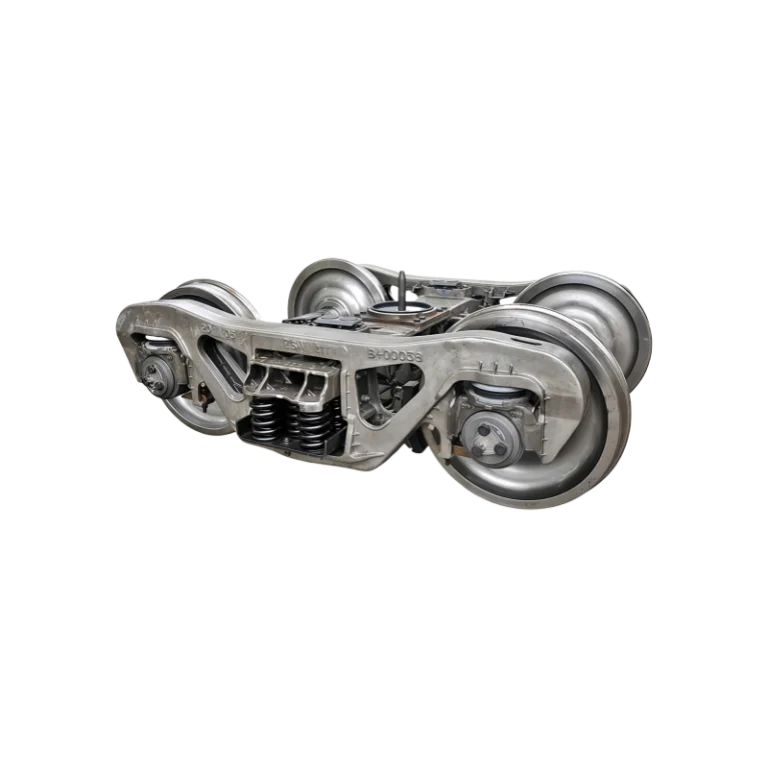
As a core component of the railway transportation system, La calidad de las ruedas del tren afecta directamente a la seguridad., eficiencia, y vida útil de los trenes. ruedas fundidas, due to their excellent comprehensive mechanical properties and high economic efficiency, have become the preferred choice in heavy-haul and railway fields. Sin embargo, their manufacturing process involves multiple precise and strict technical requirements, incluyendo la selección de materiales, diseño estructural, proceso de fundición, tratamiento térmico, y ensayos no destructivos, entre otros. Only through strict control throughout the entire process can the high reliability and long lifespan of the wheels be guaranteed during actual operation.
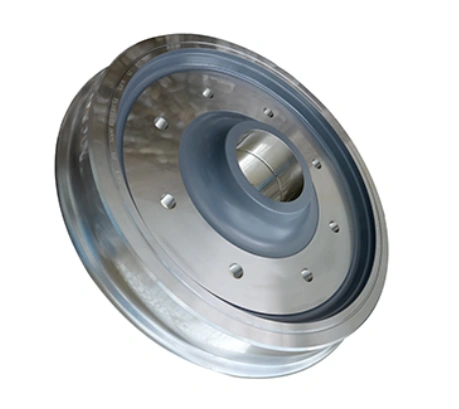
1.1 The material of the wheels must have high strength, dureza, y resistencia al desgaste. Al mismo tiempo, the manufacturers also consider good toughness and fatigue resistance. Actualmente, high-carbon low-alloy steels are widely used, such as the R7, R8, R9 series in European standards, or CL60, ER8, ER9 in Chinese standards. The carbon content is typically between 0.55% y 0.65%, with the addition of silicon, manganeso, cromo, and other alloy elements to enhance hardenability and comprehensive mechanical properties.
1.2 In addition to strictly adhering to chemical composition standards, the microstructure is also crucial. The ideal microstructure should be fine lamellar pearlite. So it can avoid the presence of network-like pre-eutectic ferrite or large carbides, as these would significantly affect the wheel’s wear resistance and resistance to contact fatigue. Por lo tanto, from steelmaking to casting, every step must strictly control the material’s purity, gas content, and non-metallic inclusions.
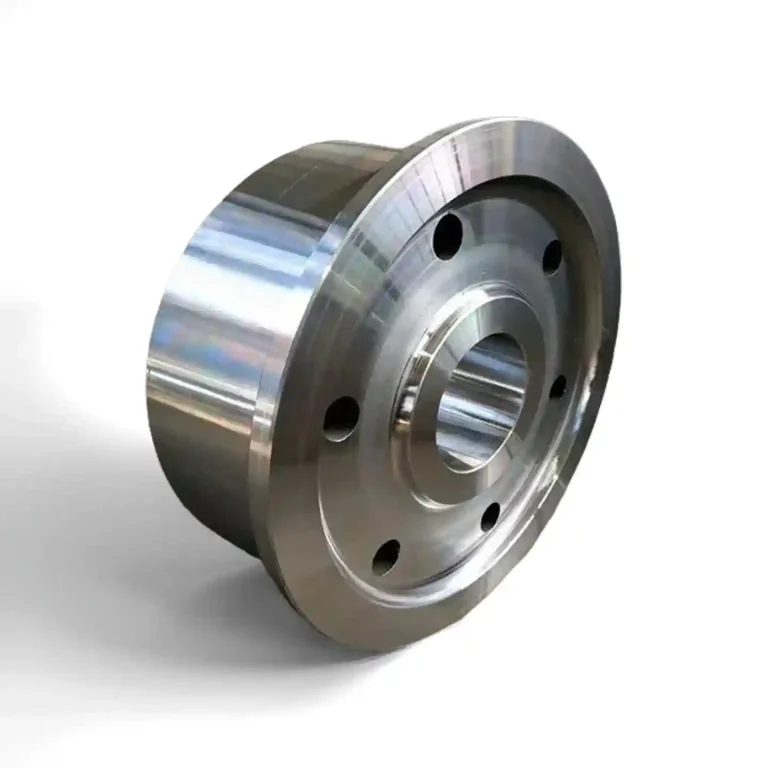
2.1 The structural design of the wheels must balance mechanical rationality, estabilidad operativa, and manufacturing feasibility. It mainly consists of the rim, spokes, y centro. el borde, which directly contacts the rails, must strictly comply with the profile standards set by the country or the International Union of Railways (UIC) for the tread contour, altura de la brida, and thickness to ensure guiding performance through curves and reduce derailment risks.
2.2 The spokes are supporting structure connecting the rim and the hub. So they need to have good bending resistance and fatigue resistance. Common designs include S-shaped and wavy shapes, which can effectively buffer vibrations and impacts during operation.
2.3 In terms of dimensional accuracy, the key dimensions of the finished wheels, such as diameter, espesor de brida, and rim width, typically need to be controlled within ±0.5 mm. So it can ensure correct fit with the rails and smooth train operation.
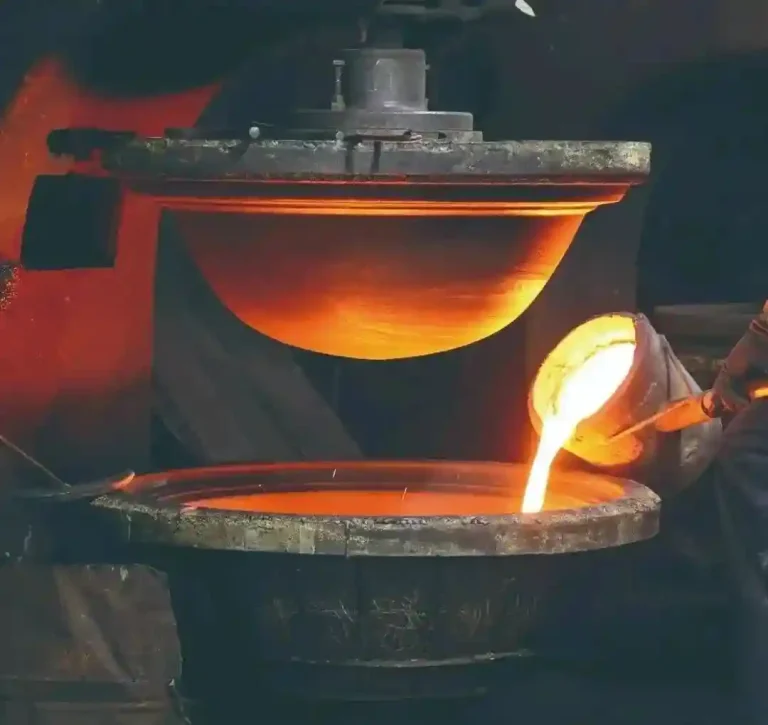
3.1 La fundición es el paso fundamental que determina el rendimiento de las ruedas.. Actualmente, La fundición por gravedad o la fundición centrífuga son los métodos principales.. La fundición centrífuga se adopta ampliamente debido a su capacidad para aumentar significativamente la densidad del metal y las propiedades mecánicas.. Durante el proceso de vertido, la temperatura del acero fundido (generalmente controlado entre 1480°C y 1520°C) Debe controlarse estrictamente para evitar defectos como granos gruesos debido a temperaturas excesivamente altas o un llenado insuficiente debido a bajas temperaturas..
3.2 Además, Parámetros como el diseño del molde y el precalentamiento., velocidad de vertido, y la velocidad de la centrífuga deben controlarse con precisión. La fundición de ruedas moderna a menudo utiliza tecnología de simulación por computadora para predecir problemas potenciales como cavidades por contracción., porosidad, o grietas calientes durante el proceso de fundición, thereby optimizing the process and improving the first-pass qualification rate.
4.1 después del casting, the wheels must undergo appropriate heat treatment to adjust their microstructure and properties, mainly including normalizing, temple, y templado. Normalizing aims to refine grains and eliminate casting stresses; quenching obtains a high-hardness martensitic microstructure through rapid cooling; and tempering reduces brittleness and improves toughness, stabilizing the microstructure.
4.2 The heating rate, holding temperature and time, cooling medium and rate during heat treatment must be set according to the wheel material and size. Por ejemplo, some high-strength wheels use isothermal quenching to obtain a lower bainite microstructure, achieving both high hardness and good toughness.
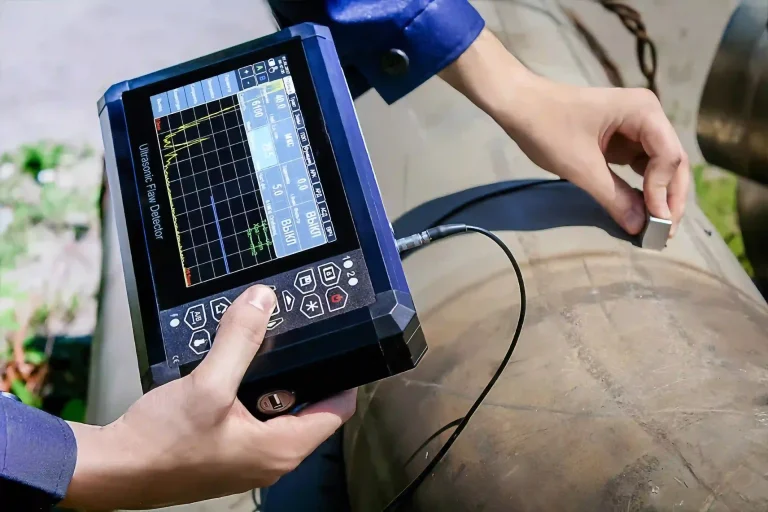
To ensure that each wheel is free of internal defects, comprehensive non-destructive testing must be conducted. Commonly used methods include ultrasonic testing (Utah), prueba de partículas magnéticas (MONTE), and eddy current testing (ET). Ultrasonic waves can effectively detect internal cracks, inclusiones, shrinkage cavities and other defects, while magnetic particle and eddy current testing are mainly used for identifying surface and near-surface defects.
In addition to non-destructive testing, destructive tests should also be conducted on samples from the same batch of wheels, including tensile tests, impact tests, hardness tests and metallographic analysis, to ensure that their mechanical properties and microstructure meet the standard requirements.
Wheels need to maintain stable performance under different climatic conditions, track conditions and operating loads. Por ejemplo, in cold regions, they need to have low-temperature impact toughness; in high-speed operation environments, they need to have excellent resistance to thermal damage and rolling contact fatigue. Por lo tanto, in addition to the control of the above manufacturing processes, their durability should also be verified through bench tests and actual operation evaluations.
Industrias pesadas Co. de Luoyang Fonyo., Limitado,Fundada en 1998, es un fabricante de piezas de fundición para ferrocarriles. Nuestra fábrica cubre un área de 72,600㎡, con más de 300 empleados, 32 tecnicos, incluido 5 ingenieros superiores, 11 ingenieros asistentes, y 16 Técnicos. Nuestra capacidad de producción es 30,000 toneladas por año. Actualmente, Producimos principalmente fundición., mecanizado, y montaje para locomotora, automotor, trenes de alta velocidad, equipo de minería,energía eólica,etc..
Somos el proveedor de repuestos ferroviarios para CRRC.(incluyendo más de 20 sucursales y subsidiarias de CRRC),Maquinaria de ingeniería Gemac,Grupo Sany, Industrias Pesadas Citic,etc.. Nuestros productos han sido exportados a Rusia., los estados unidos, Alemania, Argentina, Japón, Francia, Sudáfrica,Italia y otros países de todo el mundo..
Información del contacto:
Correo electrónico:[email protected]
Móvil:008615515321683