Scan the WeChat code to contact us
Scan the WeChat code to contact us
Feel free to send us a email and we will reply to you as soon as possible.
Creating the future with heart and soul


If you’ve ever wondered what goes into stopping a train that weighs thousands of tons, you might be surprised to learn that it’s not as simple as just pressing a brake pedal. When you’re designing a train’s braking system, it’s a lot more involved than that. It’s really about the careful, deliberate partnership between two key components: the brake shoes and the wheels themselves. How well these two work together dictates everything—how efficiently the train stops, how safe it is, and how long the parts last.
Let me walk you through how brake shoes actually do their job, why the wheels matter just as much, and how the materials we choose make all the difference in real-world performance. Now, for full clarity, modern high-speed trains often use a different setup called disc brakes, but here we’re focusing on the classic tread brake system—the one where the shoe contacts the wheel directly.
Think of brake shoes as the component that takes all that tremendous energy from a moving train and turns it into heat. They do this by pressing firmly against the wheel treads, using either hydraulic or pneumatic pressure. That contact creates friction, and that friction is what slows the train down in a smooth, controlled way.
Here’s what’s happening physically. A train barreling down the track carries an enormous amount of kinetic energy. The formula for that is one we use all the time in engineering: kinetic energy equals half the mass times the velocity squared. When you’re dealing with train masses, that number gets huge fast. What the brake shoes do is apply a steady force across the contact patch on the wheel tread, and that force works to dissipate all that energy as heat.
The math is straightforward: the work done equals the force multiplied by the distance over which it acts. But the real variable we have to nail is the friction coefficient between the shoe and the wheel. If that coefficient isn’t stable, you can’t predict stopping distances reliably. That’s why we spend so much time selecting materials that keep that friction consistent even when things get hot.
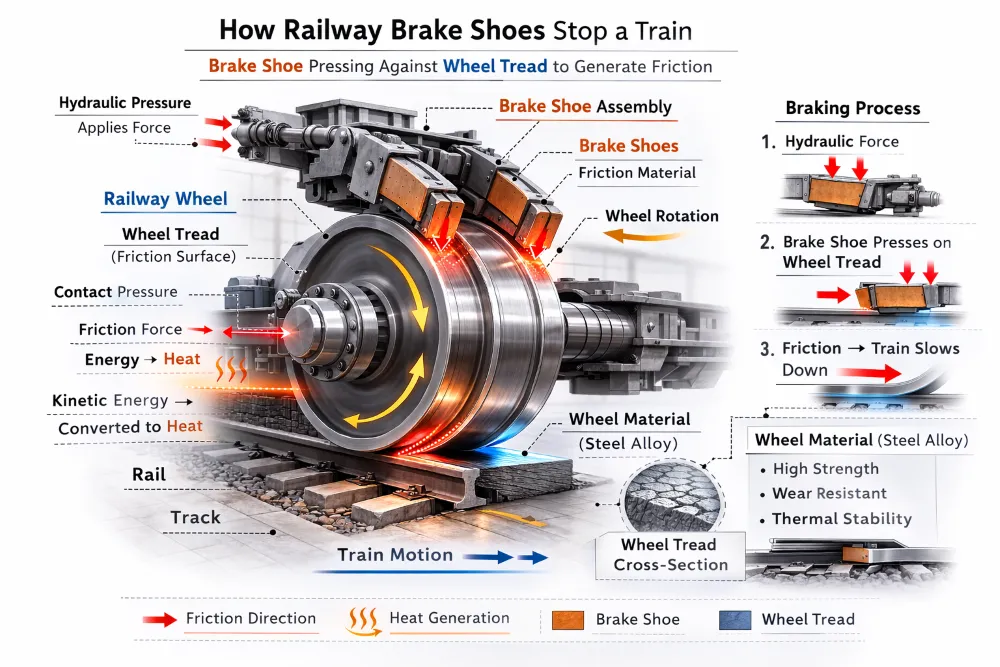
Over the years, we’ve settled on a few main types of materials for brake shoes, each with its own strengths. Cast iron is the old standby—it gives you great friction and wears like iron, literally, which is why you see it so much in freight applications where durability is king. Then there are composite materials, which are lighter and much quieter, making them the go-to for passenger trains where ride comfort matters. And for the really demanding jobs, we have specially formulated alloy materials designed to handle extreme speeds or loads without breaking down.
When I’m choosing a material for a project, I’m looking at the train’s operating speed, what kind of service it’s in, and most importantly, what the wheels are made of. You can’t just pick one in isolation.
A few key things determine whether a brake shoe design will work well in practice. Contact pressure is a big one—if it’s too high, you’ll wear out shoes and wheels too fast; too low, and you won’t stop in time. Thermal capacity is another. All that friction generates serious heat, and if the material can’t handle it, you’ll get degradation and fading. And you have to get the geometry right. The shoe has to align perfectly with the wheel tread, or you’ll end up with uneven wear and vibration that passengers will feel and complain about.
Before any design goes into production, we run simulations to model all these factors and make sure they balance out.
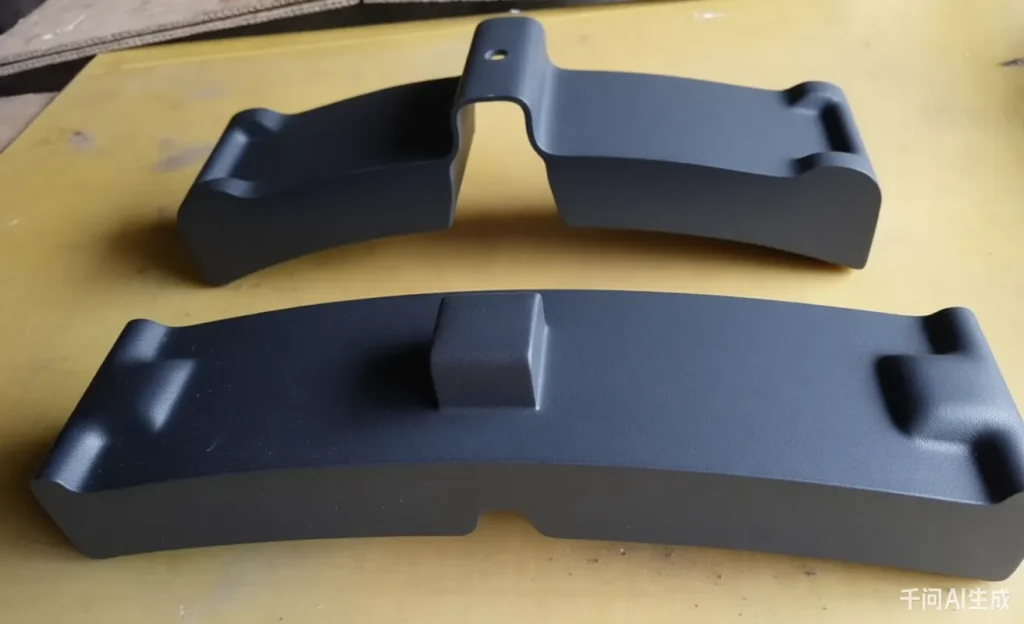
Here’s where it gets interesting. The brake shoe does half the work, but the railway wheel is its essential partner. The wheel tread provides that friction surface, and it’s also carrying the entire weight of the train. So its material and shape directly affect how well the brakes work.
Most railway wheels you’ll encounter are made from high-strength steel with what we call a ferrite-pearlite microstructure. That’s engineering-speak for a material that gives us three things we absolutely need: high wear resistance so wheels last, enough toughness to resist rolling contact fatigue from all those miles of travel, and thermal stability to handle repeated braking without deforming.
For the really high-speed stuff or extreme heavy-haul applications, we might go with martensitic steel, which is even harder. The wheel material you choose affects everything downstream. It changes the friction coefficient with whatever brake shoe material you’re pairing. It influences how quickly heat dissipates during braking. And it determines how fast both components wear. Get the pairing wrong, and you’ll see glazing on the shoe surface, cracks in the wheel tread, or premature wear that drives up maintenance costs.
You also have to pay attention to the wheel’s surface condition and its profile. How smooth the tread is, the wheel diameter, the flange design—all of these influence whether the brake shoe contacts evenly. We monitor wheel profiles constantly because even small deviations can add meters to stopping distances. When you’re talking about safety, meters matter.
The wheel material essentially sets the rules for what the brake shoe can achieve. Let me give you some real-world examples.
Take high-carbon alloy steel wheels. They’re incredibly wear-resistant, which is great for longevity, but they tend to have a slightly lower friction coefficient with standard cast iron shoes. So if you’re using these wheels, you might need to spec composite or alloy brake shoes to get the braking performance you need.
Then there are ductile iron wheels, which are softer. They actually give you higher friction, which sounds good, but they can wear faster under heavy braking. For slower freight operations where you’re not heating them up as much, they work fine.
For high-speed passenger trains, we use heat-treated steel wheels specifically designed to withstand repeated thermal cycles. They won’t deform under the heat of repeated high-speed stops. But that means your brake shoe material has to be able to maintain its friction at those elevated temperatures without fading.
Every time we design a braking system, we’re carefully matching these materials to optimize how energy gets dissipated, how wear balances out, and ultimately, how predictably the train stops.
Out in the real world, away from the lab and the simulations, a bunch of other factors come into play.
Alignment and mounting are critical. If the brake shoes aren’t positioned exactly right, you won’t get uniform contact, and that leads to vibration and uneven wear. We check this constantly during installation and maintenance.
Speaking of maintenance, you have to stay on top of wear monitoring. Wheels and shoes need regular inspections for flat spots, glazing, or cracks. A flat spot on a wheel from a locked brake, for instance, can ruin ride quality and lead to more damage down the line.
Environmental conditions throw another variable in. Rain, ice, and even oil on the track reduce friction significantly. Some systems use sanders to improve grip, and we sometimes adjust brake shoe materials to compensate for expected operating conditions.
And don’t forget load variability, especially with freight trains. A train might be fully loaded one day and empty the next. The brake shoe and wheel interaction has to handle that range without losing effectiveness.
These days, many operators use predictive maintenance software that tracks wear rates and schedules replacements before anything fails. It saves money and keeps safety margins where they should be.
It might help to compare two very different applications. In freight trains, you’ve got heavy loads but lower speeds. The priority is durability and wear resistance. That’s why cast iron brake shoes paired with high-carbon steel wheels are so common here. They wear slowly and stop reliably even with massive train weights.
Now look at high-speed passenger trains. They’re lighter but much faster. The priorities shift to quiet operation and managing thermal stress. So you’ll see composite brake shoes that run quietly and handle heat well, paired with heat-treated steel wheels that keep their shape under repeated high-speed braking.
Same basic technology, but the materials are tuned completely differently for the job.
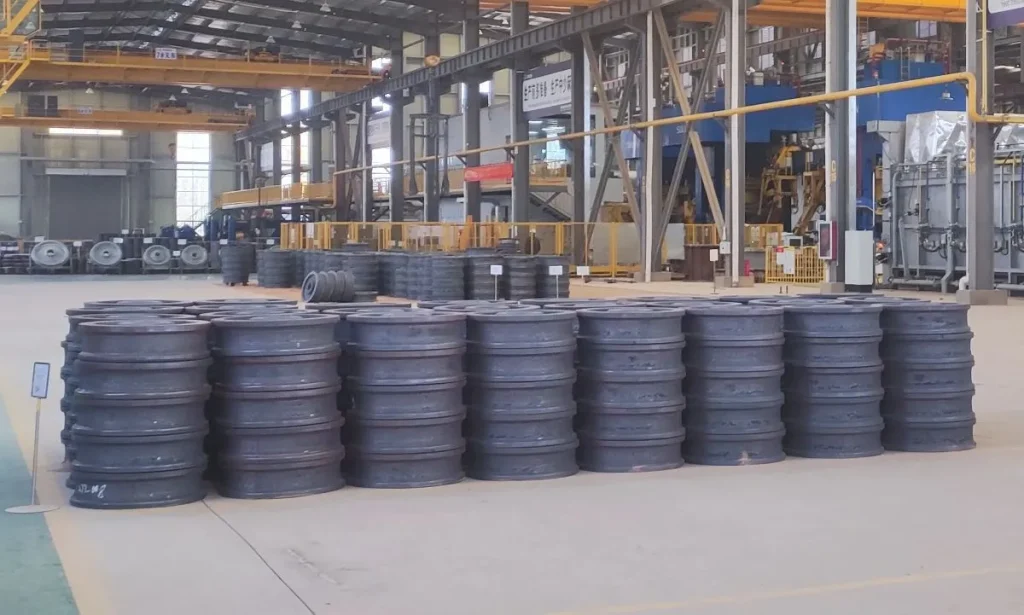
It’s easy to focus on the brake shoes because they’re the part that visibly does the work. But the wheels are just as critical, and here’s why. They’re not just along for the ride. They provide the friction surface that stops the train. They bear the full load and transmit forces through the axles and suspension. And they act as heat sinks during braking, absorbing and dissipating all that thermal energy.
When you invest in high-quality wheels, you get reduced maintenance costs, improved safety margins, and a better ride for passengers. That’s why we always evaluate the braking system as a whole—brake shoes and wheels together—not as separate components.
Stopping a train safely is a system-level engineering challenge. You have to get the brake shoe material right—the friction coefficient, wear resistance, and thermal tolerance all have to work. You have to select the wheel material carefully—hardness, microstructure, and fatigue resistance all matter. The mechanical design has to be precise—alignment, contact pressure, and wheel geometry all affect performance. And you have to account for operational factors—load, speed, and environmental conditions all change the equation. When all components work together, trains stop predictably, wear is minimized, and safety is maximized. At Luoyang Fonyo Heavy Industries Co., Ltd., we specialize in manufacturing high-quality railway wheels engineered to perform seamlessly with modern brake shoes., and we also customized railway casting and forging parts according to your drawings and samples. Our products are designed for long-term reliability, superior efficiency, and reduced maintenance costs. You can explore our full range of solutions on our website www.railwaypart.com to get more information about us.