Scan the WeChat code to contact us
Scan the WeChat code to contact us
Feel free to send us a email and we will reply to you as soon as possible.
Creating the future with heart and soul


A railway wheel quotation is a cost build-up, not a single figure. Steel yield, forming route, heat treatment cycle, machining hours, inspection scope, documentation, packing and freight all sit inside the number, and any one of them can be left out quietly.
Five suppliers receive the same drawing. Four numbers come back within a week, one takes a month, and none of them are close. The buyer looks at the spread and assumes somebody is either gouging or cutting corners.
Usually neither. What happened is that five different products were quoted, and the drawing was only the part they had in common.
We build railway wheel quotations at FONYO most weeks, to EN 13262 and to AAR M-107, and the questions we get about price are rarely about price. They are about what is inside it. So here is the stack, opened up.
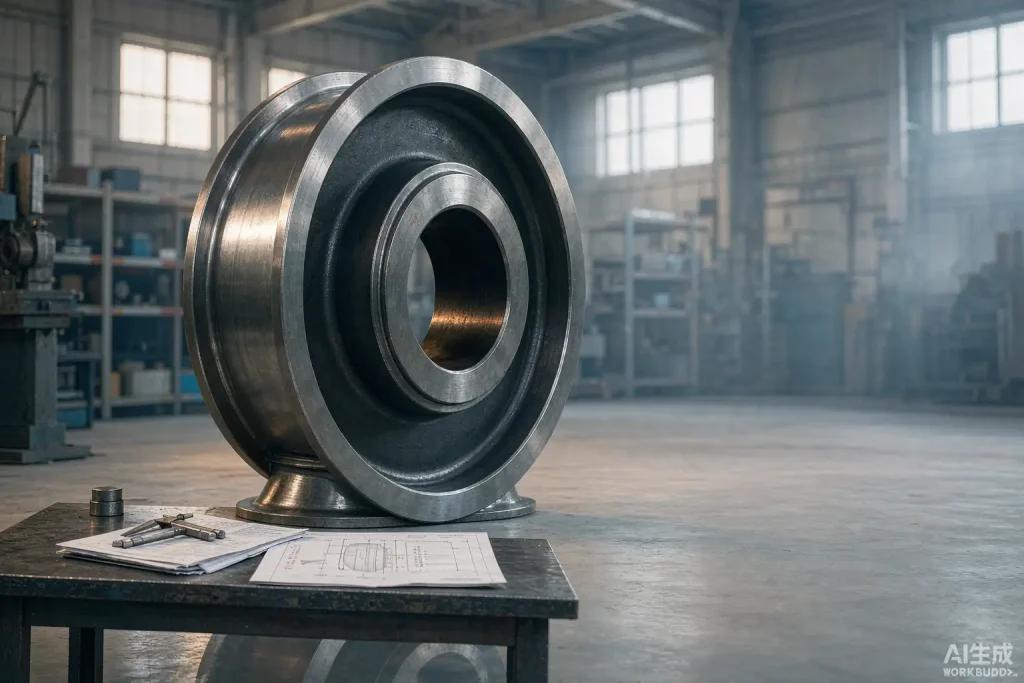
A monobloc wheel starts as a weighed piece of steel. Everything after that either removes material, changes its structure, or proves that it is correct. Each of those steps costs money, and each one has a range of legitimate ways to be carried out.
Take rim quenching. One shop runs a full quench and temper cycle with controlled cooling and verifies residual stress on samples. Another normalizes the wheel and calls it heat treated. Both can print “heat treated” on the offer. The wheels will not behave the same way in service, and the gap between those two prices is real cost, not margin.
Ultrasonic testing works the same way. EN 13262 asks for examination of rim, web and hub with acceptance levels tied to the wheel category. A quotation can include 100% UT with written records, or it can say “UT as per standard” and mean sampling. The words look similar on paper. The cost does not.
Most of a wheel’s cost is weight and hours, in that order. A finished wheel is a fraction of the input billet once you count the bore, the disc, the flash and the crop ends, and steel is bought by weight. That single ratio explains more price variance than anything else in the stack.
| Cost block | What it actually covers | Where variance hides |
| Raw material | Billet or bloom, grade, input weight per wheel | Grade substitution, yield per piece, scrap credit |
| Forming | Forging press or rolling mill, dies, setup | Die condition, pieces per die, whether setup is amortised |
| Heat treatment | Cycle time, furnace load, quench and temper | Whether rim quenching is done, whether the cycle is shortened |
| Machining | Turning hours, tread profile, bore, hub faces | Form tool versus traced profile, tool life |
| Inspection | UT, MT, dimensions, hardness, imbalance | 100% or sampling, whether records are included |
| Documentation | Certificates, heat number trace, test reports | EN 10204 3.1 versus 3.2, third-party witness |
| Packing and freight | Cradles, rust protection, sea packing, loading | Whether packing is in the price at all, Incoterm |
| Commercial | MOQ, payment terms, currency, validity | Financing cost carried by the seller |
This is how we group costs internally. It is not an industry format, and another mill will slice the same wheel differently. It also explains a good part of why railway wheel prices vary so much between offers that look identical on the first page.

I have seen the same 840 mm freight wheel offered across a range wide enough to buy two of one and one of the other. Some of that spread is cost. Some of it is a number typed into a marketplace field by someone who has never stood next to a forge.
The legitimate reasons are the ones worth learning, because they are the ones you can check.
Input weight. A shop that forges close to finish and a shop that machines from a heavier blank buy different amounts of steel for the same finished wheel. Nobody lies about this. It simply never appears in the comparison table.
Forming route. Forged and rolled, forged only, or cast. Same geometry, different grain structure, different fatigue behaviour, different price. The railway wheel manufacturing process diverges early, and the cost follows.
Heat treatment. Rim quench and temper, through hardening, or normalizing. Cycle length drives furnace time, and furnace time is one of the largest costs after material. There is a separate article on railway wheel heat treatment: normalizing, quenching and tempering if you want the metallurgy behind that line item.
Machining approach. Tread profiles such as those in EN 13715 can be turned with form tools or traced on a CNC. One is faster. The other holds profile more consistently across a batch. Guess which one costs more.
Inspection depth. 100% UT and MT with records, or sampling. A hardness map across the rim, or one reading per heat.
Quantity and setup. Twenty pieces and two hundred pieces are different products commercially. Die and setup costs land somewhere, and where they land is a choice the supplier makes.
This is where most of the real gap lives, and it is almost never dishonest. It is just unstated. Read a railway wheel quotation twice: once for what is priced, once for what is absent.
Two wheels can share a drawing and still be different products, because a drawing only fixes geometry. Material, acceptance criteria and qualification route come from the standard named in the purchase order.
EN 13262 controls steel grade, mechanical properties, internal soundness and residual stress, and it separates requirements by wheel category. Category 1 wheels carry tighter acceptance levels and additional checks on heat treatment homogeneity. AAR M-107 sets its own classes and its own inspection regime. When a buyer has not named the standard, we ask. Guessing is not a service.
The differences between these systems are covered in The Complete Guide to Railway Wheel Standards: EN 13262, AAR M-107, TB/T 2817 and More. The short version for pricing purposes: the standard changes the inspection cost, and the inspection cost changes the railway wheel quotation.
Technical note: standard editions are revised. EN 13262 was updated in 2026. Always quote the edition your technical specification refers to, and confirm acceptance criteria with the vehicle builder or the operator before the order is placed.
Quoting from a drawing alone produces a number that is either padded or wrong. So we run the same list every time, and it usually takes less than a day.
When something is missing, we ask rather than assume. A wheel quoted on an assumed bore tolerance becomes a claim eight months later. There is a useful companion piece on what to prepare before sending an RFQ for custom railway wheels, which lists the information that saves the most time.

Our offers are broken out by cost block. That is unusual in this trade and occasionally inconvenient for us, because a buyer can look at the inspection line and decide to cut it.
Sometimes they should. Often, once they see what the line contains, they leave it alone.
What should be findable in any railway wheel quotation before you sign it:
If any of those is missing, the comparison you are about to make is not between suppliers. It is between assumptions.
These are the questions that come back most often when a railway wheel quotation goes to a buyer who compares offers carefully.
Why is one quote half the price of another for the same wheel?
Sometimes it is a different inspection scope. Sometimes a different heat treatment route. Sometimes it is a trader quoting a wheel they have not bought yet. Ask for the inspection line and the heat treatment route in writing. A supplier who cannot name them is quoting a guess.
Should I compare price per piece or per ton?
Per piece, priced against the same finished weight and the same inspection scope. Per ton comparisons flatter heavy wheels and hide what you are actually buying.
Is a railway wheel quotation normally FOB or CIF?
Both are common. What matters is that the Incoterm is stated and that packing sits inside the price rather than being added at booking. We quote both and show the difference between them.
How long should a quotation be valid?
Long enough to survive your approval process, which in railway projects is rarely short. Thirty days is common. If steel prices are moving, ask for the index basis instead of a longer validity.
Does a higher price mean a better wheel?
No. It means a more expensive cost stack. The real question is which items in that stack your application actually needs. A metro wheel and a heavy-haul wheel do not need the same things.
What should I send with my drawing to get an accurate quote?
The drawing, the standard and its edition, the wheel category, annual and first-order quantity, destination port, and any marking or documentation requirement coming from your customer. Six items. With those, a quotation is usually ready within a week.
A wheel looks like a simple part. A disc, a flange, a bore. Then you price it and find out it is a stack of decisions, most of which never appear on the drawing. Read a railway wheel quotation closely enough and you can tell how it was made.
Whether you are sourcing forged wheels for a new build programme or replacing a batch that failed early in service, the comparison only works when both sides are quoting the same stack. That is the part we try to make easy, which is also why we wrote about how to select a reliable railway wheel manufacturer without turning it into a checklist of things only we do well.
At FONYO, we manufacture railway wheels and railway castings to EN 13262, AAR M-107 and other specifications, and we write quotations line by line so the numbers can be checked instead of trusted. If you have a drawing and a standard, send them over. We will come back with the breakdown, and if something in the drawing needs a decision, we will raise it before the quote rather than after.