Scan the WeChat code to contact us
Scan the WeChat code to contact us
Feel free to send us a email and we will reply to you as soon as possible.
Creating the future with heart and soul


Fish bolts loosen because they lose preload, not because the nut spins off on its own. The three reasons are almost always the same: the joint was never re-tightened after the first week of traffic, the fishing surfaces were not clean so the plate never seated fully, and repeated wheel impacts worked the threads loose one cycle at a time. Fix those three and most fish bolt loosening goes away.
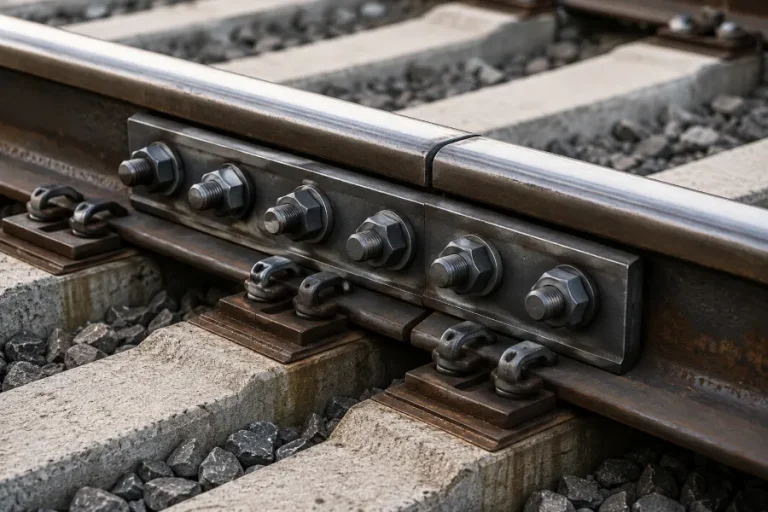
Ask a track maintainer how many times he has re-tightened the same joint, and he will usually say more times than he can count. The fish bolt is the one fastener on the track that seems to need a wrench every single visit, while the rail clips next to it just sit there. There is a reason for that, and it is not that the bolt is a bad design. It is that a fish bolt is asked to do a job most fasteners never face: it has to hold two rail ends together across a gap that is moving, under a hammering impact load, while sitting in the open weather.
So the question is worth asking properly. Not “why do bolts loosen,” as if it were one mystery, but “where does the preload go.” Because once you see where it goes, you can stop it going.
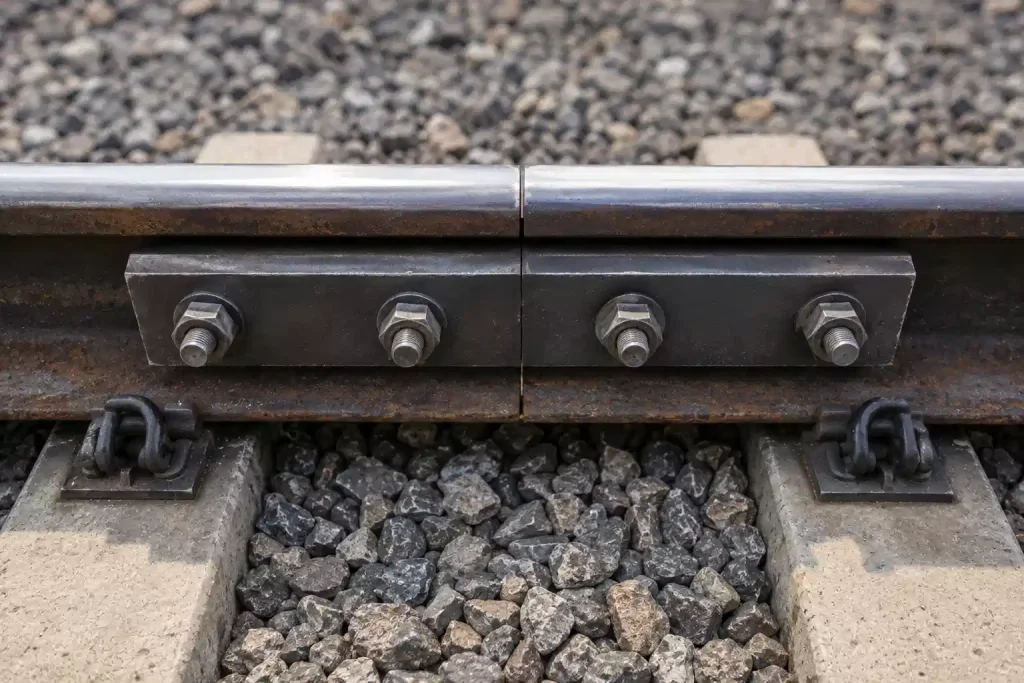
Here is the thing nobody explains at the start. A tightened fish bolt is not holding the fish plate by some magic grip. It is holding it because the bolt was stretched when you turned the nut. That stretch is called preload, and it is the actual clamping force that keeps the plate pinned against the rail web.
Lose the preload, and the bolt is technically still in the hole, still finger-tight maybe, but it is no longer clamping anything. The nut has not spun off. The bolt has just gone slack. That is why you can walk a joint, find a bolt that turns a quarter turn by hand, and yet it never fell out. It lost its stretch.
Everything that follows is really an answer to one question: what steals the stretch?
A new fish joint settles. The fishing surfaces and the bolt holes are machined, but under the first hundred trains the plate beds into the rail web, the coating on the threads compresses, and the nut works a fraction deeper into its seat. All of that settling is preload leaving the bolt without anything visibly moving.
This is the single most common cause of a loose fish bolt, and it is also the easiest to prevent. The joint has to be re-torqued after the initial settlement period, and then again on a schedule. I have watched joints that were tightened to specification on a Friday come back measurably loose by the following week, simply because nobody came back with the wrench.
A related failure is tightening by feel. If the bolt was never brought to a real torque in the first place, because someone leaned on a spanner until it “felt right,” then the preload was never there to begin with. A fish bolt needs a calibrated torque wrench, not an arm and an opinion.
A fish plate only works when it is in full contact with the rail web. If the fishing surfaces carry rust, scale, or old grease, the plate sits on high spots instead of flat against the rail. Under load, those high spots crush down, and the clamp loosens without the bolt turning at all.
Rust is the usual culprit, but so is a rough or corroded bolt hole. A hole that is oval from years of wear no longer seats the bolt straight, so the clamping force pulls at an angle and the joint relaxes. This is why surface preparation before installation matters as much as the torque value: a clean, dry, flat contact is half the job. The full sequence, including surface treatment and tightening order, is covered in our fish plate installation guide.
Corrosion does something else too. In coastal or industrial environments, rust builds on the threads and the shank, and as it grows it physically changes the interface. A heavily corroded bolt has lost section, and with it the ability to hold its stretch.
A rail joint is not a static joint. Every wheel that crosses it delivers an impact, and that impact travels through the fish plate into the bolts as a repeated pulse. Over thousands of cycles, that pulse does something small each time: it lets the nut back off a fraction of a degree against the friction that was holding it.
A spring washer is supposed to fight this by keeping a load on the nut, but only if it is still alive. A spring washer that has gone flat, or that was installed the wrong way up, is just another washer. Once the washer quits, the vibration has nothing pushing back against it, and the nut walks.
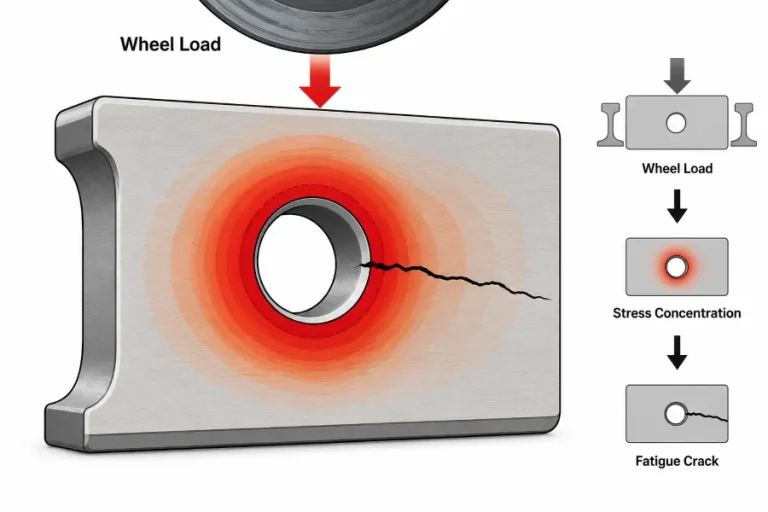
This is also why a missing bolt is worse than it looks. Every missing bolt loads the remaining bolts harder, and a joint that loses one bolt starts a cascade: more load on the rest, more movement at the joint, more loosening, until the plate cracks at the hole.
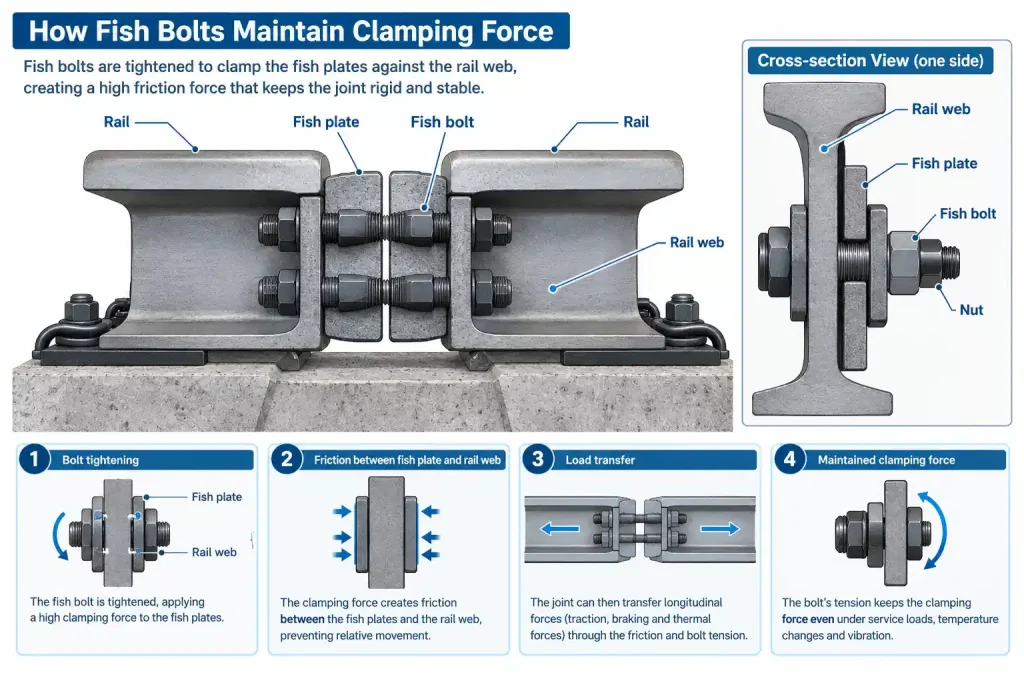
People like to point at thermal expansion as the reason bolts loosen, and it is true that a rail moves with temperature, on the order of a fraction of a millimetre per metre for every few degrees. That movement is exactly why the joint gap exists. But the gap is doing its job: it lets the rail expand and contract.
The problem is not the expansion itself. It is that a joint which was already under-tensioned, or already carrying a settled plate, has no margin left to ride the seasonal movement. When winter comes and everything contracts, a bolt that was already slack gets slacker. The temperature did not cause the problem. It exposed the preload that was already missing.
This is where people want one number, and one number does not exist. The correct torque depends on the bolt grade, the thread diameter, whether the threads are lubricated, and the standard your project is built to. If the grade itself is still an open question, start with our fish bolt selection guide before you chase a torque number.
The underlying relationship is the standard torque equation, torque equals a coefficient times preload times diameter. The coefficient, often called the nut factor, typically sits somewhere between about 0.15 and 0.25, and it changes with lubrication. A lubricated thread reaches the same preload at a lower torque than a dry one, which is why you cannot take a torque value from one source and apply it to a different thread condition.
| Bolt size | Grade 8.8 (typical) | Grade 10.9 (typical) |
| M20 | ~160-200 N·m | ~240-300 N·m |
| M22 | ~220-270 N·m | ~330-400 N·m |
| M24 | ~280-350 N·m | ~420-500 N·m |
This is a starting point, not a universal specification. These are typical working ranges for lubricated threads, and they shift with the thread condition, the specific standard, and the joint design. Always tighten to the drawing or the applicable standard with a calibrated torque wrench, not to a number remembered from a catalog.
Whatever value you use, the sequence matters as much as the value. Tighten in stages, from the centre bolts outward, alternating sides, so the plate is pulled evenly against the web instead of bowing. Then re-tighten after the joint settles, and again before winter if your climate has a real seasonal swing.
Prevention is not complicated, and it mostly comes down to discipline at three moments: installation, the first re-torque, and routine inspection.
At installation. Clean the fishing surfaces and the bolt holes down to bare metal. Check the fish plate seats flat with no visible gap. Install the spring washers the right way up. Bring every bolt to torque in the correct sequence with a calibrated wrench. Confirm the nut shows the specified thread beyond its face.
After the first week. Re-torque. This is the step most people skip, and it is the one that prevents most loosening. Then repeat on the scheduled interval, and retighten any bolt that has dropped below the specified threshold before it has a chance to walk.
In service. Replace bolts and nuts as a matched set. A new nut on an old, worn bolt will not hold, and a bolt with damaged threads should never go back in. Watch for the early signs: a joint that hammers, a plate that has started to work, a spring washer that has gone flat. Fix the loose bolt before it becomes a cracked plate.
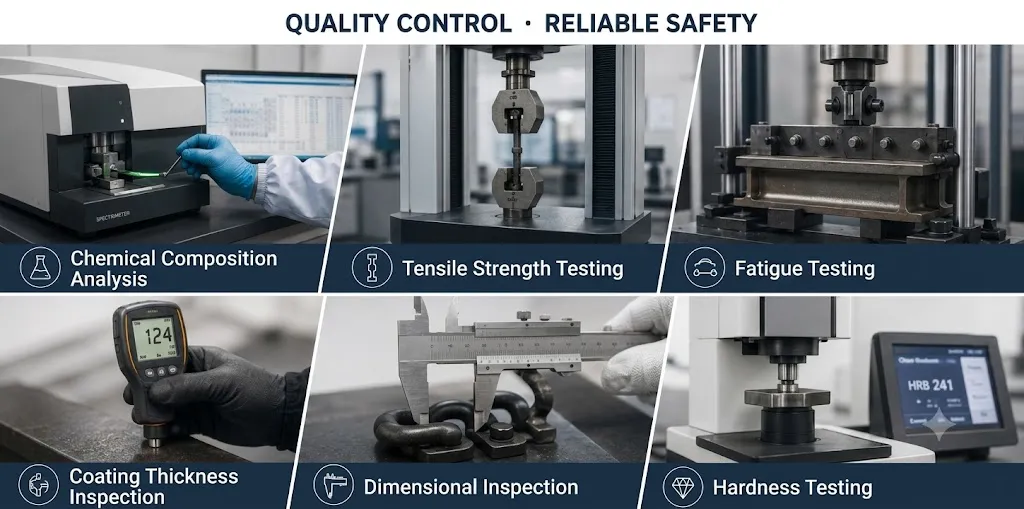
A loose fish bolt is usually the symptom, not the disease, and the disease often traces back to what was bought and how it was installed. When a joint keeps loosening no matter how often it is re-tightened, I stop looking at the wrench and start looking at the parts.
A fish bolt rarely fails without warning. The bolt goes slack, the joint starts to hammer, the plate works, and only then does something crack. The loose bolt is the first word in that sentence, and it is the cheapest moment to act.
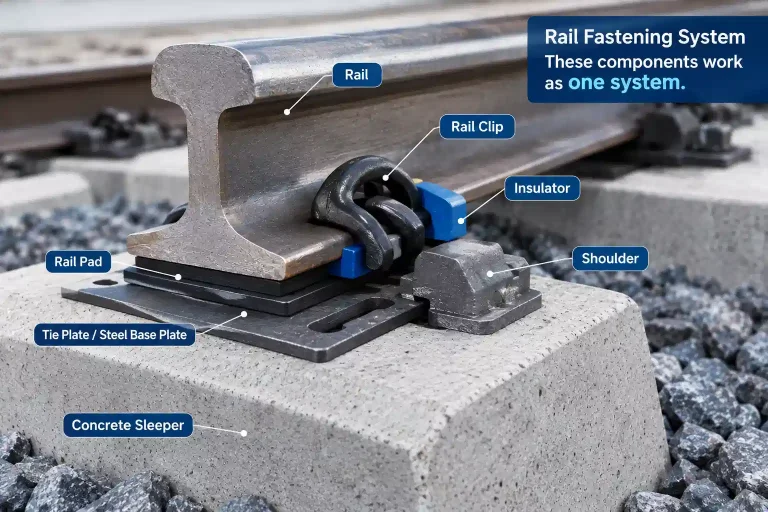
If you are replacing fish bolts, or if a joint keeps loosening and you want to get to the root of it, check the grade, the thread condition, and the installation procedure before you assume the parts are at fault. At FONYO, we manufacture fish bolts and fish plates alongside rail clips, rail pads, and the rest of the railway track components fastening system, and we quote against the applicable standard with full material traceability. Send us the joint detail and the bolt grade you are running now, and we will confirm the correct specification before we put a number on it.
Why do fish bolts loosen even when they were torqued properly?
Because the preload leaves the bolt after installation. The plate and threads settle under the first traffic, and if the joint is not re-torqued, that settlement shows up as a loose bolt that was never “untightened” by anyone. Re-torquing after the first week is the fix.
How often should fish bolts be re-tightened?
There is no single interval for every railway, but the practical rule is: re-torque after the initial settlement, then on a scheduled cycle set by traffic and joint history, and retighten any bolt that has dropped below the specified threshold whenever it is found. Heavier lines need shorter cycles.
Does temperature cause fish bolts to loosen?
Temperature changes the joint gap, which is exactly what the gap is for. The expansion does not loosen a correctly tightened bolt by itself. It exposes a bolt that was already under-tensioned or a joint that was already settled, so the seasonal movement becomes the moment the slack shows up.
Can I just tighten a loose fish bolt harder?
No. Over-tightening beyond the specification damages the thread and can yield the bolt, which reduces its ability to hold preload and shortens its life. Tighten to the correct value with a calibrated wrench, in the correct sequence, not harder.
Why should bolts and nuts be replaced as a set?
A new nut on an old, worn bolt will not hold preload properly, and a used bolt may already be stretched or have damaged threads. Replacing them as a matched set is the only way to get the clamp back to specification.
What is the first sign a fish bolt is about to cause a failure?
A joint that has started to hammer, or a fish plate that has begun to work loose against the rail web. The loose bolt is the earliest warning, and it is the cheapest point to act. Once the plate cracks at a bolt hole, you are into replacement territory.
Is a spring washer enough to stop a fish bolt loosening?
A spring washer helps, but only while it is intact and installed correctly. A flattened or upside-down washer does nothing. In high-vibration service, a lock nut or thread-locking treatment is often added on top of the spring washer, not instead of it.