Bizimle iletişime geçmek için WeChat kodunu tarayın
Bizimle iletişime geçmek için WeChat kodunu tarayın
Bize e-posta göndermekten çekinmeyin; size en kısa sürede cevap vereceğiz.
Geleceği kalp ve ruhla yaratmak


Railway side frame dimensions have a direct influence on the alignment, yük dağılımı, Üç parçalı bir demiryolu bojisinin süspansiyon davranışı ve genel performansı. Dökme çelik yan çerçeveler için, dimensional accuracy is just as important as material quality and casting integrity.
The most important railway side frame dimensions are not limited to one measurement. They include the axle box window, spring seat geometry, column guide and wear plate interface, wedge pocket geometry where applicable, and the overall squareness and parallelism of the side frame.
When these dimensions remain within the approved drawing and specification tolerances, the side frame can perform as intended. When they drift because of casting distortion, giymek, impact damage or incorrect repair, the resulting problems can affect the entire truck system.
This guide explains the five major dimensional areas that engineers and purchasing teams should pay attention to when inspecting, replacing or sourcing railway side frames.
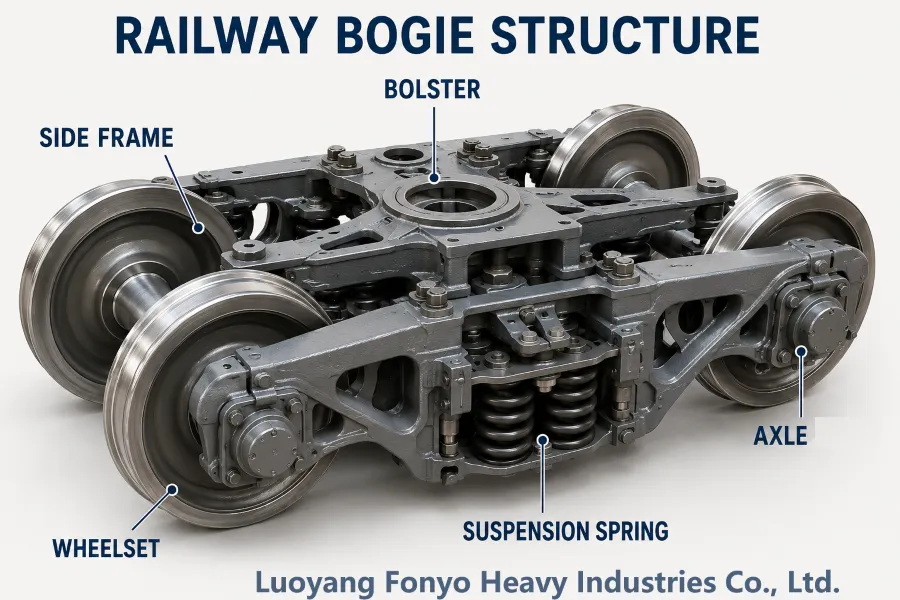
A cast steel railway side frame may look like a relatively simple structural casting, but its geometry has several important functions.
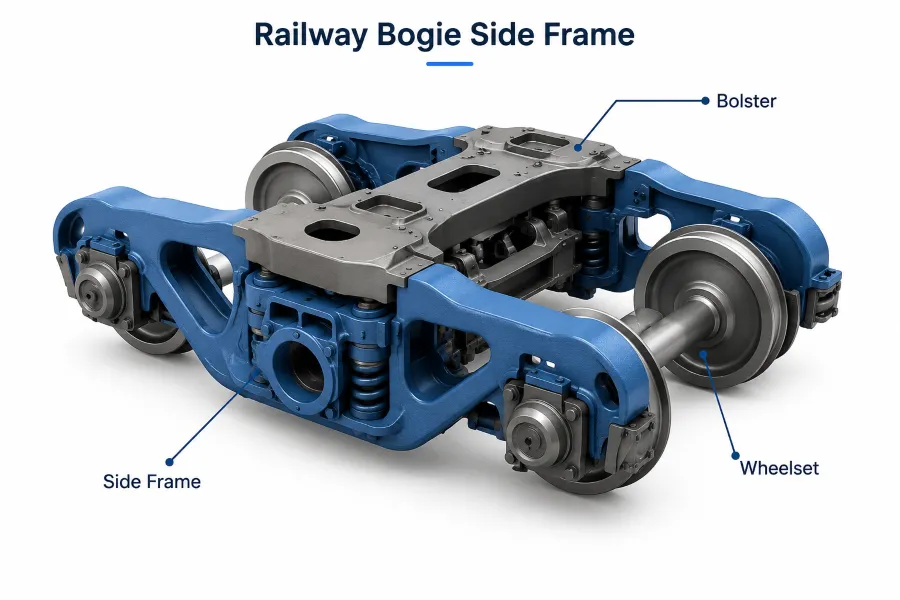
The side frame supports the suspension system, provides the interface for the bolster and axle box, and helps maintain the intended geometry of the truck. Its dimensions therefore influence how forces are transferred through the bogie.
Örneğin, the axle box window affects the position and movement of the axle box. The spring seat determines how suspension springs sit on the frame. The column guide controls the relationship between the side frame and bolster, while the overall geometry determines whether the frame remains square and properly aligned.
This is why dimensional inspection should not be treated as a secondary check after casting inspection. A side frame can pass chemical analysis and non-destructive testing and still be unsuitable if a critical dimension is outside the approved tolerance.
The exact dimensional requirements depend on the specific side-frame design, drawing, applicable railway standards and customer specification. AAR documentation separately identifies standards for steel castings, cast-steel truck side frames, and side-frame and bolster purchase and acceptance.
The axle box window is one of the most important areas when evaluating railway side frame dimensions.
Located between the lower portions of the side-frame columns, the window provides the required interface for the axle box or adapter arrangement used by the particular truck design. Its geometry must allow the required movement while maintaining the intended lateral and vertical relationship between the axle assembly and side frame.
The critical characteristics normally include:
The actual dimensions should always be taken from the approved side-frame drawing rather than from a generic value.
Wear is particularly important on side frames that have been in service for many years. Repeated movement, impact loading and contact with mating components can gradually change the original geometry.
Excessive clearance can affect the intended position of the wheelset and may contribute to uneven wheel-rail contact or abnormal wear elsewhere in the truck.
For replacement side frames, the new casting therefore needs to match the approved dimensional requirements rather than simply having the same general appearance as the original component.
The spring seat is another critical area when checking railway side frame dimensions.
The spring seat provides the supporting surface for the suspension springs. Its location, flatness and relationship to other reference points on the frame determine how the suspension components are positioned.
Two characteristics deserve particular attention: position and flatness.
The position of the spring seat must correspond with the design location of the axle box window and the mating components of the truck. Differences between the two side frames can introduce unwanted geometric variation in the assembled bogie.
Flatness is equally important. A damaged, distorted or excessively uneven spring seat can produce non-uniform contact between the spring and casting surface. Instead of distributing the load as intended, the spring may concentrate force over a smaller area.
This is why dimensional inspection of a side frame should include suitable gauges, straightedges or other calibrated measuring equipment as required by the approved inspection procedure.
A side frame that has good material properties but poor spring seat geometry is still not a satisfactory component.
The column guide is the area where the side frame interacts with the bolster and its wear components.
In a three-piece bogie, the bolster moves vertically relative to the side frames while the column guide and mating surfaces help control its lateral position. The condition of this interface therefore has a significant effect on the truck’s geometry and suspension behavior.
Önemli railway side frame dimensions in this area include:
The exact dimensions vary according to the truck design and wear system, so they should be checked against the applicable drawing or maintenance specification.
Wear plates are intentionally replaceable components because they experience repeated contact and movement. Fakat, replacing a worn plate does not automatically correct a distorted side frame.
If the underlying casting has been damaged, worn or improperly repaired, simply installing a new wear plate may not restore the intended geometry.
The column guide and bolster interface is one of the factors that contributes to the truck’s resistance to unwanted lateral movement and warping.
If excessive clearance develops, the bolster may have more freedom to move laterally than intended. When combined with other worn components or out-of-tolerance geometry, this can contribute to undesirable truck dynamics.
Bu nedenle, inspection should consider the complete interface rather than checking wear plate thickness alone.
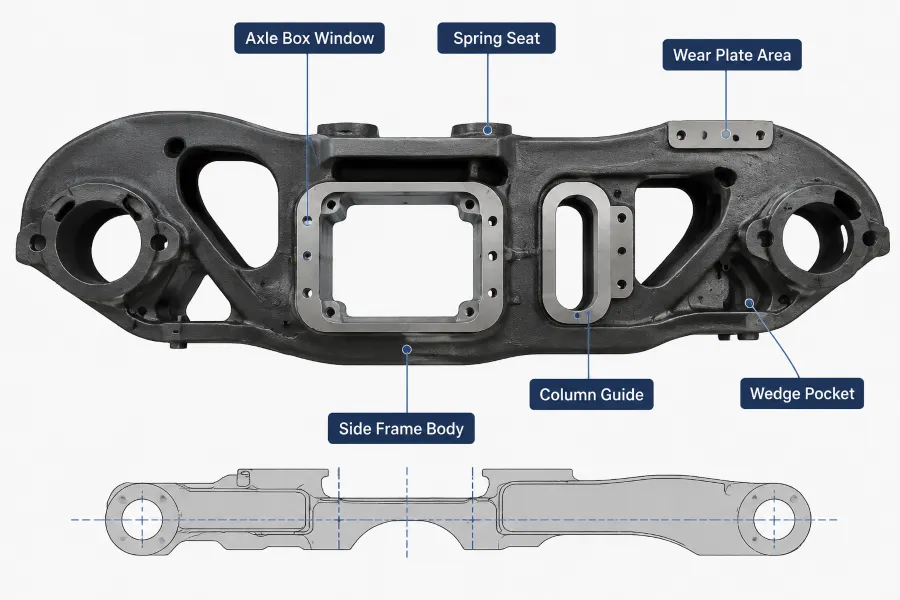
Not every railway side frame uses the same friction-damping arrangement, so wedge-pocket geometry should be considered according to the specific bogie design.
In friction-damped three-piece trucks, the wedge and its mating surfaces between the bolster and side frame form an important part of the suspension damping system. Relative vertical movement produces friction at the designed contact surfaces, helping control suspension motion.
The relevant railway side frame dimensions may include:
These dimensions should not be treated as universal values because wedge geometry varies between truck designs.
Even relatively small deviations can change the contact conditions and friction characteristics of the system. Damage, aşırı aşınma, incorrect repair or contamination can also affect the way the friction interface behaves.
For procurement specifications, the wedge pocket should therefore be controlled by the approved drawing and inspection procedure rather than by a generic dimensional value.
The first four areas concern individual features. The fifth is about the geometry of the entire casting.
This is one of the most important groups of railway side frame dimensions because a side frame can meet individual local measurements and still have an overall alignment problem.
Several checks are particularly useful.
Diagonal measurements can be used to evaluate whether the side frame has remained square.
The measurement method depends on the approved inspection drawing and reference points, but the basic principle is to compare corresponding diagonal dimensions. A significant difference can indicate distortion, twist or other geometric deviation.
The distance between spring seat reference points must correspond with the mating bolster and suspension arrangement.
If the center distance is outside the specified tolerance, assembly may become difficult or introduce unwanted preload or misalignment.
The relative position of the axle box windows is another important reference dimension.
It must correspond with the intended truck geometry and the associated axle and wheelset arrangement. This measurement should always be controlled against the approved design rather than a generalized wheelbase value.
The axle box windows and other reference surfaces must maintain the required parallelism and squareness.
Poor parallelism can introduce unwanted alignment errors in the assembled truck and may contribute to uneven loading or wear.
This is why a complete dimensional inspection is more valuable than checking only one or two easily accessible measurements.
Dimensional inspection should be combined with material and non-destructive testing.
A typical inspection program may include:
AAR’s standards structure separates requirements for steel castings, cast-steel truck side-frame design and testing, purchase and acceptance, and used/reconditioned side frames. This distinction is important when preparing a manufacturing or inspection specification.
The inspection method should therefore be based on the actual component design and applicable specification rather than assuming that every railway side frame has the same dimensional requirements.
Incorrect railway side frame dimensions do not always produce an immediate visible failure.
Some problems develop gradually as the truck operates under repeated loading.
Possible consequences include:
The important point is that dimensional errors should be considered together with wear, loading history, material condition and the geometry of the complete bogie.
A side frame should not be evaluated as an isolated casting when the final application is a complete railway truck.
Dimensional accuracy starts at the foundry.
Dökme çelik yan çerçeveler için, controlling geometry requires more than final machining or inspection. The casting process, kalıp tasarımı, steel quality, solidification behavior, heat treatment and subsequent straightening or finishing operations can all affect dimensional stability.
A reliable manufacturing process therefore needs control at several stages:
Casting → Heat Treatment → Dimensional Inspection → NDT → Final Inspection
The final inspection confirms whether the finished component meets the approved drawing, but process control is what helps make dimensional consistency repeatable from one casting to the next.
This is particularly important when replacing side frames in an existing fleet. The replacement component must not only satisfy the material and strength requirements; it must also interface correctly with the existing bolster, suspension and axle box arrangement.
For purchasing teams, asking for the material grade alone is not enough.
Sipariş vermeden önce, it is worth confirming:
1. What standard applies?
Clarify whether the project is based on AAR, GOST or another railway standard, together with the specific applicable specification.
2. Is an approved drawing available?
Critical railway side frame dimensions should be controlled by an approved drawing or technical specification.
3. Which dimensional inspection method will be used?
Ask whether the supplier will use calibrated gauges, templates, CMM or other approved equipment.
4. Which NDT methods are included?
Confirm the applicable magnetic particle, ultrasonic or other inspection requirements.
5. How are casting quality and heat treatment controlled?
Malzeme izlenebilirliği, heat-treatment records and mechanical test results should be available where required.
6. Can the supplier provide inspection documentation?
Dimensional inspection reports and NDT records provide useful evidence that the component was manufactured according to the agreed requirements.
A good side-frame supplier should be able to discuss these requirements before production begins rather than treating dimensional inspection as a final paperwork exercise.
Şu tarihte: FONYO, we manufacture cast steel railway side frames and bolsters according to applicable railway standards, approved drawings and project-specific requirements.
Our engineering and production process can cover casting, ısıl işlem, dimensional inspection and non-destructive testing according to the agreed technical specification.
For projects involving AAR requirements, it is important to distinguish the applicable standards. AAR’s current standards index separately lists M-201 for Castings, Çelik; M-203 for Truck Side Frames, Cast Steel—Design and Testing; M-210 for Side Frame and Bolsters—Purchase and Acceptance; and M-214 for Used and Reconditioned Side Frames and Bolsters.
This allows the manufacturing and inspection plan to be established around the actual side-frame design instead of relying on generic dimensions.
If you are sourcing replacement railway side frames, new bogie castings or components for a specific freight-car project, send us your drawing, part number or technical specification. Our engineering team can review the required material, railway side frame dimensions, tolerances and inspection requirements before production.
The most important railway side frame dimensions are not simply numbers on a drawing. They define how the casting interfaces with the axle box, yaylar, bolster and other bogie components.
The five major areas are:
A side frame can have excellent material properties and pass non-destructive testing while still being unsuitable because of dimensional errors.
Bu nedenle, dimensional control should be part of the manufacturing process from casting through final inspection. When the correct drawing, inspection method and applicable railway standard are established before production, dimensional consistency becomes much easier to control.
The most important areas include the axle box window, spring seat position and flatness, column guide geometry, wedge pocket geometry where applicable, and the overall squareness, parallelism and reference dimensions of the side frame.
They determine how the side frame interfaces with the axle box, Süspansiyon yayları, bolster and other bogie components. Dimensional errors can lead to incorrect clearances, uneven loading, excessive wear and assembly problems.
Not all side frames have identical dimensions. The required dimensions depend on the truck design, approved drawing, applicable railway standard and project-specific requirements.
HAYIR. AAR’s standards separate steel casting requirements from truck side-frame design and purchase/acceptance requirements. M-201 covers steel castings, while AAR separately identifies M-203 for cast-steel truck side-frame design and testing and M-210 for side-frame and bolster purchase and acceptance.
Depending on the design and inspection specification, dimensional inspection may use approved gauges, templates, calibrated measuring equipment or CMM. Dimensional inspection is normally combined with visual inspection and applicable NDT methods.
Some side frames may be eligible for reconditioning depending on their condition, design and applicable maintenance requirements. AAR separately identifies M-214 for used and reconditioned side frames and bolsters.
The most useful information includes the original drawing or part number, truck type, applicable standard, material requirement, critical dimensions, NDT requirements and quantity. Providing the original technical documentation helps the supplier confirm compatibility before production.