Отсканируйте код WeChat, чтобы связаться с нами.
Отсканируйте код WeChat, чтобы связаться с нами.
Не стесняйтесь, отправьте нам электронное письмо, и мы ответим вам как можно скорее.
Создаем будущее сердцем и душой


Many people are surprised when they learn how long it takes a train to stop. A passenger car traveling at 100 km/h can usually stop within a few dozen meters during emergency braking. A freight train running at a similar speed may require more than one kilometer to come to a complete stop. For heavy-haul trains carrying thousands of tons of cargo, the stopping distance can be even longer. На первый взгляд, this seems counterintuitive. Modern trains are equipped with powerful braking systems, so why can’t they stop as quickly as road vehicles? The answer lies in a combination of factors. Train mass is certainly important, but it is not the only reason. Railway train braking performance is also limited by wheel-rail adhesion, the design of the braking system, and the time required to transmit braking commands throughout the train.
To understand how trains stop safely, it is necessary to look at the fundamental principles behind railway braking systems.

Like any moving vehicle, a train possesses kinetic energy. Railway Train Braking is essentially the process of converting that kinetic energy into heat and dissipating it safely.
Whether the braking force is generated by тормозные колодки, тормозные диски, or traction motors, the final stopping force must be transmitted through the contact between the железнодорожное колесо and the rail.
This wheel-rail interface is one of the most important characteristics of railway transportation.
Unlike rubber tires on asphalt, steel wheels run on steel rails. The contact area between them is surprisingly small—often no larger than a coin. This small contact area contributes to the excellent energy efficiency of railways because rolling resistance remains very low. Однако, it also limits the amount of braking force that can be transferred without causing wheel slip.
The maximum braking force available is governed by wheel-rail adhesion:
F=μN
Where:
If the braking force exceeds the available adhesion, the wheels will begin to slide rather than roll. Once sliding occurs, braking efficiency decreases significantly and wheel damage may result.
This adhesion limit is one of the primary reasons why trains require much longer stopping distances than automobiles.
Although the basic objective is always the same—to slow down or stop the train—the methods used to generate braking force vary considerably depending on vehicle type and operating conditions.
Modern railway systems typically use several braking technologies working together rather than relying on a single method.
Tread braking is one of the oldest and most widely used railway braking methods, particularly on freight wagons.
In this system, тормозные колодки are pressed directly against the wheel tread. Friction between the brake shoe and the wheel converts kinetic energy into heat, slowing the rotation of the wheel.
The design is simple, reliable, and relatively inexpensive to maintain. По этой причине, tread brakes continue to be widely used on freight vehicles around the world.
Однако, because braking occurs directly on the wheel surface, the wheel tread is subjected to both wear and thermal stress. Через некоторое время, repeated braking can alter the wheel profile and increase maintenance requirements.
As railway speeds increased, disc braking became increasingly common on passenger coaches, транспорт метро, и скоростные поезда.
Instead of applying force directly to the wheel tread, brake pads clamp onto a brake disc mounted on the axle or wheel assembly.
Because heat is concentrated in the brake disc rather than the wheel itself, wheel wear is reduced and braking performance remains more consistent at higher speeds.
For modern passenger vehicles, disc brakes often provide better ride quality, lower maintenance requirements, and improved thermal management compared with traditional tread brakes.
Locomotives often employ dynamic braking to supplement mechanical braking systems.
During dynamic braking, the traction motors operate as generators rather than motors. The train’s kinetic energy is converted into electrical energy, which is then dissipated through resistor banks as heat.
Because much of the railway train braking effort is generated electrically, wear on brake shoes and discs can be significantly reduced.
This technology is particularly valuable on long downhill grades, where continuous braking would otherwise generate excessive heat in mechanical braking components.
Modern electric multiple units and high-speed trains frequently use regenerative braking.
The principle is similar to dynamic braking, but instead of dissipating the generated electricity as heat, the energy is returned to the power supply network for use elsewhere.
Regenerative braking improves overall energy efficiency and reduces operating costs while decreasing wear on conventional brake components.
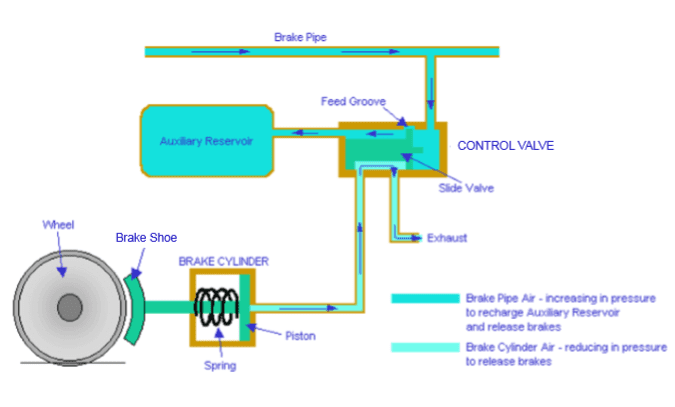
While different railway train braking technologies generate braking force in different ways, the vast majority of railway vehicles still rely on an automatic air brake system to control and distribute braking commands throughout the train.
This system, originally developed by George Westinghouse in the nineteenth century, remains the foundation of railway braking worldwide.
A typical automatic air brake system consists of a brake pipe, an auxiliary reservoir, a control valve (often called a triple valve), and a brake cylinder.
Under normal operating conditions, compressed air from the locomotive charges the brake pipe and the auxiliary reservoirs on each vehicle.
When the train is running without braking, the pressure in the brake pipe remains at its normal operating level. The brake cylinder is vented to the atmosphere, and the brake shoes or brake pads remain released.
When the driver applies the brakes, the pressure in the brake pipe is intentionally reduced.
The control valve on each vehicle detects this pressure reduction and responds by connecting the auxiliary reservoir to the brake cylinder. Air pressure entering the brake cylinder moves the piston, causing the brake shoes or pads to apply force and generate braking effort.
The greater the reduction in brake pipe pressure, the greater the braking force that can be produced.
This approach may seem unusual because the braking command is transmitted by reducing pressure rather than increasing it. Однако, this design provides a major safety advantage.

Railway train braking systems are designed according to the fail-safe principle.
If a train separates unexpectedly, a hose ruptures, or a major leak develops in the brake pipe, pressure immediately drops throughout the affected section of the train.
яnstead of losing braking capability, the system automatically applies the brakes.
This feature is one of the most important safety innovations in railway history. Без этого, a broken train could potentially continue rolling without control.
Because railway train braking is triggered by pressure reduction, the system naturally defaults to a safe condition whenever a serious fault occurs.
Braking a train becomes increasingly complex as train length and weight increase.
A modern heavy-haul freight train may extend for more than two kilometers. When the driver initiates braking, the pressure change must propagate through the entire brake pipe before every vehicle begins to respond.
Как результат, vehicles near the locomotive start braking slightly earlier than those near the rear of the train.
This delay may only be a matter of seconds, but it can create significant longitudinal forces within a very long train.
To reduce these effects, many modern freight operations employ electronically controlled braking systems that allow braking commands to be transmitted much more rapidly throughout the train.
Another challenge is air replenishment.
After a brake application, the auxiliary reservoirs must be recharged before full braking capacity is restored. Following a routine brake application, recharge may require several minutes. After an emergency brake application, the recovery period can be considerably longer.
По этой причине, train handling requires careful planning and anticipation. Unlike driving a car, train operators cannot repeatedly apply maximum braking force whenever they wish.
One of the unique characteristics of freight transportation is the large difference between empty and loaded vehicle weights.
A fully loaded wagon may weigh several times more than the same wagon when empty.
If identical braking force is applied in both conditions, problems arise. Excessive braking on an empty vehicle can lead to wheel slide and accelerated wheel damage. Insufficient braking on a loaded vehicle may result in excessive stopping distances.
To address this issue, many freight vehicles use empty-load braking devices that automatically adjust braking force according to vehicle weight.
This ensures more consistent braking performance across a wide range of loading conditions.
From a wheel manufacturer‘s perspective, braking is closely related to wheel performance and service life.
Every braking event generates heat, friction, and mechanical stress at the wheel surface. Через некоторое время, these forces gradually affect wheel condition.
In tread-braked vehicles, the wheel tread absorbs most of the braking heat. Repeated thermal cycling can contribute to surface wear, thermal cracking, обстрел, and other forms of wheel damage.
Even in vehicles equipped with disc brakes, wheels continue to experience significant loads from wheel-rail contact and rolling contact fatigue.
Как результат, railway wheels require regular inspection throughout their service life. Parameters such as wheel profile, flange thickness, износ протектора, and surface condition must be monitored to ensure safe operation.
When wear reaches specified limits, wheel reprofiling or replacement becomes necessary.
Для железнодорожных операторов, braking performance and wheel maintenance are therefore closely connected. A well-designed braking system not only improves safety but can also reduce wheel life-cycle costs.
Understanding railway train braking systems is only part of the equation. The performance of a train’s braking system is closely connected to the quality of its wheels, brake components, and structural parts. Even a well-designed braking system cannot deliver reliable service if critical components suffer from excessive wear, dimensional inaccuracies, or material defects.
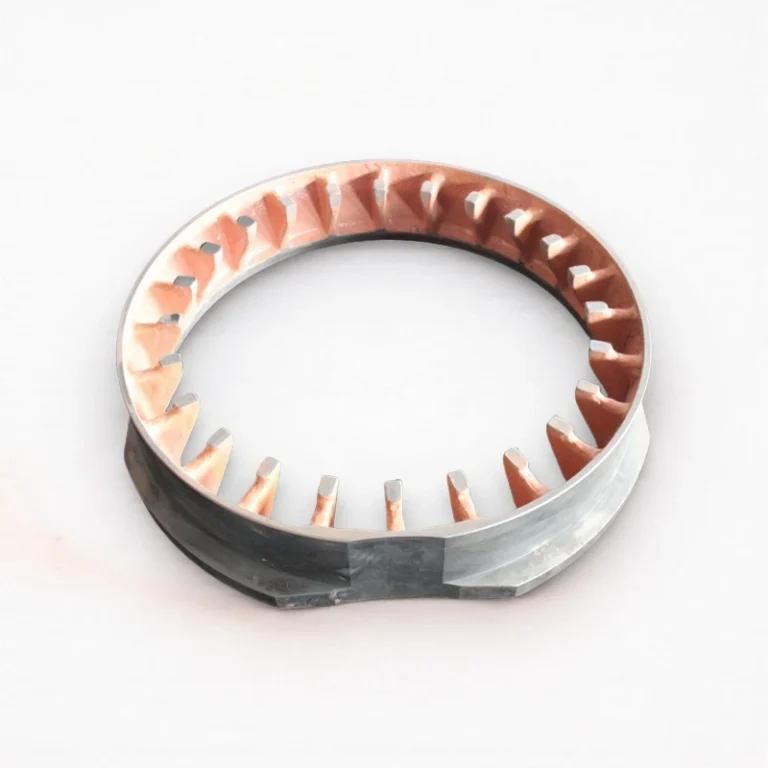
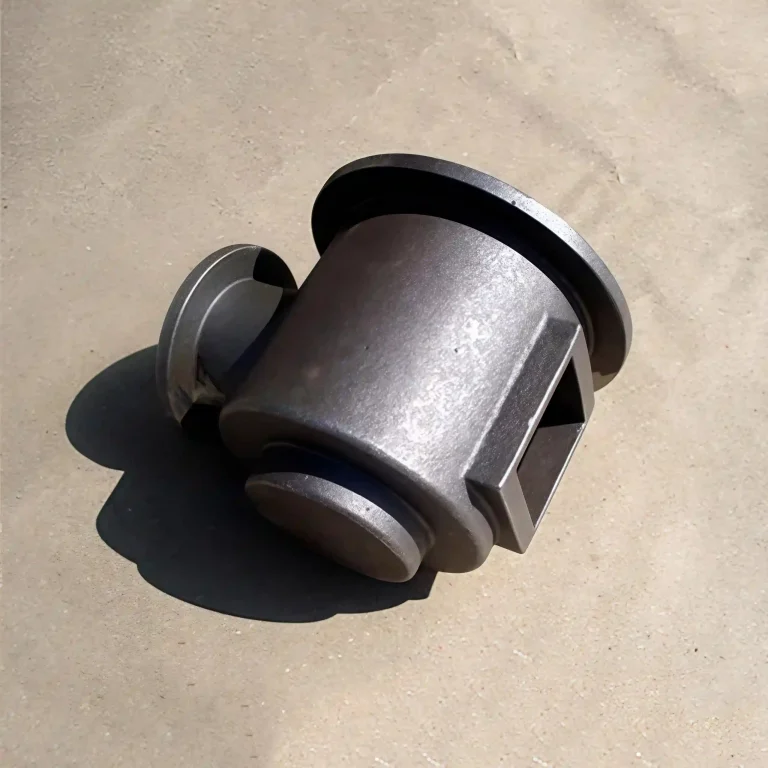
В Лоянская компания Fonyo Heavy Industries Co., ООО., we manufacture forged железнодорожные колеса, тормозные колодки and brake components, as well as a wide range of railway castings and machined railway parts for freight wagons, локомотивы, транспорт метро, и промышленное железнодорожное применение.
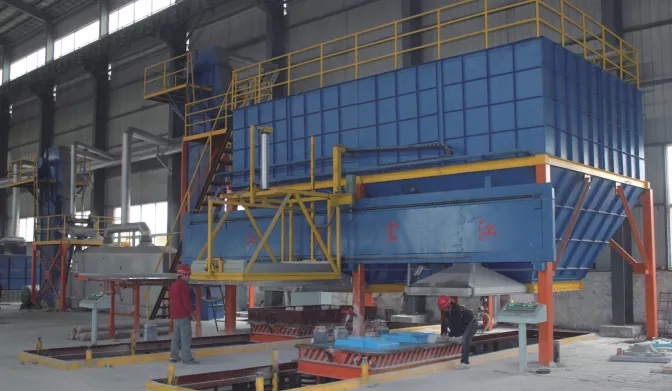
Our manufacturing capabilities include steel casting, ковка, термическая обработка, механическая обработка, и неразрушающий контроль, allowing us to supply both standard railway products and custom-made components based on customer drawings and technical specifications.
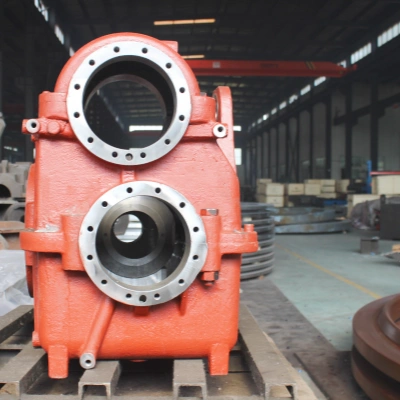
Whether the project involves railway wheels, компоненты тележки, axle box housings, корпуса коробки передач, brake system parts, or other railway castings, our engineering team can provide manufacturing support from prototype development through volume production.
If you are looking for a reliable supplier of railway wheels, brake components, or railway castings, feel free to contact us for technical discussions and project inquiries.