Scan the WeChat code to contact us
Scan the WeChat code to contact us
Feel free to send us a email and we will reply to you as soon as possible.
Creating the future with heart and soul


The short answer: UIC60 and 136RE are two heavy mainline rail sections with roughly similar mass, but they are not the same rail and they do not interchange. UIC60 (now called 60E1 in EN 13674-1) is the European standard, at about 60 kg per metre, 172 mm tall, with a 150 mm foot. 136RE is the North American AREMA section, at 136 pounds per yard, which is about 67 kg per metre, 185.7 mm tall, with a 152.4 mm foot. Close in weight, different in geometry, and every mating part is section-specific.
A buyer once told me the two rails looked the same from the railhead down. He was not wrong about the look. Both are flat-bottom, both are the heavy section you would expect on a mainline, and both are called “the sixty-kilo class” in different corners of the industry. The mistake is treating that as interchangeable, because the number that matters is not the weight. It is the profile. If you want the wider picture before we zoom in, our rail types guide runs through UIC60, 136RE, R65, and the 60 kg sections together.
So the honest way to compare these two is not to ask which is better. It is to ask which network you are building for, and then to understand exactly where the two sections part ways. Once you see the geometry, the rest of it stops being confusing.
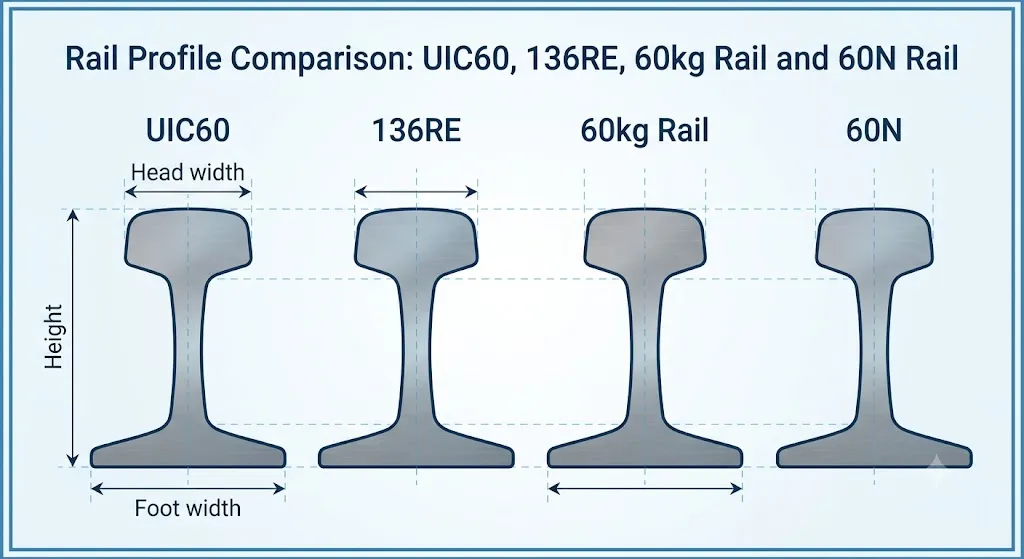
Here is the trap in one sentence: similar mass per metre does not guarantee interchangeability. UIC60 and 136RE sit close enough in weight that a buyer who matches on mass will think they are the same family. They are not.
The reason comes down to what a rail section actually is. It is not just a lump of steel of a certain weight. It is a specific cross-sectional shape, defined by height, head width, foot width, web thickness, and the radii where those meet. Every component that touches the rail, the clips, the baseplates, the fish plates, the welding moulds, the turnout castings, is machined to one of those shapes and no other.
So when you put 136RE into a fastening system cut for UIC60, the clip does not sit on the foot the same way, the plate does not bear on the same width, and the fish plate does not match the web fillet. The joint holds, poorly, until it does not. That is the whole story in one paragraph.
| Parameter | UIC60 (60E1) | 136RE |
| Standard | EN 13674-1 | AREMA |
| Nominal mass | 60.21 kg/m | 67.41 kg/m (136 lb/yd) |
| Height | 172.0 mm | 185.7 mm (7 5/16 in) |
| Foot width | 150.0 mm | 152.4 mm (6 in) |
| Head width | 72.0 mm | 74.6 mm (2 15/16 in) |
| Web thickness | 16.5 mm | 17.5 mm |
| Region | Europe and EN-aligned networks | North America and AREMA-aligned networks |
These are the nominal published dimensions. Individual sources round the head and foot figures slightly differently, and the authoritative values are the drawings in EN 13674-1 and the AREMA manual, not any single catalog table. Treat the table as a comparison, not a procurement drawing.
Look at the height column. UIC60 is 172 mm tall. 136RE is 185.7 mm. That is a 13.7 mm difference in height, on a rail that is only 172 mm to begin with. Anyone who tells you the two are “basically the same” has not looked at the section. The 136RE is a taller, heavier rail with a wider foot and a bigger head, built for the axle loads and long trains of the North American freight network.
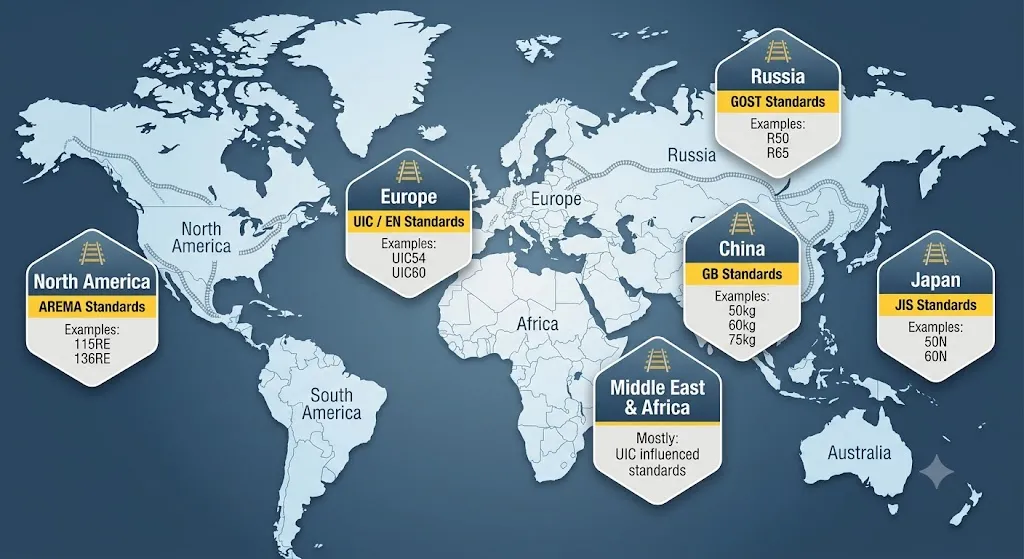
UIC60 is the section Europe standardised for mixed-traffic and high-speed mainlines, and it has become the reference rail for much of the world that builds to EN standards. Under EN 13674-1 the section is designated 60E1, and the older name UIC60 still floats around in commercial documents and tender text. They refer to the same section, but if you are writing a specification, write 60E1 to EN 13674-1 and the confusion goes away. How this section sits among the world’s standards is covered in our rail standards guide.
The steel that goes into it is a separate decision from the section. EN 13674-1 names its grades with a letter and number: R260 is the standard carbon-manganese grade at around 880 MPa minimum tensile, and R350HT is the head-hardened grade at well over 1,170 MPa, used on high-speed and heavy-haul lines where wear resistance on the running surface is what buys you life. Between the two you have the everyday choice: a softer, more weldable rail, or a harder, longer-wearing head. The full grade map, hardness ranges and all, is in our rail steel grades guide.
One thing worth knowing: UIC60 is not the same as the Chinese 60 kg/m rail, even though both are called “60 kg.” The Chinese section under GB/T 2585 has its own geometry and its own fastening system, and it does not drop into a UIC60 fastening any more than 136RE does. The “60” is a nominal mass, not a family name.
136RE is the heavy end of the AREMA section family, the “RE” standing for a revised section that has been the North American mainline standard for freight for a long time. It is named by its weight, 136 pounds per yard, which works out to about 67.4 kg per metre, noticeably heavier than UIC60 despite the similar “60 kilo class” label people apply.
The section is built around the realities of American freight: very heavy axle loads, very long trains, and unit trains that run millions of gross tonnes a year over the same rails. That is why 136RE is taller and carries more mass than UIC60. It is not that the European rail is under-built. It is that the two networks demand different things.
AREMA steel grades are a different naming world again. Instead of R260 and R350HT, you see control-cooled carbon steel, intermediate manganese, and head-hardened designations, all under AREMA’s rail chapter. The running-surface hardness is the same idea as R350HT, a harder head for wear, applied to a different section and a different specification.
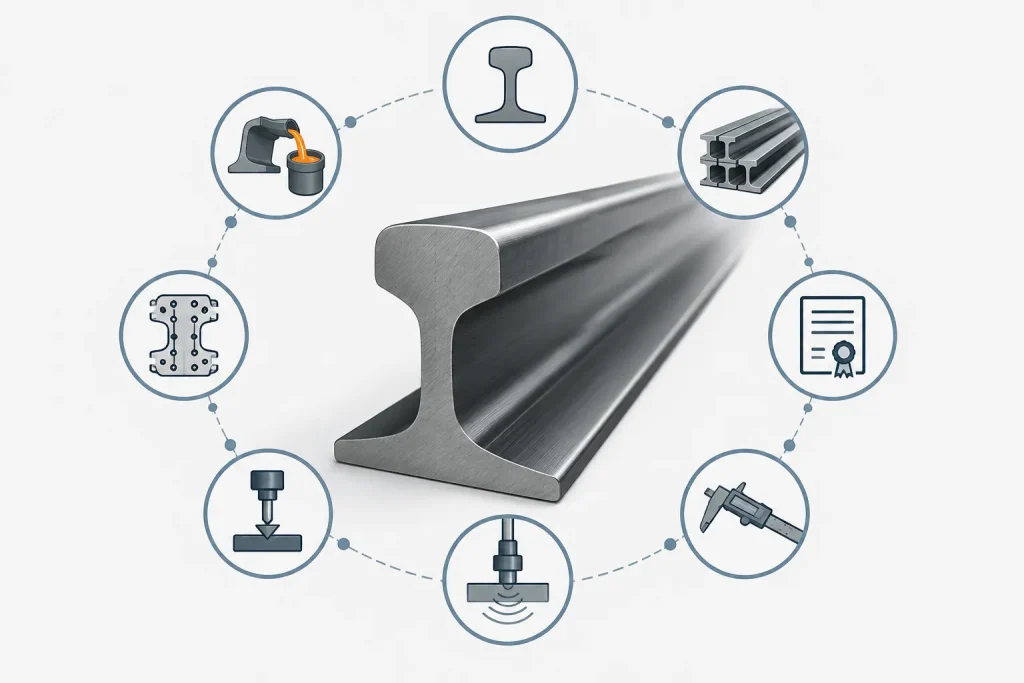
This is the part that costs money when it is ignored. The reason UIC60 and 136RE do not interchange is that every component around the rail is section-specific.
The elastic rail clip is designed for a specific foot thickness and toe geometry. The baseplate or sole plate is machined for a specific foot width and rail height. The fish plate matches one web fillet radius and one hole pattern. The aluminothermic weld mould follows one profile outline. The turnout, the switch blades, the crossings, the check rails, all of it is cut to a named section.
Drop a different section into that stack and you have not saved money. You have created a permanent transition point, and every transition is a joint, and every joint is a maintenance location for the life of the track. That is why the practical rule in rail procurement is blunt: match the section the corridor already runs, and do not mix sections without a designed compromise joint or transition weld.
This is where the answer stops being technical and becomes local.
If the project is in Europe, or in a network that has built to EN 13674-1, the answer is almost always 60E1. The fastenings, the turnouts, the maintenance grinding profiles, and the spare-rail stock are all built around it. Specifying 136RE there buys you a rail nobody can mate to the existing track.
If the project is in North America, or in a network aligned to AREMA, the answer is 136RE, for exactly the same reason in reverse. You match the existing section because the alternative is a transition you will maintain forever.
The interesting case is a greenfield project in a country with no strong legacy section, where the buyer gets to choose. There the trade-offs are real: UIC60 is the more widely used international section and generally easier to source outside North America; 136RE gives you a heavier rail for heavy-haul service but ties you to the AREMA ecosystem of fastenings and turnouts. I would not decide that on price. I would decide it on which section’s fastening and turnout family I can actually support over the life of the line.
A note on grades, because it is a separate question people fold in: the section is chosen for load and geometry, and the grade is chosen for wear and fatigue. A heavier section will not fix a curve that is wearing out from rolling contact fatigue. A harder grade will. Keep the two decisions apart.
When a rail order lands on a desk, a few lines of the specification tell you most of what you need, and they are worth confirming before anyone quotes a number.
UIC60 and 136RE are not competitors in the way people frame them. They are two good answers to two different networks’ questions, and the only real mistake is using one where the other belongs.
If you are speccing or buying rail, the order of decisions is simple: confirm the section your track and its fastening system are built around, then pick the grade for the traffic and the curves. At Luoyang Fonyo Heavy Industries Co., Ltd., we supply railway rail sections to EN, UIC, AREMA, and other standards, alongside the rest of the railway track components, and we quote against the section drawing and the grade, not against a remembered number. Send us the section, the grade, and the length you are working with, and we will confirm the specification against the current standard before we put a figure on it.
Is UIC60 the same as 60E1?
Yes, for practical purposes. UIC60 is the older name and 60E1 is the EN 13674-1 designation for the same flat-bottom section. They are treated as equivalent in commerce, but when you write a specification, use 60E1 to EN 13674-1 to avoid ambiguity.
Is UIC60 interchangeable with 136RE?
No. They have different heights, foot widths, head widths, and fillet radii. The fastening system, fish plates, weld moulds, and turnout components are section-specific, so one does not drop into the other’s track.
Which rail is heavier?
136RE, at about 67.4 kg per metre, against UIC60 at about 60.2 kg per metre. 136RE is also taller, at 185.7 mm against 172 mm.
Is UIC60 the same as the Chinese 60 kg/m rail?
No. The Chinese 60 kg/m section under GB/T 2585 shares the “60 kg” label but has its own geometry and fastening system. It does not interchange with UIC60 or 136RE.
Which should I use for a heavy-haul line?
It depends on the network, not the load alone. In North America the standard heavy-haul answer is 136RE with a head-hardened AREMA grade. In Europe and EN-aligned networks the equivalent choice is 60E1 with R350HT. Match the section to the network, then pick a hard grade for the wear.
What is the difference between rail section and rail grade?
The section is the cross-sectional shape, chosen for load and geometry. The grade is the steel and heat treatment, chosen for wear and fatigue resistance. A heavier section will not fix a curve wearing from rolling contact fatigue; a harder grade will.
Can I mix UIC60 and 136RE on the same track?
Only through a designed transition, a compromise fish plate or a transition weld. Every transition is a permanent maintenance location, so mixing sections is something to design around, not into.