WeChat 코드를 스캔하여 문의하세요
WeChat 코드를 스캔하여 문의하세요
이메일을 보내주시면 최대한 빨리 답변해 드리겠습니다..
마음과 영혼을 다해 미래를 창조하다


철도 트랙 구성 요소 모든 철도 인프라 프로젝트의 기초입니다.. 중량물 운송 라인에 사용 여부, 지하철 시스템, 산업용 철도, 또는 고속 승객 네트워크, 각 구성 요소는 안전을 보장하는 데 특정 역할을 합니다., 안정적인, 효율적인 열차운행.
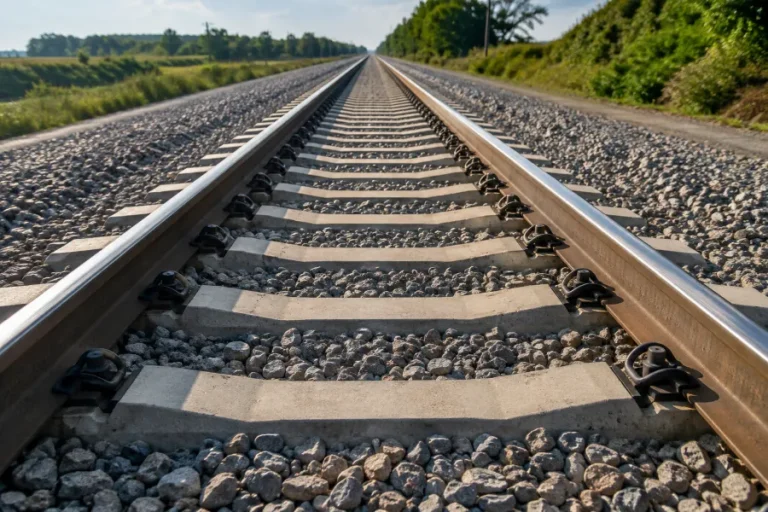
레일은 철도 선로에서 가장 눈에 띄는 부분이지만, 이는 전체 트랙 시스템의 한 요소만을 나타냅니다.. 현대 철도 노선은 바퀴 하중을 전달하기 위해 함께 작동하는 여러 엔지니어링 구성 요소로 구성됩니다., 트랙 기하학 유지, 진동을 흡수하다, 까다로운 환경 조건에서 수년간 반복되는 트래픽을 견딜 수 있습니다..
철도 선로의 신뢰성은 철도 자체의 품질에만 좌우되는 것이 아닙니다, 뿐만 아니라 성과에 대해서도 생선 접시, 물고기 볼트, 탄성 레일 클립, 레일 패드, 침목, 및 기타 고정 부품. 작은 체결 부품이라도 선로 안정성에 직접적인 영향을 미칠 수 있습니다., 유지보수 빈도, 및 서비스 수명.
철도 계약자용, 인프라 소유자, 유통업체, 유지보수 엔지니어, understanding how these components function together is essential when selecting products for new construction, track renewal, or maintenance projects.
This guide provides a comprehensive overview of the major railway track components, their functions, common materials, 국제 표준, and selection considerations. Whether you are sourcing railway fastening products or simply learning how railway tracks are built, this article will help you understand the complete railway track system.
철도 트랙 구성 요소 are the individual parts that collectively form a complete railway track structure. Each component performs a specific mechanical function, while together they create a system capable of carrying extremely heavy axle loads at speeds ranging from slow industrial operations to high-speed passenger services.
A typical railway track includes the following major components:
함께, 이러한 구성 요소는 레일에서 체결 시스템을 통해 동적 열차 하중을 안전하게 전달할 수 있는 완전한 철도 트랙 시스템을 만듭니다., 침목, 안정기, 그리고 마침내 땅 속으로.
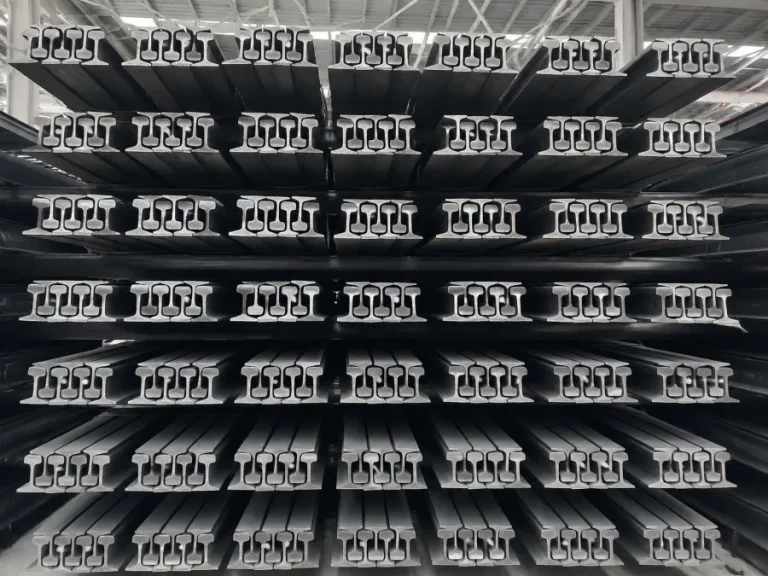
울타리 철도 선로의 주요 하중 지지 부재입니다.. 그들은 실행 표면을 제공합니다 기차 바퀴 차량 이동을 안내하고 바퀴 하중을 지지 트랙 구조로 전달하는 동안.
Modern railway rails are typically manufactured from high-strength carbon steel or low-alloy steel with carefully controlled chemical composition and heat treatment. The choice of rail profile depends on axle load, 열차 속도, track classification, 및 지역 표준.
Common rail standards include:
Each profile differs in dimensions, 무게, and intended applications. Heavy-duty freight railways generally use larger rail sections to withstand higher axle loads, while metro and light rail systems may adopt lighter rail profiles depending on operational requirements.
In addition to profile selection, rail material quality, 경도, 내마모성, and manufacturing accuracy all influence track performance and service life.
관련 기사: 철도 레일 유형 설명: UIC60, 136답장, R65, 60kg and Other Railway Rail Profiles.
침목, also known as railroad ties in North America, provide the structural foundation for the rails and fastening system. Their primary role is to maintain the correct track gauge while transferring wheel loads from the rails into the ballast.
Although sleepers appear to be simple structural members, they have a significant influence on track stability, maintenance requirements, and overall operating performance.
오늘, several sleeper types are used throughout the world:
Concrete sleepers have become the preferred solution for most modern mainline railways because they offer high strength, 우수한 치수 안정성, and long service life with relatively low maintenance.
Timber sleepers remain common in switches, 교량, and heritage railways where their machining flexibility and resilience provide practical advantages.
Steel sleepers are used in some regions because of their durability and recyclability, while composite sleepers continue to gain attention in projects that require high corrosion resistance or sustainable materials.
Selecting the appropriate sleeper depends on many factors, 축중 포함, 열차 속도, 기후, 유지 관리 관행, and local railway standards. Rather than focusing on a single material, engineers typically evaluate the entire track system to achieve the desired balance between performance, 내구성, and lifecycle cost.
관련 기사: 올바른 철도 침목 재료를 선택하는 방법?
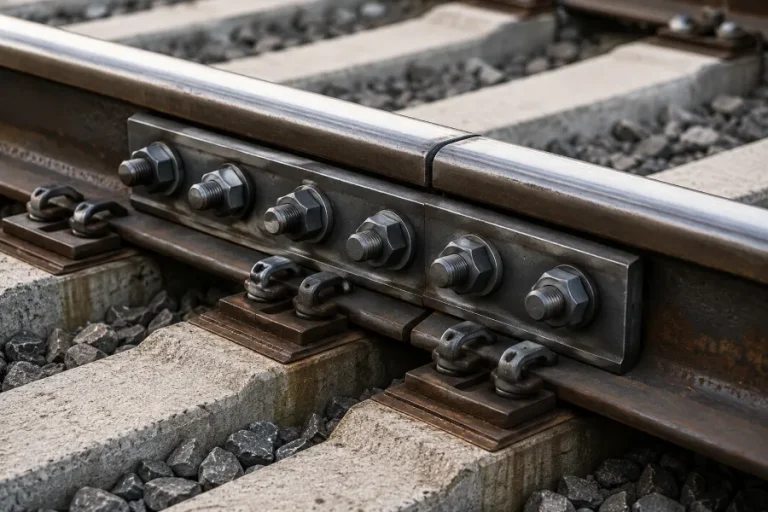
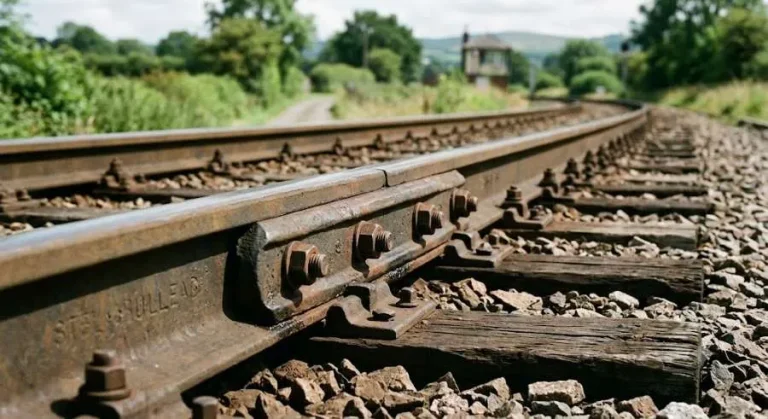
생선 접시, 조인트 바(Joint Bar)라고도 함, are steel connectors installed on both sides of a rail joint. They maintain alignment between adjacent rails and allow wheel loads to transfer smoothly across the joint.
Although continuously welded rail (CWR) has significantly reduced the number of mechanical rail joints in modern railways, fish plates remain essential for many applications, 포함:
생선 접시 are manufactured to match specific rail profiles. Their dimensions, bolt hole spacing, and contact surfaces must correspond precisely to the rail section they are designed to connect.
프로젝트 요구 사항에 따라, fish plates may be supplied in standard carbon steel, heat-treated steel, or alloy steel grades to improve wear resistance and fatigue performance.
Selecting the correct fish plate ensures accurate rail alignment, minimizes joint impact, and extends the service life of both the rail and fastening system.
관련 기사: 레일 피쉬 플레이트 설명: 유형, 표준, Materials and Applications.
피쉬 볼트 are specially designed fastening bolts used together with fish plates to secure rail joints. They provide the clamping force required to keep fish plates tightly connected to the rails while resisting repeated dynamic loads generated by passing trains.
일반 구조용 볼트와는 다르게, fish bolts are engineered specifically for railway applications. They are manufactured to precise dimensional tolerances and mechanical property requirements defined by railway standards.
Common bolt grades include:
A complete fish bolt assembly normally consists of:
Proper tightening torque is critical. Insufficient preload may allow joint movement and accelerate wear, while excessive torque may overstress the bolt or damage the joint components.
To achieve long-term reliability, manufacturers typically perform mechanical testing, hardness inspection, 치수 확인, and surface treatment quality control before shipment.
관련 기사: 피쉬 볼트 가이드: 올바른 등급을 선택하는 방법, 철도 프로젝트의 규모 및 표준.
While rails carry the train and sleepers provide structural support, neither can perform their role effectively without a reliable fastening system. This is where elastic rail clips become essential.
An 탄성 레일 클립 is designed to hold the rail firmly in position while allowing a controlled amount of flexibility. Rather than locking the rail rigidly in place, the clip applies a constant clamping force that accommodates the small movements caused by passing trains, 열팽창, and track settlement. This balance between strength and elasticity helps reduce stress throughout the track structure and contributes to longer service life.
Different railway systems use different clip designs depending on their operating conditions and standards. Some of the most widely used types include:
Although their shapes vary, they all perform the same basic function—maintaining rail position while allowing the track to respond to dynamic loading.
의 성능 레일 클립 depends heavily on its material and manufacturing process. Spring steel with carefully controlled heat treatment is commonly used to ensure that the clip maintains its designed clamping force after millions of loading cycles. Poor heat treatment or inconsistent material properties can lead to reduced elasticity, 피로 균열, or premature failure.
이러한 이유로, railway projects generally specify strict requirements for dimensional accuracy, spring force, 피로 생활, 경도, 부식 방지.
관련 기사: 다양한 철도 프로젝트에 적합한 탄성 레일 클립을 선택하는 방법
Among all railway fastening components, 레일 패드 are often overlooked because they are hidden beneath the rail. 실제로는, they play an important role in protecting both the rail and the sleeper.
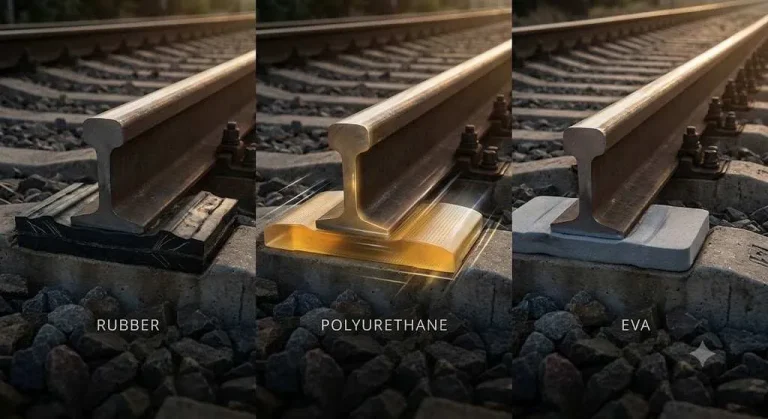
Installed between the rail foot and the sleeper or baseplate, a rail pad acts as an elastic interface within the fastening system. Every passing wheel generates impact forces and vibration. Without a resilient layer to absorb part of this energy, much of the load would be transferred directly into the concrete sleeper, increasing stress concentrations and accelerating wear.
A properly selected rail pad helps:
Different operating environments require different pad materials. Rubber remains one of the most common choices because of its excellent elasticity and durability. EVA pads are widely used where consistent stiffness and weather resistance are required, while HDPE and other engineered polymers may be selected for specialized applications.
The pad stiffness is just as important as the material itself. A pad that is too soft may allow excessive rail movement, while one that is too stiff may transmit more impact to the supporting structure. Engineers therefore select rail pads based on axle load, 열차 속도, track structure, and maintenance strategy rather than material alone.
관련 기사: Rail Pad Materials Explained: 고무, 에바, HDPE and Other Options.
Looking at each component individually helps explain its function, but a railway track performs as a complete system rather than a collection of independent parts.
When a train passes over the track, the wheel load follows a continuous path through every structural layer. Each component contributes to transferring that load safely while minimizing deformation, 진동, 그리고 피로.
The load path can be simplified as follows:
기차 바퀴 → 레일 → 레일 클립 → 레일 패드 → Sleeper → Ballast → Subgrade
Each component has a distinct responsibility within this process.
그만큼 레일 receives the wheel load directly and distributes it along the track. Its profile and material determine how efficiently it can resist bending, 입다, 롤링 접촉 피로.
그만큼 레일 클립 secure the rail to the sleeper. They maintain the required clamping force while allowing controlled elastic movement as trains pass and temperatures change. Without this elasticity, stresses would become concentrated in the rail and fastening system.
Beneath the rail, 그만큼 레일 패드 absorbs part of the impact energy generated by wheel loads. By reducing vibration and distributing pressure more evenly, it protects both the rail and the sleeper from excessive localized stress.
그만큼 침목 then spread the load across a larger area before transferring it into the ballast. 동시에, they maintain the correct rail gauge and provide a stable platform for the fastening system.
그만큼 안정기 distributes the load further into the track foundation while providing drainage and resisting lateral and longitudinal track movement. 마지막으로, 그만큼 노상 supports the entire structure and transfers the remaining load into the ground.
Because every component depends on the others, the performance of the track is only as strong as its weakest element. A high-quality rail cannot compensate for inadequate fastening components, just as premium rail clips cannot overcome problems caused by damaged sleepers or poor ballast conditions.
This systems approach is one of the reasons why railway engineers evaluate complete track performance rather than selecting components in isolation. Compatibility between rails, 고정 시스템, 침목, and supporting structures is essential for achieving long service life, 유지 관리 비용 절감, and reliable railway operation.
The terms railway track components 그리고 railway fastening system are often used interchangeably, but they do not refer to exactly the same thing.
Railway track components include every major element that forms the track structure—from rails and sleepers to ballast and subgrade. A railway fastening system, 하지만, refers specifically to the components that secure the rail to its supporting structure.
Although fastening systems differ between railway networks and manufacturers, most modern designs include the following components:
Working together, these components perform several important functions.
첫 번째, they hold the rail securely in position under repeated dynamic loading. Every passing train generates vertical, 옆쪽, and longitudinal forces that must be transferred safely into the sleeper without allowing excessive rail movement.
두번째, the fastening system provides controlled elasticity. Contrary to what many people assume, a rail should not be clamped as rigidly as possible. A certain amount of elastic movement helps reduce impact loading, 진동을 흡수하다, and prevent excessive stress from concentrating in the rail or sleeper.
제삼, fastening components maintain track geometry over time. By resisting gauge widening, rail overturning, and longitudinal creep, they help preserve the designed alignment of the railway and reduce maintenance requirements.
Because every railway project has different operating conditions, there is no universal fastening system suitable for all applications. High-speed passenger railways, 대형 화물 운송 노선, 지하철 시스템, crane rail installations, and industrial railways all place different demands on the fastening system. 축중과 같은 요인, 열차 속도, 레일 프로필, 슬리퍼 유형, 환경 조건, and maintenance strategy all influence the selection of fastening components.
Rather than evaluating each part individually, engineers typically assess the performance of the fastening system as a complete assembly, ensuring that all components work together to provide the required stiffness, 내구성, 장기적인 신뢰성.
Material selection has a direct influence on the strength, 내구성, 피로 저항, and maintenance requirements of railway track components. Since different components perform different mechanical functions, they are manufactured from materials specifically chosen for those operating conditions.
The following table summarizes the materials most commonly used throughout the railway industry.
| 요소 | Common Materials | Primary Performance Requirements |
| 레일 | High-carbon steel, pearlitic steel, 합금강 | 고강도, 내마모성, 피로 저항 |
| 생선 접시 | Medium-carbon steel, heat-treated alloy steel | 힘, 인성, 충격 저항 |
| Fish Bolt | 탄소강, 합금강 (등급 8.8, 10.9, 등.) | High tensile strength and reliable preload |
| 탄성 레일 클립 | Spring steel | 탄력적 회복, 피로 생활, consistent clamping force |
| 레일 패드 | 고무, 에바, HDPE, polyurethane | 탄력, vibration reduction, weather resistance |
| Sleeper | Prestressed concrete, 재목, 강철, 합성물 | Structural stability and long service life |
Selecting the right material is rarely about choosing the strongest option. 대신에, engineers aim to achieve the best balance between mechanical performance, 내구성, 제조 비용, maintenance requirements, and expected service life.
예를 들어, spring steel is ideal for rail clips because it can maintain elastic deformation over millions of load cycles. Using a higher-strength structural steel without adequate spring properties would actually reduce the clip’s long-term performance.
비슷하게, the hardness of a railway rail must be carefully controlled. A rail that is too soft may wear rapidly under heavy traffic, while excessive hardness can increase the risk of brittle fracture under certain operating conditions.
Rail pads provide another good example. Their effectiveness depends not only on the material itself but also on stiffness, 두께, and long-term compression characteristics. The same material may perform differently depending on formulation and manufacturing quality.
As railway technology continues to develop, manufacturers are also introducing improved alloys, engineered polymers, and advanced heat-treatment processes to enhance durability while reducing lifecycle costs.
Railway infrastructure is built according to national and international standards that define dimensions, 재료 특성, 테스트 방법, and performance requirements. Following these standards helps ensure compatibility between components supplied by different manufacturers and provides confidence in long-term operational safety.
Several standards are widely adopted around the world.
UIC standards are commonly used across Europe, 중동, 아프리카, and many international railway projects. They specify rail profiles, fastening components, 테스트 방법, and other technical requirements for interoperable railway systems.
AREMA standards are widely applied throughout North America and in many heavy-haul railway projects worldwide. They cover rail sections, 고정 시스템, track construction, 점검, 및 유지 관리 관행.
European EN standards define material specifications, 기계적 성질, production tolerances, and quality requirements for many railway products manufactured within or supplied to European markets.
British Standards continue to be referenced in numerous railway projects, particularly where existing infrastructure follows traditional UK specifications.
Australian Standards are commonly adopted for railway infrastructure serving mining operations, 화물 철도, and regional transportation networks.
China’s GB standards cover a broad range of railway products and are widely applied in domestic railway construction as well as many international infrastructure projects supported by Chinese contractors.
Although these standards differ in certain technical details, they share the same objective: ensuring that railway components meet consistent levels of safety, 신뢰할 수 있음, and interchangeability.
When sourcing railway track components, buyers should verify not only compliance with the applicable standard but also the manufacturer’s quality management system, inspection procedures, and production capability. Certification alone cannot replace consistent manufacturing quality.
Choosing railway track components is not simply a matter of matching dimensions on a drawing. Every railway project has unique operating conditions, and components should be selected as part of an integrated track system rather than in isolation.
Several factors are typically considered during the selection process.
고속철도, 대형 화물 운송 노선, 지하철 시스템, 산업용 트랙, and crane rail installations all impose different loading conditions. Components suitable for one application may not provide the required performance in another.
Heavier axle loads and higher traffic density increase stresses throughout the track structure. Components with greater fatigue resistance and higher mechanical strength are generally required for demanding service conditions.
생선 접시, 레일 클립, 레일 패드, and many fastening accessories are designed for specific rail profiles. Ensuring compatibility between components is essential for proper installation and long-term performance.
Temperature fluctuations, 습기, coastal environments, desert climates, and corrosive industrial conditions all influence material selection and protective surface treatments.
Different countries and railway operators specify different standards. Selecting components manufactured in accordance with the required specifications helps simplify installation, 유지, and future replacement.
The lowest purchase price does not always result in the lowest overall project cost. Products with better materials, tighter manufacturing tolerances, and higher fatigue performance often reduce maintenance frequency and extend service life, providing greater value over the lifetime of the railway.
실제로, experienced engineers rarely evaluate a single component independently. 대신에, they consider how rails, 고정 시스템, 침목, and supporting structures interact as a complete track system. This integrated approach leads to more reliable operation, lower maintenance requirements, and improved long-term performance.
| 요소 | 기능 | Related Article |
| 레일 | Load bearing | Rail Types |
| 레일 클립 | Fastening | 탄성 레일 클립 |
| 레일 패드 | Vibration control | Rail Pad Materials |
| 생선 접시 | Rail joint | 생선 접시 |
| Fish Bolt | Joint fastening | 피쉬 볼트 |
| Sleeper | 부하 이송 | 침목 |
Railway track components operate under demanding conditions every day. 무거운 차축 하중, repeated impact, 진동, 온도 변화, and exposure to harsh environments all place continuous stress on the track structure. Even components that appear relatively simple—such as a rail clip or fish bolt—are expected to perform reliably through millions of load cycles.
이러한 이유로, quality is determined by much more than whether a component meets its nominal dimensions. 재료 선택, manufacturing consistency, 열처리, 치수 정확도, and inspection procedures all contribute to long-term performance in service.
예를 들어, a rail clip with inconsistent spring properties may gradually lose its clamping force. A fish plate with poor machining accuracy can create uneven load transfer at the rail joint. 비슷하게, inadequate heat treatment of fish bolts may reduce fatigue resistance, increasing the likelihood of premature failure under repeated loading.
To minimize these risks, reputable manufacturers implement quality control throughout the production process rather than relying solely on final inspection. Typical quality assurance measures include:
These procedures help ensure that every component performs consistently once installed on the railway.
~에 뤄양포뇨중공업(Luoyang Fonyo Heavy Industries), 주식회사., we manufacture and export a wide range of railway track components for customers around the world. Our product portfolio includes rail fish plates, 물고기 볼트, 탄성 레일 클립, 레일 패드, and other railway fastening products manufactured in accordance with international standards such as UIC, 안에, 아레마, 학사, and other customer-specific specifications.
Whether the requirement is for standard products or customized solutions, our focus remains the same: delivering reliable railway components supported by strict quality control, 기술적 전문성, and responsive customer service.
Railway track parts are the individual parts that form a complete railway track system. They include rails, 침목, 레일 고정 부품, 생선 접시, 물고기 볼트, 안정기, and other supporting elements that work together to safely support and guide train operations.
철도 트랙 구성 요소 refer to the entire track structure, while the railway fastening system specifically consists of the components that secure the rail to the 자는 사람, ~와 같은 레일 클립, 레일 패드, 절연체, shoulders, and fastening bolts.
The principal components include 울타리, 침목, 레일 클립, 레일 패드, 생선 접시, 물고기 볼트, 안정기, and the supporting subgrade. Each serves a different function in maintaining track strength, 안정, 그리고 안전.
Elastic 레일 클립 apply continuous clamping force to hold the rail securely while allowing controlled elastic movement. This helps reduce vibration, accommodate thermal expansion, and improve the overall durability of the fastening system.
레일 패드 reduce impact forces, 진동을 흡수하다, distribute wheel loads more evenly, and protect both the rail and the sleeper from excessive stress. They also contribute to quieter railway operation and longer component life.
예. Although continuously welded rail has reduced the number of mechanical rail joints on many mainline railways, 생선 접시 remain widely used for industrial railways, 크레인 레일, 임시 트랙, maintenance work, 확장 조인트, and certain conventional railway applications.
Most elastic 레일 클립 are manufactured from high-quality spring steel. After appropriate heat treatment, spring steel provides the elasticity, 피로 저항, and long-term clamping force required for railway applications.
Common standards include UIC, 안에, 아레마, 학사, 처럼, and GB specifications. The applicable standard depends on the railway network, 국가, project requirements, and customer specifications.
Selection depends on several factors, including rail profile, 축중, 열차 속도, 슬리퍼 유형, 환경 조건, 적용 가능한 표준, 유지관리 전략. Components should always be evaluated as part of the complete track system rather than individually.
예. manufacturers can produce 철도 부품 according to customer drawings, 레일 프로필, 재료 사양, surface treatments, and applicable international standards. Customization is particularly common for 생선 접시, 물고기 볼트, 레일 클립, and other fastening products used in specialized railway projects.
Although railway tracks may appear straightforward from the outside, they are highly engineered systems made up of components that must work together under demanding operating conditions. From rails and sleepers to 생선 접시, 물고기 볼트, 탄성 레일 클립, 그리고 레일 패드, every component contributes to the safety, 안정, and service life of the railway.
Understanding the function of each component—and, 더 중요한 것은, how they interact as a complete system—helps engineers, 계약자, and procurement professionals make better decisions during design, 건설, 및 유지 보수. Selecting compatible components manufactured to recognized international standards can improve track reliability, reduce maintenance requirements, and lower lifecycle costs.
If you are looking for a reliable supplier of railway track components, our team is ready to support your project with technical expertise and manufacturing experience. We supply a wide range of railway fastening products for freight railways, 여객철도, 지하철 시스템, 산업용 트랙, 및 크레인 레일 애플리케이션, with solutions tailored to your specific technical and project requirements.
To learn more about individual railway track components, we recommend the following guides: