WeChat 코드를 스캔하여 문의하세요
WeChat 코드를 스캔하여 문의하세요
이메일을 보내주시면 최대한 빨리 답변해 드리겠습니다..
마음과 영혼을 다해 미래를 창조하다


~ 안에 철도 바퀴 조작, 가장 큰 오해는 하나의 가공 프로세스가 모든 응용 분야에 서비스를 제공할 수 있다는 것입니다..
종이에, a wheel is just a circular steel component.
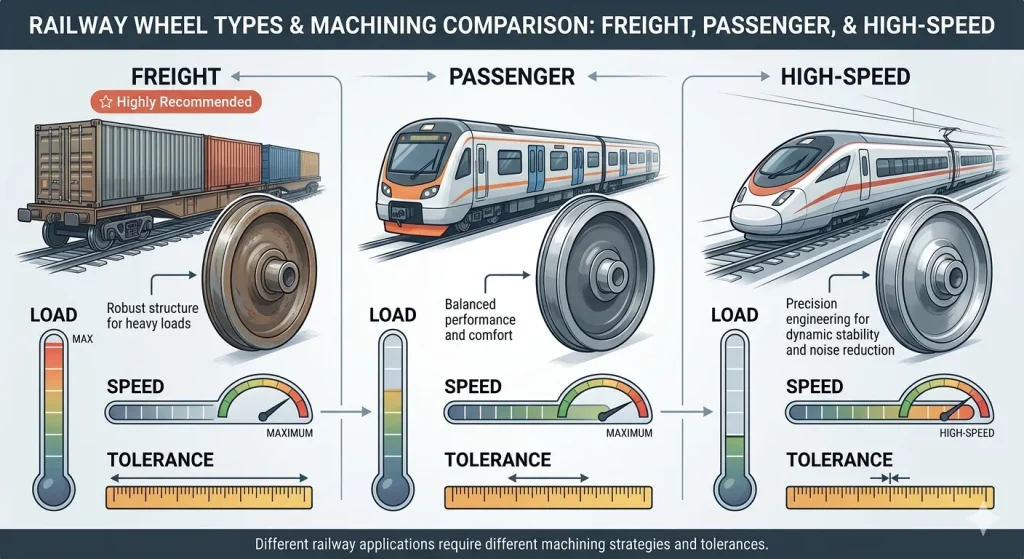
But in real operation, 화물 마차, 승객 코치, and high-speed trains place completely different demands on it.
Over years of production, one thing becomes very clear:
The problem is never just machining accuracy — it is how the wheel behaves in service over time.
That is why at our facility, we do not rely on a single production route.
대신에, we separate railway wheel machining into dedicated production lines based on real operating conditions.
Freight wheels are often misunderstood.
They do not run at high speed, but they carry extremely heavy loads over long distances and harsh environments.
From a machining perspective, the challenge is not extreme precision.
The challenge is 반복성.
When we run freight wheel production, what we really focus on is:
In freight applications, a single perfect wheel means nothing if the next thousand wheels behave slightly differently.
That variation is what creates long-term maintenance problems.
Passenger wheel machining looks similar on drawings, but behaves very differently in practice.
Even if a wheel is within dimensional tolerance, it can still generate noise or vibration during operation.
In real workshop experience, we found that passenger wheel quality is not judged by machining alone, but by how the wheel behaves after installation.
That is why this production line focuses more on:
In passenger transport, comfort is directly linked to small mechanical variations that are not always visible in standard inspection reports.
High-speed rail wheels operate in a completely different category.
At this level, machining is no longer just shaping steel — it is controlling stability under extreme dynamic conditions.
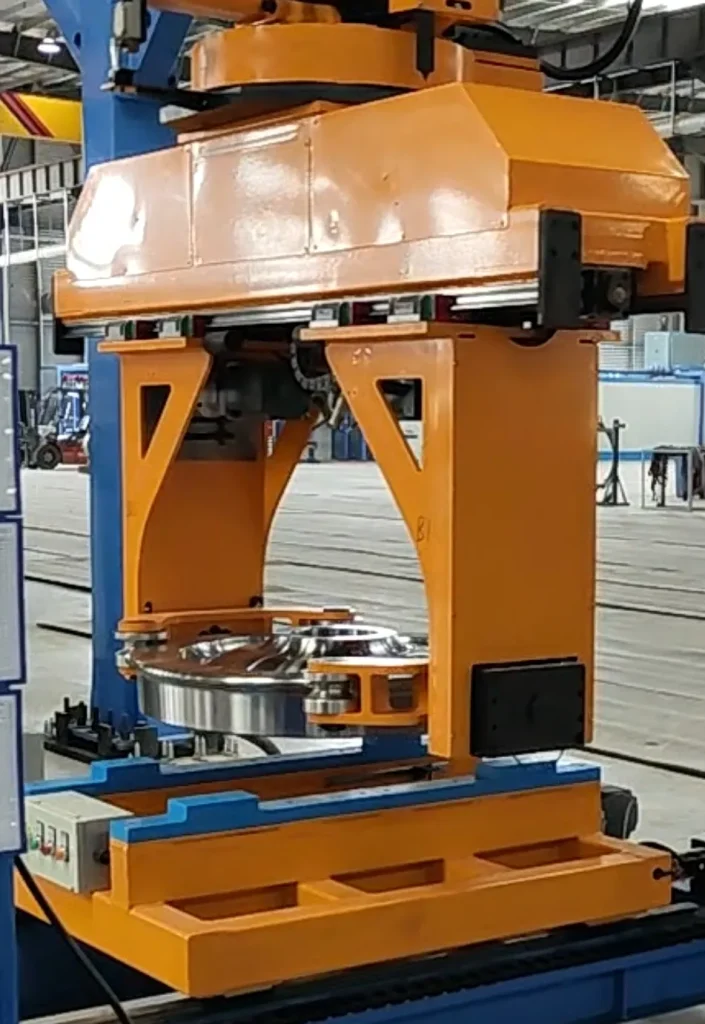
This is where we use German Hegenscheidt machining, 교련, and milling centers, combined with integrated online measurement systems.
Each wheel is processed as an individual controlled unit, not just a batch part.
The system continuously measures and adjusts during machining, reducing dependency on manual intervention.
결과적으로, we are able to maintain machining accuracy within: 3 μm, 즉 3 마이크로미터.
At this level, even small thermal or tool variations can matter. That is why closed-loop control is critical in high-speed rail applications.
엔지니어링 관점에서, combining all wheel types into one process would look efficient on paper.
실제로, it creates hidden compromises.
We separate machining lines for three practical reasons:
1. Process Stability
Each wheel type has different tooling, clamping, and machining behavior. Separation reduces interference between processes.
2. Quality Control Logic
Freight wheels require statistical stability, while high-speed wheels require individual traceability.
3. Real Operating Conditions
The way a freight wheel fails is completely different from how a high-speed wheel fails.
So the manufacturing logic must also be different.

All machining lines are built around high-precision CNC systems, including German Hegenscheidt equipment.
Each machine is equipped with integrated measuring probes, enabling real-time correction during machining.
실용적인 측면에서, 이것은 의미한다:
This is especially important for high-speed rail applications, where consistency matters as much as accuracy.
In real railway wheel production, quality is not determined by one machine or one inspection step.
It is determined by how the entire system is structured.
Freight wheels, passenger wheels, and high-speed rail wheels all fail in different ways — so they must be manufactured in different ways.
That is the reason we built dedicated machining lines instead of forcing a single process to cover all applications.
If you are working on railway wheel procurement or engineering projects and require production aligned with AAR, 안에, or high-speed rail standards, our engineering team can provide technical consultation and machining solutions tailored to your application.
We are 뤄양포요중공업(낙양포뇨중공업), 주식회사., and more technical information about our railway wheel manufacturing capabilities can be found at www.railwaypart.com