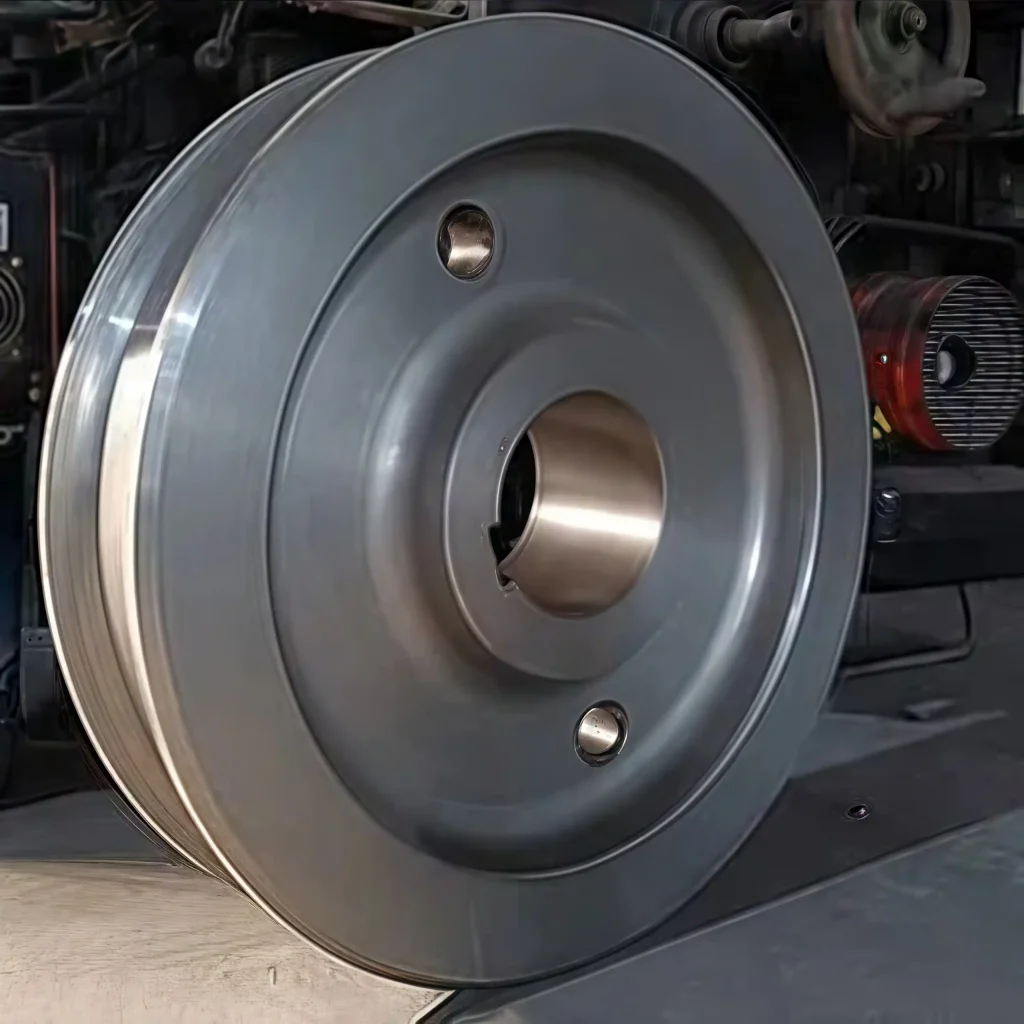
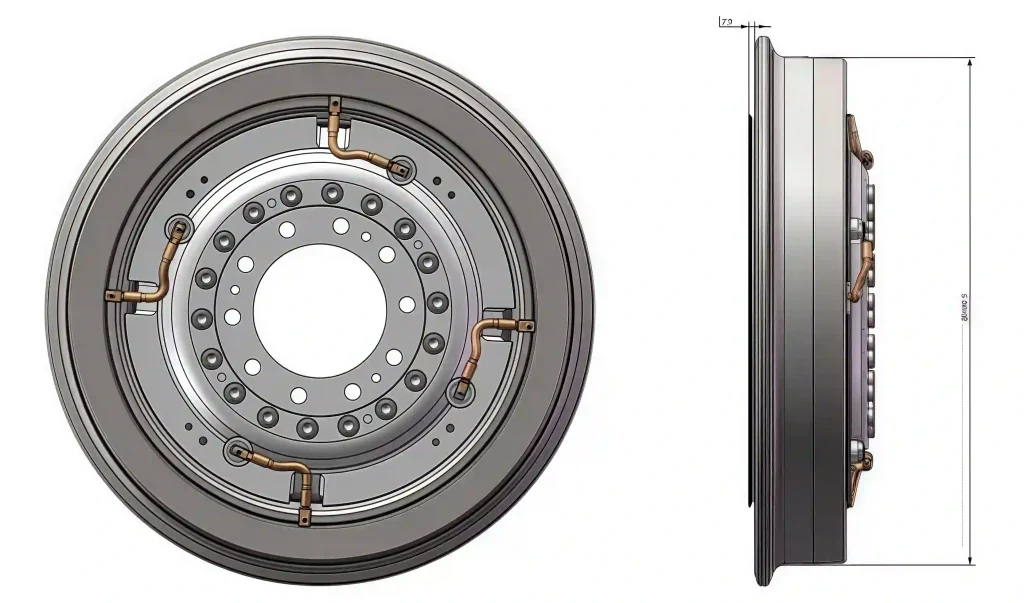
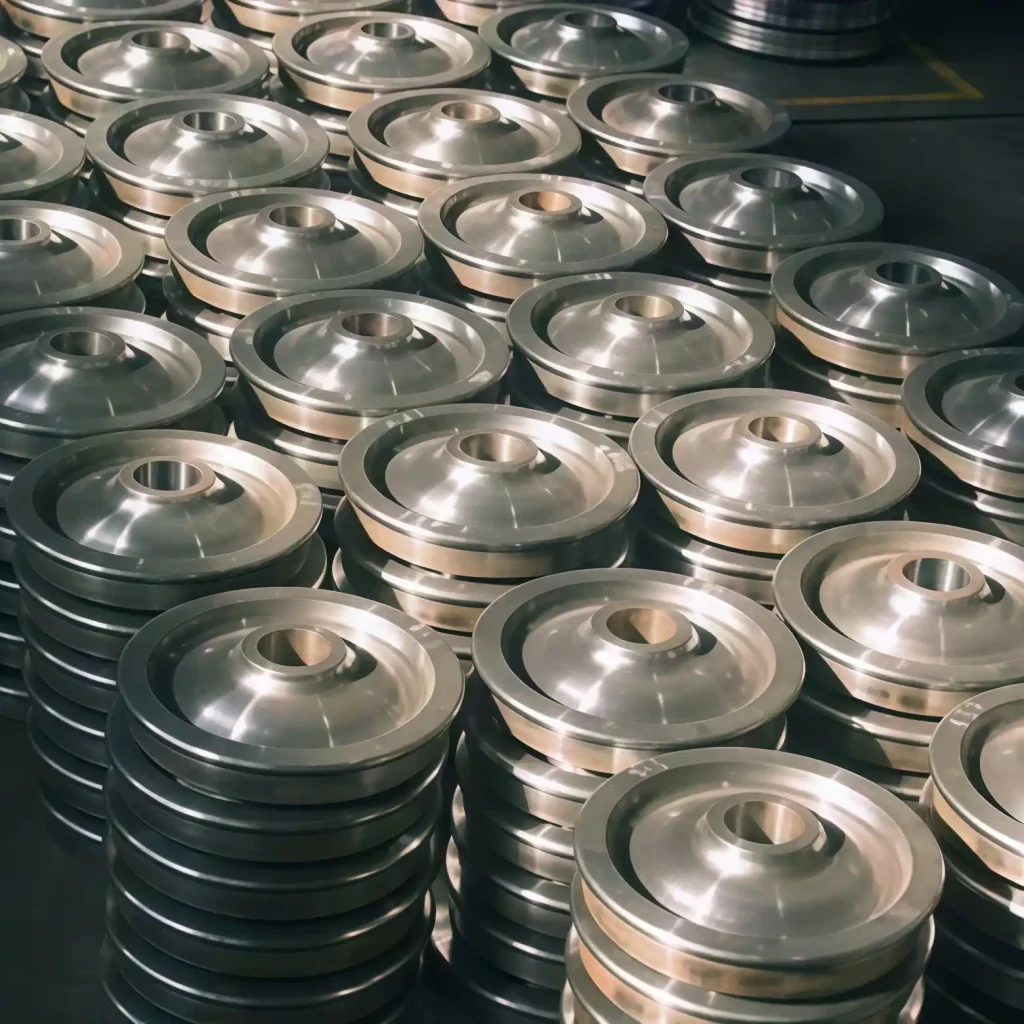
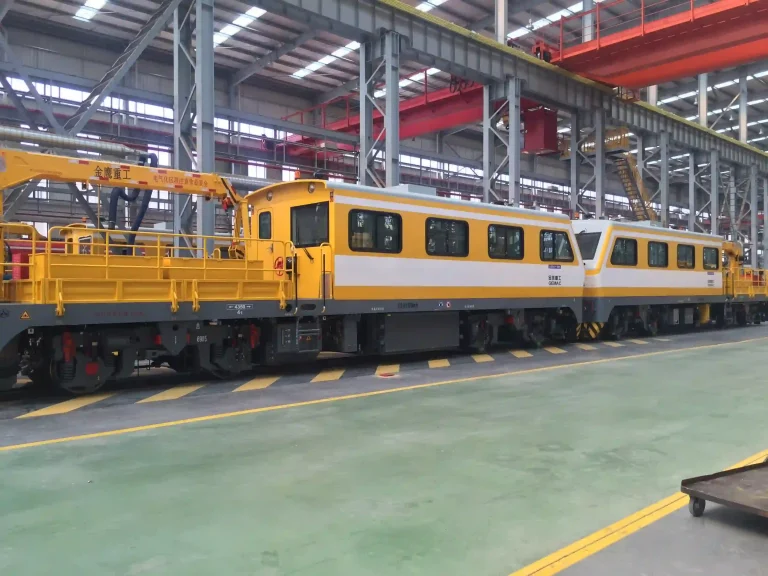
As core components of rail vehicles, 철도 바퀴must operate reliably under extreme conditions. 디자인은 세 가지 주요 요구 사항을 충족해야 합니다.:
Extremely heavy load bearing:Single-axle loads can reach 30 톤 (for heavy-duty freight trains), 훨씬 초과 1-2 tons of automotive wheels;
Extremely long lifespan:Design lifespans exceeding 1 백만 킬로미터, while maintaining performance in complex environments such as high speeds (350 km/h), low temperatures (-40℃), and high humidity;
Safety Redundancy Design:Any minor defect can lead to a derailment, placing stringent demands on material uniformity and process reliability.
철도 바퀴
2. 단조공정: Balancing High Performance with High Cost
2.1 Process Principles and Material Properties
Forged railway wheels utilize a combined radial forging and die forging process. A medium-carbon steel (예를 들어, 50망) 또는 합금강 (예를 들어, 30NiCrMoV12) billet heated to 450-500°C is gradually formed using a multi-directional press (with a pressure of up to 10,000 톤). This process creates a bidirectional fibrous structure in the metal grains along the circumference and axial directions of the rim, refining the grain size to 15-25μm and achieving a density of 99.8%.
Through T6 heat treatment (solution treatment + aging), the forged wheel hub achieves a tensile strength of 900MPa, a yield strength of 800MPa, an elongation of 15%, and a fatigue limit of 450MPa—30% higher than cast hubs. In a simulated drop-weight test (impact energy of 100kJ), the forged hub exhibited a residual deformation of only 2mm, far superior to the 5mm of a cast hub.
2.2 Performance Advantages and Applications
The core advantage of the forging process lies in its superior material properties:
피로생활:Under heavy load conditions, the crack growth rate is reduced by 50% compared to cast wheels, with a design life of up to 1.5 백만 킬로미터.
Thermal Stability:At 300°C, the strength retention rate reaches 85%, making it suitable for braking conditions in high-speed EMUs.
충격 저항:Passes EN 13262 테스트 (10^7 cyclic loading), with no crack initiation at a stress of 250 MPa.
These properties make it the preferred choice for high-speed EMUs (such as the China Harmony CRH380 series) and heavy-duty freight trains (such as the Daqin Railway C80 coal-hauling train). 예를 들어, the CR400AF Fuxing EMU uses forged wheels. When operating continuously at 350 km/h, the rim temperature remains stable below 80°C, resulting in a fatigue life of 12 백만 킬로미터.
하지만, the high cost of forged wheels (8,000-12,000 yuan per wheel) and long production cycle (20-30 날) limit their application, and they currently only hold approximately 15% of the high-end market share.
철도 바퀴
3. 주조 공정: The Cornerstone of Economic Efficiency and Large-Scale Application
3.1 Process Principles and Material Optimization
The mainstream process for railway wheel hub casting is static casting combined with heat treatment. The specific process is as follows:
Melting and Refining:Steel ingots (such as AAR M201-E1 grade steel) are melted in a medium-frequency induction furnace. Vacuum degassing is used to control the hydrogen content to below 1.5 ppm, 그리고 0.04% titanium is added to refine the grain size.
Filling and Solidification:Liquid metal is poured into a sand or metal mold. A controlled cooling rate (gradient of 3-5°C/s) minimizes shrinkage defects, achieving a yield of 85%.
Heat Treatment Optimization:A normalizing (890°C for 2 시간) followed by tempering (580°C for 4 시간) process is used to achieve a wheel hub tread hardness of 280-320 HB and a core hardness of 180-220 HB, achieving both wear resistance and toughness. Performance and Application Compatibility
3.2The core advantages of cast wheels lie in their affordability and scalable production:
비용 효율성:The cost per wheel is 2,000-3,500 원, only one-third that of forged wheels, and the production cycle is only 7-10 날.
Reliability Verification:Tested according to EN 13262 (10^7 cyclic loading), the wheels show no crack initiation at 200 MPa, meeting the requirements of standard lines.
제한사항:Under ultra-high-speed (>300 km/h) or ultra-heavy load (>30 tons axle load) 정황, fatigue life is 40% shorter than forged parts, requiring increased wall thickness (10-15 mm) to compensate for this.
Cast wheels are widely used in conventional passenger trains (such as the 25T passenger car) and standard-load freight trains (such as the C70 general-purpose open wagon). 예를 들어, Shanghai Metro Line 16 uses cast wheels. Operating at 80 km/h and with an average daily passenger flow of 100,000, the wheel replacement cycle is 12 연령, with a maintenance cost per kilometer of only 3,000 yuan per year.
철도 바퀴
4. Technological Evolution and Future Trends
4.1 Process Innovation Directions
Liquid Forging Technology:Liquid metal is injected into a mold and immediately subjected to high pressure (150 MPa). This combines the low cost of casting with the high performance of forging, increasing wheel strength by 25% while increasing costs by only 10%.
3D Printed Sand Casting: 3D printing complex sand molds enables topological optimization of the wheel structure, 체중 감량 8-12% while increasing design freedom.
Composite Wheels:Carbon fiber reinforcement rings (5-8 mm 두께) are embedded in the outer layer of the steel wheel hub, increasing rim stiffness by 40% 그리고 체중을 줄이는 것 15%. 하지만, this technology is costly (~ 위에 50,000 yuan per wheel) and is currently limited to the experimental stage. Market Trend Forecast
High-speed rail drives forging demand:As China’s high-speed rail operating mileage exceeds 40,000 킬로미터, the penetration rate of forged wheels in 350 km/h EMUs is expected to increase from the current 10% 에게 25%.
Heavy-haul freight drives casting upgrades:Through processes such as liquid forging, the proportion of cast wheels in 25-ton axle-load freight trains will reach 70%, replacing traditional cast wheels.
Intelligent manufacturing reduces costs and increases efficiency: 산업 4.0 technologies (such as robotic automated polishing and AI quality inspection) can reduce the cost of forged wheels by 20%, narrowing the price gap with cast wheels to less than 2x. Decision Guide and Typical Case Studies.
철도 바퀴
4.2 Key Selection Dimensions
작동 속도:For high speeds (>250 km/h), choose forging; for standard speeds (<200 km/h), choose casting.
차축 하중:For heavy loads (>25 톤), choose forging; for standard loads (<25 톤), choose casting.
Line Conditions:For extreme environments (cold/hot/rainy), choose forging; for standard environments, choose casting.
Life Cycle Cost:Forging has a higher initial purchase cost but lower maintenance costs; casting has a lower initial purchase cost but higher replacement frequency. Practical Application Cases
High-speed EMUs:The CR400AF Fuxing EMU uses forged wheels. When operating continuously at 350 km/h, the wheel rim temperature remains stable below 80°C, resulting in a fatigue life of 12 백만 킬로미터.
Heavy-haul freight trains:The Daqin Railway’s C80E coal transport vehicle uses liquid forged wheels. Under the demanding conditions of a 30-ton axle load and an annual freight volume of 200 million tons, the wheel life has been extended from 5 년 ~ 8 연령, reducing lifecycle costs by 35%.
도시철도:Shanghai Metro Line 16 uses cast wheels. Operating at 80 km/h and with an average daily passenger flow of 100,000, the wheel replacement cycle is 12 연령, with an annual maintenance cost of only 3,000 yuan per kilometer.
The choice between forging and casting is essentially a trade-off between performance and economic efficiency. With technological advancements, the distinction between the two will gradually blur, but the core differences—material density and process reliability—will remain the key factors in the selection decision.
철도 주조 부품 공급업체
뤄양포뇨중공업(Luoyang Fonyo Heavy Industries), 주식회사, 1998년에 설립된 캐스트 철도 부품 제조업체입니다.. 우리 공장의 면적은 72,600㎡입니다., 이상으로 300 직원, 32 기술자, 포함 5 수석 엔지니어, 11 보조 엔지니어, 그리고 16 기술자. 우리의 생산 능력은 30,000 연간 톤. 현재, 우리는 주로 주조물을 생산하고 있습니다, 가공, 기관차 조립 및 조립, 철도 차량, 고속 열차, 광산 장비, 풍력, 등. 우리의 제품은 러시아로 수출되었습니다, 미국, 독일, 아르헨티나, 일본, 프랑스, 남아프리카, 이탈리아 및 기타 국가. 연락하다: 스텔라 리우 이메일: [email protected] 왓츠앱: +86-155-1535-1287