WeChat 코드를 스캔하여 문의하세요
WeChat 코드를 스캔하여 문의하세요
이메일을 보내주시면 최대한 빨리 답변해 드리겠습니다..
마음과 영혼을 다해 미래를 창조하다


The wheel set, a core component in contact with the rails on locomotives and vehicles, is composed of two wheels pressed onto the same axle. Its functions include bearing the static and dynamic loads of the locomotive, transmitting driving and braking forces, and ensuring the steering of the vehicle. The distance between the inner sides of the wheel set must be strictly controlled within the range of 1353 ± 3 밀리미터, and the processing accuracy of the axle neck and the wheel tread must comply with the standards for ellipticity and eccentricity.
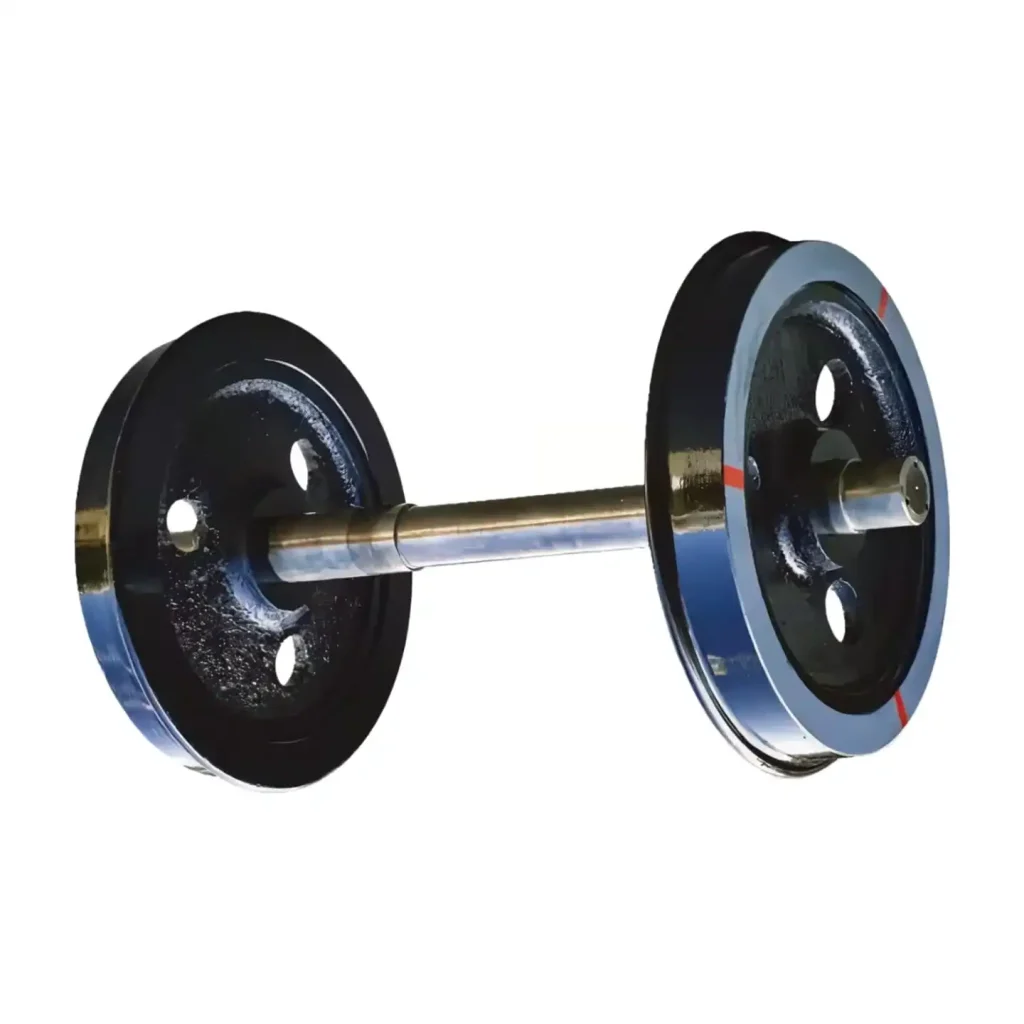
2.1Vehicle wheel sets and locomotive wheel sets. Locomotive wheel sets are further subdivided by power type into steam locomotive wheel sets, diesel locomotive wheel sets, electric locomotive wheel sets, and power axle wheel sets of EMUs. By bearing type, they can be divided into rolling bearing wheel sets and sliding bearing wheel sets. All passenger cars in China’s railways have adopted rolling bearing wheel sets. The axle is forged from medium carbon steel and consists of components such as the wheel seat, axle neck, and axle body.
2.2 The wheel seat, which is the part for wheel pressing and has the largest diameter, and the axle neck, which cooperates with the bearing for rotation, are key parts. The structure of the wheel is divided into two types: rimmed wheels and integral wheels. Rimmed wheels are composed of the rim, wheel core, and retaining ring, while integral wheels adopt an integrated design of the rim and wheel core. The wheel tread has a 1:10 taper to achieve curve guidance, and high-speed trains use wear-shaped treads to extend the grinding cycle.
3.1 Wheel sets are classified into two types: vehicle wheel sets and locomotive wheel sets. Locomotive wheel sets are further divided into steam locomotive wheel sets, diesel locomotive wheel sets, electric locomotive wheel sets and driving wheel sets of EMUs based on the type of locomotive. The driving wheel sets of diesel locomotives, electric locomotives and EMUs are equipped with transmission gears on the axle body. Modern high-speed passenger cars and EMUs all adopt disc brakes, with brake discs installed on the axle body or wheels. Steam locomotive wheel sets are classified into guide wheel sets, driving wheel sets, trailing wheel sets and coal and water car wheel sets. Guide wheel sets are located at the front of the locomotive and serve as a guide. Driving wheel sets transfer the locomotive’s power, with those directly driven by the piston through the rocker arm being the leading driving wheel sets, and those driven by the leading driving wheels through the connecting rod being the trailing driving wheel sets. The wheel cores of driving wheel sets have crank pins, crank pin holes and balance weights, and the cranks of the left and right wheels should have a 90° phase difference when assembled. The bearings of the driving wheels and guide wheels are all on the inner side of the wheels. Trailing wheel sets and coal and water car wheel sets are similar in shape to those of passenger and freight vehicles.
3.2 Wheel sets can be classified into rolling bearing wheel sets and sliding bearing wheel sets based on the type of bearing suitable for the axle. All passenger cars in China’s railways have adopted rolling bearing wheel sets, and the number of freight cars using rolling bearing wheel sets is also increasing.
According to the maximum allowable axle load (the maximum static pressure exerted by the wheel set on the rail), sliding bearing wheel sets for freight cars are divided into four types: 비, 기음, D and E. The dimensions of the axle and wheel of each type of wheel set, except for the wheel diameter, are different. Rolling bearing wheel sets for passenger and freight cars are also divided into three types: RC, RD and RE. 게다가, within the same type of wheel set, there are different lengths of journal due to the different types of rolling bearings used, which are distinguished by subscripts, such as RC, RD, 등. The axle is forged from medium carbon high-quality steel and has a cylindrical body with different diameters in each section. It can be classified into locomotive axles and passenger and freight car axles based on the type of vehicle. It can also be classified into sliding bearing axles and rolling bearing axles based on the type of bearing.
4.1 Wheel seat, the part where the wheel is pressed onto the axle, and also the part with the largest diameter on the axle;
4.2 Journal, the part of the axle that interacts with the bearing;
4.3 Axle body, the part between the two wheels. Some passenger and freight car axles have a gradually decreasing diameter from the wheel seat to the center, while others have a cylindrical shape throughout. The transmission gears of diesel locomotives and electric locomotives and the axle-mounted brake discs of disc brake-equipped locomotive axles are installed on the axle body;
4.4 Dust cover seat, the transition part between the journal and the wheel seat on passenger and freight car axles, where the dust cover of the sliding bearing box or the rear guard plate of the rolling bearing box is installed;
4.5Axle collar, the part at both ends of the passenger and freight car axle that protrudes from the journal, used to prevent excessive movement of the sliding bearing on the journal. Rolling bearing axles do not have axle collars;
4.6 Journal shoulder, the part of the journal near the dust cover seat, which is made into an arc transition to avoid stress concentration caused by sudden changes in diameter.
The load on the axle of a locomotive or vehicle during operation is constantly changing, and due to the continuous rotation of the wheel set, alternating stress is generated inside the axle. 그러므로, it is necessary to improve the endurance limit of the axle material. To this end, during the manufacturing process, the entire length of the axle body must be turned, the journal and wheel seat must be strengthened by roller pressing, and load-reducing grooves must be set at the wheel seat and the arc transition (for rolling bearings) of the journal shoulder. Throughout the service life, strict ultrasonic and electromagnetic flaw detection must be carried out.
Axles are usually solid, but the stress distribution on the cross-section of the axle is uneven, being greater near the surface and smaller at the center. 그러므로, it is possible to use hollow axles instead of solid axles to reduce the harmful effects of unsprung weight on locomotives, vehicles and tracks. Although hollow axles have been tested on railways in some countries for many years, due to the complex stress state during operation, they are still under research and improvement.
뤄양포뇨중공업(Luoyang Fonyo Heavy Industries), 주식회사, 1998년에 설립된 철도 주조 부품 제조업체입니다. 저희 공장 부지는 72,600㎡입니다., 이상으로 300 직원, 32 기술자, 포함 5 수석 엔지니어, 11 보조 엔지니어, 그리고 16 기술자. 우리의 생산 능력은 30,000 연간 톤. 현재, 우리는 주로 주조물을 생산하고 있습니다, 가공, 기관차 조립 및 조립, 철도 차량, 고속 열차, 광산 장비,풍력,등.
우리는 CRRC에 철도 부품을 공급하고 있습니다.(이상 포함 20 CRRC의 지사 및 자회사),Gemac 엔지니어링 기계,삼니그룹, 중공업,등. 우리의 제품은 러시아로 수출되었습니다, 미국, 독일, 아르헨티나, 일본, 프랑스, 남아프리카,이탈리아와 전 세계의 다른 나라들.