Scansiona il codice WeChat per contattarci
Scansiona il codice WeChat per contattarci
Sentiti libero di inviarci un'e-mail e ti risponderemo il prima possibile.
Creare il futuro con cuore e anima


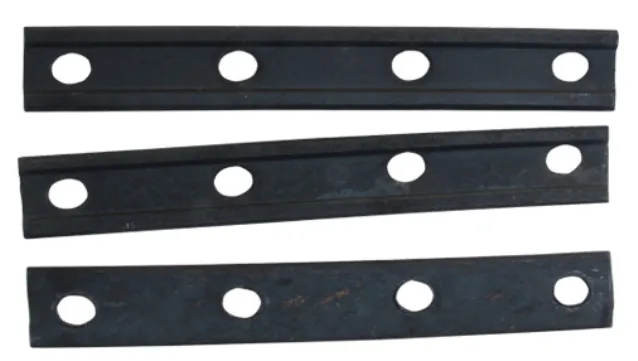
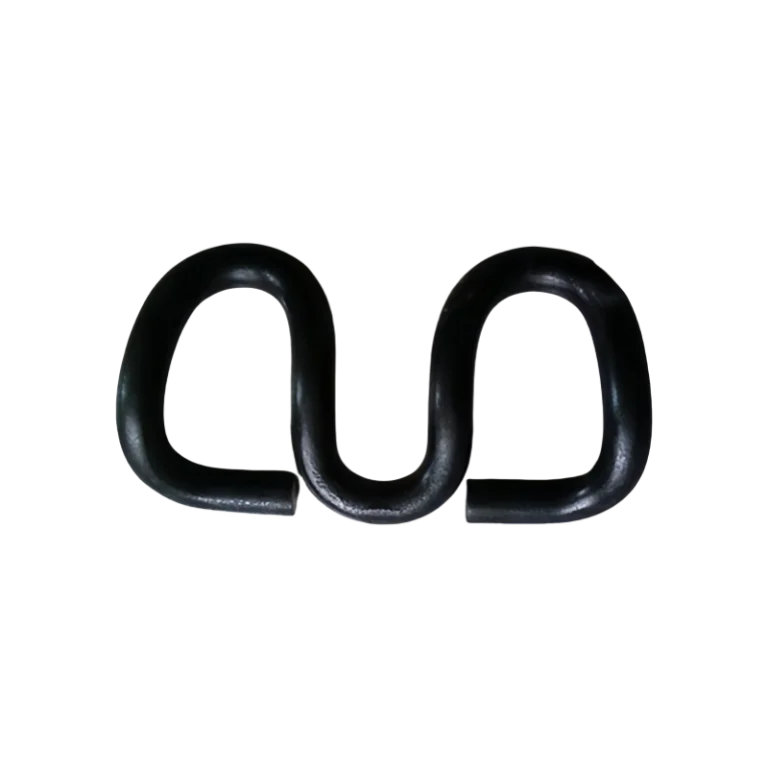
When two steel rails come together, a railway fishplate, also called a rail joint bar or splice bar—locks them firmly in place. This seemingly simple piece of metal plays a crucial role: it ensures the rails stay perfectly aligned, bears the weight and stress of passing trains, and upholds the safety and reliability of the entire track system.
This guide will help you understand key fishplate specifications—including dimensions, materiali, hole spacing, and types—so you can choose the right product for your needs.
A railway fishplate is a sturdy metal bar that bolts onto the ends of two rails, holding them together with precision. It reinforces the track, keeps the rails perfectly aligned, and channels the weight and forces from one rail to the next. Since each rail has its own unique profile, choosing this important railway parts that matches the rail section exactly is crucial—this is why careful attention to specifications makes all the difference.
Because every rail type has a unique profile, it’s essential to match the fishplate to the exact rail section. That’s why paying attention to specifications matters.
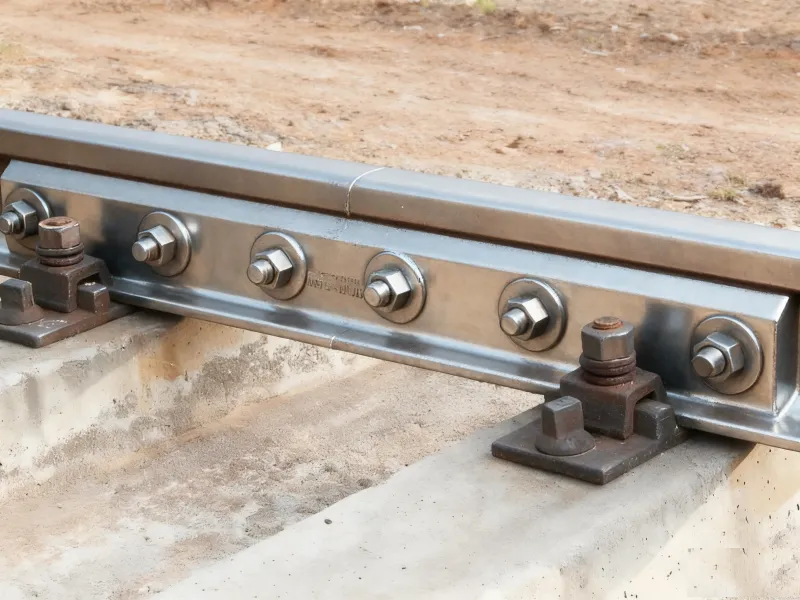
Selecting the correct fishplate ensures:
A stable and continuous rail connection
Proper track gauge and alignment
Smooth load transfer, even under heavy traffic
Reduced vibration and lower risk of rail breakage
Full compatibility with rail bolts and tie plates
Using incorrect specifications can lead to rail movement, loose bolts, or even derailment risks.
Fishplate sizes are designed to match specific rail models. Here’s a practical breakdown covering the most widely used types across Asia, Africa, the Middle East, Sud America, and industrial railways.
Light Rail Fishplate Specifications
| Tipo di binario | Lunghezza (mm) | Spessore (mm) | Holes |
| 8 kg | 230–250 | 12–14 | 4 |
| 9 kg | As per corresponding standard | 4 | |
| 12 kg | 260–280 | 14–16 | 4 |
| 15 kg | 300–320 | 14–18 | 4 |
| 18 kg | 330–350 | 16–18 | 4 |
| 22 kg | 360–380 | 16–20 | 4 |
| 24 kg | As per corresponding standard | 4 | |
| 30 kg | 400–420 | 18–22 | 4 |
Heavy Rail Fishplate Specifications
| Tipo di binario / Standard | Lunghezza (mm) | Spessore (mm) | Holes |
| 38 kg | 450–480 | 20–24 | 4 |
| 43 kg | 500–550 | 22–26 | 4 |
| 50 kg / UIC50 | 550–600 | 24–28 | 6 |
| 60 kg (Cina) | 650–700 | 26–30 | 6 |
Crane Rail Fishplate Specifications (QU Series)
| Tipo di binario | Also Known As | Common Configurations |
| QU70 | Crane Rail Inclined Joint Bar | 6 holes |
| QU80 | Crane Rail Inclined Joint Bar | 6 holes |
| QU100 | Crane Rail Inclined Joint Bar | 6 holes |
| QU120 | Crane Rail Inclined Joint Bar | 6 holes |
We also supply fishplates conforming to international standards such asBS47 (per esempio., BS80A, BS75R) EUIC series (per esempio., UIC54, UIC60).
A complete fishplate specification includes:
Lunghezza – depends on rail weight and expected load.
Spessore – influences strength and stiffness.
Bolt Hole Diameter – typically 18–25 mm.
Bolt Hole Spacing – must match the rail’s drilling pattern.
Number of Bolt Holes – commonly4-buco O6-buco designs.
Surface Contour – ensures a perfect fit with the rail head and foot.
We also support customized specifications for industrial and mining railways.
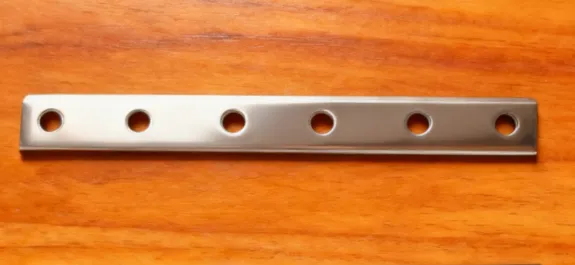
Standard Fishplate
Used in conventional railways and light industrial tracks.
Heavy-Duty Fishplate
Thicker and stronger, ideal for high-speed lines and heavy axle loads.
Insulated Fishplate
Made of composite or fiberglass; used in electrified railways and track circuit sections.
Forged Fishplate
Offers higher strength, suitable for demanding conditions.
Cast Steel Fishplate
A cost-effective solution for light to medium-duty applications.
We offer fishplates in several materials to suit different performance needs:
Q235 Rolled Steel – A reliable choice for general use.
Forged Steel – Provides enhanced strength and durability.
Ferro duttile – Known for its good mechanical properties and impact resistance.
All materials can be produced to meet international standards such as AREMA, BS, UIC, TBC/T, or JIS, depending on your region.
Here’s a simple checklist to help you choose:
Identify the exact rail model (per esempio., 50 kg, UIC60, QU100).
Confirm bolt size and hole spacing.
Select the material grade based on load and environmental conditions (per esempio., corrosione, temperatura, impatto).
Consider special types like insulated fishplates for track circuits.
Provide your supplier with a rail drawing or profile standard for accurate matching.
Luoyang Fonyo Heavy Industries Co., Ltd. è stata fondata nel 1998 . Nel corso degli anni, Fonyo has been recognized multiple times as the Luoyang Engineering Technology Center, Luoyang Tecnologia R&Centro D, e un'impresa nazionale ad alta tecnologia.
Con una capacità produttiva annua di 30,000 tonnellate, we specialize in cast steel and cast iron (compresa la ghisa grigia e la ghisa duttile), as well as machining of finished products and component assembly for industries such as locomotive, vagone ferroviario, ferrovia ad alta velocità, attrezzature minerarie, e l'energia eolica.
Our products are exported to more than ten countries and regions, compresa la Russia, gli Stati Uniti, Germania, Argentina, Giappone, Francia, Sudafrica, e Italia.
Domande frequenti
Q1: Sei un produttore o una società commerciale?
UN:Siamo un produttore. La nostra azienda è stata fondata nel 1998, con quasi 30 anni nel settore della fusione, una superficie totale di 72.600㎡, con un'area edificabile di 51.000㎡.
Q2. Quali sono i vostri prodotti principali??
UN: Ci concentriamo principalmente sulla fusione di acciaio, fusione di ferro, lavorazione del prodotto finito, e produzione di assemblaggi di componenti per locomotive, vagone ferroviario, treni ad alta velocità, attrezzature minerarie, energia eolica, ecc.
Q3: Con quanta precisione puoi produrre parti di fusione?
UN: Abbiamo la capacità di produrre parti di fusione con diversi processi di fusione. La produzione è rigorosamente conforme alla norma ISO 9001, ISO 14001 e ISO45001,EN15085, IRIS.
Q4. Puoi produrre secondo i campioni?
SÌ, possiamo produrre dai vostri campioni o disegni tecnici. Possiamo costruire disegni per te anche dopo aver ricevuto i tuoi campioni.
Q5: Come si effettua il controllo qualità prima della consegna??
UN: Il controllo di qualità è un fattore molto importante per garantire la qualità delle parti in fusione di acciaio. Seguiamo 3 tempi di ispezione durante l’intero processo produttivo. E forniremo un rapporto sui test dei materiali, rapporto di collaudo dimensionale, e rapporto sui test delle proprietà meccaniche ai nostri clienti prima della consegna.
If you are interested in any products, please feel free to contact us.