Scansiona il codice WeChat per contattarci
Scansiona il codice WeChat per contattarci
Sentiti libero di inviarci un'e-mail e ti risponderemo il prima possibile.
Creare il futuro con cuore e anima


In most railway bogies, the side frame is not just a structural component—it is where casting quality directly translates into long-term performance.
Dal punto di vista ingegneristico, Fusione del telaio laterale del carrello ferroviario is one of the most critical processes because any internal defect, residual stress, or dimensional deviation can eventually lead to fatigue cracks in service.
Nel corso degli anni, we have seen that many in-service failures are not caused by design, but by inconsistencies in casting control. That is why understanding how side frames are actually manufactured is essential—not only for engineers, but also for procurement teams evaluating suppliers.
Fusione del telaio laterale del carrello ferroviario refers to the manufacturing of side frames using steel casting processes, typically through resin sand or similar molding methods.
Unlike smaller cast components, side frames present several inherent challenges:
From a process standpoint, this is not a simple “pour and cool” operation. The geometry itself creates multiple hot spots, which makes defect control significantly more difficult.
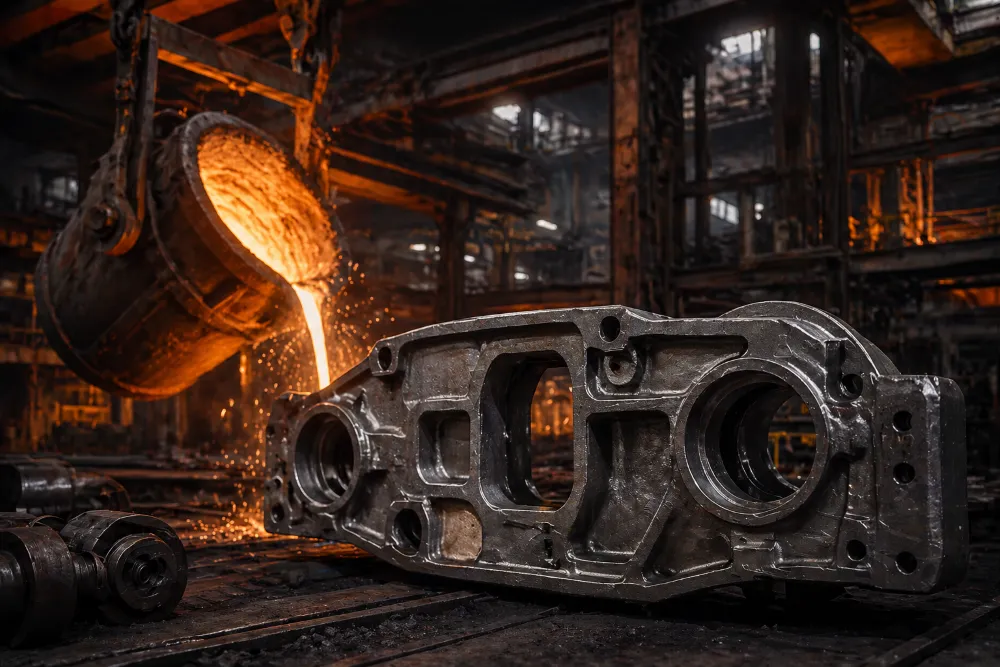
From practical production experience, a typical Fusione del telaio laterale del carrello ferroviario process follows these stages:
Pattern and Mold Preparation
The process starts with pattern design, which directly affects dimensional accuracy and shrinkage compensation. Resin sand molding is commonly used due to its stability and surface quality.
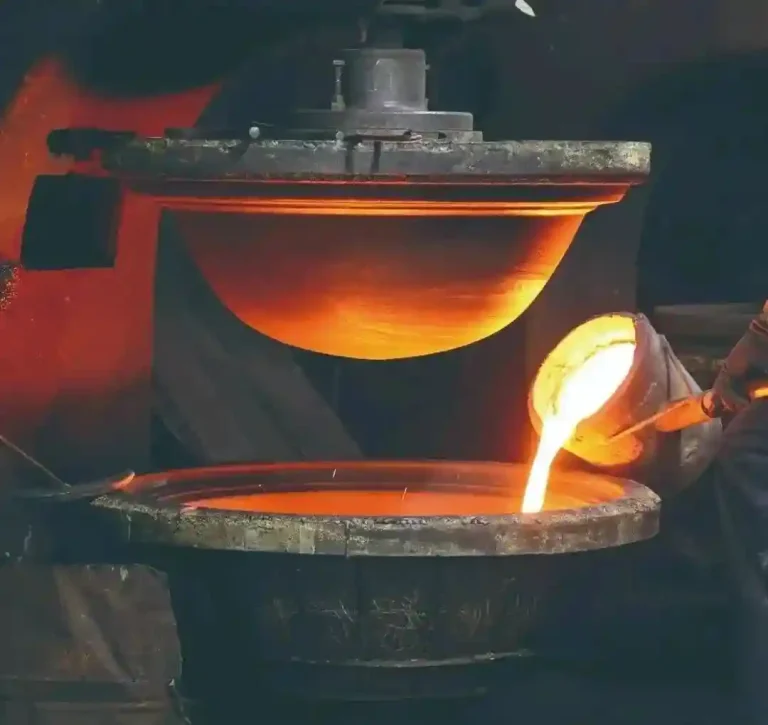
Fusione e colata
Steel is melted in electric arc furnaces or induction furnaces.
The key here is not just temperature—but chemical composition control and pouring stability.
Poor pouring practices often lead to:
Solidification and Cooling Control
This is where most casting problems originate.
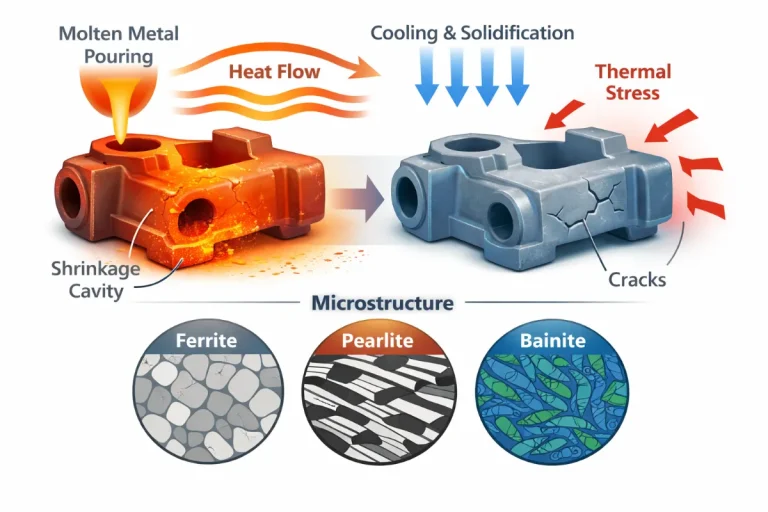
Due to uneven wall thickness, different sections cool at different rates. Without proper riser design and cooling control, defects such as shrinkage cavities are very difficult to avoid.
Shakeout and Cleaning
Dopo la solidificazione, the casting is removed from the mold, followed by shot blasting and surface cleaning.
In real production environments, Railway Bogie Side Frame Casting defects are not theoretical—they are recurring issues if not properly controlled.
Shrinkage Cavities
Usually found in thicker sections.
They are caused by insufficient feeding during solidification.
Cracks (Hot Cracks and Cold Cracks)
Often appear in:
These are typically related to thermal stress and improper cooling rates.
Sand Inclusion and Slag Inclusion
These defects are often linked to:
Dimensional Deviation
Side frames must match axle box and bolster assembly precisely. Even small deviations can affect bogie alignment.
Dal punto di vista ingegneristico, quality control is not one step—it is a system.
Process Design Optimization
Chemical Composition Control
Material consistency directly impacts:
Trattamento termico
Normalizing and tempering are typically applied to:
Prove non distruttive (NDT)
Critical inspection methods include:
Without proper NDT, many defects remain undetected until failure occurs in service.

From field experience, poor Fusione del telaio laterale del carrello ferroviario quality usually shows up as:
Al contrario, well-controlled casting results in:
For operators, this is not just a component issue—it directly impacts safety and operational efficiency.
H2: Choosing a Reliable Railway Bogie Side Frame Casting Supplier
From a buyer’s perspective, evaluating a supplier should go beyond price.
Key aspects include:
In molti casi, the difference between a reliable and an unreliable supplier is not visible in the first delivery—but becomes obvious after months of service.
What is Railway Bogie Side Frame Casting?
Railway Bogie Side Frame Casting is the process of manufacturing bogie side frames using steel casting methods, ensuring structural strength and dimensional accuracy for railway applications.
What are the common defects in side frame casting?
Common defects include shrinkage cavities, crepe, inclusione di sabbia, and dimensional deviation, mainly caused by poor solidification control and process design.
Why is heat treatment important in side frame casting?
Heat treatment improves mechanical properties, relieves internal stress, and enhances fatigue resistance, which is critical for long-term service performance.
Which inspection methods are used?
Test ad ultrasuoni (UT) and Magnetic Particle Testing (MT) are widely used to detect internal and surface defects.
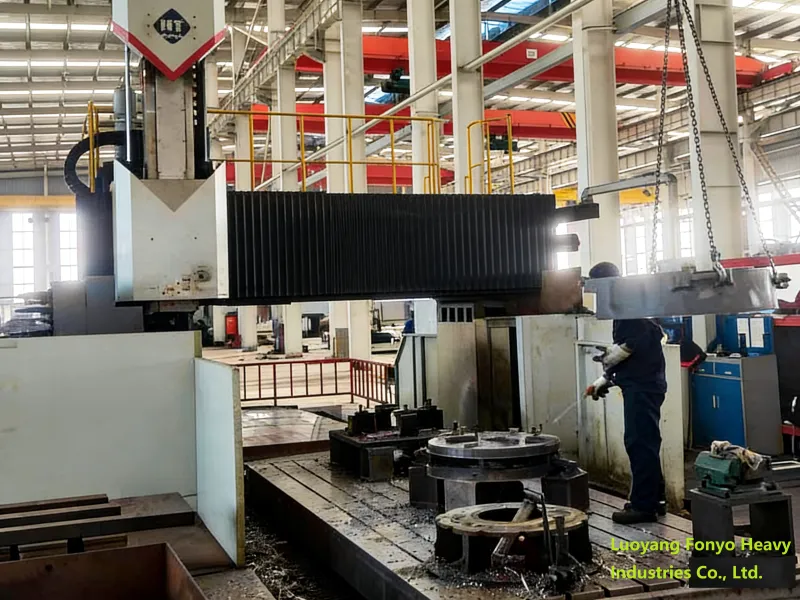
In Fusione del telaio laterale del carrello ferroviario, quality is not something that can be added at the end—it must be built into every step of the process.
In our production practice, we focus on:
If you are working on railway bogie components or evaluating long-term suppliers, understanding the casting process is often the fastest way to identify real manufacturing capability.
Learn more about our railway casting solutions:
Luoyang Fonyo Heavy Industries Co., Ltd.