Scannen Sie den WeChat-Code, um mit uns Kontakt aufzunehmen
Scannen Sie den WeChat-Code, um mit uns Kontakt aufzunehmen
Schicken Sie uns gerne eine E-Mail und wir werden Ihnen so schnell wie möglich antworten.
Mit Herz und Seele die Zukunft gestalten


Für den sicheren Betrieb auf Bahngleisen ist die zuverlässige Verbindung zwischen den Waggons von entscheidender Bedeutung. The train couplerS are the key component that achieves this connection. Befindet sich am Ende jedes Wagens, it is responsible for connecting the carriages, transmitting tractive and impact forces. So it can ensure train moving smoothly.
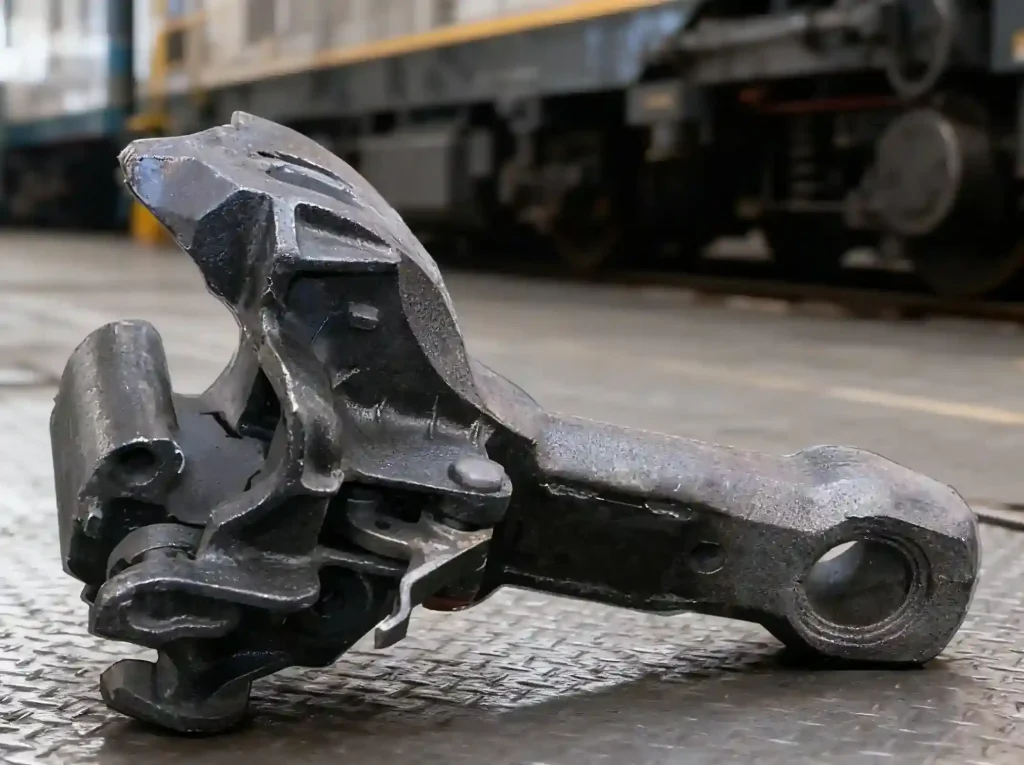
When two carriages are coupled, their couplers come into contact, collide, and automatically lock. It will form a solid unit. This connection must be strong enough to withstand the enormous forces generated during train start-up, Beschleunigung, Verzögerung.
Ähnlich, when the train brakes, the braking force is transmitted from the locomotive to the rear carriages through the couplers. Zusätzlich, longitudinal shocks and vibrations are inevitable during train operation. And the coupler structure can absorb and buffer these forces to a certain extent, reducing the violent shaking between carriages and enhancing the smoothness and comfort of the ride.
This type of coupler design automates the connection process, significantly improving operational efficiency and safety. Its core components include the coupler tongue, coupler lock, and coupler tongue pusher, unter anderem.
When two carriages approach each other slowly, the train coupler heads of both couplers collide. Under the impact force, the coupler tongue rotates, the coupler lock lifts and then drops, automatically locking the coupler tongue in the closed position. An dieser Stelle, the two couplers are firmly connected. The operator usually checks and confirms the connection status and connects the brake air pipes and electrical lines between the carriages.
2.3 When it is necessary to uncouple the carriages, the operator operates the uncoupling device, usually by pulling the lever on one side of the coupler. This action lifts the coupler lock, releasing the restraint on the coupler tongue. When the locomotive pulls the front carriage forward, the coupler tongue can rotate freely and open, and the two carriages are separated.
Designers calculate the maximum load the coupler needs to withstand based on the train’s traction weight and operating conditions. The coupler must be made of high-strength alloy steel and undergo strict heat treatment processes to ensure it has sufficient tensile, compressive, und Schlagfestigkeit.
It is usually installed behind the coupler and contains elastic elements such as springs or rubber pads. When the train starts or brakes, the buffer device is compressed, absorbing some of the energy and thus mitigating the impact force between carriages. For heavy-duty or high-speed trains, more advanced hydraulic buffers are used to provide better buffering performance.
Zum Beispiel, even if the coupler lock may slightly lift due to unexpected vibration, there is an anti-jump device to prevent it from fully unlocking, thus preventing the train from accidentally separating during operation. Zusätzlich, all components of the coupler undergo detailed flaw detection during regular maintenance to promptly identify and replace parts with fatigue cracks or excessive wear, eliminating potential safety hazards in their infancy.
Before the widespread use of automatic couplers, early trains used simple chain-link couplers, which had low strength, poor buffering performance, and required manual operation by workers, posing a high safety risk. The invention and application of automatic couplers were a significant technological advancement in railway history. It greatly improved the efficiency of shunting operations and reduced the labor intensity and personal risks for workers.
The couplers of modern high-speed EMUs not only have higher strength but also integrate more functions. They usually adopt a close-coupled structure, which reduces the longitudinal gap between carriages and makes the train run more smoothly. Gleichzeitig, the electrical connectors used for data transmission and control signals are often integrated with the couplers, achieving synchronous automatic connection and disconnection of mechanical, electrical and pneumatic circuits.
The train coupler is a precise component that integrates mechanical design, materials science and safety assurance. Although it is hidden at the connection points of carriages and is not often seen by passengers, it is one of the core devices that maintain the integrity of the entire train, transmit power and ensure operational safety. Its reliability is directly related to the efficiency and safety of railway transportation.
Luoyang Fonyo Heavy Industries Co., Ltd, Das 1998 gegründete Unternehmen ist ein Hersteller von Gussteilen für die Eisenbahn. Unsere Fabrik erstreckt sich über eine Fläche von 72.600㎡, mit mehr als 300 Mitarbeiter, 32 Techniker, einschließlich 5 leitende Ingenieure, 11 Hilfsingenieure, Und 16 Techniker. Unsere Produktionskapazität beträgt 30,000 Tonnen pro Jahr. Momentan, Wir produzieren hauptsächlich Gussteile, Bearbeitung, und Montage für Lokomotive, Triebwagen, Hochgeschwindigkeitszüge, Bergbauausrüstung, Windkraft, usw.
Wir sind der Eisenbahnteilelieferant für CRRC(darunter mehr als 20 Zweigniederlassungen und Tochtergesellschaften von CRRC), Gemac Engineering Machinery, Sanygroup, Citic Heavy Industries, usw. Unsere Produkte wurden nach Russland exportiert, die Vereinigten Staaten, Deutschland, Argentinien, Japan, Frankreich, Südafrika, Italien und andere Länder auf der ganzen Welt.