Scan WeChat-koden for at kontakte os
Scan WeChat-koden for at kontakte os
Du er velkommen til at sende os en e-mail, og vi vil svare dig hurtigst muligt.
At skabe fremtiden med hjerte og sjæl


Jernbanekoblinger findes i flere hovedtyper - buffer og kæde, Janney (AAR), Scharfenberg, tightlock, Tomlinson, og skruekobling – hver designet til specifikke jernbaneanvendelser, koblingskræfter, hastighedsområder, og regionale standarder. Choosing the wrong coupler type for a given operation can create interoperability problems, safety risks, or premature wear that shows up in maintenance costs long after the initial purchase.
If you’ve ever stood on a station platform when two rail cars couple together, the connection looks simple enough—a loud clang, a slight jolt, and the train is ready to depart. But the mechanism doing that work varies enormously depending on which continent you’re on, whether the train carries passengers or iron ore, and whether it needs to couple automatically at 160 km/h or be connected by hand in a classification yard.
Railway couplers are one of those railway components that nobody thinks about until something goes wrong. A failed coupling delays trains. An incompatible coupler type stops rolling stock from being moved between networks. And in heavy haul operations, an underspecified coupler doesn’t just wear out—it can fail under drawbar force with serious consequences.
This guide covers the main railway coupler types in use today, how each works, where each is applied, and what procurement teams should look at when specifying or sourcing couplers.
If you want to know more about the railway couplers, you can read Hvor meget ved du om togkoblinger?
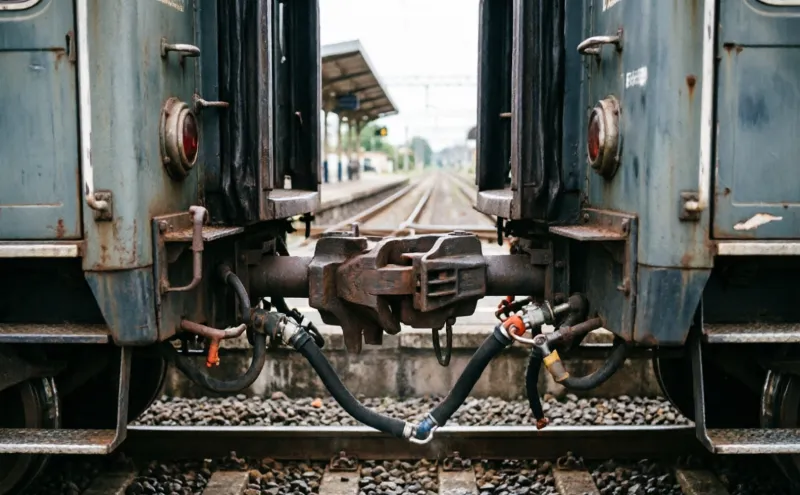
A railway coupler has three jobs: mechanically connect two vehicles, transmit tensile and compressive forces (sometimes hundreds of tons), and—depending on the type—provide electrical continuity, air brake connections, or data communication.
The reason there isn’t one universal coupler design comes down to history, belastningsforhold, and operational philosophy. North American freight railways standardized on the knuckle coupler over a century ago. European passenger networks developed automatic compact couplers for high-speed operation. UK freight still uses buffers and screw chains in many applications because the infrastructure was built around them.
For anyone involved in railway procurement or fleet management, the practical question is usually: which coupler does this application actually need? The answer depends on drawbar force, krav til koblingshastighed, vedligeholdelsesmiljø, og hvad naboflåderne allerede bruger.
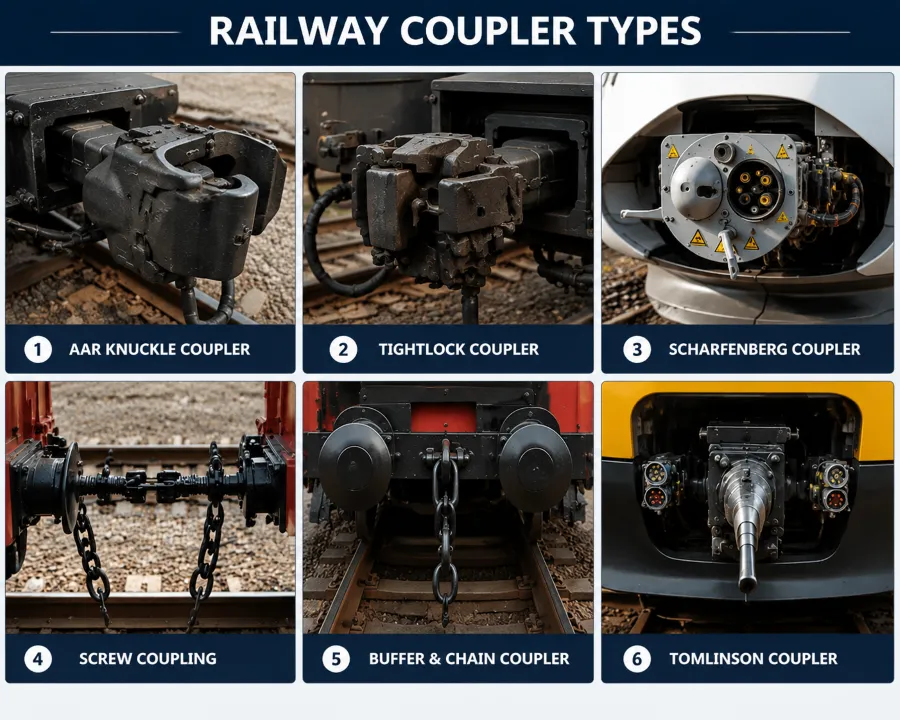
Buffer- og kædekobling - eller buffer-og-skrue - er en af de ældste jernbanekoblingsmetoder, der stadig er i normal drift. Hvert køretøj har en buffer ved hvert hjørne (normalt to per ende) og et skrueled med en krog på hver side. Operatøren skruer manuelt skrueleddet ind i krogen på det tilstødende køretøj og vikler håndtaget, indtil bufferne er trykket mod hinanden.
Systemet har reelle fordele i visse sammenhænge. Det giver en betydelig poleringskapacitet gennem bufferskiverne med stor diameter, som optager langsgående kræfter under rangering og bremsning. The screw link allows precise control of the draw force between vehicles—tighten it more for heavy haul, leave some slack for passenger comfort. It’s also relatively simple to manufacture and repair with basic machining capability.
But the drawbacks are equally real. Manual coupling is slow, labor-intensive, and increasingly difficult to justify from a safety standpoint. A worker standing between two rail cars handling a heavy screw chain in rain, sne, or darkness is exposed to pinch points, dropped equipment, and unexpected vehicle movement. Many regulatory bodies have moved away from manual coupling wherever automatic alternatives exist.
Buffer and chain remains common in UK freight operations, some Indian Railways services, and older industrial railway systems. For new projects outside these regions, it’s rarely specified unless retrofitting into existing fleets.
The Janney coupler—also known as the AAR (Association of American Railroads) coupler or simply the “knuckle coupler”—is the dominant coupling system for freight railways across North America, Australien, parts of South America, and an increasing number of heavy haul operations worldwide.
The operating principle is straightforward but effective. A rotating knuckle on each coupler head opens to accept the knuckle of the opposing coupler. When the two heads meet, the knuckle closes and a locking block drops into place, securing the connection. Decoupling is done from the side of the vehicle by pulling a lever that lifts the lock pin—the knuckle swings open under spring pressure, and the cars separate.
What made the Janney coupler dominate freight is not just the automatic coupling action. It’s the combination of reliable mechanical lock, high tensile strength (Type E couplers are rated for substantial drawbar forces suitable for heavy haul), relative ease of maintenance, and over a century of standardization that means a coupler from one manufacturer fits another’s draft gear without modification.
Fra et produktionsperspektiv, AAR couplers are typically forged or cast from medium-carbon or alloy steel, heat treated to achieve the required toughness and fatigue resistance. The knuckle and lock block are the highest-wear components and are commonly replaced items in any freight car maintenance program. Coupler bodies themselves last longer but are inspected regularly for cracks, wear on the coupling face, and deformation.
One detail worth mentioning: within the AAR system, there are multiple grades and types. Type C is common for general service. Type E handles heavier loads and is standard on unit trains and intermodal cars. De “tightlock” variant adds additional mechanical engagement for passenger and commuter applications where preventing separation during a derailment is critical—which brings us to the next type.
Tightlock couplers evolved from the basic AAR knuckle design but add a secondary mechanical interlock that prevents vertical or lateral separation even if the primary knuckle fails or the coupler rotates during a derailment. This feature matters enormously on passenger trains, where coupled cars must stay connected under accident conditions to prevent telescoping or separation.
I praksis, a tightlock coupler looks similar to a standard AAR coupler from a distance. The difference is in the extended locking surfaces on the top and bottom of the coupler head that engage with matching features on the mating coupler. Even if the knuckle opens unexpectedly, these secondary locks hold the coupling together.
Commuter rail systems in North America widely specify tightlock couplers. Some metro systems use them as well, particularly where trains operate at moderate speeds on shared corridors or where crashworthiness standards require anti-telescoping performance. The trade-off is cost—tightlock couplers are more complex to manufacture and maintain than standard AAR types—and the fact that they’re generally incompatible with plain knuckle couplers without an adapter.
For indkøbsteams, der evaluerer tightlock vs. standard AAR-koblinger, beslutningen afhænger normalt af driftsmiljøet og gældende sikkerhedsforskrifter frem for præference. Hvis tjenesten er passagerbefordring, og de lovgivningsmæssige rammer eller OEM-specifikationer kræver tightlock, der plejer at afgøre spørgsmålet.
Scharfenberg-koblingen - opkaldt efter dens tyske opfinder Karl Scharfenberg - er den automatiske kobling til europæiske højhastighedstog, de fleste metrosystemer på verdensplan, og mange letbaneapplikationer. I modsætning til AAR-knoen, som kobler mekanisk og kræver separate forbindelser til bremser og el, Scharfenberg integrerer mekanisk kobling, elektriske ben, og pneumatiske/luftbremsekanaler til en enkelt kompakt front-face operation.
Når to Scharfenberg-udstyrede tog nærmer sig hinanden, koblingen strækker sig fremad (på de fleste moderne installationer), de elektriske ben forlænges, og de mekaniske kæber lukker sig omkring det parrende koblingshoved - alt sammen uden menneskelig indgriben og på få sekunder. Dette gør den ideel til hyppige til- og frakoblingsoperationer som f.eks. metro pendulkørsel, togsætsammenføjning/adskillelse på højhastighedsstrækninger, og automatiserede passageroverførselssystemer.
Koblingsfladen har et karakteristisk udseende: et cirkulært hoved med elektriske stifter anbragt over og under den centrale mekaniske koblingsåbning, og ofte synlige luftslangetilslutningsporte på siderne. Der findes forskellige konfigurationer - nogle prioriterer antallet af elektriske ben for passagertog (magt, kontrollere, kommunikation), andre fremhæver pneumatisk flow for hurtig bremseopladning.
Fremstillingskompleksiteten for Scharfenberg-koblinger er betydeligt højere end for AAR-typer. Det præcisionsbearbejdede koblingshoved, forlænge-tilbagetrækningsmekanisme, elektrisk pin samling, og integreret ventilgruppe kræver alle snævre tolerancer og strenge tests. Enhedsomkostninger afspejler dette – de er betydeligt dyrere pr. kobling end en smedet AAR-knogle – men de samlede ejeromkostninger i højfrekvente automatiske koblingsapplikationer favoriserer dem ofte, fordi arbejdsbesparelser og driftsfleksibilitet opvejer startprisen.
Skruekobling - også kaldet kædekobling - er det dominerende manuelle koblingssystem for europæiske godsbaner. Ligner i konceptet til buffer og kæde, men uden de store sidebuffere (Europæiske vogne har ofte en enkelt centerbuffer eller slet ingen), den bruger et skrueled med kroge eller buck-eye-løkker i hver køretøjsende.
Operatøren fastgør krogen på et køretøj til løkken eller øjet på det næste, bruger derefter et skruehåndtag (-en “spændespænde”) at trække køretøjerne sammen og spænde koblingen. Skruemekanismen tillader kontrolleret trækkraftjustering, hvilket er nyttigt i fragtoperationer, hvor forskellige vogntyper og lastkombinationer kræver forskellige koblingsspændinger.
Skruekoblinger bliver gradvist erstattet af automatiske koblinger på nyt europæisk godsmateriel, især intermodale vogne og enhedstog. Men den installerede base af skruekoblede vogne i hele Europa, det tidligere Sovjetunionen, and parts of Africa and Asia means this coupler type will remain in service for decades. Procurement of spare screw links, hooks, and turnbuckle handles continues to be a steady demand item for railway component suppliers.
The Tomlinson coupler is a specific type used extensively on UK multiple-unit passenger trains (DMUs and EMUs). It combines a mechanical coupling bar with integral electrical connector pins, allowing both mechanical and electrical connection in one operation—though unlike the Scharfenberg, it is not fully automatic and requires alignment and extension by the operator or system.
Tomlinson couplers sit in a recessed housing at the end of each vehicle. When two units are brought together, the coupler bar extends, engages with the mating socket, and the electrical pins make contact. It’s simpler than a Scharfenberg and lower in cost, which suits the UK’s extensive commuter and regional multiple-unit fleet where high-speed automatic coupling isn’t normally required.
From a maintenance perspective, Tomlinson couplers are moderately complex—the electrical pins and socket contacts wear and require periodic inspection and replacement, and the mechanical coupling bar can suffer from misalignment damage if units are coupled with excessive gap or angle. But compared to maintaining separate mechanical couplers and jumper cables, the integrated design reduces overall connection time and reduces the risk of electrical connections being missed or damaged during coupling.
Different applications call for different coupler solutions. Here’s how the main types compare across the factors that matter most in selection:
| Coupler Type | Coupling Method | Typisk anvendelse | Draw Force Capacity | Automatisk | Electrical Integrated |
| Buffer & Chain | Manual | UK freight, industriel | Moderat | Ingen | Ingen |
| Janney / AAR | Automatisk | North American freight, tungt træk | Høj | Mechanical only | Ingen (som regel) |
| Tightlock | Automatisk | Commuter rail, passager | Høj | Mekanisk + secondary lock | Ingen (som regel) |
| Scharfenberg | Fully automatic | Høj hastighed, metro, letbane | Moderate-High | Ja | Ja |
| Skruekobling | Manual | European freight, post-Soviet | Moderat | Ingen | Ingen |
| Tomlinton | Semi-automatic | UK multiple units | Moderat | Semi | Ja |
These comparisons are generalized—specific models within each type vary significantly in ratings, options, and compatibility details. But the pattern is clear: automatic couplers dominate new passenger and high-frequency applications, while manual couplers persist in legacy freight fleets where replacement economics don’t yet justify conversion.
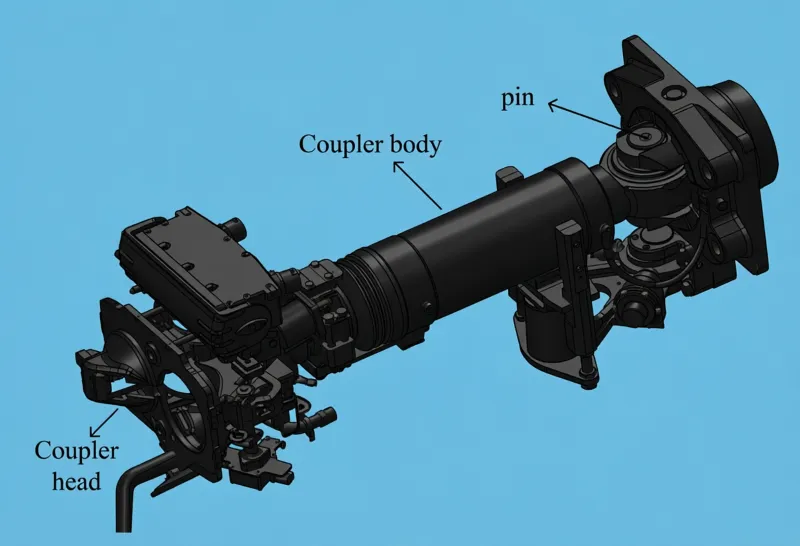
Coupler procurement is one of those areas where the drawing and the purchase order tell only part of the story. Experienced railway engineers and buyers typically evaluate several factors beyond the basic coupler type and part number.
For steel couplers—particularly AAR knuckles, tightlock bodies, and screw coupling components—the material certificate should specify steel grade, varmebehandlingsproces, and resulting mechanical properties (udbyttestyrke, trækstyrke, elongation, slagstyrke). For couplers operating in cold climates, low-temperature impact test results (Charpy V-hak ved minusgrader) blive kritisk. En kobling, der yder pålideligt ved +20°C, kan opføre sig anderledes ved -40°C, hvis stålovergangstemperaturen ikke var korrekt kontrolleret under produktionen.
Afhængig af koblingstype og målmarked, relevante standarder kan omfatte AAR M-201 for koblinger, EN specifikationer for europæiske applikationer, UIC-foldere til internationale udvekslingskoblinger, eller specifikke krav til jernbaneoperatørens godkendelse (såsom Network Rail-accept i Storbritannien eller DB-specifikation for tyske applikationer). En leverandørliste ISO 9001 certificering er et udgangspunkt, men produktspecifik overholdelse af standarder og tredjepartsinspektionsregistre har større vægt i faktiske indkøbsbeslutninger.
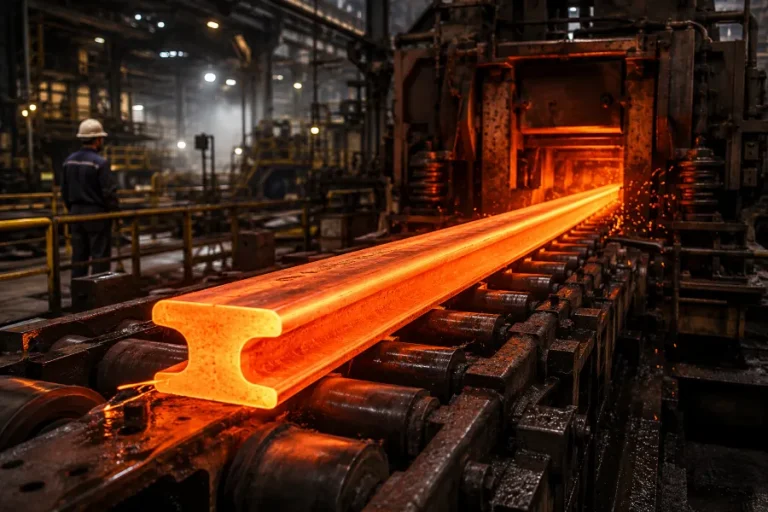
Mange koblingskomponenter - især AAR koblingslegemer, knoer, og tightlock dele - fremstilles ved enten smedning eller støbning, afhængig af komponenten, bind, og producentens kapacitet. Smedede koblingsdele tilbyder generelt overlegen træthedsmodstand og foretrækkes til højcyklus, applikationer til tunge træk. Støbte koblingskomponenter kan være omkostningseffektive til visse geometrier og applikationer med lavere belastning, men kræver omhyggelig opmærksomhed på støbeprocesstyring, varmebehandling, og ikke-destruktiv test for at sikre intern forsvarlighed.
Forståelse af, om en leverandør producerer koblingskomponenter gennem støbning, smedning, eller en kombination - og hvilken inspektion og test der understøtter hver metode - fortæller dig mere om langsigtet pålidelighed end enhedsprisen alene.
Koblinger har forbrugsdele: knoer, låseblokke, stifter, bushings, screws, and electrical contacts for automatic couplers. When selecting a coupler supplier or specifying a coupler type for a new fleet, it’s worth confirming that wear parts will be available throughout the expected service life of the vehicle. A well-designed coupler with unavailable spare parts becomes an expensive problem after a few years of operation.
Fra et produktionsperspektiv, coupler quality problems tend to show up in predictable ways: surface defects from casting or forging that initiate fatigue cracks, incorrect heat treatment that leaves the component either too soft (overdreven slid) or too brittle (impact fracture), dimensional deviations that cause poor engagement with mating couplers, and inadequate NDT that allows internal defects to reach service.
Reputable coupler manufacturers address these risks through process control—consistent melt practice for steel composition, documented heat treatment cycles with furnace records, dimensional gauging at key stages, og 100% NDT (magnetic particle inspection for surface-breaking defects, ultrasonic testing for internal soundness) on safety-critical components.
For procurement teams, asking for sample inspection records, reviewing the supplier’s NDT procedures, and understanding their traceability system (can they identify exactly which melt batch a delivered coupler came from?) reveals substantially more about manufacturing quality than any sales presentation.
A railway coupler may appear to be a single mechanical component, but its design, material quality, and manufacturing process determine whether trains connect reliably every day or whether coupling failures become a recurring maintenance burden. Selecting the correct coupler type for the application, verifying material and manufacturing quality, and ensuring spare parts availability will reduce coupling-related delays, safety incidents, and unplanned maintenance costs across any rail fleet.
PåLuoyang Fonyo Heavy Industries Co., Ltd., vi fremstiller railway coupler components, jernbanestøbninger, jernbanehjul, and related track components for freight railways, passenger rail operators, og industrielle jernbanesystemer. Our casting, bearbejdning, and inspection capabilities allow us to produce coupler bodies, knoer, and custom coupling components to AAR, I, UIC, og kundespecifikke krav. Our engineering team can support material selection, heat treatment specification, and documentation requirements based on your operating conditions and applicable standards.
Generelt, nej – ikke uden en adapter. AAR-knoglekoblinger kan ikke kobles direkte til Scharfenberg eller skruekoblinger. Adapterkoblinger findes til nogle kombinationer (f.eks, AAR-til-buffer-kæde-adaptere bruges, når godsvogne skal flytte mellem nordamerikanske og britiske/europæiske netværk), men adaptere introducerer mekanisk spil, nedsat styrke, og yderligere vedligeholdelse. Til permanent flådeoperationer, matchende koblertype til netværksstandarden er den foretrukne tilgang.
Inspektionsintervaller afhænger af koblingstypen, servicens sværhedsgrad, og lovkrav. AAR-koblinger på godsvogne i Nordamerika inspiceres typisk under planlagte vedligeholdelsescyklusser og under mellemliggende gårdinspektioner, med fokusområder inklusive knoslid, låsemekanisme funktion, koblingsansigtstilstand, og enhver synlig revnedannelse. Automatiske koblinger som Scharfenberg kræver yderligere kontrol af elektriske ben, forlænge-tilbagetrækningsmekanisme, og pneumatiske tætninger. Operatørmanualer og gældende vedligeholdelsesstandarder bør definere specifikke intervaller for hver flåde.
Type C og Type E henviser til AAR-koblingskvaliteter med forskellige styrkeklassificeringer. Type C er designet til generel fragtservice med moderate trækkraft og er almindelig på ældre rullende materiel og lettere opgaver. Type E har en højere styrkevurdering og er standarden for moderne godsvogne, enhedstog, og tunge træk, hvor trækkraften er væsentligt større. Using a Type C coupler in a Type E application creates a potential failure point under maximum load.
It depends on the component and application. Forged coupler parts—knuckles, locks, and certain body sections—generally provide superior fatigue resistance and are preferred for high-load, high-cycle applications such as heavy haul freight. Cast coupler components can perform well when properly produced with adequate process control, varmebehandling, og inspektion, and may be the only practical manufacturing method for complex geometries. The key factor is not casting versus forging itself, but whether the chosen manufacturing method is backed by appropriate quality controls and testing for the intended service conditions.
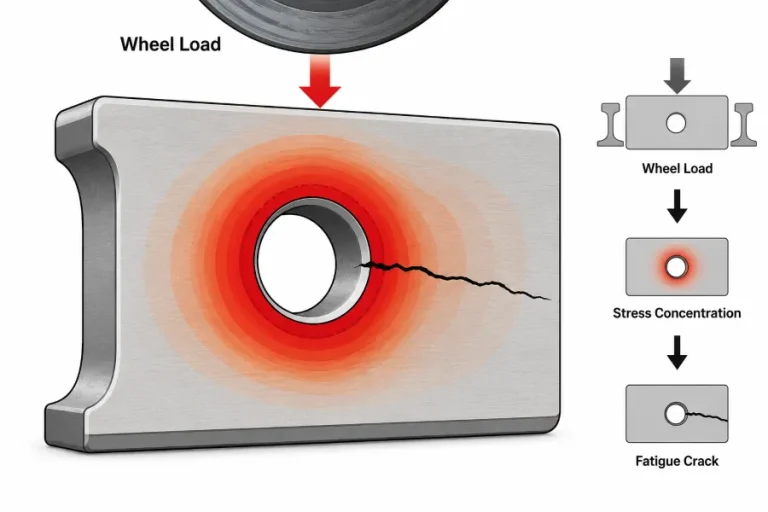
Knuckle failures typically originate from fatigue crack growth, often initiated at stress concentrations near the knuckle pivot hole, the locking lug, or the coupling nose area. Contributing factors include repeated high-force coupling impacts (particularly during shunting operations with excess speed), wear that changes the engagement geometry, corrosion reducing effective section thickness, and material or heat treatment deficiencies that reduce fatigue resistance. Regular inspection for wear limits and surface cracking, combined with timely replacement of worn knuckles before cracks propagate, prevents most knuckle-related failures.
Some coupler components are designed as replaceable wear parts (knoer, låseblokke, stifter, bushings, electrical contacts) and are routinely replaced during maintenance. The coupler body or main housing—in both AAR and automatic coupler types—is generally not repaired in the field; if it reaches wear limits, shows cracking, or fails inspection, it is replaced as a complete unit. Minor surface wear on a coupler face can sometimes be reconditioned by qualified workshops, but any repair to load-bearing sections requires careful evaluation against the applicable standard, and many operators prefer replacement over repair for safety-critical coupler components.