Scan the WeChat code to contact us
Scan the WeChat code to contact us
Feel free to send us a email and we will reply to you as soon as possible.
Creating the future with heart and soul


When an unfinished casting arrives in the workshop, one of the first questions people ask is simple: Is this cast iron part or cast steel part? At first glance, the two materials can look surprisingly similar. Both are iron-based alloys, both are produced through casting, and both are widely used in industrial equipment. However, once machining, welding, or assembly begins, the differences become obvious. Choosing the wrong material can affect strength, service life, repairability, and even safety. From our experience manufacturing cast steel components for railway and heavy industrial applications, identifying the material isn’t about relying on a single trick. Instead, engineers combine visual inspection, machining behavior, material documentation, and testing results to reach a reliable conclusion.
This guide explains the practical methods commonly used to distinguish cast iron from cast steel and when each method is most useful.
Cast iron is an iron-carbon alloy that typically contains 2.1%–4.0% carbon, together with silicon and small amounts of other alloying elements. During solidification, much of the carbon forms graphite flakes or graphite nodules, giving cast iron its unique characteristics.
Because of its excellent fluidity, cast iron fills complex molds easily, making it a cost-effective choice for intricate castings. It also provides good vibration damping and wear resistance, which is why it is commonly used for machine bases, engine blocks, pump housings, and valve bodies.
The trade-off is toughness. Compared with cast steel, cast iron is more brittle and has lower impact resistance.
Cast steel contains less than 2% carbon and behaves much more like wrought steel after heat treatment. Instead of free graphite, its microstructure consists mainly of ferrite, pearlite, bainite, or martensite, depending on the alloy grade and heat treatment process.
This gives cast steel much higher tensile strength, better ductility, and superior impact resistance.
For structural applications where safety and fatigue performance matter, cast steel is usually the preferred material.
At FONYO, most of the large structural components we manufacture for railway systems—including bogie bolsters, side frames, gearbox housings, axle boxes, and other heavy-duty castings—are produced from cast steel because these parts must withstand repeated dynamic loading throughout their service life.
Before machining or surface treatment, both materials may have a similar rough casting appearance. If the surface is coated with primer or shot blasted, visual differences become even less obvious.
That’s why experienced engineers rarely rely on appearance alone. Instead, they evaluate several characteristics together before making a judgment.
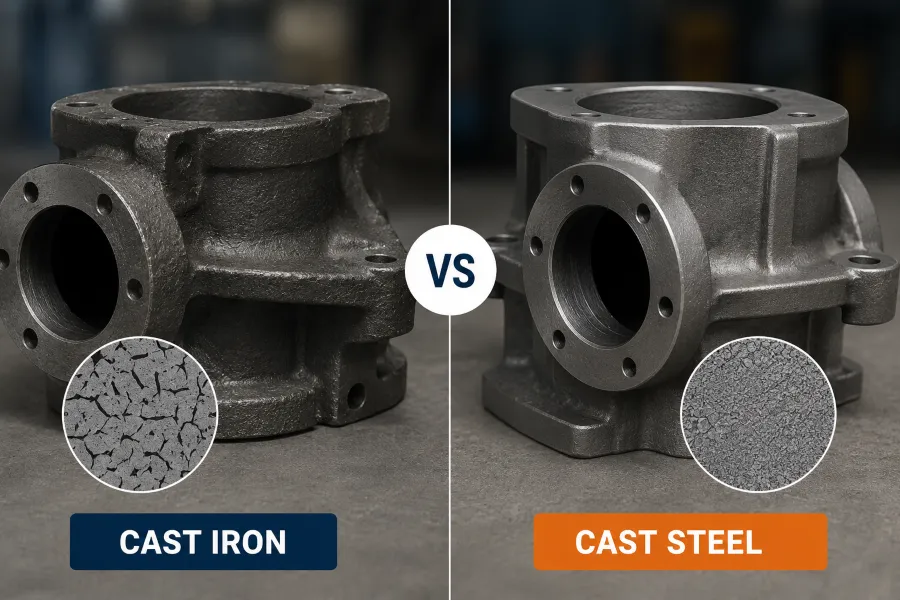
Surface appearance provides useful clues, although it should never be the only basis for identification.
Gray cast iron generally has a darker, matte-looking surface because of the graphite contained in its structure. Cast steel often appears more metallic after shot blasting or machining, although oxidation, paint, or scale can easily change its appearance.
In production, surface finish is usually treated as an initial observation rather than definitive evidence.
If a damaged or test sample is available, the fracture surface often reveals much more than the exterior.
Gray cast iron typically breaks with a rough, dull gray fracture because graphite flakes interrupt the metal matrix. Cast steel usually shows a denser, brighter fracture with a more fibrous appearance.
This difference is one of the most reliable visual indicators used during failure analysis.
One of the easiest methods inside a machine shop is simply watching the chips produced during machining.
Cast iron usually breaks into short, powder-like chips because the graphite acts as a natural chip breaker.
Cast steel behaves differently. It tends to produce longer, continuous chips similar to rolled steel, especially during turning or milling.
For machinists, this distinction becomes obvious within seconds after cutting begins.
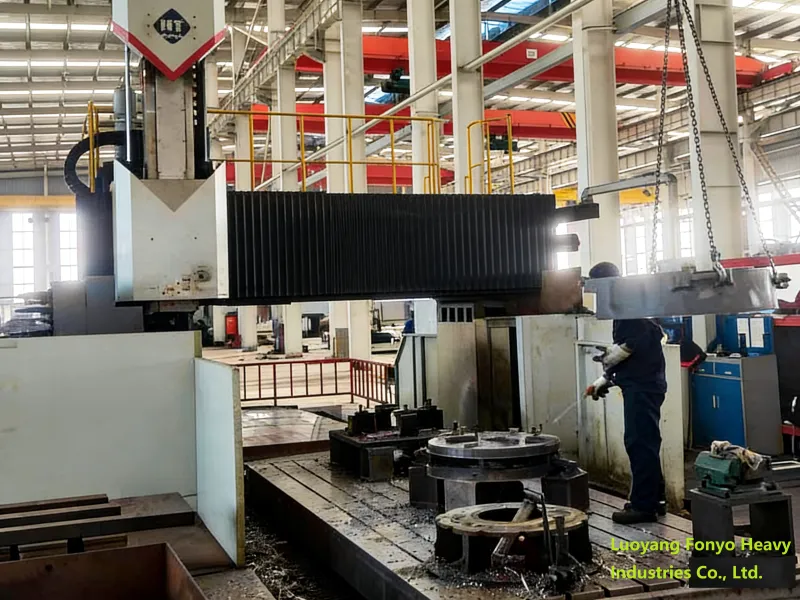
Mechanical performance often tells the real story.
Cast steel can deform under heavy loading before failure, while cast iron is much more likely to fracture suddenly.
For applications involving repeated impact, vibration, or fatigue loading, cast steel offers a significant advantage.
This is one of the main reasons why railway bogies, mining equipment, construction machinery, and heavy structural castings are commonly manufactured from cast steel rather than cast iron.
Many experienced inspectors lightly strike castings with a small hammer during inspection.
Cast steel generally produces a clearer ringing sound, while gray cast iron often sounds shorter and duller.
However, this method should only be considered a quick reference. Casting size, wall thickness, geometry, and support conditions all influence the sound, making it unsuitable as a standalone identification method.
In industrial manufacturing, the most reliable identification method is not visual inspection—it’s documentation.
Material certificates, chemical composition reports, mechanical property reports, and heat treatment records provide definitive information about the material grade.
For critical railway components, complete traceability is essential. Every casting should be linked to its heat number, inspection records, and testing reports to ensure compliance with customer specifications and international standards.
Sometimes the application itself provides valuable clues.
If the component must withstand high impact loads, cyclic fatigue, or structural stress, it is likely to be cast steel.
Typical cast steel applications include:
Cast iron is more commonly used for:
Understanding how a component is used often helps narrow down the material choice.
| Property | Cast Iron | Cast Steel |
| Carbon Content | 2.1–4.0% | Less than 2.0% |
| Toughness | Lower | Higher |
| Ductility | Low | High |
| Impact Resistance | Lower | Excellent |
| Machinability | Excellent | Moderate |
| Weldability | Limited | Better |
| Vibration Damping | Excellent | Moderate |
| Typical Applications | Engine blocks, valves, machine bases | Railway components, mining equipment, heavy machinery |
Railway equipment operates under conditions that few industrial components experience. Every journey subjects the structure to repeated impact, vibration, braking forces, and changing environmental conditions.
Because of these demands, structural components require high strength together with excellent toughness and fatigue resistance.
This is why cast steel has become the preferred material for critical railway castings such as bogie bolsters, side frames, axle boxes, and gearbox housings.
At FONYO, every cast steel component undergoes a controlled manufacturing process that includes casting, heat treatment, precision machining, dimensional inspection, and non-destructive testing such as ultrasonic testing (UT) and magnetic particle testing (MT). These quality control steps help ensure that each casting meets the mechanical performance required for demanding railway applications.
No. Cast steel generally provides higher tensile strength, better ductility, and greater impact resistance than cast iron.
Not reliably. Both materials are typically magnetic, so magnetism alone cannot identify them.
Cast iron is generally easier to machine because the graphite structure naturally breaks chips and reduces cutting forces.
It can be welded, but the process is much more difficult than welding cast steel and usually requires specialized procedures to reduce the risk of cracking.
For industrial applications, material certificates combined with chemical analysis and mechanical testing provide the most reliable identification.
Correct material selection is only the first step. The manufacturing process, heat treatment, machining accuracy, and quality inspection all play an equally important role in the long-term performance of a casting.
Luoyang Fonyo Heavy Industries Co., Ltd. is a Chinese manufacturer specializing in custom cast steel components for the railway, mining, and heavy equipment industries. Our manufacturing capabilities cover the complete production process—from casting and heat treatment to CNC machining, non-destructive testing (UT & MT), dimensional inspection, and final assembly.
Our typical products include:
Whether you need a replacement part manufactured to an existing drawing or a completely customized casting developed for a new project, our engineering team can provide material recommendations, manufacturing support, and quality documentation that meets international industry standards.