Scan the WeChat code to contact us
Scan the WeChat code to contact us
Feel free to send us a email and we will reply to you as soon as possible.
Creating the future with heart and soul

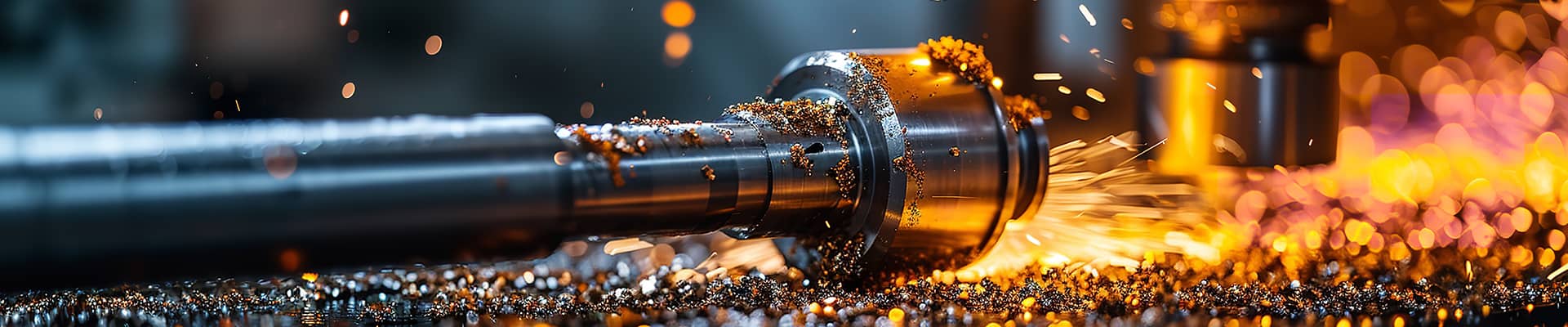
Fallen leaves cause low adhesion on railway tracks because train wheels crush them into a hard, slippery film on the railhead. This contamination film cuts the grip between wheel and rail, which lengthens stopping distances and makes both traction and braking less predictable.
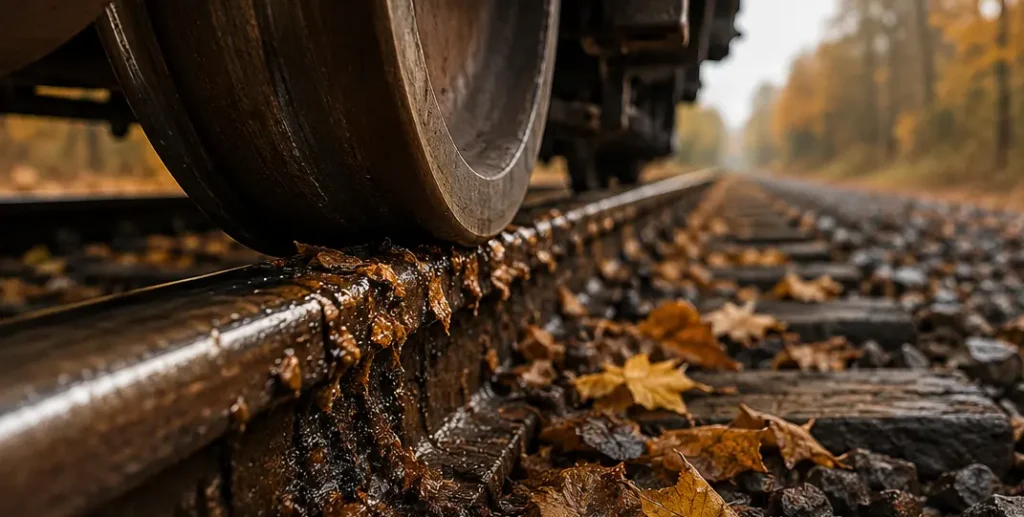
To understand why leaves matter, it helps to start with how a wheel actually meets the rail on railway tracks. A railway wheel does not grip a rail the way a car tyre grips tarmac. A wheel and rail meet over a small, localised area known as the wheel–rail contact patch. Its exact size varies with the wheel load, the contact geometry and the material stiffness, but it is always small relative to the train it carries. Everything a train does, every bit of traction it puts down and every bit of braking it needs, has to pass through that small area.
That is the thing nobody tells you about rail operation. It is not the sheer weight of a train that keeps it moving and stopping safely. It is what happens inside a contact patch far smaller than the vehicle it supports.
When that patch is clean, a steel wheel on a steel rail transmits force predictably. The available tangential force is roughly the product of the adhesion coefficient and the normal load, sometimes written as F ≈ μN. Clean steel under good conditions gives you an adhesion coefficient high enough to start a loaded freight train and stop it where the signal says to stop.
Autumn changes all of that.
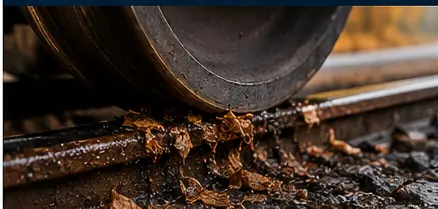
Fallen leaves do not simply sit on the rail and get blown away. A passing train crushes them against the railhead under enormous contact pressure, and that crushing spreads the plant material across the running surface of the railway tracks.
The result is not loose leaf debris. It is a compacted contamination film made up of organic residues, and it interacts with moisture and the rail’s own surface oxides in ways that cut the available grip. That film is notoriously hard to remove, and it is thin enough that a visual inspection will often miss it. The rail looks sound, no cracks, no deformation, and yet the running surface is coated in something that has already reduced adhesion.
Moisture plays a real part here, but not a simple one. Wet leaves bond to the rail far more effectively than dry ones, which is one reason the problem is seasonal and worst on a damp autumn line. At the same time, moisture does not act the same way in every situation, a point worth returning to later.
The effect shows up first in two places: acceleration and braking.
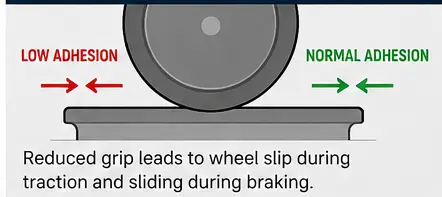
When a locomotive applies traction, its driving wheels have to transfer force through the contact patch. If the requested force exceeds what the contaminated patch can transmit, the wheel spins faster than the train is actually moving. That is wheel slip. It wastes tractive effort and grinds the tread.
Braking is the more dangerous side of it. If braking force exceeds available adhesion, a wheel stops turning and slides along the rail instead of rolling. A sliding wheel generates heat in one spot and wears a flat on the tread. Engineers call the result a wheel flat, and it is not a cosmetic mark. A flatted wheel hammers the rail with every rotation and will generally take a vehicle out of service for reprofiling.
Modern vehicles carry control systems to limit both problems. Traction control trims motor torque, and wheel-slide protection, the rail equivalent of a car’s ABS, meters the braking. But these systems can only work with the adhesion the track gives them. They do not create grip. They ration it.
That is the key point. A heavy train is not automatically a train that can stop. The condition of the railway tracks at the wheel rail contact is part of the braking calculation, and when that condition degrades, so does the margin a driver can rely on.
Infrastructure managers treat low adhesion on railway tracks as a maintenance and operations problem, and they attack it on several fronts at once.
Railhead cleaning. Specialist vehicles use high-pressure water jets to blast the compressed leaf film off the railhead. It is effective but not permanent. A freshly cleaned rail can be re-contaminated the moment the next batch of leaves falls, so cleaning has to be timed and repeated rather than done once.
Sanding. Many vehicles carry sanding systems that apply sand near the wheel rail contact when the driver or an automatic system calls for extra grip. Sand works by roughening the interface, but it is one tool in the box, not a substitute for cleaning or vegetation control.
Vegetation management. The cheapest fix is upstream. Cutting back lineside trees and dense growth reduces the volume of leaf material that reaches the line in the first place. Managers identify the sections where leaves cause repeat trouble and schedule work there before and during autumn.
Monitoring and planning. Weather forecasts, incident history, route inspections and increasingly the use of data all feed into risk models that flag low-adhesion sections ahead of time. The response can be anything from adjusted driving technique and revised braking points to speed restrictions and targeted treatment.
The goal across all of it is the same: predictable train performance even when the surface condition of the railway tracks is working against you.
No. Leaves are the best-known cause, but they are not the only one, and the factors rarely act alone.
| Contaminant | Effect at the wheel rail contact |
| Crushed leaves | Organic film that bonds to the railhead and resists removal |
| Moisture | Can bond contaminants and alter the effective adhesion |
| Rust and iron oxides | Can reduce grip depending on the surface state |
| Oil and grease | Creates a slippery film, often worsened by moisture |
| Other biological deposits | Dirt, crushed insects and plant material alter contact |
The combination of contamination and moisture is usually worse than either on its own, which is why a light rain after a dry spell can produce an unexpectedly slippery line.
Technical note: severe leaf contamination can reduce wheel–rail adhesion to very low levels, well below typical dry-rail values. The exact figure depends on speed, moisture, film thickness and wheel and rail condition, so treat any quoted number as indicative rather than universal.
There is a nuance worth keeping in mind. Moisture does not affect adhesion in the same way under all conditions, and that is as true on railway tracks as anywhere else. Rain, dew and wet leaf contamination can interact differently with the railhead, depending on the type and amount of contamination. Operators therefore need to consider the actual surface condition rather than assume that every wet rail has the same adhesion characteristics.
The leaves-on-the-line problem points to a distinction worth keeping clear: manufacturing quality and operating conditions are different things, and they need different controls. A wheel’s performance on the railway tracks is not decided by its build quality alone.
A railway wheel is a precision component, and its requirements depend on the intended application, the governing standard and the purchaser’s technical specification. EN 13262:2026 covers product requirements for railway wheels in its scope, while AAR M-107 is relevant to applicable North American wheel specifications. Material grade, dimensions, heat treatment and inspection requirements should be confirmed against the current edition and the project documentation.
But no amount of manufacturing quality stops a leaf film from forming on a contaminated railhead. A correctly manufactured wheel will still slide on a rail coated in a pectin-containing contamination film. That is not a defect in the wheel. It is an operating condition.
Confusing the two leads to the wrong fix. If a fleet is suffering wheel flats every autumn, the answer is rarely “buy a harder wheel”. It is usually an adhesion-management and braking-control problem on the operating side, sometimes compounded by a tread profile choice. A buyer who understands the difference asks better questions.
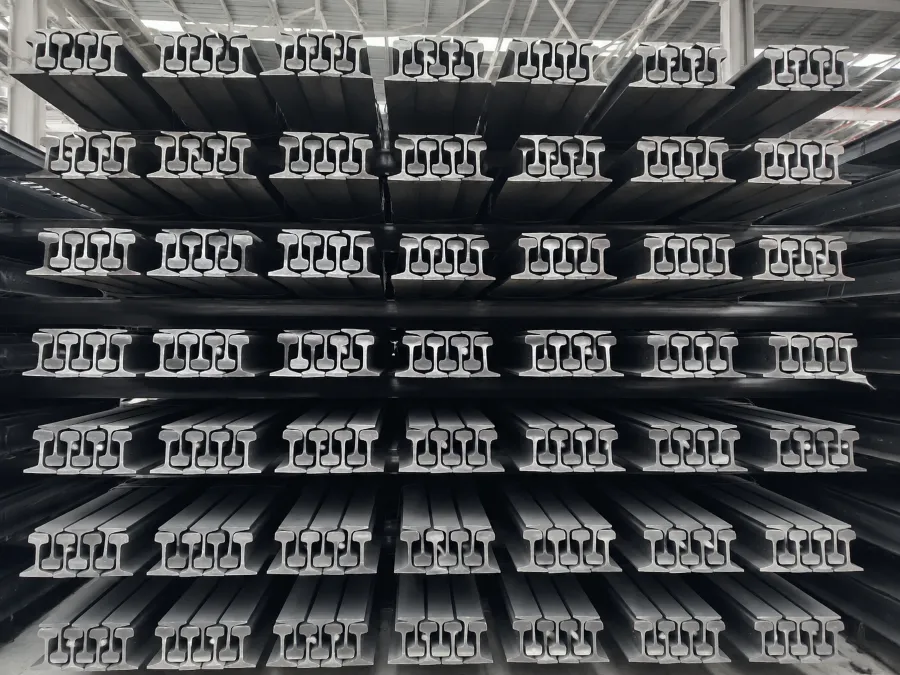
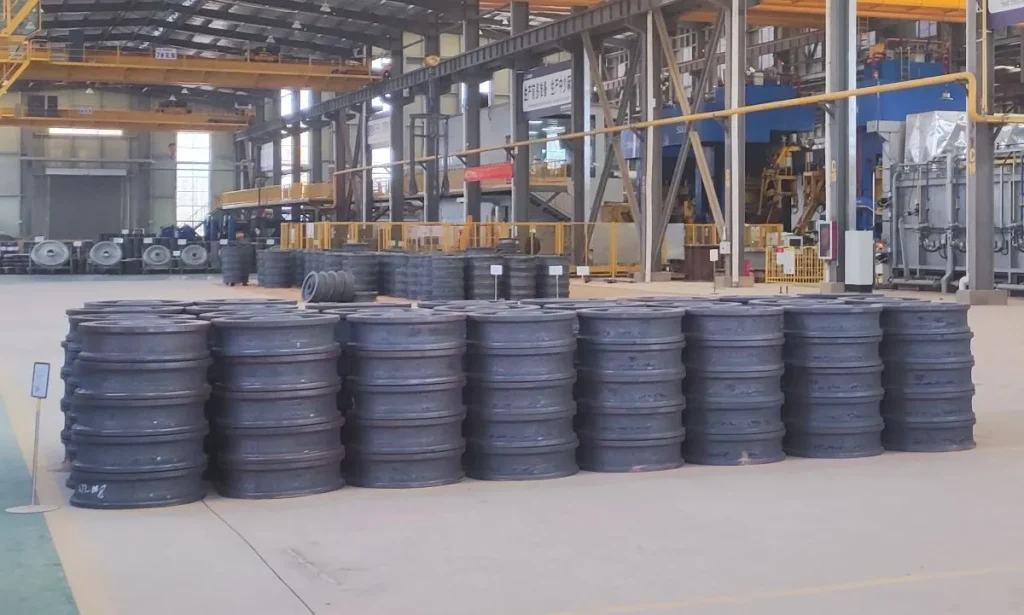
At FONYO, we manufacture forged and rolled railway wheels, along with railway cast and forged components and machined parts to customer drawings or samples. For each project, the material, dimensions, application, inspection criteria and applicable standard should be defined clearly up front. If you are specifying or replacing wheels, we can review an existing sample or drawing before quotation.
Why do leaves cause low adhesion on railway tracks?
Crushing spreads the plant material across the railhead, forming a contamination film that bonds with moisture and surface oxides. That film reduces the grip between wheel and rail, cutting both traction and braking.
How slippery can a railway track get in autumn?
It depends on the film and the moisture, but severe leaf contamination can reduce adhesion well below typical dry-rail values. The practical effect is longer stopping distances and more wheel slip.
Does wet weather always make rails more slippery?
No. Rain, dew and wet leaf contamination interact with the railhead differently depending on the type and amount of contamination. A wet rail is not automatically a low-adhesion rail, so the actual surface condition matters more than the weather alone.
What is a wheel flat?
When a wheel slides during braking, it wears a flat spot on the tread. A flatted wheel hammers the rail and may need reprofiling, but whether it has to come out of service depends on the damage depth and the operator’s inspection limits.
Can a better wheel prevent leaf-related adhesion problems?
No. Wheel quality and surface contamination are different issues. A correctly manufactured wheel will still slide on a contaminated rail, so the fix is adhesion management, not a harder or more expensive wheel.
Is low adhesion only an autumn problem?
Leaves make autumn the worst season, but rust, oil, light rain after dry weather and even crushed insects can all produce low adhesion at other times of year.
What standards govern railway wheels?
In Europe, railway wheel product requirements are covered by EN 13262 (currently the 2026 edition), and in North America by AAR M-107. Always confirm the applicable edition and any purchaser-specific requirements.