Bizimle iletişime geçmek için WeChat kodunu tarayın
Bizimle iletişime geçmek için WeChat kodunu tarayın
Bize e-posta göndermekten çekinmeyin; size en kısa sürede cevap vereceğiz.
Geleceği kalp ve ruhla yaratmak


Although both straight and curved tracks are made of çelik raylar, stres durumları oldukça farklı. Bu ayrımı anlamak güvenliğin sağlanması açısından çok önemlidir., konfor, and efficiency of railway operations.
In an ideal situation, the stress pattern of a straight track is straightforward.
Vertical load is dominant: It mainly bears the vertical downward pressure from the wheels. This force is transmitted from the rail to the sleeper and then dispersed to the ballast and subgrade. The core of the mechanical analysis lies in ensuring that the track structure has sufficient strength and toughness to withstand the repeated wheel loads and prevent fatigue damage, such as rail head cracking and crushing.
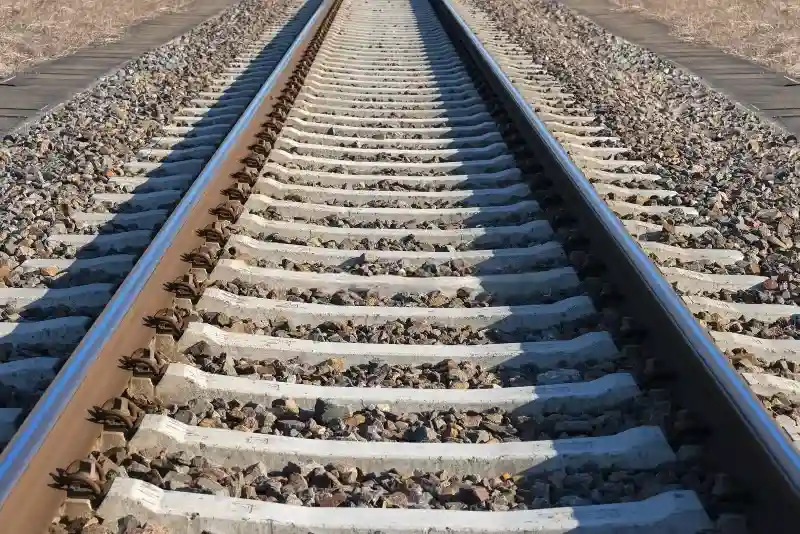
Minor longitudinal force: When a train accelerates, decelerates, or runs on a straight track, there is a slight creep force between the wheels and the rails, which is a friction state between pure rolling and sliding, thereby generating a longitudinal force. Ek olarak, the rails themselves will experience thermal expansion and contraction stresses due to temperature changes. Fakat, in conventional analysis, the vertical load is always the absolute protagonist.
The “hidden” existence of lateral force: Even on a straight section, the train will experience slight snake-like movements (an inherent lateral oscillation) during operation, which results in a small lateral force. Fakat, genellikle, this force is small and does not pose a major threat to the track structure.
Öyleyse, the mechanical model of a straight track is relatively simple, with the design focus on optimizing vertical stiffness and strength and controlling settlement.
Once the track bends, its stress state immediately upgrades from “two-dimensional” ile “üç boyutlu”, becoming extremely complex. A train passing through a curve can be regarded as a “constrained centrifugal motion”.
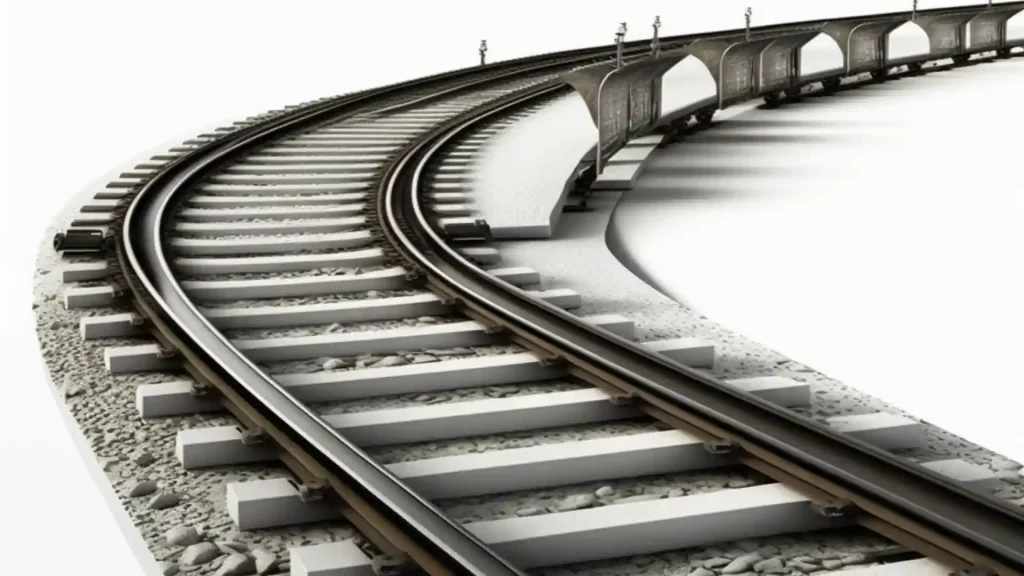
The intervention of centrifugal force – the root of all complexity: This is the most fundamental difference between curved and straight tracks. When a train of mass m travels at speed v through a curve with radius R, a huge centrifugal force F_c = mv²/R is generated. This force is horizontally outward, attempting to throw the train off the track.
The art of superelevation: To counteract the effect of the centrifugal force, engineers raise the outer rail of the curve section, bir oluşturmak “aşırı yükseklik”. In this way, the horizontal component of the vehicle’s weight G * sinθ (θ is the track surface inclination angle) can provide an inward “centripetal force” to counterbalance the centrifugal force. İdeal olarak, when the two are equal, the vertical loads on the inner and outer rails can be equalized, and passengers will not feel uncomfortable. Fakat, in reality, due to the varying speeds of trains, complete balance is extremely difficult to achieve.
The sharp increase and uneven distribution of lateral force:
Guiding force and derailment risk: When the centrifugal force is not fully balanced (yani., “under-superelevation”), the remaining huge centrifugal force can only be provided by the squeezing between the wheel flange and the inner side of the outer rail. This huge lateral contact force is called the guiding force. It will cause severe wear on the outer rail and, in extreme cases (such as severe wheel flange wear or poor track geometry), lead to terrifying derailment or climbing accidents.
The tendency of rail overturning: The huge lateral force not only acts on the rail head but also generates a moment that causes the rail to overturn and the sleeper to shift laterally, posing a severe test to the stability of the entire track structure.
The complication of longitudinal force – creep and wear: On a curve, the rolling of the wheels is no longer pure rolling. Due to the different lengths of the inner and outer rails, the wheels need to constantly make minor sliding adjustments (yani., creep) to compensate for the path difference. This generates a complex longitudinal creep force, which is the main cause of wheel-rail side wear (especially on the inner side of the outer rail and the top of the inner rail), and the wear rate of the curved track is much higher than that of the straight section.
The birth of torque: Due to the completely different forces on the inner and outer rails (the outer rail bears huge lateral and vertical forces, while the inner rail mainly bears vertical forces), the entire track structure is subjected to a huge torsional moment, which places higher demands on the fixing ability of fasteners and sleepers.
Summary of Core Differences: Load characteristics, Linear track, Curved track
Dominant force: Vertical load, Centrifugal force, and the huge lateral force derived from it
Complexity of force system: Nispeten basit, approximately two-dimensional. Extremely complex, three-dimensional force system, with torque
Force distribution: Left and right tracks bear force basically evenly. Inner and outer tracks bear force extremely unevenly; the outer track is the “disaster area” of force bearing.
Key issues: Vertical strength, tükenmişlik, settlement; Lateral stability, derailment risk, tekerlek rayı aşınması
A linear track is a world centered on static strength and vertical dynamic response, while a curved track is a battlefield full of dynamic games, with the core being the balance of forces (superelevation and speed), the confrontation of forces (wheel flange and rail), and the dissipation of forces (giymek). From linear to curved, the force state of the track changes from a “load-bearing beam” bir “guiding arm”, and the design, construction, and maintenance strategies also undergo fundamental changes. Every smooth turn of a train is a symphony of safety composed by precise mechanical calculations and solid engineering materials.
Luoyang Fonyo Ağır Sanayi A.Ş., Ltd.,1998 yılında kurulan demiryolu döküm parçaları üreticisidir. Fabrikamız 72.600㎡ alanı kaplamaktadır., fazlasıyla 300 çalışanlar, 32 teknisyenler, içermek 5 kıdemli mühendisler, 11 yardımcı mühendisler, Ve 16 teknisyenler.Üretim kapasitemiz 30,000 ton/yıl. Şu anda, ağırlıklı olarak döküm üretiyoruz, işleme, ve lokomotif için montaj,vagon,yüksek hızlı trenler, madencilik ekipmanları,rüzgar enerjisi,vesaire.
CRRC'nin demiryolu parça tedariği biziz(fazlası dahil 20 CRRC'nin şube şirketleri ve bağlı ortaklıkları), Gemac Mühendislik Makina, Sanygroup, Citic Ağır Sanayi, vesaire. Ürünlerimiz Rusya'ya ihraç edildi, Amerika Birleşik Devletleri, Almanya, Arjantin, Japonya, Fransa, Güney Afrika, İtalya ve dünyanın her yerindeki diğer ülkeler.
İletişim Bilgileri:
E-posta:satış@railwaypart.com
Mobil:008615515321683