Отсканируйте код WeChat, чтобы связаться с нами.
Отсканируйте код WeChat, чтобы связаться с нами.
Не стесняйтесь, отправьте нам электронное письмо, и мы ответим вам как можно скорее.
Создаем будущее сердцем и душой


Buying железнодорожные колеса is rarely as simple as comparing prices.
Для железнодорожных операторов, wagon builders, maintenance companies, и промышленные железнодорожные системы, a wheel directly affects safety, срок службы, расходы на техническое обслуживание, and equipment availability. A cheaper wheel can become the most expensive option if it wears prematurely or causes unexpected downtime.
After working with railway wheels for years, we’ve noticed that experienced buyers tend to ask the same technical questions before placing an order. These questions help them identify suppliers who truly understand railway applications rather than simply manufacturing steel components.
В этом руководстве, we’ll walk through the ten questions every buyer should ask before selecting a railway wheel supplier.
This is always the first question.
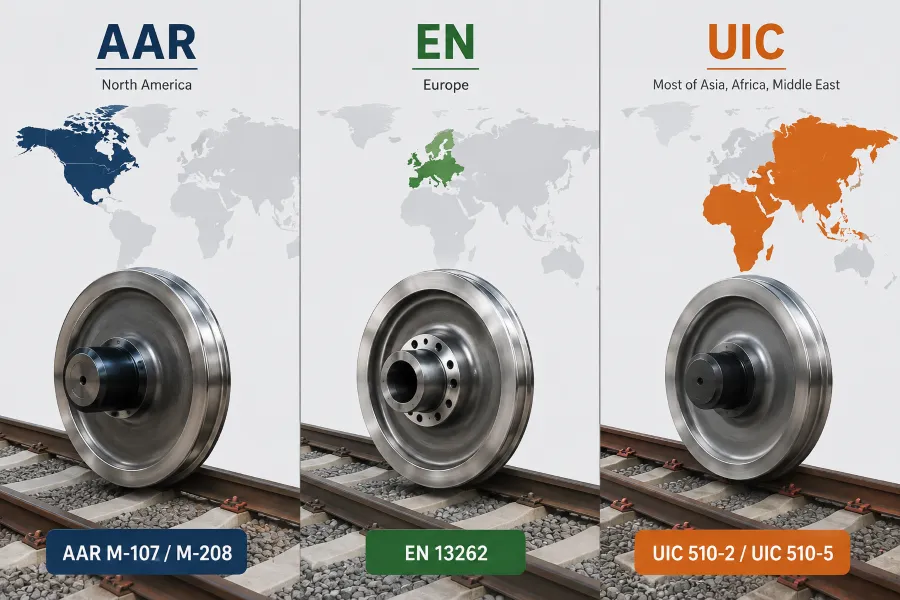
Railway wheels are manufactured according to different standards depending on where they will operate. A wheel designed for North America is not necessarily suitable for Europe or Asia.
Typical standards include:
If a supplier cannot clearly explain which standards their wheels meet—or cannot provide supporting documentation—you should proceed cautiously.
A professional manufacturer will also explain почему a particular standard is appropriate for your project instead of simply listing certificates.
Different railway networks follow different standards, and choosing the wrong specification can lead to compatibility and certification issues. If you’re unsure how AAR, В, МСЖД, or GOST standards differ, наш Полное руководство по стандартам на железнодорожные колеса explains the key requirements and where each standard is commonly used.
Not all railway wheels are made from the same steel.
Material composition determines:
Ask your supplier about:
Experienced manufacturers should be comfortable discussing these details rather than giving vague answers such as “high-quality steel.”
Steel grade is only one part of the equation. The internal microstructure created during forging and heat treatment has an even greater impact on long-term performance. Learn more in our article Почему контроль микроструктуры железнодорожных колес важен в производстве.
Although cast wheels are used in certain industrial applications, forged railway wheels are generally preferred for most railway vehicles because forging improves grain flow and structural integrity.
Ask the supplier:
How is this wheel manufactured?
A trustworthy supplier should explain the complete manufacturing route—from steelmaking and forging to heat treatment, механическая обработка, инспекция, and final testing.
Understanding the manufacturing process helps you evaluate long-term reliability instead of focusing only on the purchase price.
Many buyers ask whether forged wheels are worth the additional investment. In most railway applications, the answer depends on the operating conditions and required service life. We explain the complete production process in Railway Wheel Manufacturing Process : Прогулка по нашей производственной линии
Heat treatment has a major influence on wheel performance.
Proper heat treatment improves:
Ask whether the supplier controls:
A wheel that looks identical on the outside may perform very differently depending on its heat treatment.
Heat treatment is one of the most important factors affecting a railway wheel’s performance. Different processes, например, нормализация, закалка, and tempering, are used to achieve the required balance of hardness, прочность, и усталостная стойкость. If you’d like to understand how these processes work, read our article Термическая обработка железнодорожных колес: Нормализация, Объяснение закалки и отпуска.
Beyond the manufacturing process itself, proper heat treatment has a direct impact on wear resistance, контактная усталость при качении, и срок службы. We explain these benefits in more detail in Как термообработка улучшает качество железнодорожных колес.

Inspection should never be treated as an optional extra.
Перед отправкой, railway wheels should normally undergo dimensional inspection, механические испытания, и неразрушающий контроль.
Depending on the application, this may include ultrasonic testing (ЮТ), магнитопорошковое тестирование (МТ), испытание на твердость, and material verification.
Ask whether the supplier provides complete inspection reports with every batch.
Good documentation makes future maintenance and traceability much easier.
A reliable inspection process should include both dimensional checks and non-destructive testing before shipment. If you’d like to understand how railway wheels are verified before delivery, read Как железнодорожные колеса и детали из литой стали проверяются перед доставкой компанией NDT.
Traceability becomes extremely important once wheels enter service.
Each wheel should be traceable back to its:
If a problem occurs years later, complete traceability allows engineers to identify the cause quickly instead of replacing entire batches unnecessarily.
Complete traceability is much easier when the manufacturer controls the entire production process—from forging and heat treatment to machining and inspection. Learn more about our Railway Wheels Manufacturing Capabilities.
Railway wheels are not one-size-fits-all products.
Requirements differ significantly between:
An experienced supplier will ask about your operating conditions before recommending a wheel.
They may ask questions about axle load, рабочая скорость, состояние пути, климат, or maintenance schedule. These conversations usually indicate real engineering experience.
Wheel requirements vary significantly between freight wagons, локомотивы, системы метро, and industrial rail vehicles. Choosing a wheel designed for your specific application can improve both reliability and service life.
No manufacturer can guarantee an exact lifespan because operating conditions vary.
Однако, they should be able to explain the major factors that influence wheel life, включая:
If the only promise is “длительный срок службы,” you probably aren’t getting enough technical support.
Many projects require more than standard catalogue products.
You may need:
A manufacturer with in-house engineering and machining capabilities can usually respond much faster to these requirements than a trading company.
Every railway project has unique technical requirements. If you need custom wheel dimensions, механическая обработка, or material specifications, explore our Custom Railway Wheel Manufacturing Services to see how we support OEM projects.
The purchasing process doesn’t end when the shipment leaves the factory.
Reliable suppliers continue supporting customers by providing:
technical documentation, отчеты об инспекциях, packaging guidance, engineering assistance, replacement recommendations, and after-sales support whenever questions arise during installation or operation.
Long-term technical support is often more valuable than a small difference in purchase price.
Selecting a supplier isn’t just about today’s order—it’s about long-term technical support and consistent quality over the entire service life of the wheel. If you’re evaluating suppliers for an upcoming project, explore our Железнодорожные колеса page or contact our engineering team to discuss your application.
Every procurement team works within a budget.
Однако, the lowest quotation doesn’t always represent the lowest overall cost.
Unexpected wheel failures can lead to equipment downtime, maintenance expenses, replacement costs, and operational disruptions that far exceed the initial savings.
Asking the right technical questions before placing an order helps reduce these risks and leads to a more reliable supply chain.
В железнодорожном применении, value is measured by performance over years of service—not simply by the purchase price.

В Лоянская компания Fonyo Heavy Industries Co., ООО., we manufacture forged railway wheels for freight wagons, локомотивы, passenger rolling stock, транспорт метро, и промышленное железнодорожное применение.
Our production process covers forging, термическая обработка, обработка с ЧПУ, проверка размеров, and non-destructive testing to help ensure consistent quality and full product traceability. We also support customized dimensions and specifications based on customer requirements.
If you’re evaluating suppliers or planning a new railway wheel project, our engineering team is available to discuss your technical requirements and recommend suitable solutions.
Visit www.railwaypart.com or contact us to learn more about our railway wheel manufacturing capabilities.