Отсканируйте код WeChat, чтобы связаться с нами.
Отсканируйте код WeChat, чтобы связаться с нами.
Не стесняйтесь, отправьте нам электронное письмо, и мы ответим вам как можно скорее.
Создаем будущее сердцем и душой


Термическая обработка железнодорожных колес – один из важнейших процессов в обеспечении безопасности, долговечность, и длительный срок службы.
In real operating conditions, железнодорожные колеса подвергаются большим осевым нагрузкам, непрерывный контакт качения, and repeated thermal stress from braking.
In our manufacturing experience, heat treatment is not just a standard production step—it directly determines whether a wheel can perform reliably over time.
This article explains the core stages of железнодорожное колесо термическая обработка, including normalizing, закалка, и закалка, and how each step influences final performance.
Railway wheels operate under a combination of extreme conditions:
Без должной термической обработки., wheels may suffer from:
This is why international standards such as EN 13262 and AAR M-107 place strict requirements on railway wheel heat treatment.
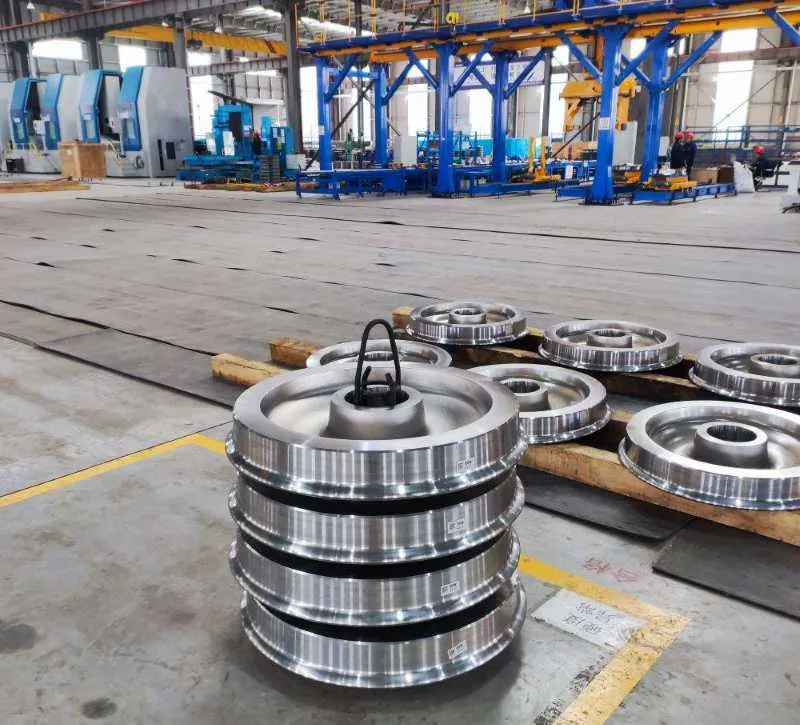
The three main processes work together to achieve a balance between hardness and toughness.
| Процесс | Цель | Engineering Impact |
| Нормализация | Уточнить зернистую структуру | Improves uniformity and machinability |
| закалка | Increase surface hardness | Enhances wear resistance on tread |
| Закалка | Reduce brittleness | Ensures toughness and safety |
After proper heat treatment, the wheel is not simply “harder”—it achieves a controlled balance that allows it to resist wear while maintaining structural integrity.
Normalizing is typically the first heat treatment step after forging or rough machining.
The process involves heating the wheel above its critical temperature, followed by controlled air cooling.
The main purpose is to refine the internal grain structure and eliminate residual stresses from forging.
С инженерной точки зрения, proper normalizing ensures that the material structure is uniform before further processing.
If this step is not well controlled, it can lead to inconsistent hardness and instability during later stages such as quenching.
На практике, normalizing also improves machinability, which is important for achieving tight dimensional tolerances in subsequent operations.
Quenching is the most critical step in железнодорожное колесо термическая обработка, especially when combined with rim hardening technology.
The wheel is heated to the austenitizing temperature and then rapidly cooled.
В железнодорожном применении, закалка обода is commonly used, where only the tread and flange areas are intensively cooled.
This creates a unique property distribution:
| Wheel Area | Typical Property | Functional Role |
| Рим | High hardness | Resists wear and rolling contact fatigue |
| Web | Moderate strength | Transfers stress between rim and hub |
| Центр | Higher toughness | Absorbs impact from axle load |
This gradient structure is essential.
A fully hardened wheel would be too brittle, while a fully soft wheel would wear out quickly.
From production experience, the biggest challenge in quenching is not reaching a certain temperature, but controlling the cooling rate precisely.
Excessive cooling can lead to cracks, while insufficient cooling results in inadequate hardness.
После закалки, the wheel enters the tempering stage.
Tempering involves reheating the wheel to a lower temperature, followed by controlled cooling.
This process reduces brittleness and stabilizes the internal structure formed during quenching.
Without proper tempering, the wheel may appear hard enough but remain vulnerable to sudden fracture under impact or fatigue conditions.
In real applications, tempering is what ensures that the wheel can withstand long-term service rather than just passing initial inspection.
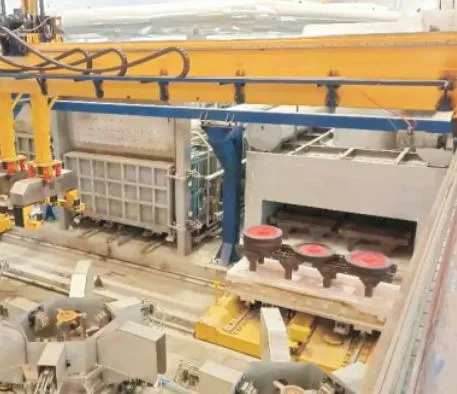
Through the combined effect of normalizing, закалка, и закалка, the internal structure of the railway wheel evolves into a more refined and stable form.
The final result is typically a fine pearlitic structure with a controlled hardness gradient.
This microstructure allows the wheel to resist wear on the surface while maintaining toughness internally.
Что еще более важно, proper heat treatment reduces residual stress, which plays a major role in fatigue performance.
In many failure cases, issues are not caused by insufficient hardness, but by poor stress control.
In a typical production environment, the heat treatment process is integrated into the overall manufacturing workflow:
Forging → Rough Machining → Normalizing → Rim Quenching → Tempering → Final Machining → Inspection
Each step must be coordinated to ensure consistency.
Heat treatment cannot be isolated from machining or material quality—it is part of a complete system.
Common Problems in Railway Wheel Heat Treatment and How to Avoid Them
Even with advanced equipment, heat treatment defects can occur if process control is insufficient.
| Issue | Root Cause | Practical Solution |
| Закалка трещин | Cooling rate too aggressive | Controlled spray cooling |
| Uneven hardness | Temperature inconsistency | Automated furnace control |
| Остаточное напряжение | Inadequate tempering | Optimized tempering cycle |
На практике, preventing these issues depends more on process stability than on theoretical parameters.
С инженерной точки зрения, heat treatment is not just about achieving a target hardness value.
What really matters includes:
Во многих случаях, wheel failures are not due to insufficient strength, but due to uneven properties caused by unstable processes.
In our production of forged railway wheels, heat treatment is managed as a fully controlled process rather than an isolated step.
Мы ориентируемся на:
Our goal is not only to meet standard requirements, but to ensure that each wheel performs consistently across large production batches.
If you are sourcing railway wheels or developing custom railway components, understanding heat treatment capability is essential when selecting a supplier.
Railway wheel rim quenching and heat treatment are critical processes that directly determine wheel safety, долговечность, and service performance.
A well-controlled process ensures the right balance between hardness, прочность, and fatigue resistance under real operating conditions.
Для железнодорожных применений, consistency in heat treatment is just as important as material selection and machining precision.
We are a manufacturer specializing in railway wheels and railway components, with experience in forging, механическая обработка, and controlled heat treatment processes including normalizing, закалка, и закалка.
Our production focuses on stable process control and consistent quality across large-scale manufacturing, ensuring reliable performance in real railway service environments.
If you are looking for railway wheels or customized rail components, please feel free to contact us with your technical requirements.
Лоянская компания тяжелой промышленности Fonyo, ООО.
Веб-сайт: www.railwaypart.com
We support OEM and customized solutions for railway wheels, отливки, and machined components.