हमसे संपर्क करने के लिए WeChat कोड को स्कैन करें
हमसे संपर्क करने के लिए WeChat कोड को स्कैन करें
बेझिझक हमें एक ईमेल भेजें और हम यथाशीघ्र आपको उत्तर देंगे.
दिल और आत्मा से भविष्य का निर्माण करें


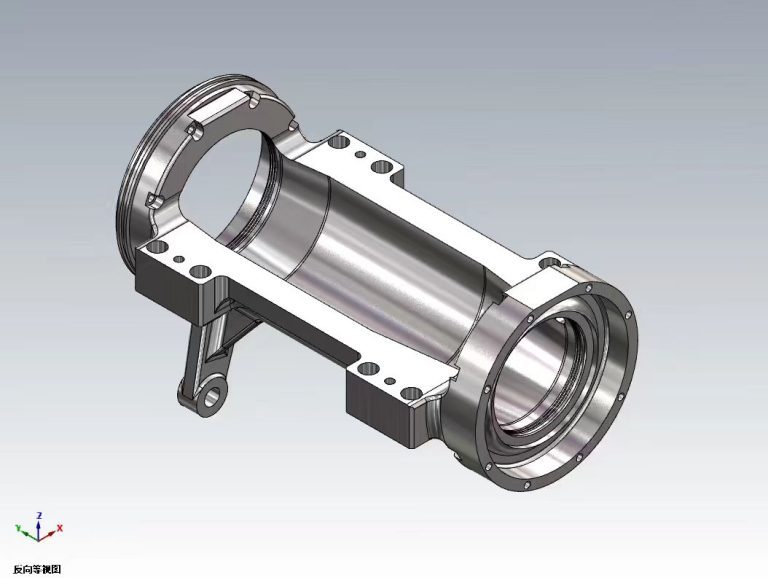
About ten years ago, we produced a complex aluminum housing using investment casting. At that time, metal additive manufacturing was not widely available in industrial production, and precision casting was often the most practical solution for manufacturing complex aluminum parts. आज, the comparison between aluminum 3D printing vs investment casting has become increasingly relevant in modern engineering. The component we manufactured featured a complicated internal structure, multiple mounting surfaces, and relatively thin walls. From an engineering perspective, investment casting allowed us to achieve the required geometry while maintaining acceptable mechanical strength, although the process itself required significant preparation and tooling effort.
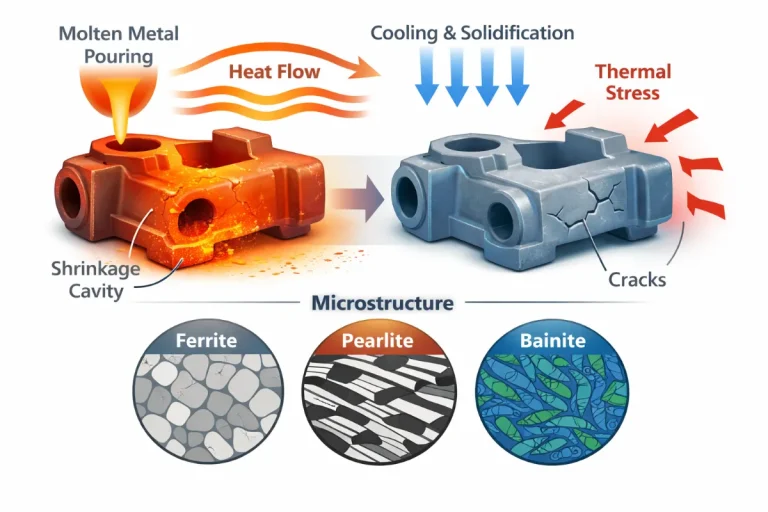
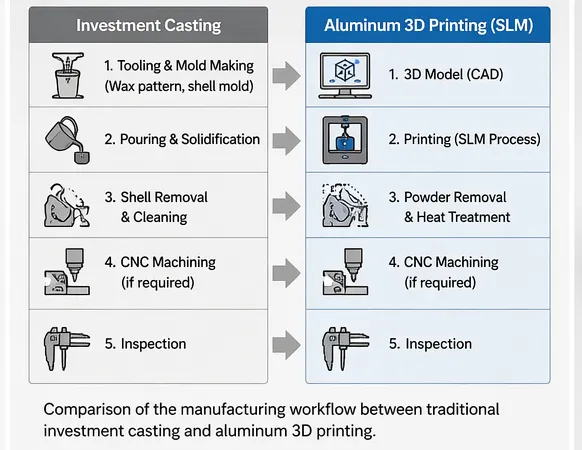
Before the rise of metal additive manufacturing, complex aluminum components were commonly produced through precision casting. The typical process included:
For aluminum castings, alloys similar to those used in modern additive manufacturing—such as AlSi10Mg—were already widely used because of their good castability and mechanical properties.
From a manufacturing standpoint, investment casting offered several advantages:
तथापि, the process also involved a significant amount of preparation before the first part could be produced.
In practical production, the biggest challenge was not the casting itself, but the tooling and preparation stage.
For complex aluminum housings, tooling development often required several weeks. If the design needed modification after the first samples, new tooling or adjustments might be necessary. This added both time and cost to the development process.
Another limitation involved internal geometry. While investment casting can produce complex shapes, there are still restrictions related to:
Some internal channels or closed structures were simply not practical to manufacture through casting.
These limitations were acceptable in the past, because there were few alternative manufacturing methods capable of producing such complex parts.
With the development of metal additive manufacturing, aluminum components can now be produced directly from digital models.
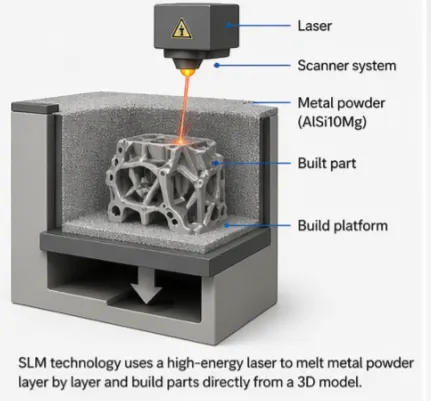
Processes like Selective Laser Melting build parts layer by layer by melting metal powder using a high-energy laser. One of the most commonly used materials is AlSi10Mg, which offers a good balance of strength, printability, and corrosion resistance.
From an engineering standpoint, aluminum 3D printing introduces several important advantages.
One of the most noticeable differences is design freedom.
When designing cast parts, engineers must consider mold removal and casting flow. These factors often require compromises in geometry.
With metal 3D printing, those constraints are greatly reduced.
It becomes possible to design:
These structures are extremely difficult—or sometimes impossible—to manufacture using traditional casting.
For industries such as aerospace and advanced mechanical systems, this design flexibility can significantly improve product performance.
Another major difference is development speed.
For investment casting, the timeline often includes:
This process can take several weeks before a qualified part is produced.
With aluminum 3D printing, the workflow is much simpler:
CAD model → printing → post-processing.
Prototype components can often be produced within a few days. This makes additive manufacturing particularly useful for:
For engineering teams working on new equipment or specialized components, this time advantage can be extremely valuable.
From a dimensional accuracy perspective, both processes can achieve good results.
Typical tolerances are approximately:
| प्रक्रिया | Typical Accuracy |
| Investment Casting | ±0.1–0.3 mm |
| Aluminum 3D Printing | ±0.05–0.15 mm |
तथापि, most functional components still require सीएनसी मशीनिंग for critical surfaces, regardless of the manufacturing method.
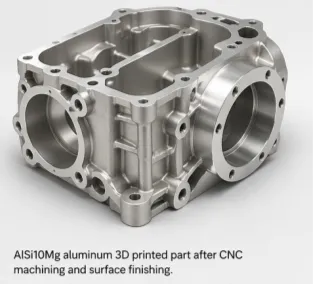
Surface finish is another difference. Cast parts often have smoother as-cast surfaces, while metal 3D printed parts typically require additional finishing such as:
Cost is where the two technologies differ significantly depending on production volume.
Investment casting requires upfront tooling costs, but once the mold is available, the cost per part decreases significantly for larger production runs.
Metal 3D printing, on the other hand, eliminates tooling costs but has higher material and machine costs per part.
From an engineering and procurement perspective, the general guideline is:
This balance between tooling cost and production efficiency determines which process is more economical.
In practice, aluminum additive manufacturing becomes especially attractive when:
For these scenarios, the flexibility of metal 3D printing can significantly simplify manufacturing.
Looking back at aluminum housings produced more than a decade ago, investment casting was often the most practical and reliable manufacturing solution available at that time.
आज, advances in metal additive manufacturing have significantly expanded the design and production possibilities for aluminum components.
For complex geometries, aluminum 3D printing using alloys such as AlSi10Mg can enable faster prototyping, greater design freedom, and cost-efficient small-batch production.
Both investment casting and additive manufacturing continue to play important roles in modern engineering. The key lies in selecting the most suitable process based on design complexity, production volume, performance requirements, and project timeline.
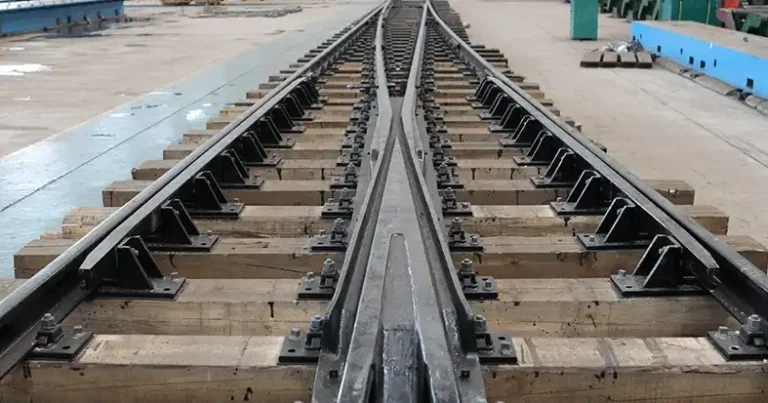
पर Luoyang Fonyo Heavy Industry Co., लिमिटेड. (www.railwaypart.com), we apply these manufacturing principles across a wide range of रेलवे के पहिये, रेलवे कास्टिंग, and precision railway components, helping customers select the most suitable process based on performance and application requirements.