Scannez le code WeChat pour nous contacter
Scannez le code WeChat pour nous contacter
N'hésitez pas à nous envoyer un email et nous vous répondrons dans les plus brefs délais.
Créer l'avenir avec cœur et âme


The safety and reliability of railway transportation largely depend on the quality of its core components. Moulages ferroviaires, such as couplers, components of bogies, and some key connecting parts for locomotives and rolling stock, are essential parts of railway equipment.
The inspection standards for railway castings serve as the basis for quality determination and mainly cover the following aspects:
1.1 Material Standards: The chemical composition and mechanical properties of the railway castings must comply with the requirements of the design drawings and relevant technical specifications. This includes precise control of the content of major elements such as carbon, silicon, manganèse, sulfur, and phosphorus, as well as assessment of mechanical performance indicators such as tensile strength, limite d'élasticité, élongation, and impact toughness.
Dimension and Geometric Tolerance Standards: The actual dimensions, surépaisseurs d'usinage, and shape and position tolerances (such as straightness, flatness, coaxiality, etc.) of the railway castings must be inspected strictly in accordance with the product drawings to ensure precise assembly with other components.
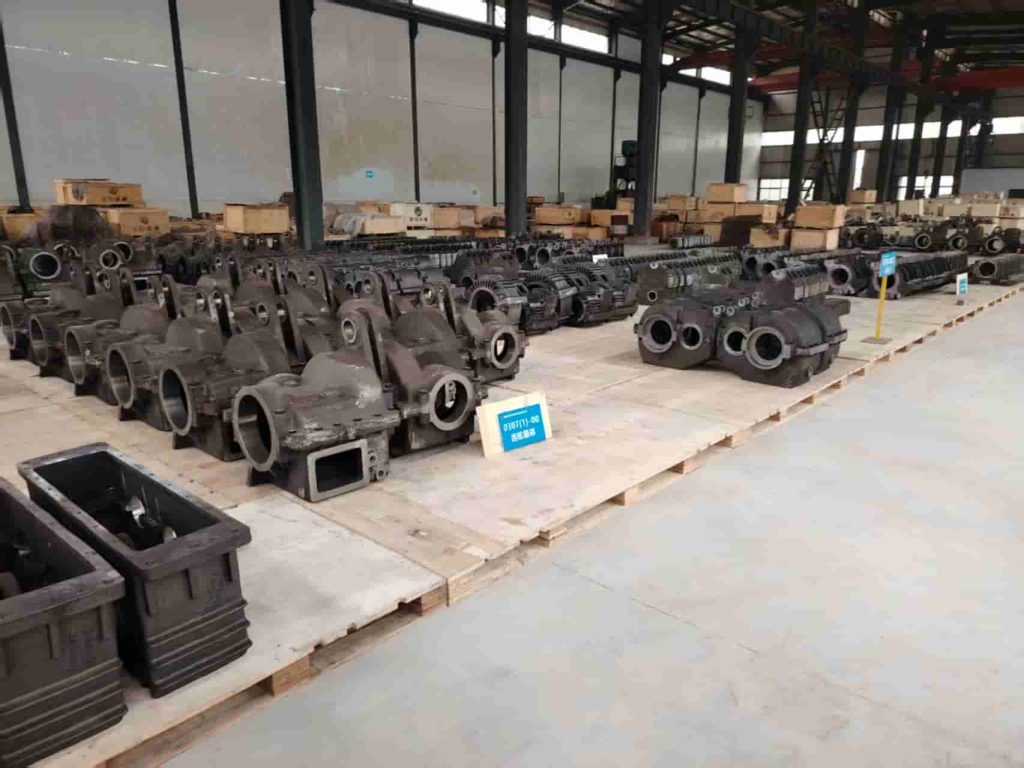
1.2 Surface Quality Standards:
Appearance Defects: The railway castings’ surfaces must not have defects that affect their performance, comme des fissures, cold shuts, cavités de retrait, and scabs. Permissible surface imperfections (such as minor sand sticking and burrs) are subject to clear limits on depth, taille, and quantity.
Surface Cleaning: The residual molding sand, oxide scale, flash, and gates on the castings’ surfaces must be cleaned thoroughly to meet the specified requirements.
Internal Quality Standards: This is a critical inspection step. The castings must not have internal defects such as shrinkage porosity, gas holes, inclusions de scories, and cracks that could affect structural integrity and safety. The allowable levels, sizes, and distribution ranges of these internal defects are typically specified in non-destructive testing standards.
The inspection procedures for railway castings are carried out throughout the entire production process, following the sequence from raw materials to finished products. They mainly include the following steps:
2.1 Incoming Inspection: Chemical composition or physical properties of raw materials such as metal furnace charges, alloy additives, casting sands, and resin binders are sampled and inspected upon entry into the production process to ensure material stability from the source.
Process Inspection (First Article Inspection and Patrol Inspection):
2.2 Mold Inspection: Before batch production, the dimensions and surface conditions of the molds are verified to ensure they can produce qualified blanks.
2.3 Melting and Pouring Control: The melting process is monitored, and rapid composition analysis is usually conducted at the furnace front. Chemical composition in the furnace is adjusted if necessary. Temperature and time during pouring are strictly controlled.
2.4 First Article Inspection: After each batch of products or when there is a change in the production process, the first few railway castings produced are inspected comprehensively for dimensions and appearance. Production can continue only after they are confirmed to be qualified.
2.5 Patrol Inspection: Inspectors conduct random inspections at the production site to supervise whether the operations of molding, core making, box closing, verser, and cleaning comply with the process specifications.
2.6 Inspection finale: This is a comprehensive quality assessment of the railway castings before they leave the factory and is the core of quality control.
Inspection visuelle: Inspectors visually inspect or use magnifying glasses to check 100% of the castings’ surfaces for obvious surface defects.
3.1 Tool Inspection: Key dimensions and tolerances are measured using conventional tools such as calipers, micrometers, thread gauges, and templates. For complex-shaped castings, a coordinate measuring machine may be used for precise inspection.
3.2 Mechanical Properties Testing:
Sampling: Special test bars (blocks) are cast in the same melting furnace batch and heat treatment batch for mechanical property testing, or sample blanks are cut from designated parts of the castings.
Essai: Résistance à la traction, limite d'élasticité, and elongation of the samples are determined on a universal material testing machine; impact toughness is measured on an impact testing machine. The results must meet the material standards. Analyse de la composition chimique: Drill shavings from castings or test bars are taken, and the precise determination of chemical composition is carried out using equipment such as spectrometers or carbon-sulfur analyzers.
3.3 Contrôles non destructifs: This is a necessary means to detect minute defects inside and on the surface of castings.
3.4 Test de particules magnétiques (MT): It is applicable to ferromagnetic materials (such as cast steel and cast iron) and is used to detect linear defects such as cracks and folds on or near the surface of castings.
3.5 Penetrant testing (PT): It is suitable for various metal materials and is mainly used to detect surface opening defects.
3.6 Tests par ultrasons (Utah): By utilizing the propagation characteristics of ultrasonic waves in objects, it detects internal defects such as shrinkage cavities, inclusions, and cracks in castings, and can also assess their depth and size.
3.7 Radiographic testing (RT): X-rays or gamma rays are used to penetrate castings, and the two-dimensional shape and distribution of internal defects are displayed through film or imaging systems. This method is costly and is typically used for important and structurally complex castings.
Samples are cut, ground, polished, and etched, and their microstructure (such as grain size and phase composition) is observed under a metallographic microscope to evaluate the effect of heat treatment and whether the microstructure meets requirements.
4.1 Pressure testing: For castings with pressure-bearing requirements (such as valves and brake system components), water pressure or air pressure tests are conducted to check for leaks or permanent deformation within the specified pressure and holding time.
4.2 Identification and record-keeping: All qualified castings must be marked with permanent identifiers (such as batch numbers and material codes) to enable quality traceability. All data throughout the production and inspection process, including chemical composition reports, mechanical property reports, and non-destructive testing reports, must be compiled into a complete and searchable quality record archive.
4.3 Control of non-conforming products: Non-conforming products identified during inspection must be clearly marked, isolated, and reviewed according to procedures. Possible handling methods include scrapping, rework (which requires approval and re-inspection), or downgrading for use.
Luoyang Fonyo Heavy Industries Co., Ltée, fondée en 1998, est un fabricant de pièces moulées ferroviaires. Notre usine couvre une superficie de 72 600㎡, avec plus de 300 employés, 32 techniciens, y compris 5 ingénieurs supérieurs, 11 ingénieurs adjoints, et 16 techniciens. Notre capacité de production est 30,000 tonnes par an. Actuellement, nous produisons principalement du moulage, usinage, et montage pour locomotive, wagon, trains à grande vitesse, équipement minier, énergie éolienne,etc..
Nous sommes la fourniture de pièces ferroviaires au CRRC(dont plus de 20 succursales et filiales de CRRC),Machines d'ingénierie Gemac,Groupe Sany, Industries lourdes Citic,etc.. Nos produits ont été exportés vers la Russie, les États-Unis, Allemagne, Argentine, Japon, France, Afrique du Sud, Italie et autres pays du monde.