Scansiona il codice WeChat per contattarci
Scansiona il codice WeChat per contattarci
Sentiti libero di inviarci un'e-mail e ti risponderemo il prima possibile.
Creare il futuro con cuore e anima


During the cold winter season, IL railway lines covered with ice and snow used to be the greatest nightmare for transportation safety. Switches would freeze, and the contact network would be covered with ice. Minor delays were possible, but severe situations could lead to complete paralysis. Traditional manual ice removal workers were exposed to the cold wind, with low efficiency and high risks. Ora, the emergence of railway ice removal robots is quietly reshaping this winter scene, becoming the key force to ensure the unobstructed flow of the steel arteries.
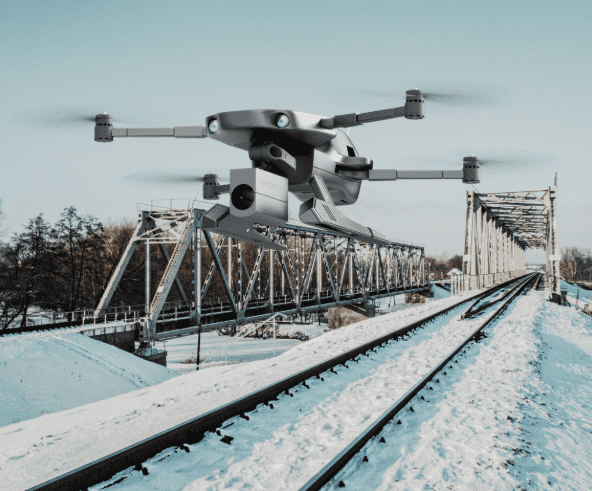
These intelligent guardians are far from being simple machines. They integrate precise sensing, adaptive robotic arms, and efficient thermal technology, forming a powerful ice removal system. High-definition cameras and multi-spectral sensors are like “wise eyes”, accurately identifying the thickness and location of the ice layer; multi-jointed robotic arms are as flexible as human hands, able to operate precisely in complex track areas; and ice removal methods such as microwaves, hot air, or mechanical crushing are like “sharp swords”, quickly and efficiently breaking through the hard ice. Their intelligent decision-making system can automatically optimize the operation mode based on environmental temperature and ice layer characteristics, ensuring stable output even in temperatures ranging from -30°C to 50°C.
The value of railway ice removal robots is particularly remarkable in terms of safety and efficiency:
Safety Guardians: The robots replace human operations in the most dangerous areas of the contact network and switches, completely avoiding risks such as falling from heights and frostbite, achieving “essential safety”. Their 24-hour standby capability further minimizes the probability of train disruptions caused by sudden ice coverage.
Efficiency Multiplier: The operation efficiency far exceeds that of manual workers. Taking a certain type of thermal ice removal robot as an example, it can efficiently remove hundreds of meters of ice covering the contact network in a single operation, taking only a fraction of the time of traditional human teams, significantly reducing the valuable “window period”.
Economic New Engine: Efficient operations significantly reduce train delays and stoppage losses. If a busy mainline experiences a 50% reduction in delays due to ice coverage, the direct transportation revenue guarantee and indirect socioeconomic benefits are extremely considerable. The one-time investment in equipment is covered by the continuous return of efficiency dividends in long-term operation.
Quality Stabilizer: The robot operations are standardized, avoiding the variability of manual operations, ensuring precise compliance with key parameters such as contact network height and switch tightness, and improving the quality of line maintenance.
In the vast land, these intelligent figures have begun to take root. In the cold northeastern region, robots have become the main force for ice removal on high-speed rail contact networks; in snowy mountainous railway lines, they flexibly cope with complex terrain; in busy railway hubs, they efficiently maintain key switches during the night “window period”. A typical case is that after the Harbin-Dalian high-speed railway introduced the ice removal robot system, the train delay rate caused by contact network icing during winter decreased by approximately 30%. They are like tireless guardians, silently safeguarding the smooth operation of the tracks in the snow and wind.
Looking to the future, the development picture of railway ice removal robots is highly anticipated. The deep application of artificial intelligence algorithms will give them stronger environmental perception and autonomous decision-making capabilities, and cluster collaboration robot systems are expected to achieve larger-scale collaborative operations. Allo stesso tempo, the multi-functional integration of the robot platform (such as inspection and simple maintenance) will maximize its value. With the popularization of technology, its application will extend from mainline railways to local railways and even dedicated lines of industrial and mining enterprises, benefiting a wider transportation network.
The icy and cold weather has long constrained the nerve endings of railway transportation. The rise of railway ice removal robots is reshaping the railway’s resilience and ability to cope with extreme weather with its precise, efficiente, sicuro, and reliable characteristics. They are not only physical tools for removing ice but also a powerful engine driving the intelligence and modernization leap of railway transportation. When these intelligent guardians move steadily in the snow and wind, the railway, this major artery of the national economy, has a solid guarantee for crossing the winter and being unobstructed throughout the year, truly achieving the transportation vision of “people can travel, goods can flow freely”.
Luoyang Fonyo Heavy Industries Co., Ltd,fondata nel 1998, è un produttore di pezzi fusi per ferrovie. La nostra fabbrica copre un'area di 72.600㎡, con più di 300 dipendenti, 32 tecnici, compreso 5 ingegneri senior, 11 ingegneri assistenti, E 16 tecnici. La nostra capacità produttiva è 30,000 tonnellate all'anno. Attualmente, produciamo principalmente fusione, lavorazione, e assemblaggio per locomotiva,vagone ferroviario,treni ad alta velocità, attrezzature minerarie,energia eolica,ecc.
Siamo la fornitura di componenti ferroviari a CRRC(compreso più di 20 filiali e controllate di CRRC), Macchine per l'ingegneria Gemac, Sanygroup, Industrie pesanti Citic, ecc. I nostri prodotti sono stati esportati in Russia, gli Stati Uniti, Germania, Argentina, Giappone, Francia, Sudafrica, Italia e altri paesi in tutto il mondo.
Informazioni sui contatti:
E-mail:[email protected]
Mobile:008615515321683