Scannez le code WeChat pour nous contacter
Scannez le code WeChat pour nous contacter
N'hésitez pas à nous envoyer un email et nous vous répondrons dans les plus brefs délais.
Créer l'avenir avec cœur et âme


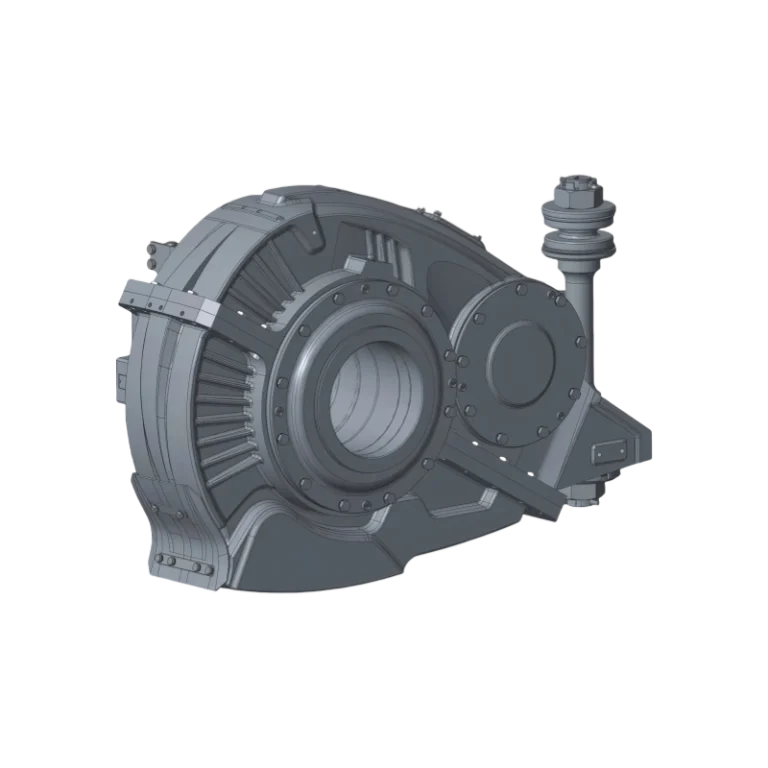
Railway gearboxes are the “core hubs” for train power transmission and need to operate stably under high-frequency vibration, shock loads and temperature fluctuations. The traditional gray cast iron process is prone to induce cracks in stress concentration areas such as tooth roots and bearing housings due to its inherent brittleness – tensile strength is only about 200MPa, and the flake graphite structure is like a “microcrack source”. En outre, traditional heat treatment (such as normalizing) leads to a stress imbalance of “hard on the outside and brittle on the inside”, accelerating the propagation of fatigue cracks. The combination of the two makes the gearbox prone to tooth surface peeling and box body cracking, with a lifespan of only 3 à 5 années, which has become a key bottleneck for the longevity of railway equipment. To break through this predicament, it is necessary to start from material modification and heat treatment optimization to achieve the goal of a 15-20 long service life for gearboxes.
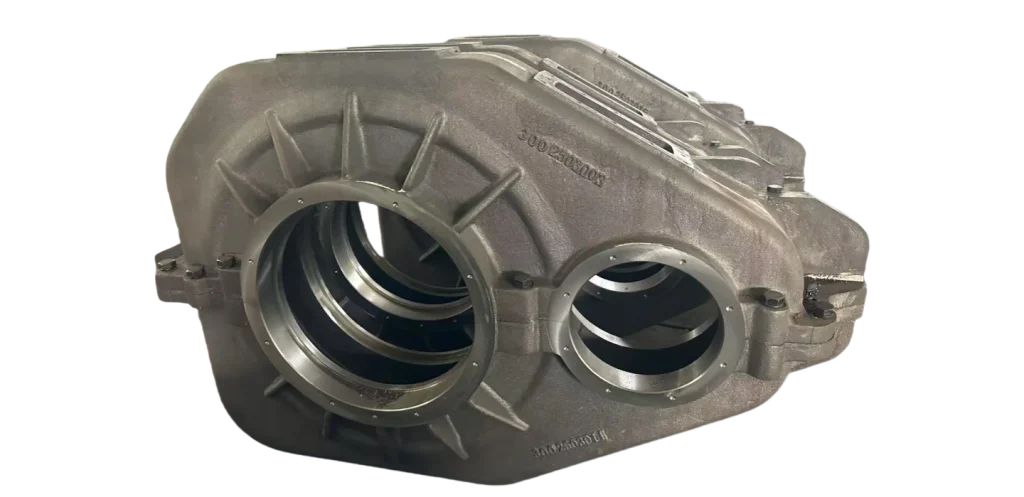
Common gray cast iron has significant brittleness defects in the application of railway gearboxes, with a tensile strength of only about 200MPa. During railway operation, gearboxes need to withstand high-frequency vibrations, impact loads and temperature fluctuations. The flaky graphite structure of traditional cast iron is like a “micro-crack source” in the matrix, and is prone to inducing crack initiation in stress concentration areas such as tooth roots and bearing housings. Par exemple, during the long-term service of high-speed railway gearboxes, due to the insufficient toughness of traditional cast iron, problems such as tooth surface peeling and box cracking often occur, leading to premature equipment failure and affecting the safety of train operation and maintenance costs.
The traditional casting and heat treatment processes are difficult to meet the strict requirements of railway gearboxes. Although normalizing treatment can enhance the surface hardness, the core has insufficient toughness, resulting in an uneven stress distribution phenomenon of “hard on the outside and brittle on the inside”. Under the variable load and high vibration conditions of railways, this unevenness will accelerate the propagation of fatigue cracks and shorten the service life of gearboxes. En outre, traditional processes have limited control over the morphology of graphite. Flake graphite splits the matrix, reducing the overall fatigue resistance of the material and making it difficult to meet the long-distance and high-intensity operation requirements of railways.
Comme le “cœur” of train power transmission, railway gearboxes have long been constrained by traditional craftsmanship: the tensile strength of ordinary gray cast iron is only about 200MPa, and the flake graphite structure, like the “inherent crack source” in the matrix, is prone to crack initiation in stress concentration areas such as tooth roots and bearing housings under high-frequency vibration and impact loads. The traditional normalizing process further leads to a stress imbalance of “hard on the outside and brittle on the inside”, accelerating the propagation of fatigue cracks and limiting the service life of gearboxes to 3 à 5 années, which is difficult to meet the strict requirements of high-speed railways and heavy-haul railways for long service life and high reliability.
In response to the high-performance demands of railway gearboxes, modern processes achieve material upgrades through alloying modification. After adding elements such as nickel and chromium, the cast iron matrix forms a martensitic-bainite composite structure, and the tensile strength is increased to over 300MPa. Nickel refines grains, inhibits the coarsening of graphite, and improves the uniformity of the material. Chromium enhances hardenability and ensures a uniform structure for thick and large cross-section gearboxes. This modification significantly enhances the tooth surface contact fatigue strength of railway gearboxes under high-speed and heavy-load working conditions, effectively delaying crack initiation and extending the equipment maintenance cycle.
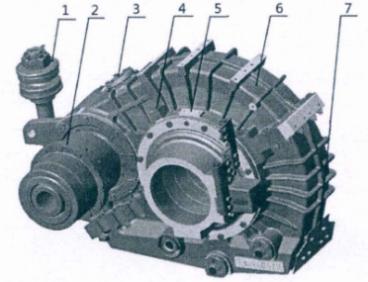
The isothermal quenching process is the core breakthrough in the heat treatment of modern railway gearboxes. This process involves heating cast iron to the austenite zone and then rapidly immersing it in a salt bath at 250-350℃ to form a bainitic structure rich in high-carbon austenite. This structure combines the high strength of martensite with the toughness of graphite, increasing the impact toughness of the gearbox by 50% and raising the fracture toughness to 1.8 times that of traditional processes. In the extremely cold environment of railways or scenarios with sudden temperature changes, isothermal quenched gearboxes can still maintain excellent impact resistance, with the crack growth rate reduced by 70%, significantly enhancing the operational reliability of the equipment.
The difference in lifespan between traditional and modern craftsmanship essentially lies in the innovation of crack control concepts. The traditional cast iron has a short crack initiation life due to the graphite splitting of the matrix. Modern alloy cast iron delays initiation through microstructure refinement, and the ductile matrix formed by isothermal quenching effectively prevents crack propagation. Ce “nipping problems in the bud” design has extended the service life of railway gearboxes from the traditional 3 à 5 années à 15 à 20 years under complex working conditions, achieving a leap from “passive maintenance” à “active longevity”, and providing a solid guarantee for the safe and efficient operation of high-speed and heavy-haul railways.
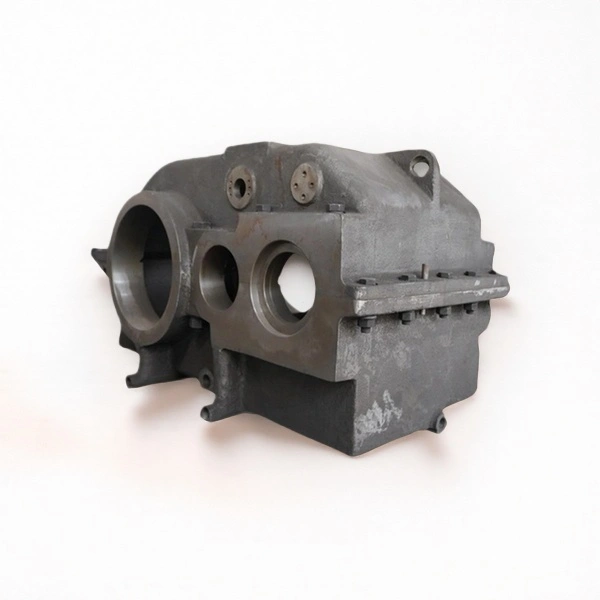
From material modification to heat treatment optimization, le “longevity code” of modern railway gearboxes lies in the innovation of the entire chain of processes. This innovation not only enhances the performance of single parameters but also, through the deep coupling of material genes and process parameters, achieves high reliability of gearboxes under extreme working conditions such as high speed, heavy load, et les fluctuations de température, writing a technological chapter for the longevity of railway equipment.
Luoyang Fonyo Heavy Industries Co., Ltée, fondée en 1998, est un fabricant de pièces ferroviaires moulées. Notre usine couvre une superficie de 72 600㎡, avec plus de 300 employés, 32 techniciens, y compris 5 ingénieurs supérieurs, 11 ingénieurs adjoints, et 16 techniciens. Notre capacité de production est 30,000 tonnes par an. Actuellement, nous produisons principalement du moulage, usinage, et montage pour locomotive, wagon, trains à grande vitesse, équipement minier, énergie éolienne, etc.. Nos produits ont été exportés vers la Russie, les États-Unis, Allemagne, Argentine, Japon, France, Afrique du Sud, Italie et autres pays.
Contact: Stella Liu
E-mail: [email protected]
WhatsApp: +86-155-1535-1287