Escanea el código WeChat para contactarnos
Escanea el código WeChat para contactarnos
No dudes en enviarnos un correo electrónico y te responderemos lo antes posible.
Creando el futuro con corazón y alma


Descripción general
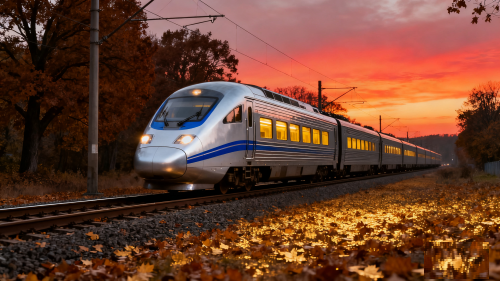
Imagine a train weighing hundreds of tons, hurtling at a speed of over a hundred kilometers per hour on tracks that are not perfectly smooth. Every slight misalignment at the juntas de rieles, every minor settlement of the roadbed, and even every frictional impact between the wheels and the track surface generates tremendous vibration energy. If this force were to be directly transmitted to the train body, not only would passengers experience unbearable jolts, but the vehicle structure itself would also suffer accelerated fatigue damage, and precision equipment might malfunction. en este momento, the key role that silently takes on the responsibility of “transforming rigidity into flexibility” is the train’s shock-absorbing spring system – they are like the train’s invisible “flexible spine” y “energy absorber”, the cornerstone for ensuring smooth operation, seguridad, and comfort.
I. Core Mission: Energy Conversion and Isolation
The core working principle of shock-absorbing springs (o, more accurately, the elastic elements in the suspension system) is not simply to “withstand” the impact but rather to ingeniously absorb, store, and slowly release the impact energy. When the wheels encounter track irregularities (such as rail joints, interruptores, minor depressions or protrusions), a huge impact force is transmitted upwards. En este punto, the springs are compressed (or stretched, depending on the type), converting the kinetic and potential energy generated by the impact into their elastic deformation energy and temporarily storing it. Después, as they return to their original shape, this energy is released back into the system relatively smoothly. This process significantly extends the duration of the impact force, greatly reducing its peak value (in accordance with the law of conservation of momentum), thereby effectively isolating the track irregularities and preventing them from being transmitted violently to the bogies and the train body.
II. Family Members: Diverse Spring Forms and Applications
The train’s shock absorption system is not dominated by a single type of spring but rather a carefully configured “spring family” based on force characteristics, space constraints, y requisitos de rendimiento:
Spiral Compression Springs:
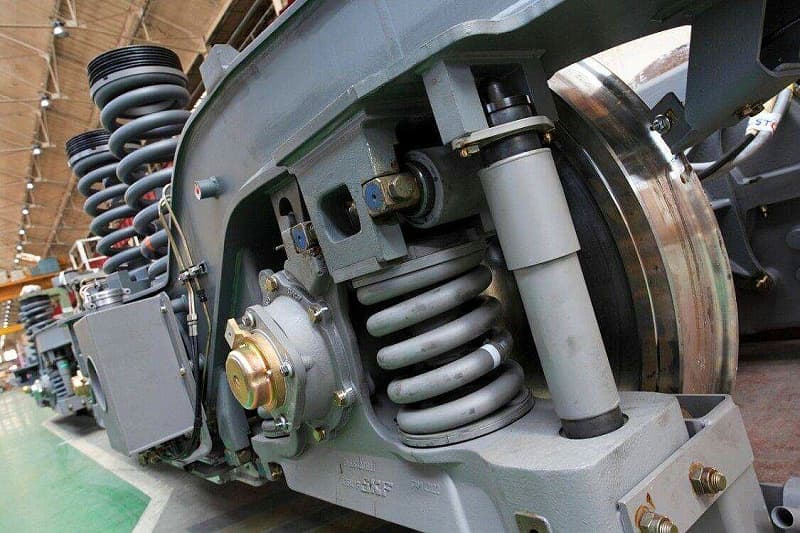
Form and Characteristics: The classic cylindrical helical coil structure, typically formed by hot or cold coiling of high-strength alloy spring steel rods, followed by quenching and tempering to achieve excellent elasticity and fatigue life. Their stiffness (the force required for unit deformation) is relatively constant.
Main Battlefield: The core of the primary suspension. Directly installed between the axle box (wheelset bearing box) and the bogie frame. They are the first to absorb the most direct and intense high-frequency, small-amplitude impacts between the wheels and the track (such as rail joints and minor irregularities). Their performance directly affects the wheel-rail adhesion (reducing wheel-rail impact and noise) and the filtering effect of initial impacts. Engineers precisely calculate their stiffness, free height, and working stroke to ensure sufficient compression margin (safety margin) under maximum load and strictly control their vertical stiffness to match the wheel-rail dynamics requirements.
Rubber-Metal Composite Springs (Rubber Stacks):
Form and Characteristics: Composed of multiple layers of natural or synthetic rubber alternately vulcanized and bonded with metal plates. Their unique advantage lies in the independent design of three-directional stiffness (vertical, lateral, longitudinal) and the combination of elasticity and moderate damping (internal friction). The viscoelasticity of rubber provides additional vibration attenuation.
Main Battlefield: The main force in the secondary suspension. Located between the bogie and the train body. They shoulder a more important mission: further isolating the remaining medium and low-frequency, larger amplitude vibrations after initial filtering by the primary suspension (such as long-wave track irregularities, centrifugal force compensation when turning), and providing necessary elastic positioning constraints for the train body relative to the bogie in the lateral and longitudinal directions. This is crucial for the smooth turning of high-speed trains and the suppression of snaking motion. The internal structure design (rubber hardness, number of layers, forma, metal plate angle) is a highly customized art.
Air Spring:
Form and Characteristics: Composed of a high-strength rubber bladder (usually with a cord-reinforced layer) and upper and lower cover plates (or pistons), it is filled with compressed air (typically from the train’s main air reservoir). Its revolutionary advantage lies in its nonlinear stiffness and highly adjustable nature – the air pressure determines the load-bearing capacity. The most prominent feature is its nearly constant “equal frequency characteristic”: by connecting an additional air chamber (regulated by a throttle valve or height valve), the system can automatically maintain the floor height of the vehicle body basically unchanged under different passenger loads (with significant weight variations), and keep the vibration frequency relatively stable, thereby providing excellent and consistent comfort in both empty and fully loaded conditions.
Main Battlefield: The preferred choice for the secondary suspension of modern high-speed trains and passenger cars with extremely high comfort requirements. Its outstanding vibration isolation performance (especially at low frequencies), automatic leveling ability, and relatively low weight make it a key technology for enhancing ride quality. Maintenance personnel need to closely monitor its air tightness and the condition of the rubber bladder.
Leaf Spring (Decreasing in Use):
Form and Characteristics: Composed of multiple spring steel plates of decreasing lengths, stacked and fixed by a central bolt or clamp. It mainly relies on the friction between the plates to provide elasticity and a certain amount of damping. It has a relatively simple structure, low cost, and high load-bearing capacity, but it is heavy, has unstable friction damping (easily affected by the environment), has obvious stress concentration, and is prone to noise.
Escenarios de aplicación: Mainly found in some old trucks or specific types of bogies. Due to its inherent drawbacks, it has been largely replaced by coil springs, rubber stacks or air springs in modern passenger vehicles that pursue lightweight, high comfort and maintenance-free features.
III. Beyond “Elasticidad”: The Indispensability of Damping
It must be emphasized that only springs (elastic elements) are not enough! After absorbing energy, if the spring is allowed to release it freely (oscillate), the vehicle body will sway like a swing, resulting in even worse comfort. Por lo tanto, spring systems always work in conjunction with damping elements (mainly shock absorbers/hydraulic dampers). The role of the shock absorber is like a “buffer within a buffer”, consuming the energy stored in the spring (converting it into heat energy), quickly suppressing oscillations, and making the vehicle body movement quickly stabilize. An excellent suspension system is a precise match between the spring (stiffness characteristics) and the shock absorber (damping characteristics).
IV. Materiales y Procesos: The Foundation of Reliability
The reliability of springs is related to driving safety. The core material is usually high-strength, high-toughness, and high-fatigue-limit alloy spring steel (como 60Si2MnA, 50CrVA, etc.), which has excellent anti-relaxation ability (small loss of elasticity after long-term compression). The manufacturing process is extremely strict:
Coiling: Precise control of wire diameter, number of turns, and helix angle.
Tratamiento térmico: Quenching provides high strength, tempering eliminates stress and stabilizes the structure, achieving the best comprehensive mechanical properties (tensile strength usually at the 1500-2000 MPa level). Surface decarburization is a strictly controlled fatal defect.
Strong pressure treatment (setting treatment): Applying a load exceeding the working limit to the spring, causing beneficial residual compressive stress on the surface layer, significantly increasing fatigue life.
Tratamiento superficial: Shot peening further introduces a residual compressive stress layer and enhances resistance to corrosion fatigue. Coatings (such as phosphating and powder coating) provide rust protection. Rubber springs have extremely high requirements for rubber formula, vulcanization process, and metal bonding strength.
V. Challenges and Evolution
Designers continuously face challenges: How to provide stronger load-bearing capacity, better vibration isolation performance (especially at low frequencies), higher reliability (fatigue life of millions of cycles), and lower maintenance requirements in a lighter weight and more compact space? New materials (such as high-performance non-metallic composite materials), new structures (such as variable stiffness springs), and more intelligent control (semi-active/active suspensions, adjusting damping or stiffness in real-time through sensors and actuators) are the cutting-edge directions. The continuous optimization of air spring technology (such as more compact structures and more intelligent height control valves) keeps it leading in high-end applications.
Proveedor
Industrias pesadas Co. de Luoyang Fonyo., Limitado, fundada en 1998, es un fabricante de piezas de ferrocarril de fundición. Nuestra fábrica tiene una superficie de 72.600㎡, con más de 300 empleados, 32 tecnicos, incluido 5 ingenieros superiores, 11 ingenieros asistentes, y 16 tecnicos. Nuestra capacidad de producción es 30,000 toneladas por año. Actualmente, Producimos principalmente fundición., mecanizado, y montaje para locomotora, automotor, trenes de alta velocidad, equipo de minería, energía eólica, etc.. Nuestros productos han sido exportados a Rusia., los estados unidos, Alemania, Argentina, Japón, Francia, Sudáfrica, Italia y otros países..
Contacto: cathy
Correo electrónico:[email protected]
Móvil:008615515321683