Escanea el código WeChat para contactarnos
Escanea el código WeChat para contactarnos
No dudes en enviarnos un correo electrónico y te responderemos lo antes posible.
Creando el futuro con corazón y alma


Heat treatment plays a critical role in manufacturing high-performance ruedas de ferrocarril. This process gives locomotive wheels and other train wheels the necessary strength, tenacidad, and wear resistance to operate safely for decades under extreme conditions. Indeed, without proper heat treatment, even the best steel could fail under heavy loads and high speeds.
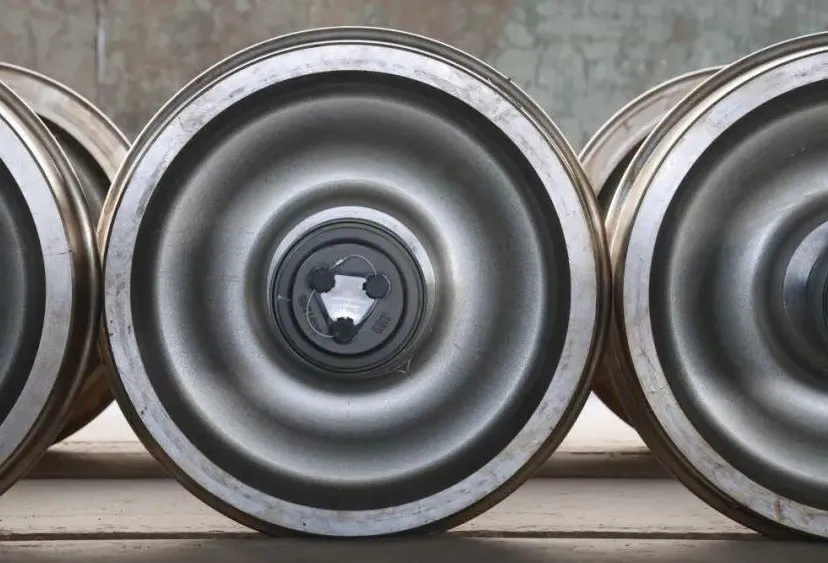
Every railway wheel faces tremendous stress from its contact with the rail, including forces from braking, aceleración, y cambios de temperatura. Heat treatment fundamentally enhances the steel’s internal structure, making it stronger and more reliable. Como consecuencia, it helps the train wheel resist cracking, improves its surface hardness, and maintains an optimal balance between strength and flexibility.
Normalizando
The first key stage in railway wheel heat treatment is normalizing. Here, we heat the wheel to approximately 900°C and then cool it in still air. This process effectively refines the steel’s grain structure, relieves internal stresses, and prepares the material for subsequent steps.
Rim Quenching
Rim quenching is one of the most crucial steps. Operators then rapidly cool the rim of the wheel—the part that directly contacts the rail—using water or air sprays. Como resultado, this creates a exceptionally hard, wear-resistant outer layer, while the wheel’s core remains tough and flexible to absorb impacts. A properly executed rim quenching process significantly extends the service life of forged railway wheels.
Tempering
After quenching, the wheel still contains high internal stresses. Tempering addresses this by reheating the wheel to a lower temperature, typically between 550°C and 650°C, followed by controlled cooling. This essential step enhances the locomotive wheel’s stability and prevents delayed cracking during service.
Recocido (If Applicable)
For some cast or specially designed heavy-duty train wheels, we may employ annealing. This process softens the steel’s structure and improves its machinability before the final machining operations.
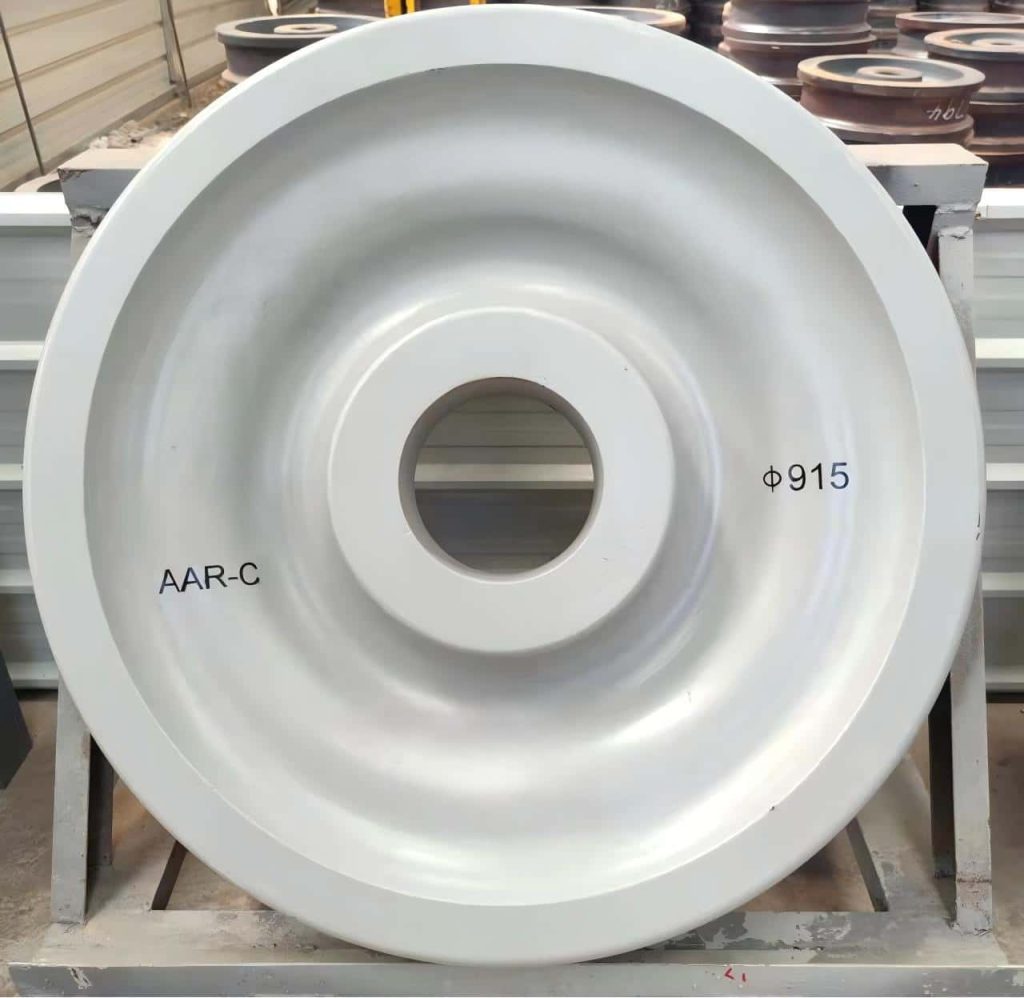
Successful heat treatment of railway wheels demands precise control at every stage:
Temperature Uniformity: The heating must be even throughout the wheel. De lo contrario, uneven temperatures can induce stress and lead to cracks.
Cooling Rate Control: We must carefully manage the cooling speed. Excessive speed can cause rim cracking, while insufficient speed reduces hardness.
Localized Quenching: The quenching process should focus solely on the rim. Por lo tanto, the wheel’s center and web can retain the necessary toughness to absorb shocks.
Timely Tempering: Tempering must follow quenching promptly to prevent any build-up of internal stress.
Rigorous Verification: Technicians must perform hardness testing and microstructure checks after treatment to guarantee quality.
Después del tratamiento térmico, each rueda de ferrocarril undergoes rigorous inspection. Common testing methods include:
Hardness Testing: This confirms the correct hardness gradient from the rim to the hub.
Ultrasonic Inspection: We use this to check for any internal defects or cracks.
Residual Stress Analysis: This ensures the train wheel will not deform in service.
Metallographic Examination: This verifies a uniform microstructure free from signs of overheating.
These comprehensive steps guarantee that every locomotive wheel meets the strictest international safety and performance standards.
En Industrias pesadas Co. de Luoyang Fonyo., Limitado., we apply advanced heat treatment technology to produce some of the most durable and safe railway wheels on the market. Our optimized process features precise temperature control, specialized rim quenching, and full hardness testing. We treat and inspect every forged railway wheel to ensure consistent performance and an extended service life.
Visit our website www.railwaypart.com to get more information. Fonyo is your trusted partner for high-quality railway wheels, ruedas de locomotora, and other premium cast steel components. Contact us today to discuss your requirements.