Escanea el código WeChat para contactarnos
Escanea el código WeChat para contactarnos
No dudes en enviarnos un correo electrónico y te responderemos lo antes posible.
Creando el futuro con corazón y alma


In traditional perception, the performance differences between cast iron and steel are like the contrast between “stone and steel”. Graphite in cast iron products is distributed in flakes, similar to “grietas” in the metal matrix, resulting in high brittleness and poor impact resistance of the material. The birth of ductile iron originated from a revolutionary breakthrough by scientists in the morphology of graphite, by adding spheroidizing elements such as magnesium and cerium to molten iron, graphite formed spherical structures with diameters of only 0.05 a 0.3 millimeters during solidification. These “miniature shock absorbers” are evenly distributed in the metal matrix, retaining the excellent casting properties of cast iron while endowing it with mechanical properties close to those of steel: tensile strength can reach 600-1400 MPa, elongation up to 24%, and the cost is only 60% of forged steel.
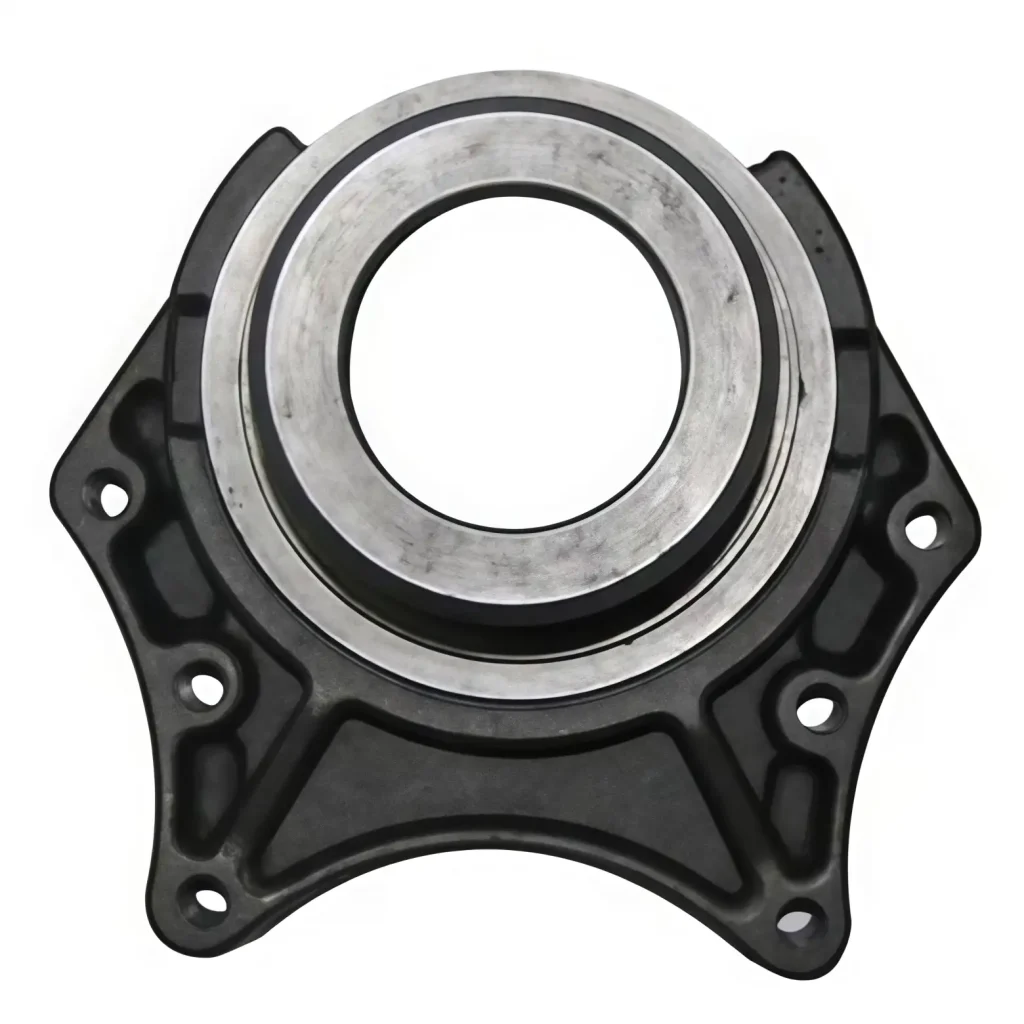
The industrialization path of ductile iron is full of challenges. In the 1940s, the International Nickel Company of the United States first achieved industrial production of spheroidizing treatment. Sin embargo, the early process had problems such as rapid spheroidizing decline and numerous slag inclusion defects. Chinese scientists have increased the absorption rate of magnesium from 30% a 70% by innovating the “injection method” spheroidization process. Al mismo tiempo, they have developed highly efficient inoculants, enabling the number of graphite spheres to exceed 300 per mm². In the research and development of the bogies and axle boxes for the Beijing-Shanghai High-Speed Railway, the scientific research team successfully stabilized the spheroidization rate at over 98% by controlling the sulfur content in the molten iron to be ≤0.015% and the oxygen content to be ≤20ppm. Como resultado, the impact energy of the material at -40℃ reached 15J, reaching the international leading level.
The performance regulation of ductile iron can be regarded as an “artistic creation” in materials science. Three typical matrix structures can be obtained through different heat treatment processes:
Ferrite matrix: After annealing treatment at 900℃, the material’s elongation can reach 24%, similar to “metallic rubber”, and is used to manufacture components such as high-speed rail axle boxes that require high toughness.
Pearlite matrix: After normalizing treatment, the strength increases by 40%, and the hardness reaches HRC28, suitable for wear-resistant parts such as gears and connecting rods.
Bainite matrix: By using an isothermal quenching process, its tensile strength has exceeded 1600MPa, which is three times that of aviation aluminum alloy. It is used to manufacture extreme load components such as high-speed rail brake discs.
In the research and development of the bogie of the CR400AF Fuxing bullet train, the impact energy of traditional imported materials at -40℃ is only 8J, which cannot meet the operation requirements in high-cold regions. CRRC Sifang Co., Limitado. has collaborated with research institutes to develop QT400-18AL low-temperature ductile iron, reducing the manganese content from 1.2% a 0.8% and adding 0.03% niobium to refine the grain structure. This material still has an impact energy of over 13J at -60℃ and a yield strength exceeding 250MPa. It has been applied to high-cold lines such as the Beijing-Harbin Line and the Harbin-Dalian Line, with a cumulative safe operation distance of over 200 millones de kilómetros.
In the research and development of 30-ton axle load freight cars on the Daqin Line, traditional cast steel couplings are prone to cracking under impact loads. Taiyuan Heavy Industry has developed the QT500-7 high-strength ductile iron coupler through technological breakthroughs. It adopts a silicon solid solution strengthening process, which increases the ferrite content in the matrix structure to 85%. Mientras tanto, by controlling the diameter of graphite spheres to ≤50μm, the fatigue life has been extended to 2 millones de veces, which is three times higher than that of traditional materials. This coupler has been equipped on 100,000 heavy-duty trucks, with an annual transportation volume exceeding 400 million tons.
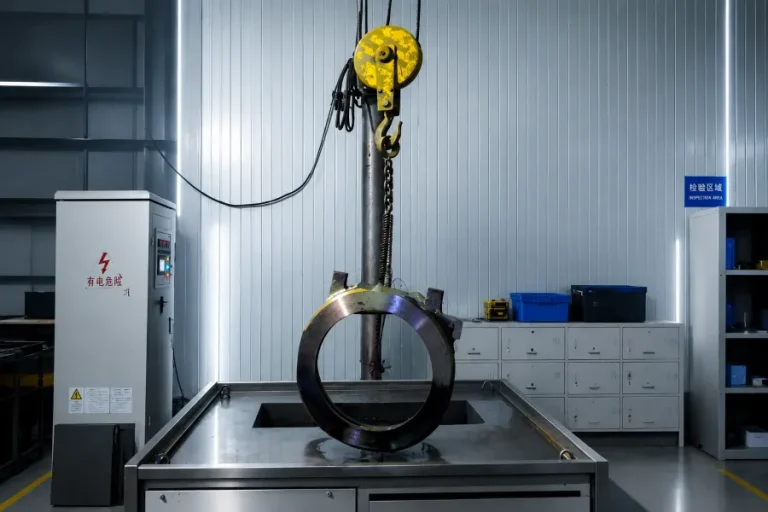
In the production of high-speed rail axle boxes, Zhengzhou Machinery Research Institute has adopted advanced technology to achieve full-process digital control from smelting to casting. The system can monitor 128 parameters in real time, such as the temperature of molten iron and the amount of spheroidizing agent added. Through machine learning algorithms, it automatically adjusts the process, reducing the spheroidizing decline rate from 5% a 0.3%, and the product consistency meets the aviation-grade standard.
The intelligent factory of Guangxi Yuchai Machinery Co., Limitado. has adopted the lost foam casting process to replace the traditional sand casting, and the recovery rate of waste sand has increased from 60% a 95%. Through the short-process melting technology of electric furnaces, the energy consumption per unit product is reduced by 20%. The bag filter system equipped has reduced the dust emission of Micron by 80%, and it has been awarded the title of “National Green Factory”.
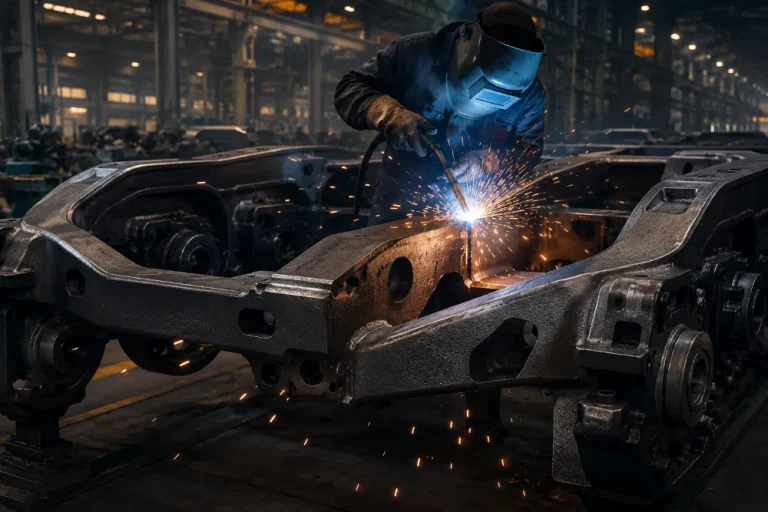
CRRC Qishuyan Institute has developed an integral bogie frame for a 600-kilometer-per-hour maglev train by using 3D printing technology. Traditional craftsmanship requires the framework to be disassembled into over 20 parts for welding, while 3D printing can form complex structures in one go, reducing weight by 15% and increasing fatigue life by three times. This technology has been certified by German TUV, marking the entry of China’s ductile iron technology into a new era of “intelligent manufacturing”.
In response to the development demands of the Arctic shipping route, Harbin Institute of Technology is currently developing QT500-22AL ultra-low temperature ductile iron. Al agregar 0.05% boron, the growth of ferrite grains is inhibited, with the goal of achieving an impact energy of ≥10J at -80℃. This material will be applied to components in extreme environments such as the propeller shafts of icebreakers, contributing to the upgrading of China’s polar scientific research equipment.
A team from Shanghai Jiao Tong University has developed an intelligent material that can monitor stress and cracks in real time by embedding piezoelectric ceramic particles into ductile iron matrices. Preliminary tests show that the material has a detection sensitivity of 99.7% for 0.1-millimeter-sized cracks. En el futuro, it can be applied to the health monitoring system of high-speed railway Bridges to achieve intelligent interaction among “materiales – structures – environment”.
The carbon fiber reinforced ductile iron composite material jointly developed by Tsinghua University and CRRC Corporation has achieved interface strengthening through chemical vapor deposition technology, with a specific strength of 320MPa/(gramos/cm³), cual es 40% lower than that of traditional materials, while maintaining excellent corrosion resistance and damping performance. This material has passed the bench test of the bogie of a 400-kilometer-per-hour EMU and is expected to lead the transformation of materials for the next generation of rail transit equipment.
From the “graphite spheroidization” in the laboratory to the “Chinese standard” for high-speed rail tracks, ductile iron technology is reshaping the modern transportation equipment landscape at an annual performance improvement rate of 8%. With the deep integration of technologies such as 3D printing and artificial intelligence, este “black gold in steel” is bound to write more industrial legends and inject strong impetus into “Made in China”.
Industrias pesadas Co. de Luoyang Fonyo., Limitado, fundada en 1998, es un fabricante de piezas de ferrocarril de fundición. Nuestra fábrica tiene una superficie de 72.600㎡, con más de 300 empleados, 32 tecnicos, incluido 5 ingenieros superiores, 11 ingenieros asistentes, y 16 tecnicos. Nuestra capacidad de producción es 30,000 toneladas por año. Actualmente, Producimos principalmente fundición., mecanizado, y montaje para locomotora, automotor, trenes de alta velocidad, equipo de minería, energía eólica, etc.. Nuestros productos han sido exportados a Rusia., los estados unidos, Alemania, Argentina, Japón, Francia, Sudáfrica, Italia y otros países..
Contacto: Estela Liu
Correo electrónico: [email protected]
WhatsApp: +86-155-1535-1287