Escanea el código WeChat para contactarnos
Escanea el código WeChat para contactarnos
No dudes en enviarnos un correo electrónico y te responderemos lo antes posible.
Creando el futuro con corazón y alma


Railway castings are expected to work under some of the harshest operating conditions in the transportation industry. Every day, components such as marcos de bogie, marcos laterales, refuerza, carcasas de cajas de eje, y carcasas de caja de cambios carry heavy loads while being exposed to continuous vibration, impacto, cambios de temperatura, and millions of loading cycles.
Producing a sound casting is only the beginning. Without proper heat treatment, even a well-cast component may contain excessive residual stress, uneven mechanical properties, or insufficient toughness. These problems can eventually lead to deformation, premature wear, or fatigue cracking during service.
Por esta razón, heat treatment is not simply another manufacturing step. It is one of the most important processes for ensuring that railway castings achieve the strength, durabilidad, and dimensional stability required by international railway standards.
En este artículo, we’ll explain how heat treatment works, why different railway castings require different heat treatment cycles, and how manufacturers verify that every component meets demanding quality requirements.
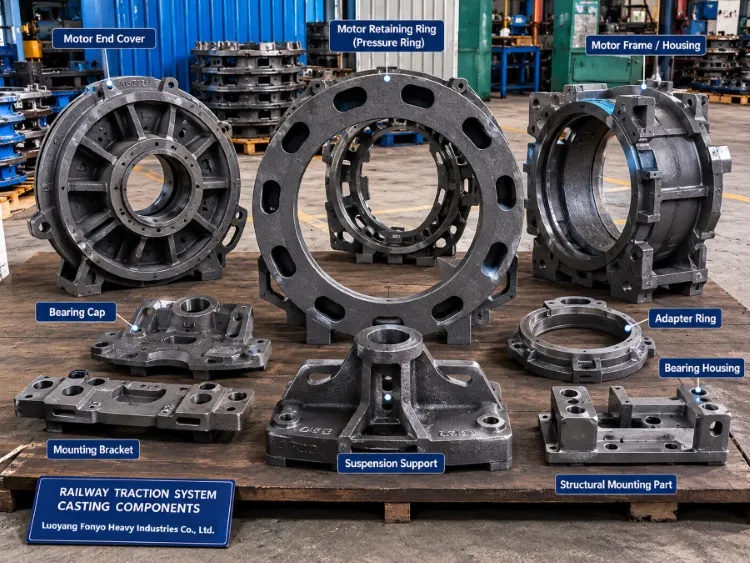
Freshly cast steel does not automatically have the mechanical properties required for railway service. During solidification, the casting develops internal stresses and a microstructure that may not be suitable for long-term operation.
Heat treatment changes the internal structure of the steel without changing its shape. By carefully controlling both heating and cooling, manufacturers can refine the grain structure, improve strength and toughness, reduce residual stress, and make mechanical properties more consistent throughout the casting.
For railway applications, these improvements directly affect service life.
A properly heat-treated bogie frame is better able to resist fatigue caused by repeated loading. An axle box housing maintains its dimensional accuracy during machining and operation. A gearbox housing is less likely to deform under continuous vibration, while bearing housings gain the combination of strength and wear resistance needed for long-term reliability.
En pocas palabras, good casting quality begins in the foundry, but reliable railway performance is achieved through proper heat treatment.
Heat treatment is not a single operation. It is a controlled sequence of processes carried out after casting and before final machining.
A typical production flow looks like this:
Casting → Cleaning → Initial Inspection → Heat Treatment → Hardness Testing → Mechanical Property Testing → Non-Destructive Testing → CNC Machining → Final Inspection
Each stage builds on the previous one. Heat treatment is positioned before finish machining because steel may undergo slight dimensional changes during heating and cooling. Machining afterward ensures the final dimensions meet drawing tolerances.
Modern heat treatment relies on precisely controlled furnace temperatures, tiempos de espera, cooling rates, and process records. Even small deviations can affect hardness, tenacidad, or dimensional stability.
For safety-critical railway components, consistency is just as important as achieving the target mechanical properties.
Different castings require different heat treatment cycles depending on their material, geometría, and service conditions. The following processes are commonly used in railway manufacturing.
Normalizing is one of the most widely used heat treatment methods for railway cast steel castings.
The casting is heated above its critical temperature and then cooled naturally in air. This process refines the grain structure, improves uniformity throughout the casting, and reduces stress created during solidification.
Many structural railway components begin with a normalizing treatment because it provides an excellent foundation for subsequent machining or additional heat treatment.
When higher strength and toughness are required, quenching and tempering are often performed together.
During quenching, the casting is heated and rapidly cooled using water, oil, or another controlled medium. This significantly increases hardness but also introduces brittleness.
Tempering follows immediately afterward. By reheating the casting to a lower temperature, internal stresses are reduced while toughness is restored. The final result is a balanced combination of strength, dureza, and impact resistance that is suitable for demanding railway applications.
Some large railway castings do not require additional hardness but must remain dimensionally stable throughout machining and service.
Stress relief heating removes residual stress accumulated during casting and cooling without significantly changing the material’s strength.
This treatment is particularly important for large structural castings with complex shapes.
Annealing is less common for finished railway components but may be used when improved machinability or additional stress reduction is required before further manufacturing operations.
The process produces a softer and more uniform structure that simplifies subsequent machining.
Not every railway casting requires the same heat treatment schedule. The manufacturing process is selected according to the component’s function, condiciones de carga, and material grade.
Bogie frames support the entire vehicle while absorbing dynamic loads from the track. These large structural castings usually receive normalizing followed by stress relief to achieve uniform mechanical properties and minimize distortion.
Side frames and bolsters experience continuous cyclic loading throughout their service life. Heat treatment focuses on improving fatigue resistance while maintaining adequate toughness to withstand impact loads.
Cajas de grasa require high dimensional accuracy because they interface with bearings and wheelsets. Heat treatment helps maintain dimensional stability during machining while providing sufficient strength for long-term service.
Gearbox housings must resist vibration without losing alignment. Proper heat treatment reduces internal stress and helps maintain machining accuracy over time.
Bearing housings combine high contact loads with continuous vibration. Depending on the material and application, quenching and tempering are often used to achieve the required balance between strength, resistencia al desgaste, y dureza.
Heat treatment delivers excellent mechanical properties only when every parameter is carefully controlled.
One common issue is distortion, especially in large or asymmetrical castings. Controlled heating rates, proper support fixtures, and carefully managed cooling help minimize deformation.
Quench cracking may occur if cooling is too rapid or uneven. Manufacturers reduce this risk by selecting appropriate quenching media and optimizing cooling procedures for each casting design.
Uneven hardness usually results from inconsistent furnace temperatures or insufficient holding time. Modern furnaces use automatic temperature control to maintain uniform conditions throughout the heating cycle.
Other potential problems include excessive grain growth, oxidation, surface scaling, and residual stress. These issues are prevented through carefully developed heat treatment procedures and continuous process monitoring.
Heat treatment is only complete after the casting has been verified through inspection and testing.
Hardness testing confirms that the required mechanical properties have been achieved. Metallographic examination evaluates the internal microstructure and verifies that the heat treatment produced the desired grain refinement.
Pruebas mecánicas, including tensile and impact testing when required, confirms that the casting meets specification requirements.
Pruebas no destructivas such as ultrasonic testing (Utah) and magnetic particle testing (MONTE) is then carried out to detect internal or surface defects before machining or shipment.
Dimensional inspection is also performed to ensure that no unacceptable distortion occurred during heat treatment.
Juntos, these inspections provide confidence that every railway casting is ready for reliable service.
For railway buyers, heat treatment capability is just as important as casting capability.
A manufacturer may produce a visually good casting, but without controlled heat treatment, consistent mechanical properties cannot be guaranteed.
When evaluating a supplier, buyers should look beyond the finished component and ask questions about the manufacturing process.
Are furnace temperatures automatically recorded? Is every heat treatment cycle documented? How are hardness and mechanical properties verified? Is complete traceability maintained from raw material to final inspection?
The answers to these questions often reveal the true manufacturing capability behind the product.
En Industrias pesadas Luoyang Fonyo, heat treatment is an integral part of our railway casting manufacturing process rather than a separate operation.
Each heat treatment cycle is developed according to the casting material, component geometry, and applicable railway standards. Furnace temperature, holding time, and cooling conditions are carefully monitored and recorded throughout production.
Después del tratamiento térmico, castings undergo hardness testing, verificación de propiedades mecánicas, inspección dimensional, and non-destructive testing before entering the machining process.
This controlled approach helps ensure that every bogie frame, marco lateral, reforzar, caja de grasa, caja de cambios, and other railway casting delivers the strength, dimensional stability, and long-term reliability required for demanding railway applications.
Heat treatment is only one part of producing reliable railway castings. Equally important are casting design, selección de materiales, machining accuracy, and quality inspection throughout the manufacturing process.
En Industrias pesadas Luoyang Fonyo, we manufacture a broad range of railway castings and components, incluido marcos de bogie, marcos laterales, refuerza, carcasas de cajas de eje, carcasas de caja de cambios, carcasas de cojinetes, acopladores, and other custom steel castings for freight wagons, autocares de pasajeros, locomotoras, and metro vehicles. With integrated foundry, tratamiento térmico, mecanizado, and testing capabilities, we help customers obtain consistent quality from raw casting to finished railway component.